.svg)
.svg)


Why Product-Led Startups Are Winning Faster in 2026
.webp)
Key Takeaways:
Product-led growth has stopped being a clever tactic and become the default way startups win. In 2026, the companies pulling ahead let the product do the selling: users try before they buy, reach value in minutes, and pull the team into the product before a salesperson ever calls. Here is what this blog covers:
- Why product led growth now dominates B2B SaaS, and the fresh 2026 numbers behind the shift.
- How product-led startups cut acquisition costs and grow revenue faster than sales-led rivals.
- The frameworks and metrics that separate winners from the 85% of PLG attempts that stall.
- A practical checklist and comparison table you can act on this quarter.
- Where AI is rewriting the rules of onboarding, activation, and self-serve growth.
If you lead a startup or SME and you want faster, cheaper, more durable growth, this is your field guide.
What Is Product-Led Growth in 2026?
Product-led growth (PLG) is a go-to-market model where the product itself drives customer acquisition, conversion, and retention. Users try it through a free trial or freemium tier, reach value within minutes, and buy without a sales pitch. In 2026, it is the default model for B2B SaaS.
📝 Fast fact: Cursor, the AI code editor built by Anysphere, went from $500 million in ARR in mid-2025 to $2 billion ARR by February 2026, growing almost entirely through developer adoption without a traditional sales team. It is the clearest proof yet of how fast product-led startups can win.
The Quiet Takeover: How Product-Led Growth Became the Default
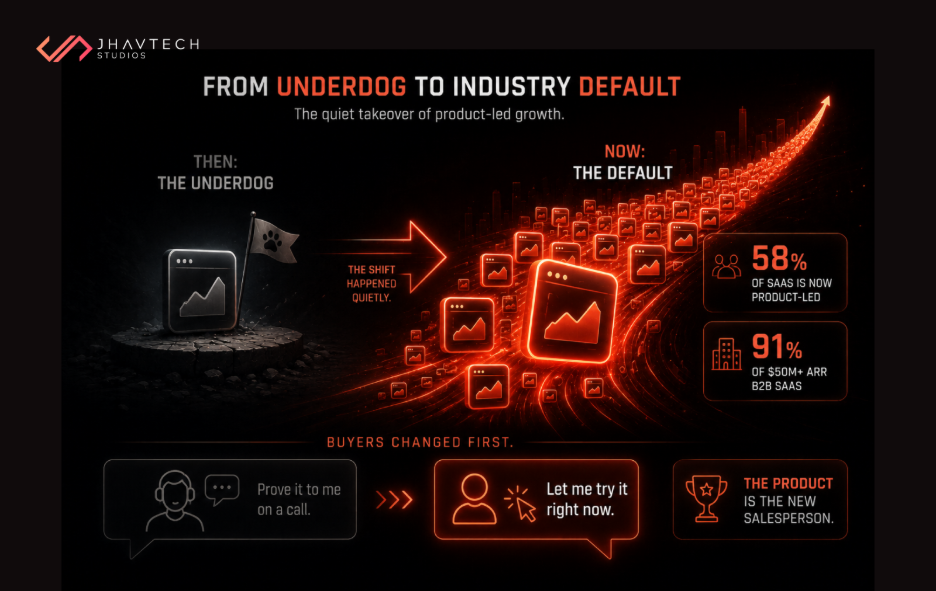
A few years ago, product led growth was the scrappy underdog play, the thing you did when you could not afford a sales team. That story is over.
In 2026, roughly 58% of SaaS companies now run some form of product-led model, and among B2B SaaS companies over $50 million in ARR, adoption sits at a striking 91%. Product-led growth has become the default acquisition motion for B2B SaaS in 2026, and 91% plan to increase that investment. When nearly every serious software company is moving the same direction, that is not a trend anymore. It is the water everyone is swimming in.
Here is the simple reason it caught on. Buyers changed first, and the companies that adapted got rewarded. Modern users have zero patience for a five-step demo booking flow before they can even see whether your product solves their problem. SaaS users no longer tolerate long onboarding processes or multi-day setup periods, and they expect a product to start delivering value within minutes of first touch. The expectation has flipped from "prove it to me on a call" to "let me try it right now."
For founders, that shift is a gift. It means your best salesperson can be the product itself, working 24 hours a day, in every timezone, without commission. And when you get it right, the economics are genuinely hard to beat.
The Numbers Don't Lie: Why Product-Led Startups Grow Faster
Let us talk about why decision makers keep pouring money into this. It comes down to three things: speed, cost, and durability.
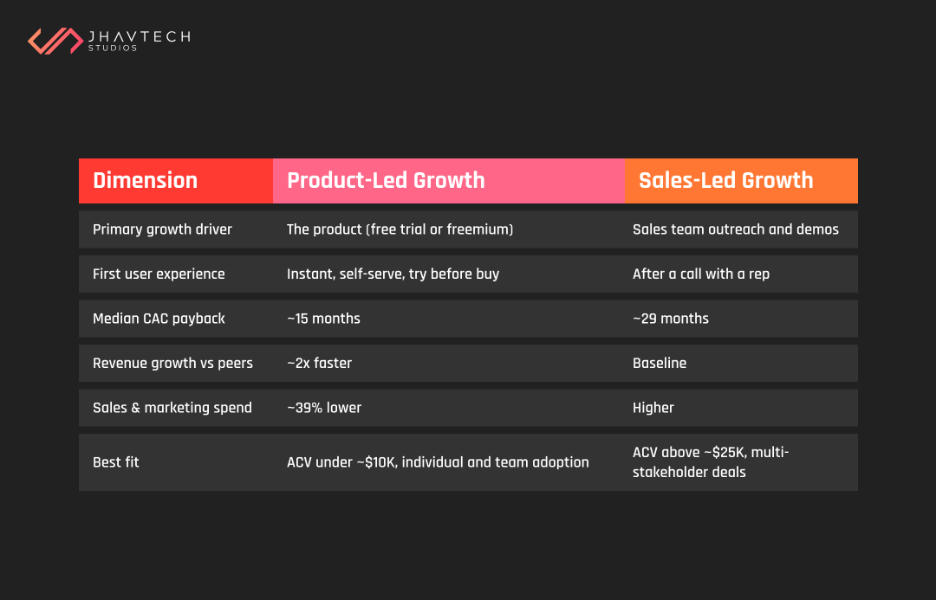
On speed and revenue, the gap is not subtle. PLG companies grow revenue roughly twice as fast as their peers and trade at a 50% higher revenue multiple on public markets, according to OpenView Partners' SaaS Benchmarks (as reported by Ortto). That multiple matters enormously if you ever plan to raise or exit. Investors are paying a premium for the product-led model because it compounds.
On cost, the case is even sharper. OpenView data shows PLG companies report a median CAC payback period of about 15 months versus 29 months for sales-led companies, nearly half the time to recoup acquisition costs. For a startup watching every dollar of runway, cutting the time to earn back your customer acquisition spend almost in half is the difference between scaling and stalling. This is why a solid customer acquisition strategy in 2026 usually starts inside the product, not the ad account.
And the model is not just cheaper, it is more capital-efficient across the board. Benchmark reporting shows PLG companies report 50% higher growth and 39% lower sales and marketing spend. Lower spend, higher growth. That is the whole pitch in one line.
The clearest proof is happening in real time. Take Cursor again: the company did not hire an enterprise sales rep until well past the $200M ARR mark. Developers pulled the tool into their teams on their own, the product created the demand, and sales showed up later to capture the expansion. That is the modern playbook in one company, and it is why its ARR curve looks the way it does.
A Side-by-Side Look at the Two Models
Numbers land harder when you can see them next to their alternative. Product-led and sales-led growth are not just different marketing styles; they pull on completely different levers, from how a user first meets your product to how long it takes to earn back what you spent acquiring them. The table below puts the two motions head-to-head across the dimensions decision makers actually weigh when choosing a direction.
*Source figures drawn from OpenView Partners via Ortto and PLG benchmark reporting.
The honest takeaway from the table: product led growth is not automatically right for everyone. If you sell $200,000 enterprise contracts to buying committees of twelve people, you still need sales. But for the vast majority of startups and SMEs selling to individuals and small teams, letting the product lead is the faster path.
What Separates Winners from the Rest
Here is the part most articles skip, and it is the most important part. Adopting product-led growth is easy. Winning with it is not.
The uncomfortable truth: around 85% of PLG shifts fail because teams copy free trials and freemium without fixing activation, time-to-value, or pricing. Founders bolt a free tier onto a clunky product, watch signups climb, celebrate, and then wonder why nobody converts. They are acquiring free users faster than they can retain them.
The winners treat this as a system, not a switch you flip. And the single most important lever in that system is activation; the moment a new user actually reaches the core value of your product, the "aha" moment.
This is where the real opportunity hides. Activation is the single strongest predictor of whether a free user converts to paid, yet only about 34% of PLG companies actively track it. Read that again. The one metric that best predicts revenue, and two-thirds of companies are flying blind on it. If you measure activation and act on it while your competitors do not, you have an edge most of your market is ignoring.
The stakes are real at the top of the funnel too. In a typical PLG funnel, 40 to 60% of free users never reach the activation milestone at all. Every one of those users is a lead you paid to acquire and then lost inside your own product, usually to friction, confusion, or a setup process that asks too much before it gives anything back.
This is exactly why the quality of your build matters so much. A beautiful marketing site cannot rescue a product that is slow, confusing, or broken on the third screen. Getting the underlying engineering and experience right is the foundation everything else sits on, which is where thoughtful custom mobile and web product engineering earns its keep. The product is the funnel now, so the product has to be genuinely good.
The Metrics That Really Matter
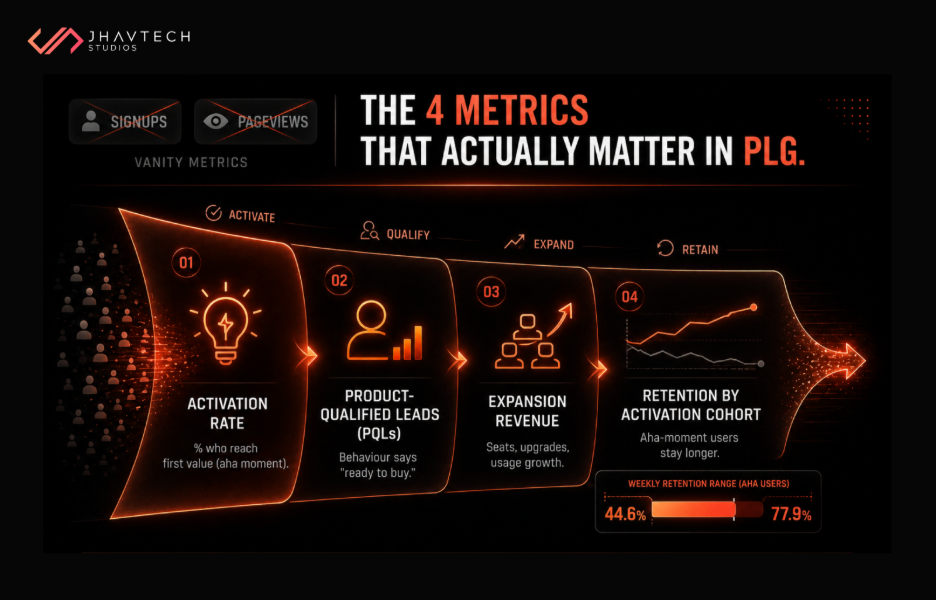
Signups and pageviews feel good and mean little. The metrics that compound are the ones tied to value and revenue. Higher-leverage metrics include activation, product-qualified leads, and expansion revenue rather than signups and page views.
Watch these four closely:
- Activation rate. The percentage of new users who reach your defined "aha" moment. If you define nothing, you measure nothing.
- Product-qualified leads (PQLs). Users whose in-product behaviour signals they are ready to buy. Far warmer than a form fill.
- Expansion revenue. Seat additions, tier upgrades, and usage overages. For PLG companies, expansion is typically the most capital-efficient growth lever available.
- Retention by activation cohort. Users who hit the aha moment should retain far better than those who did not. Weekly retention for B2B products ranges from 44.6% to 77.9% globally, a gap wide enough that the difference often comes down to activation quality.
The AI Twist Reshaping Product-Led Marketing in 2026
You cannot talk about SaaS growth strategy in 2026 without talking about AI, because it is quietly changing the whole equation.
AI is collapsing time-to-value from days to seconds. Onboarding that used to require a wizard, a help doc, and a support ticket can now happen through an in-product AI assistant that walks the user straight to their first win. When onboarding friction drops, activation climbs, and acquisition costs fall again. The frictionless entry that made Cursor explode is becoming available to everyone.
There is a bigger shift underneath this. A new generation of startups scaled at unprecedented speeds by bypassing traditional enterprise sales motions entirely, relying instead on developer-led adoption and evolved product-led growth strategies. AI-native products, built around AI from the ground up rather than bolting a chatbot onto legacy software, are the ones capturing outsized value.
For product-led marketing, this means your content and your product are merging. The blog post, the interactive demo, the free tool, and the onboarding flow are all becoming one continuous experience that pulls users toward value. The teams that win treat every touchpoint as part of the product, not as a separate marketing layer sitting on top.
Your Product-Led Growth Framework: A Starter Checklist
Frameworks get complicated fast. Here is a grounded startup growth framework that you can actually use, boiled down to the decisions that move the needle. Run through this checklist before you invest another dollar in your funnel.
The Product-Led Growth Readiness Checklist
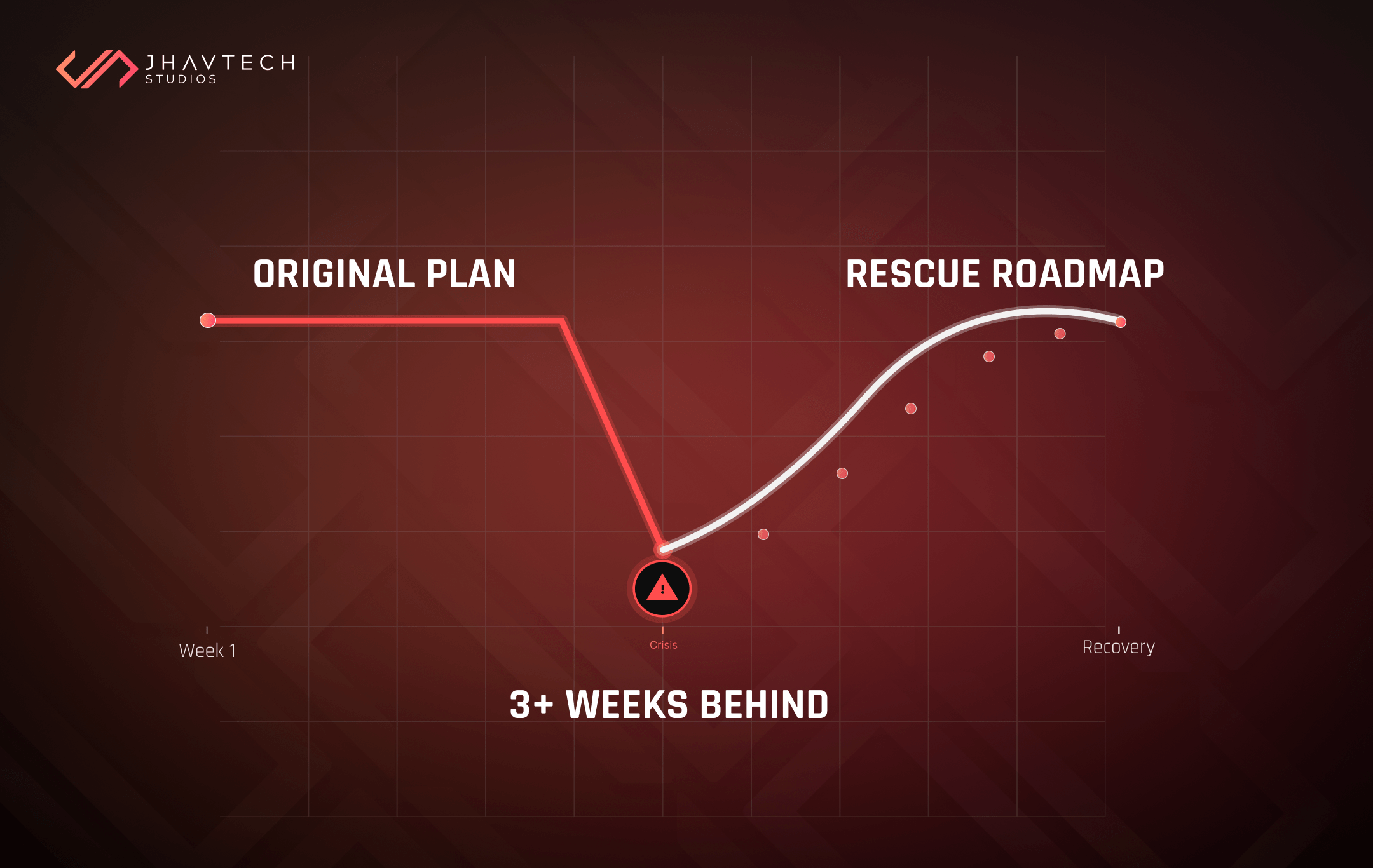
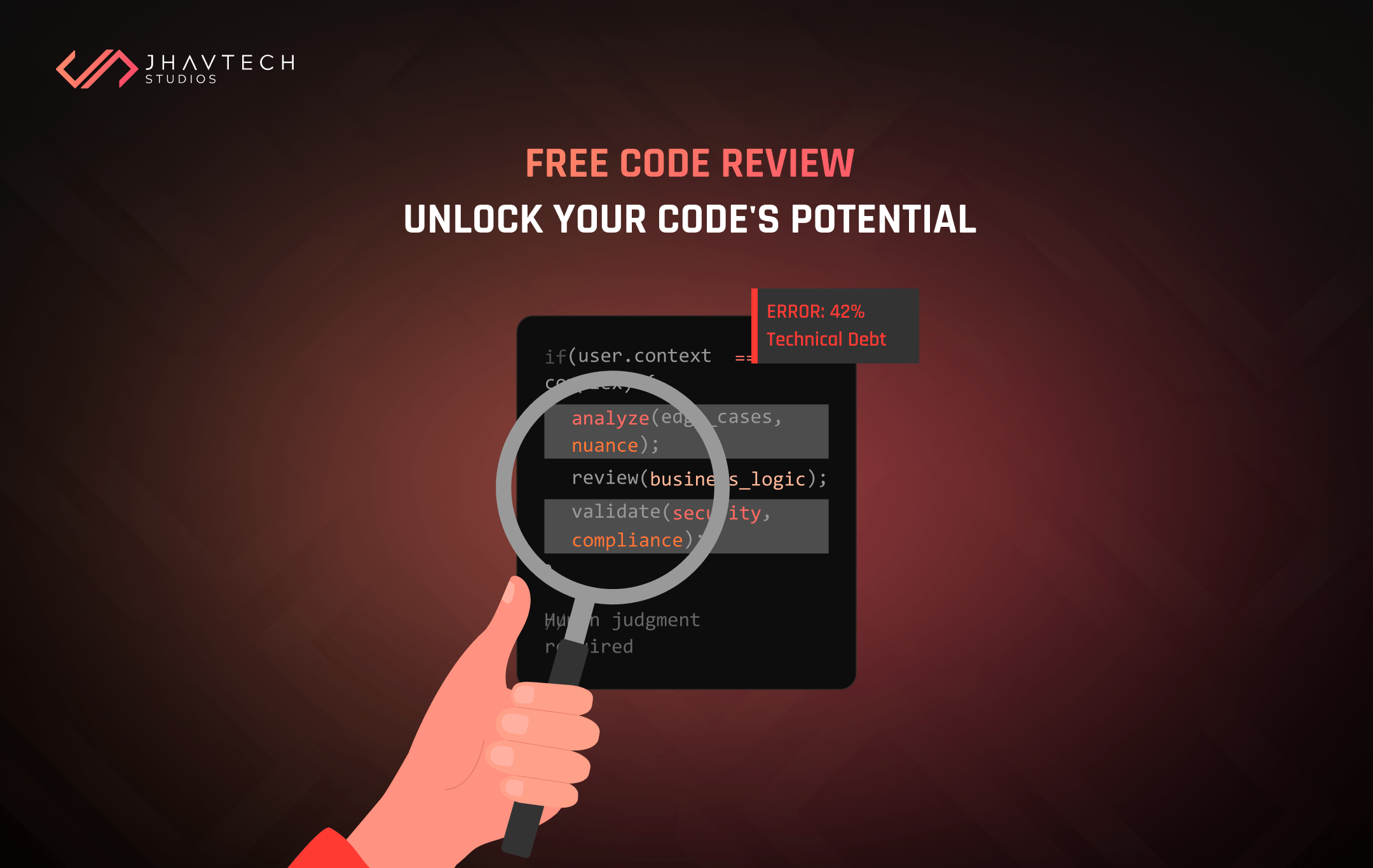
If a stalled or shaky build is blocking you on any of these, that is a fixable problem. A focused rescue and rebuild of an underperforming product often unlocks the activation and reliability gains that make PLG finally click, and a free code review is a low-risk way to find out exactly where the friction lives.
What This Means for Startups and SMEs
Let us bring it home. If you are a founder or an SME leader deciding where to put your limited time and money, the signal from 2026 is loud and clear.
Product led growth wins faster because it aligns the whole business around the one thing that determines success: whether users get value quickly and repeatedly. It lowers your acquisition costs, shortens your payback period, grows revenue faster, and raises your valuation multiple. Those are not soft benefits. They are the exact numbers investors and acquirers care about.
But the model rewards execution, not intention. The startups winning right now are the ones treating their product as a measurable growth engine, obsessing over activation, and building something reliable enough that it can carry the weight of being the funnel. The ones failing are the ones who added a free tier and hoped.
You do not need to be Cursor. You do not need to double revenue every two months. You just need a product genuinely good enough to sell itself to the right first user, and the discipline to measure whether it does. That is within reach for almost any startup willing to build it properly.
For more on getting the foundation right, our guides on why software scalability matters from day one and what happens when startups skip product discovery go deeper on the groundwork that makes product-led growth possible. And if you are watching the numbers, why SaaS startups need a code audit before seeking investment pairs neatly with everything above.
Frequently Asked Questions

.webp)

.webp)
.webp)
.webp)

.webp)
.webp)

.webp)
.webp)





.png)
.png)
.png)
.png)
.png)
.png)


.png)
.png)
.png)
.png)
.png)
.png)
.png)


.png)
.png)
.png)




.png)
.png)
.png)
.png)
.png)
.png)
.png)
.png)
.png)
.png)
.png)
.png)
.png)
.png)
.png)
.png)
.png)
.png)
.png)
.png)
.png)
.png)
.png)
.png)
.png)
.png)
.png)
.png)
.png)
.png)