.svg)
.svg)


Technical Debt Management: Why Most Businesses Wait Until It's Too Late

Businesses ignore technical debt because it never appears as a line item. It shows up instead as missed deadlines, unreliable estimates, and developer resignations. By the time those symptoms are impossible to explain away, the same fix costs several times what it would have a year earlier.
Who this is for: Founders, CEOs, and operations leads at startups and SMEs who own a software product but do not write the code.
First, a Definition Worth Getting Right
Technical debt in software development is:
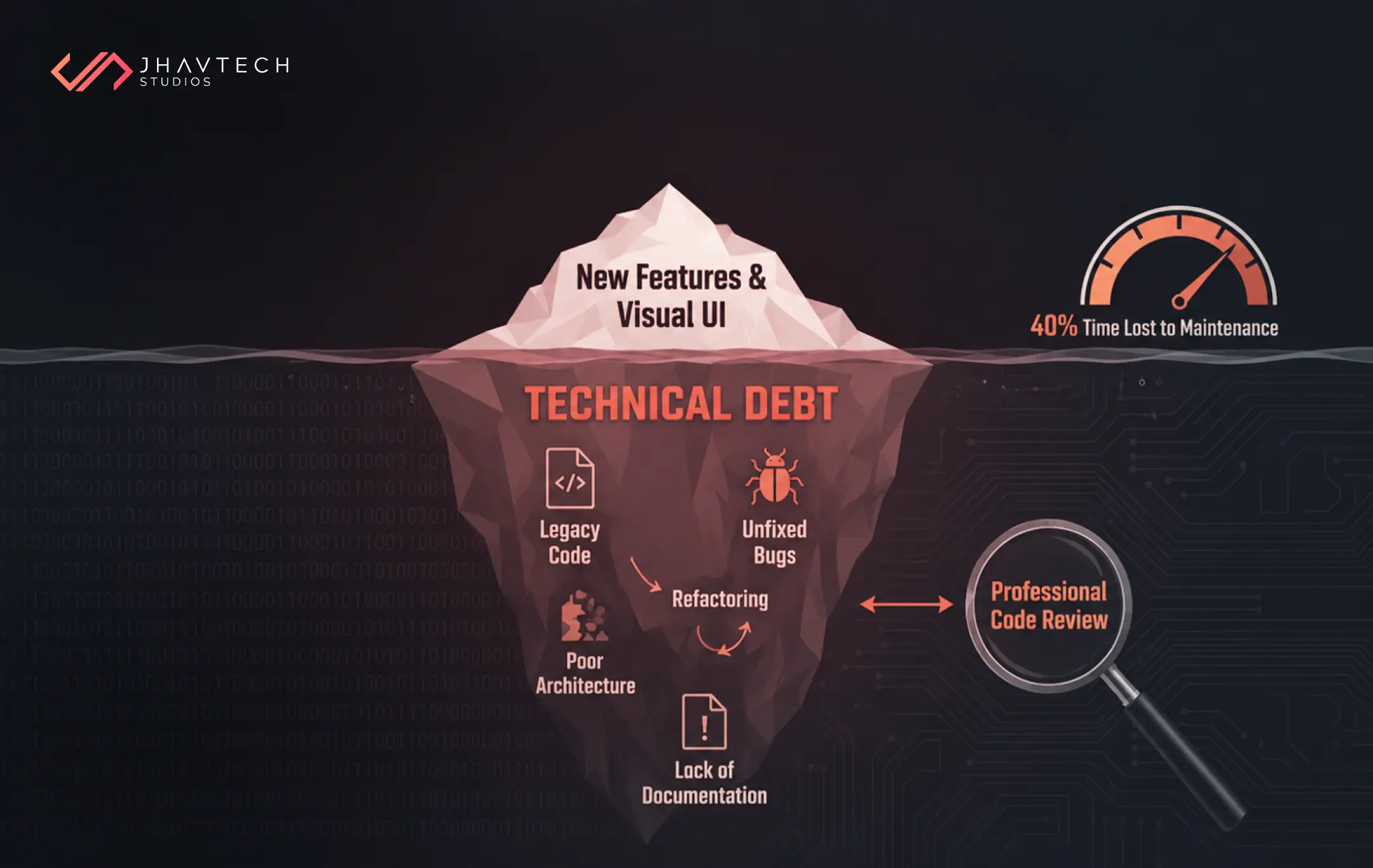
- Any shortcut, workaround, or ageing dependency that makes future changes slower or riskier
- Interest-bearing, meaning the same repair costs more the longer it waits
- Sometimes deliberate and commercially sensible, sometimes accidental and dangerous
- A real liability, despite appearing nowhere in your accounts
Some debts are smart. Ward Cunningham, who coined the term, was describing a deliberate trade: ship the imperfect version, win the customer, refactor with the revenue. Perfectly reasonable. That only holds if somebody plans the repayment at the outset, which is the difference between a rushed MVP and a build that lasts past version three.
What damages companies is the debt nobody tracked, priced, or planned to repay. Left alone long enough, it begins to set your budget for you. Which is why technical debt management belongs on the leadership agenda rather than at the bottom of a sprint backlog.
Four Reasons the Problem Stays Invisible
Every business that ends up in trouble had access to the same information yours does. What keeps the problem hidden has less to do with negligence than with how companies are structured, budgeted, and reported on. Four causes come up in almost every engagement.
1. It Has No Line Item
Your P&L has categories for salaries, hosting, licences, and contractors. It has no row called accumulated structural compromise in the checkout module. So, the cost gets distributed invisibly across every other row, mostly payroll.
McKinsey's research found that CIOs estimate tech debt at 20% to 40% of the value of their entire technology estate, and that roughly 30% believe more than a fifth of their new-product budget is quietly diverted to fixing old problems. You are paying for it. You just never receive the invoice.
2. The Incentives Reward Shipping, Not Maintaining
Nobody gets thanked for cleaning up code that already works. Investors ask about features, users ask about features, and the board asks when the integration goes live. A quarter spent on code optimisation produces a slide that reads "no visible change, but faster later," which is a hard sell in a room watching every dollar.
So the trade gets made again. And again. Each individual decision is defensible. The cumulative effect is not.

3. The People Who Feel It Are Not in the Room
Your developers know exactly where the rot is. They can name the file. That knowledge rarely survives the trip up the org chart, partly because it sounds like complaining and partly because it needs vocabulary the leadership team does not share.
In Stack Overflow's annual developer survey, technical debt ranked as the number one frustration among tens of thousands of professional developers, cited at roughly double the rate of the second-place complaint. When that many practitioners converge on one answer, it is worth reading as operational data.
4. The Symptoms Look Like Other Problems
This is the big one. Engineering inefficiency caused by technical debt never announces itself. It masquerades as:
- A team that seems slower than they used to be
- Estimates that are consistently wrong in one direction
- A senior developer who resigns without a clear reason
- A competitor who somehow shipped the same feature in six weeks
- QA finding more bugs each release than the last
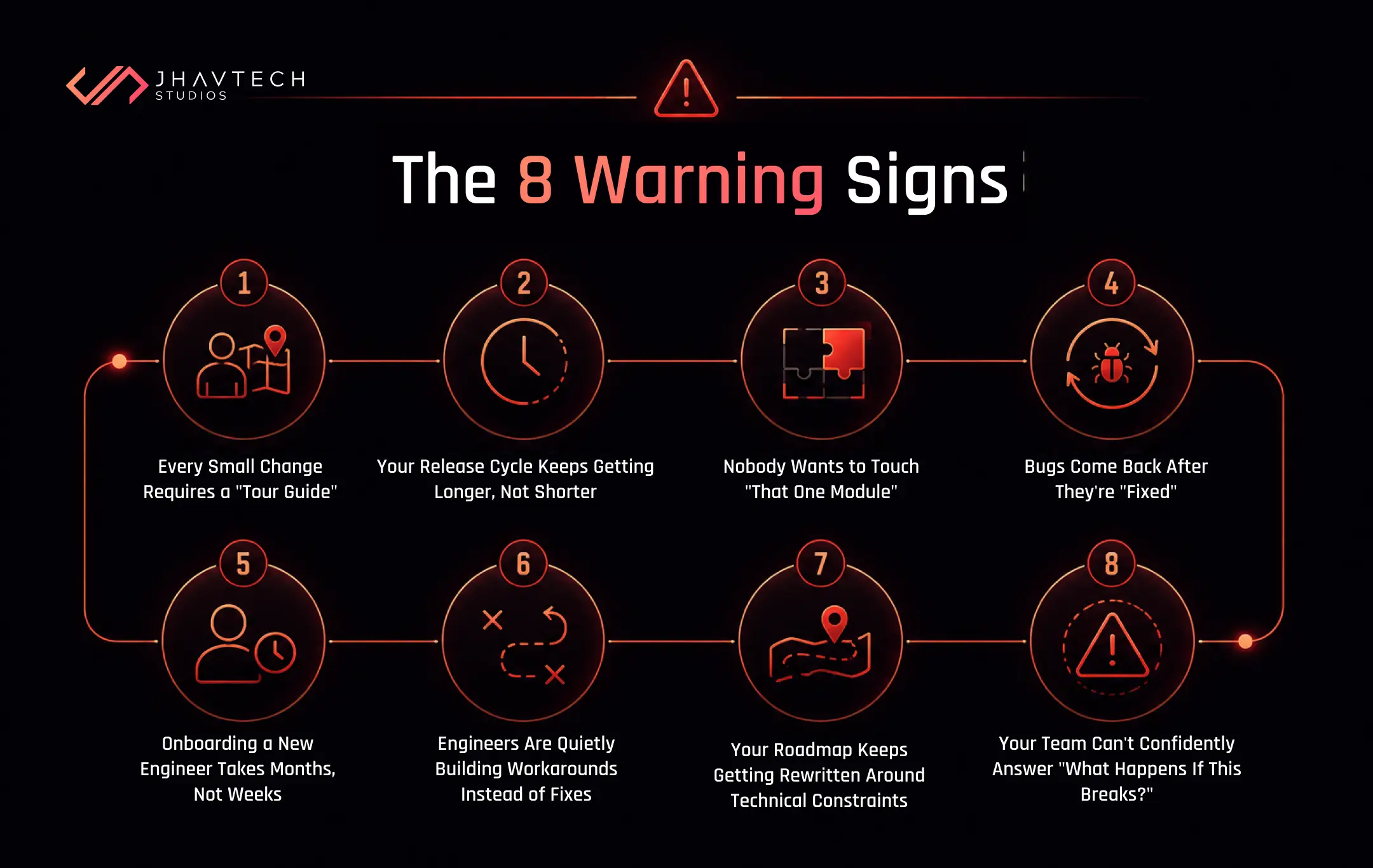
Every one of those has an alternative explanation, and leaders reliably reach for the alternative. It is easier to conclude you hired the wrong contractor than to accept that the codebase itself has become the constraint. We unpacked this pattern in 8 warning signs your software is becoming unmanageable, and the resignation signal is usually the most under-read of the lot.
The Four Stages of Technical Debt, and Where the Cost Explodes
Debt rarely arrives as a crisis. It arrives as a slow narrowing of your options. The transition between stages is invisible from the outside, because revenue holds and the product still works while the team quietly works harder to deliver the same amount. By the time something actually breaks, you have usually been paying for two or three years without knowing it. Here is the progression most SMEs follow, and roughly what each stage costs to exit.
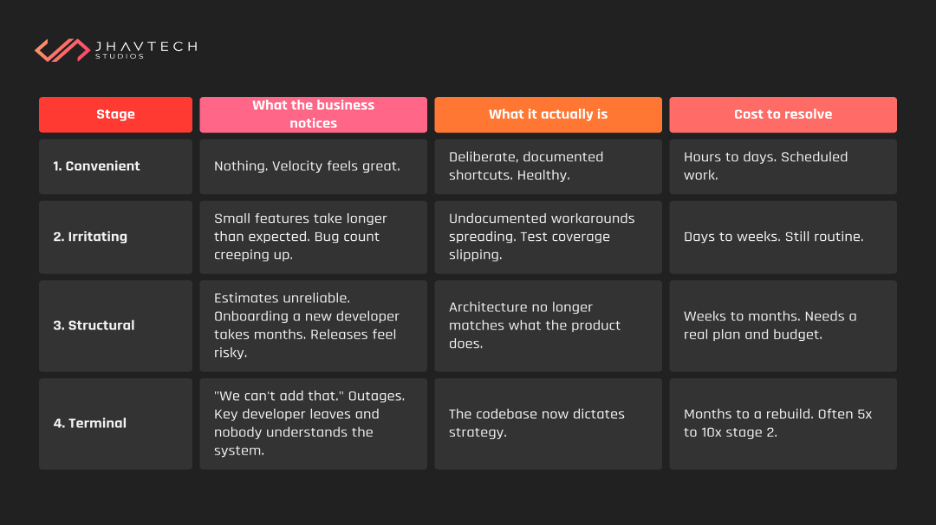
Most businesses first take the problem seriously at stage 3 or 4, which is the whole issue. The work required at stage 2 is a maintenance task. The same work at stage 4 is a capital expenditure, a hiring freeze on new features, and a very uncomfortable board meeting. It also tends to surface at the worst possible moment, because technical due diligence during a funding round or an acquisition is where a lot of founders discover what their shortcuts are actually worth. At that point the discount gets applied to your valuation rather than your engineering budget, and you have no leverage to argue.
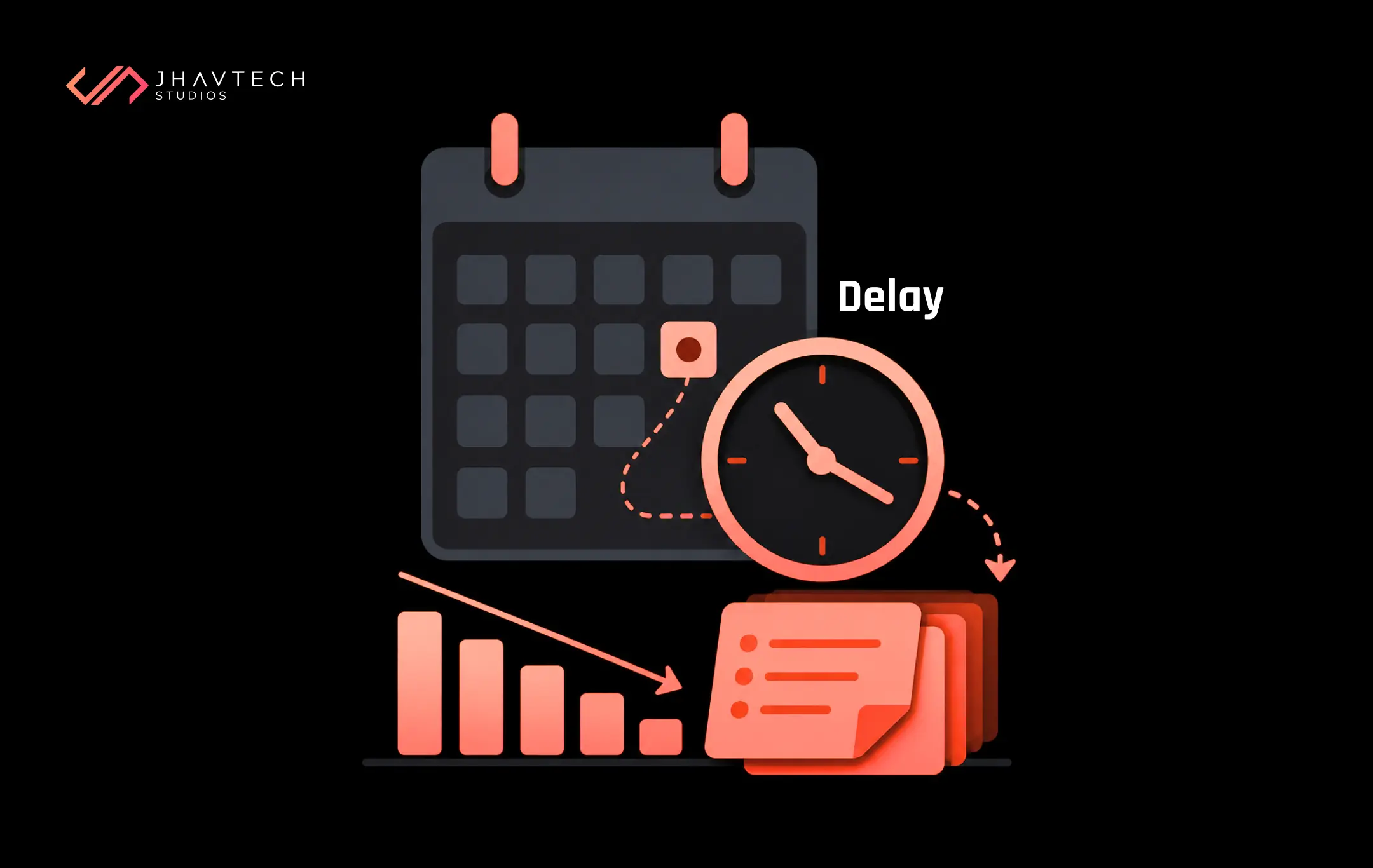
A rough illustration of how the cost of fixing the same underlying flaw scales with delay:
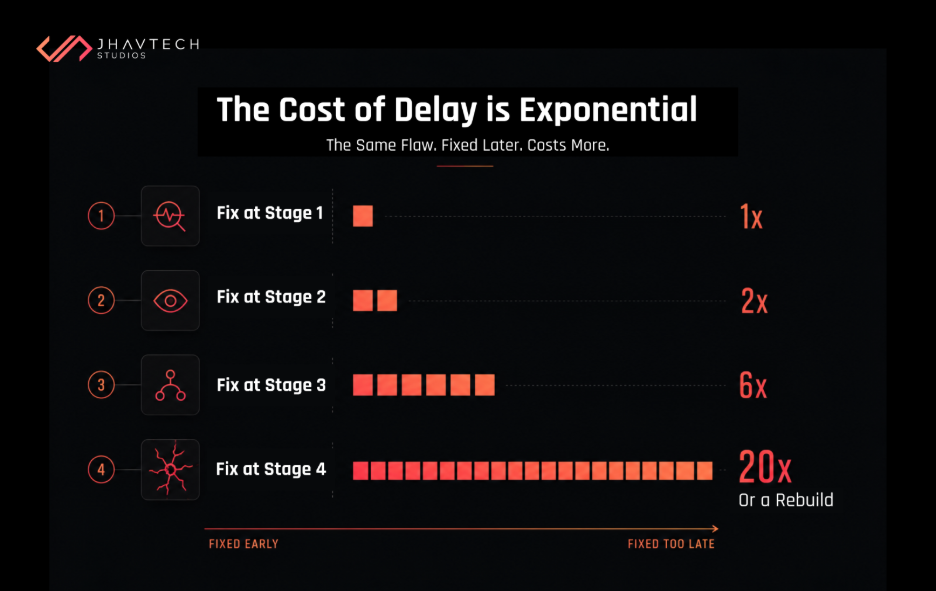
Indicative, based on remediation-effort patterns commonly reported across code quality research. Your multiplier depends on how central the flawed component is. A cosmetic issue in a rarely-touched module may barely move off 1x for years, while a flaw in your authentication or payments layer compounds every time another feature is built on top of it. The multiplier is not the code getting worse on its own, it is the number of things now depending on the mistake.
The 2026 Accelerant Nobody Priced In
AI coding assistants have changed the math here in about eighteen months, and most budgets have not caught up.
Google's 2025 DORA report, drawing on responses from close to 5,000 technology professionals, found around 90% of developers now use them. Its central finding: AI works as an amplifier, magnifying the strengths of high-performing organisations and the dysfunctions of struggling ones.
Translated for a founder: if your engineering discipline is strong, AI makes your team meaningfully faster. If your codebase is already tangled and your review process is thin, AI helps your team generate tangle at unprecedented speed. DORA's data showed delivery instability continuing to rise even as throughput improved, and teams without solid foundations saw stability go backwards.
The 2025 Stack Overflow survey adds a useful detail. The top developer frustration with AI tools was output that is "almost right, but not quite," reported by 66% of respondents, with 45% saying debugging AI-generated code takes longer than expected. Code that looks correct and survives a casual review is precisely the kind that becomes stage 3 debt eighteen months later.
Use the tools. Just accept that software risk reduction now has to keep pace with a codebase growing faster than anyone can read it.
How to Build a Technical Debt Management Plan that Fits a Real Budget
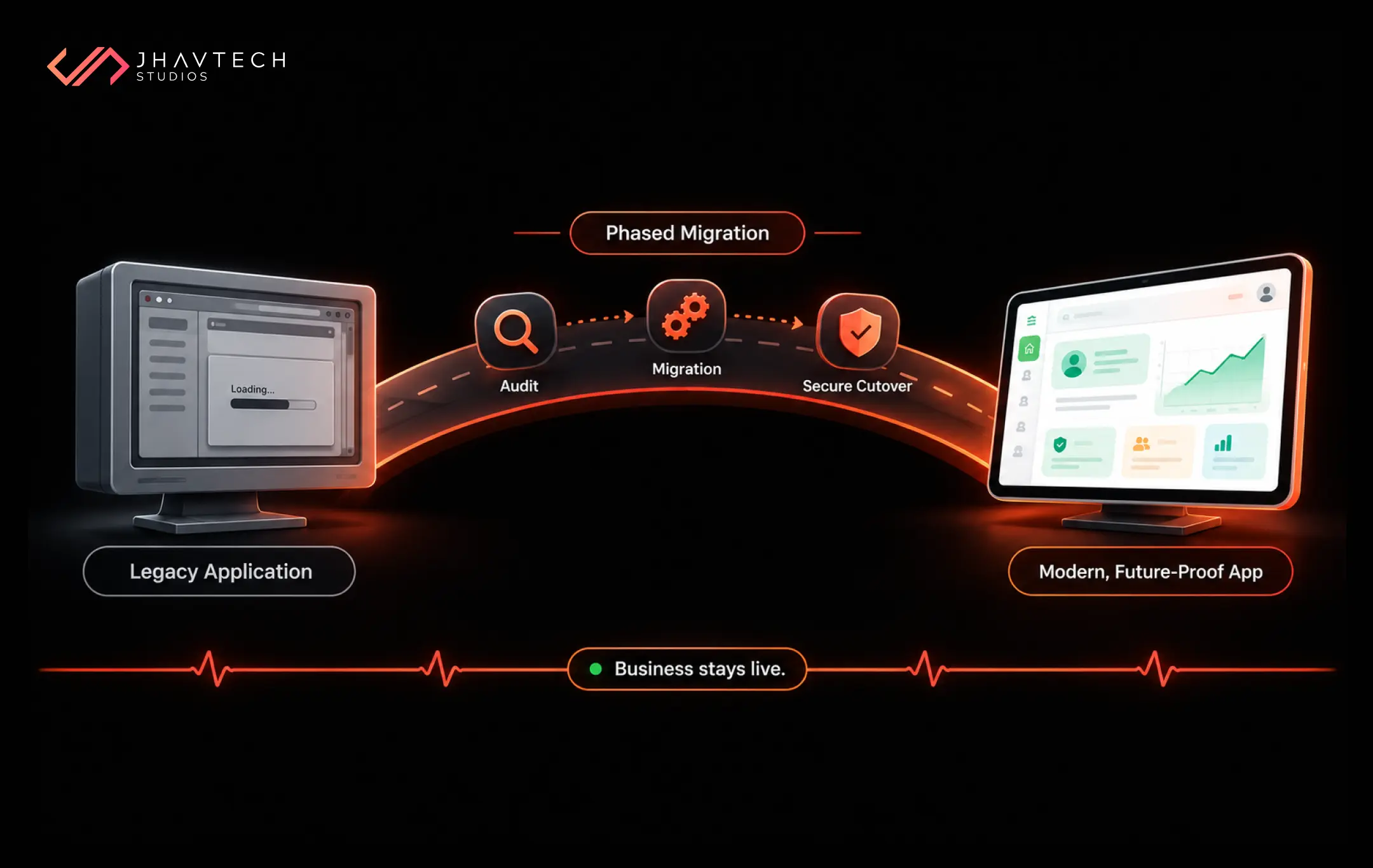
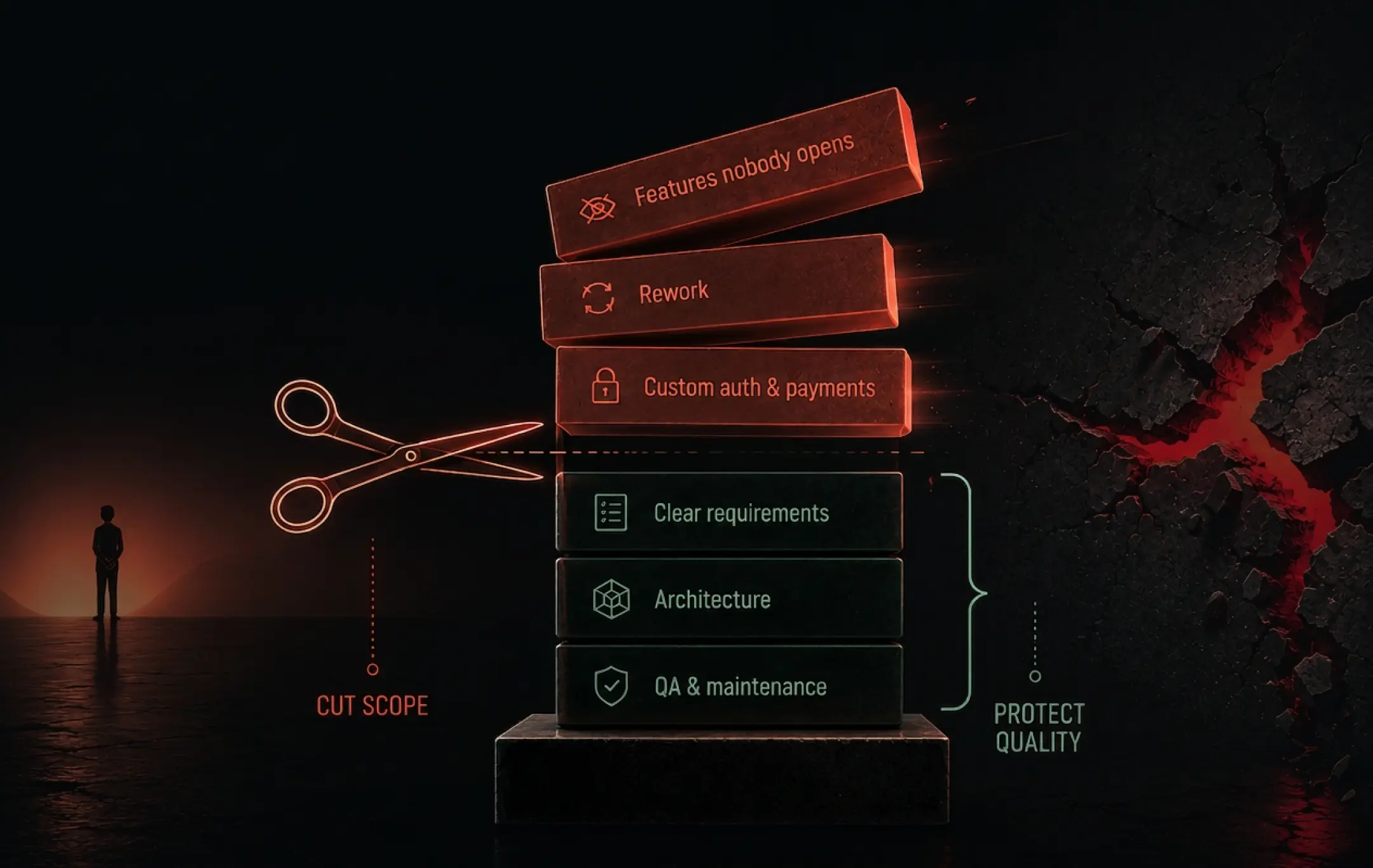
The instinct when the problem finally lands is to demand a full rewrite. Resist it. Rewrites fail at spectacular rates, and they freeze your product for as long as they run. Incremental repayment, funded properly and reported upward, beats a heroic rebuild almost every time.
The software cleanup strategy checklist
The payoff is well documented. McKinsey found that organisations actively managing their debt freed engineers to spend as much as 50% more of their time on work that generates value. That is capacity you are already paying for and not receiving.
For the operational version of this, our piece on treating maintenance as an investment rather than an afterthought covers how to structure the ongoing spend. If the root cause sits deeper than code quality, how poor architecture creates long-term business risk is the better starting point.
How to Talk About This Without a Technical Vocabulary
You do not need to read code to govern this well. You need three questions, asked quarterly:
- "What can we no longer do easily that we could do a year ago?" Loss of optionality is the clearest signal of accumulating debt.
- "If our lead developer left tomorrow, what breaks?" Concentration of knowledge is debt in human form.
- "What percentage of last quarter went to unplanned work?" Above 30% and you are already at stage 3.
Ask those consistently and you will catch problems a year earlier than most of your peers. That is the whole advantage on offer here. Nobody avoids technical debt. Some businesses just notice it while it is still cheap.
If your software has already started deciding what you can and cannot ship, get the project back from the edge before stage 4 makes the decision permanent. The earlier that conversation happens, the smaller the cheque.
Frequently Asked Questions




.png)

.webp)
.webp)
.webp)
.webp)
.webp)
.webp)
.webp)
.webp)
.webp)





.png)
.png)
.png)
.png)
.png)
.png)

.png)
.png)
.png)
.png)
.png)
.png)



.png)

.png)


.png)




.png)
.png)
.png)
.png)
.png)
.png)
.png)
.png)
.png)
.png)
.png)

.png)

.png)

.png)
.png)
.png)
.png)
.png)
.png)
.png)



.png)
.png)
.png)
.png)
.png)
.png)
.png)
.png)
.png)
.png)

.png)
.png)
.png)

.png)
.png)
.png)