.svg)
.svg)


How to Know If Your Software Project Needs a Rescue Team
.png)
Software projects silently fail every day... not with a bang, but with a slow accumulation of missed deadlines, mounting bugs, and developer burnout. This article breaks down the clearest warning signs that your project is in distress, explains what a 48-hour code audit actually examines, and walks you through the specific thresholds that separate a project in need of a tune-up from one that genuinely needs a rescue team. If you're a founder, CTO, or product owner who's been lying awake wondering whether your development situation is fixable, this one's for you.
Let's be blunt about something most technology vendors won't say out loud: a significant number of software projects are quietly failing right now. Not crashing dramatically, just quietly falling behind, burning through budgets, and eroding the trust of the people who depend on them.
The numbers back this up. According to a McKinsey analysis widely cited across the industry, only 0.5% of all IT projects are delivered on time, on budget, and with the intended benefits. Read that again. One in two hundred. Meanwhile, projects that miss even one of those targets typically exceed their budgets by 75% and deliver 39% less value than predicted. And it gets worse for SMEs and startups, where the margin for error is basically zero.
The question isn't whether software projects fail; they clearly do, and often. The real question is: how do you know when yours is heading that way, and what does intervention actually look like?
The Slow Burn vs. The Red Flag
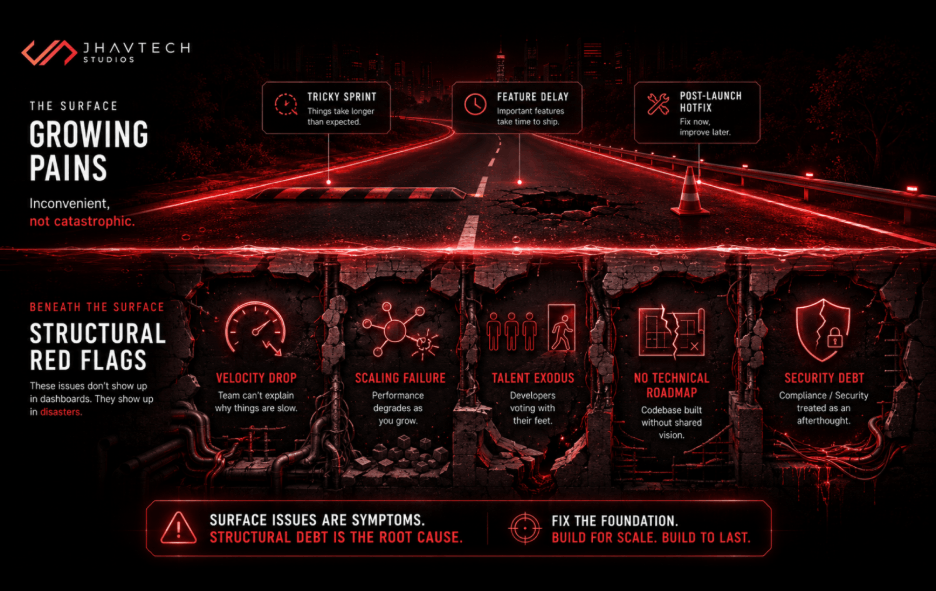
There's an important distinction between a project that's going through normal growing pains and one that has structural problems threatening its future. Growing pains look like: a tricky sprint, a feature that took twice as long as expected, or a post-launch bug that needed a hotfix. These are inconvenient, not catastrophic. Structural problems look like something else entirely.
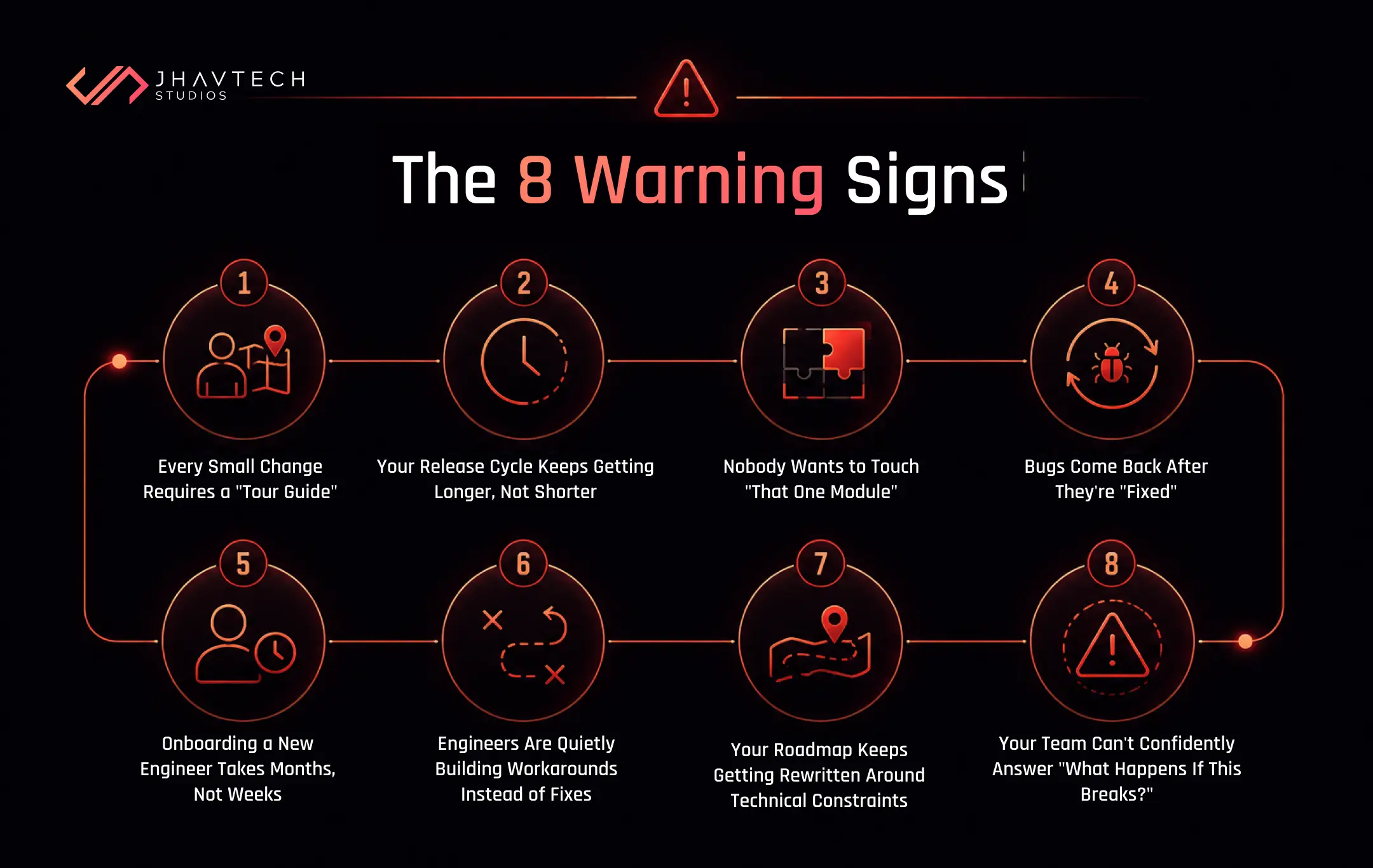
Warning Sign #1 — Your Team Can't Tell You Why Things Are Slow
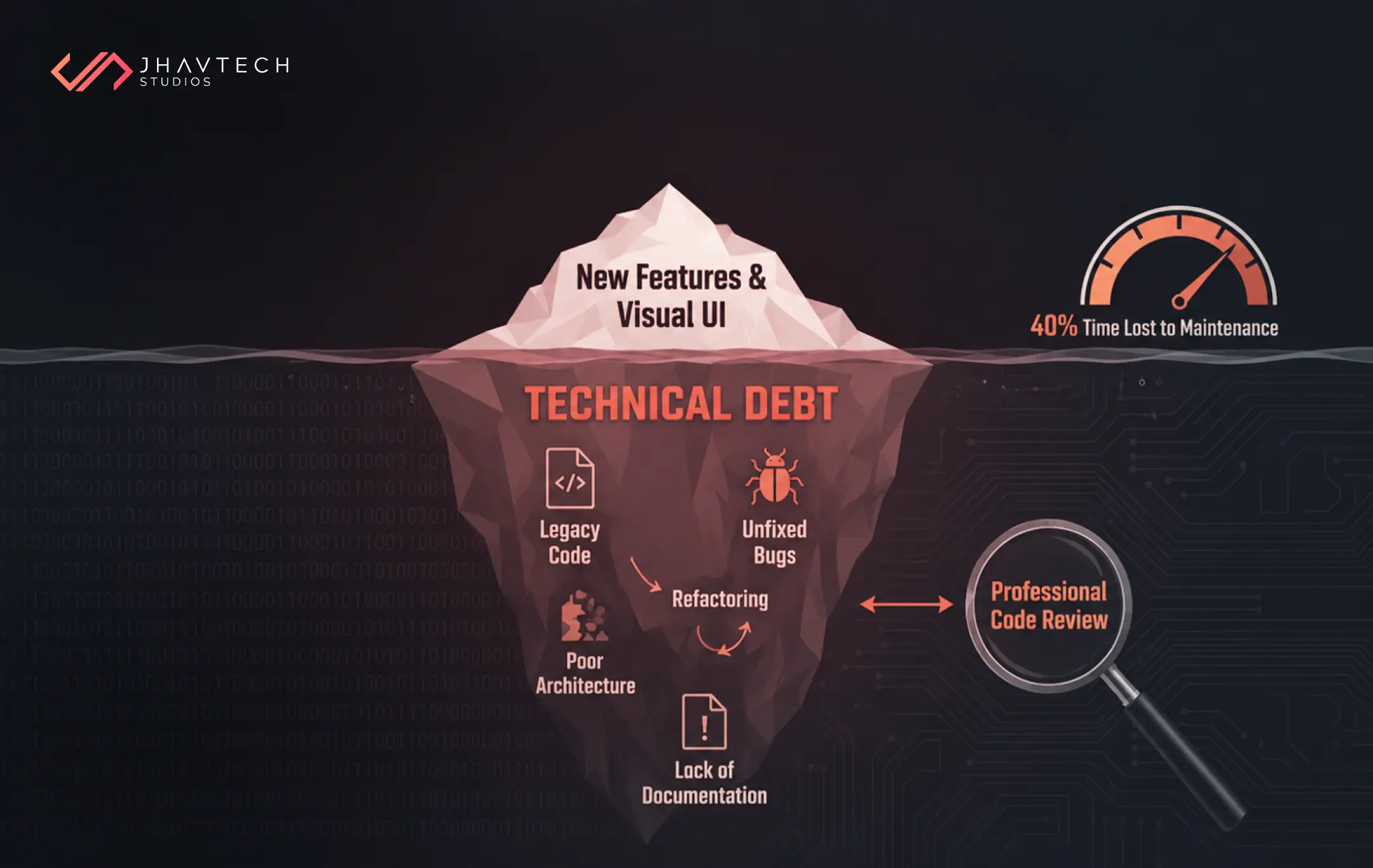
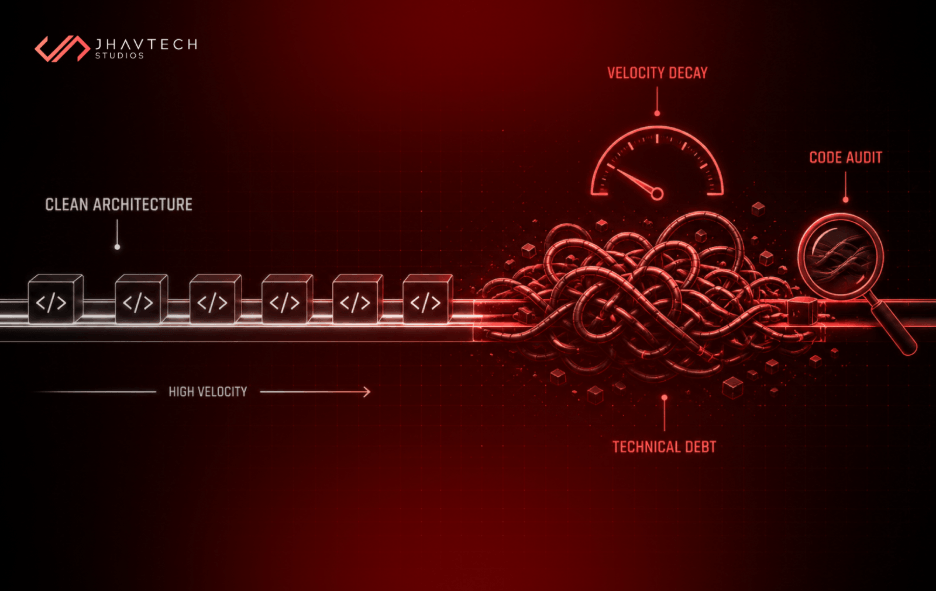
When developers struggle to articulate why velocity has dropped, it's usually because the codebase itself has become the obstacle. Technical debt or the accumulated cost of cutting corners during development, now represents a staggering $370 million annual drain on the average global enterprise, according to a 2025 Pegasystems study conducted across 500+ IT decision-makers worldwide.
For startups and SMEs, the proportional hit is even harder. When your team is spending more time navigating old code than building new features, you're not scaling; you're surviving. If you've noticed your developers increasingly talking about "needing to refactor before we can add X," this is worth paying close attention to. Our recent deep-dive on the hidden costs eating into your feature delivery timeline explores exactly how this pattern plays out across development teams.
Warning Sign #2 — Performance Is Degrading as You Grow
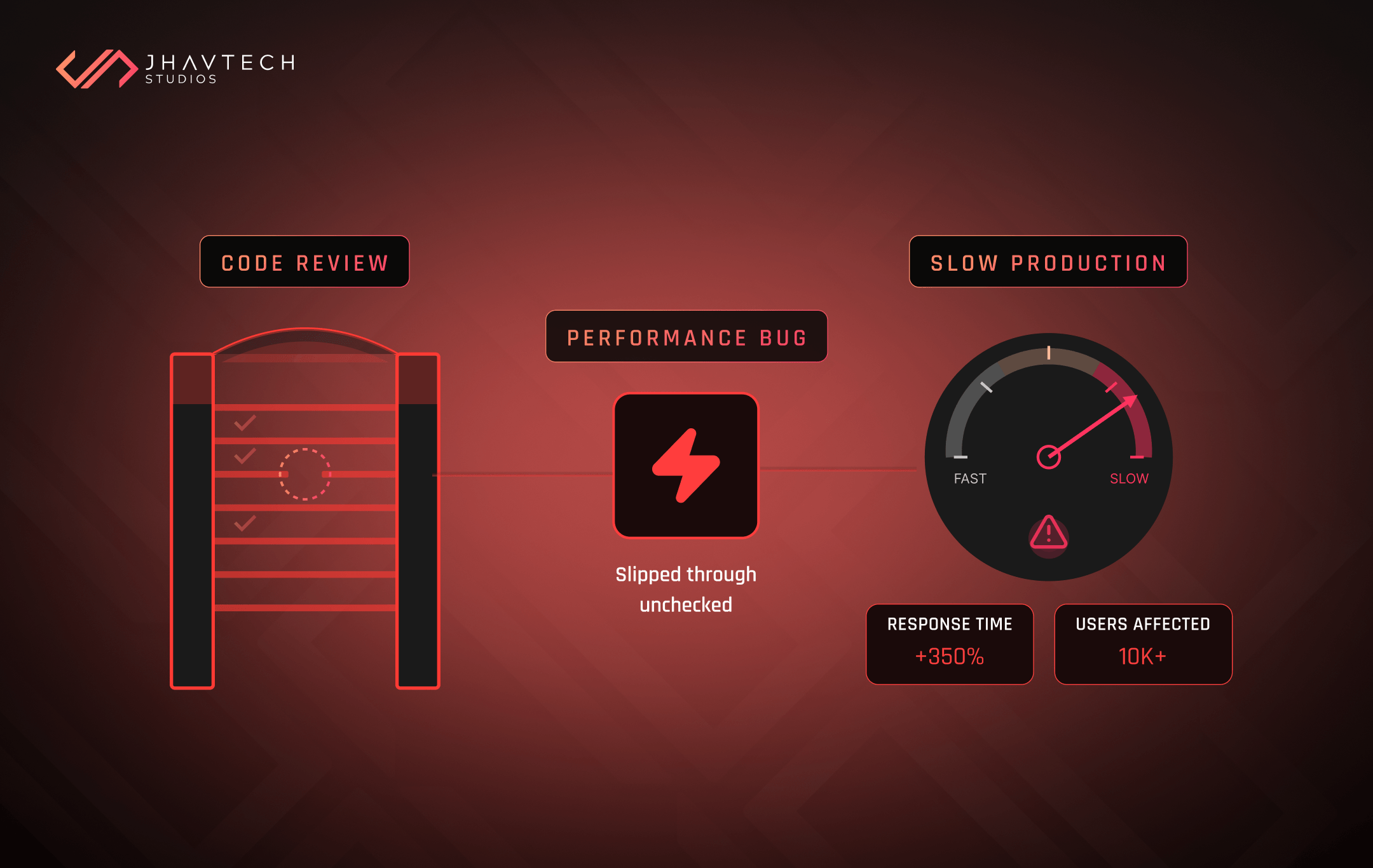
An app that worked beautifully with 500 users should not be struggling at 5,000. If your application is getting slower, throwing errors more frequently, or requiring manual restarts as your user base expands, that's an architecture problem and not a hosting problem.
An application performance audit will often uncover that the original build was never designed for scale. Database queries that weren't indexed, APIs without caching, front-end assets being loaded without optimisation. These issues are invisible at low traffic and catastrophic at high traffic. This is especially common in apps that were never stress-tested against real-world usage patterns — a problem you can avoid entirely with mobile apps engineered for performance from day one. Unplanned downtime compounds this quickly: according to a New Relic study published in September 2025, significant downtime now costs businesses a median of $33,333 per minute, or roughly $2 million per hour. For a startup or growing SME, even a fraction of that cost per incident changes the financial picture entirely.
Warning Sign #3 — You've Had Multiple Developers Walk Away from the Project
Developer turnover is a lagging indicator. By the time someone leaves, they've usually been frustrated for months. When two or more developers exit a project in a short window, especially if they cite "legacy code" or "poor architecture" in their feedback, the problem almost certainly isn't the people. It's the codebase they were asked to work in.
Experienced engineers vote with their feet. If yours are leaving, it's worth asking what they saw.
Warning Sign #4 — No One Owns the Technical Roadmap
This one is surprisingly common in fast-moving startups. The founding team moved quickly, hired contractors, shipped product and somewhere along the way, nobody stopped to document the architecture, set coding standards, or establish a clear technical direction. The result is a codebase built by many hands with no shared vision.
When you ask "where is this headed technically?" and no one has a confident answer, you're looking at a project that has outgrown its foundations.
Warning Sign #5 — Security and Compliance Are Afterthoughts
In 2026, "we'll add security later" is no longer a viable position. Whether you're building a health app, a fintech platform, or an enterprise SaaS product, data protection obligations exist from day one. A thorough software risk assessment will almost always surface security vulnerabilities in codebases that weren't built with security-first practices and those vulnerabilities are often far more extensive than teams expect. Our breakdown of what a rapid code examination actually uncovers goes into this in detail and is worth a read if your team hasn't had an independent security review in the last 12 months.
What Is a 48-Hour Code Audit, and Why Does the Timeframe Matter?
A 48-hour code audit is a rapid, structured assessment of your software's architecture, code quality, security posture, and scalability readiness — conducted by an independent technical team within two business days. Think of it as a diagnostic scan rather than a prolonged engagement.
The reason the timeframe matters is twofold. First, it forces the auditing team to prioritise ruthlessly, focusing on the issues with the highest business impact rather than producing an exhaustive list of minor nitpicks. Second, it gets information into decision-makers' hands quickly, which is exactly what you need when you're trying to decide whether to invest more into a struggling project or change course.
A well-executed 48-hour code audit typically covers:
- Architecture review — Is the system designed in a way that supports your growth plans, or will it need to be largely rebuilt to handle 10x the current load?
- Code quality assessment — What does the codebase actually look like under the hood? Are there patterns that signal future instability?
- Security vulnerability scan — Where are the exposure points, and how severe are they?
- Technical debt quantification — How much hidden rework is buried in the system, and what is it likely costing you in developer hours per sprint?
- Dependency analysis — Are you running outdated libraries that carry known security risks or compatibility issues?
- Go/no-go readiness check — A plain-English summary of whether the project is salvageable in its current form, needs partial rebuilding, or requires a more fundamental intervention.
This is the kind of clarity that should inform every significant resourcing decision. And yet, most teams only seek it out after a crisis — which is exactly backwards.
The Difference Between a Code Review and a Full Rescue Engagement
Not every distressed project needs to be completely rebuilt. This is important to understand, because the fear of hearing "you need to start over" often stops founders from seeking help at all, and that delay almost always makes things worse.
A code quality review might determine that the architecture is fundamentally sound but that certain modules need to be refactored, security gaps need to be patched, and better testing coverage needs to be added. That's a cleanup, not a rescue.
An app scalability audit might reveal that the core application logic is fine but the database layer and API design need to be reworked before you go to market. That's a targeted intervention.
A full software rescue engagement — the kind our team handles — is warranted when the issues are systemic: when the architecture can't support the product's direction, when security risks are too significant to patch around, or when the team that built it is no longer available and no one left understands how it works. Think of how a specialist crisis team approaches broken software differently from a standard development team. They don't start fresh unnecessarily, but they're also not afraid to make hard calls when the evidence demands it.
The 48-hour code audit is what tells you which category you're actually in.
The "Sunk Cost" Trap and Why Founders Fall into It
One of the most consistent patterns we see is what might be called the sunk cost trap. A founder has already invested $150,000 (or $500,000, or more) into a software project. The thought of acknowledging that the project has serious problems feels like admitting that money was wasted. So they keep investing and hoping that one more sprint, one more developer, one more feature will turn things around. It rarely does.
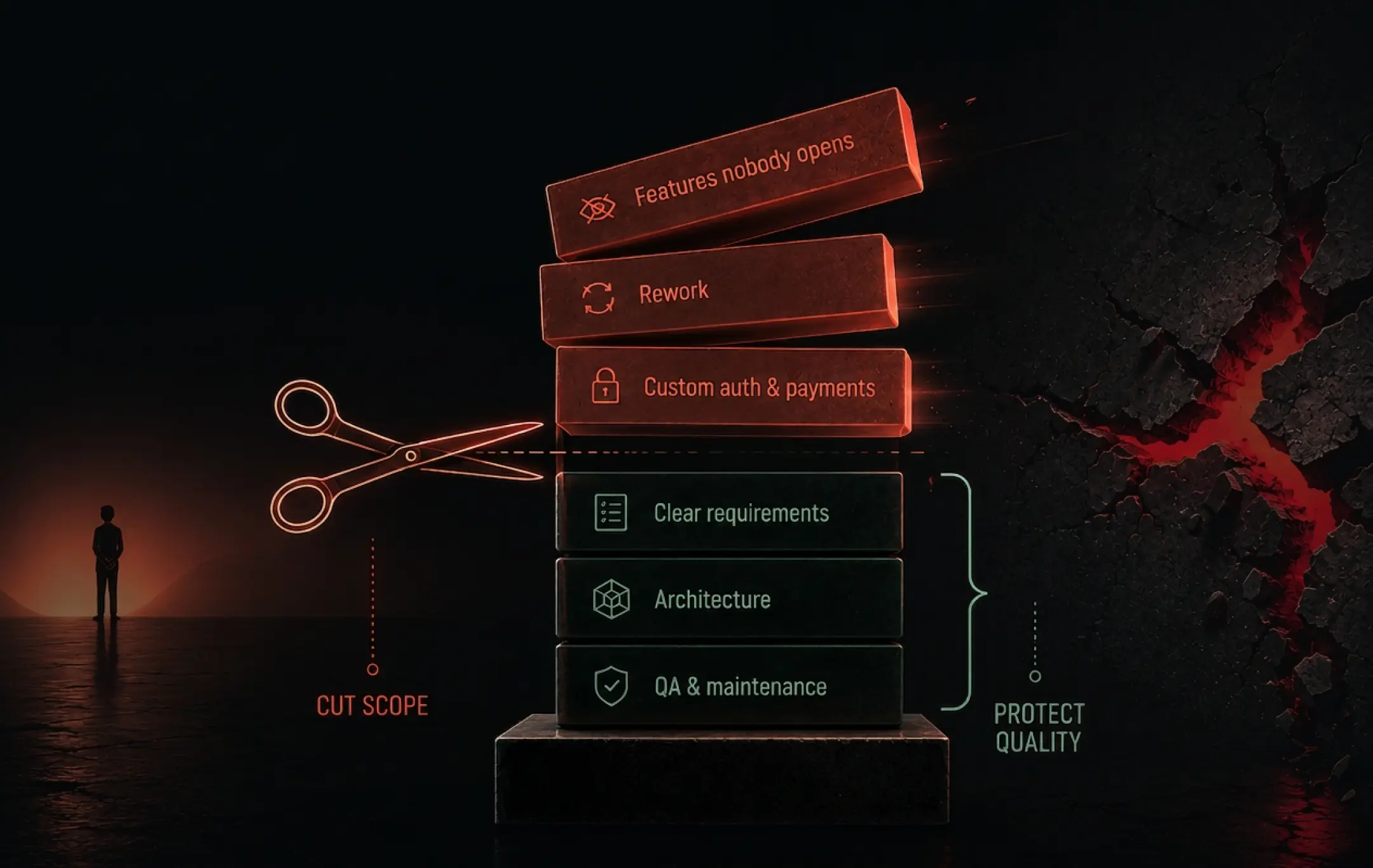
The right frame isn't "how do I protect what I've already spent?" It's "what does my business need to succeed from this point forward, and what's the most efficient path to get there?" Sometimes the answer is targeted rescue work. Occasionally it's a rebuild with the right team, structured properly from the start with a validated approach. What matters is making that call with actual data and not gut feel or the reluctance to face a difficult truth.
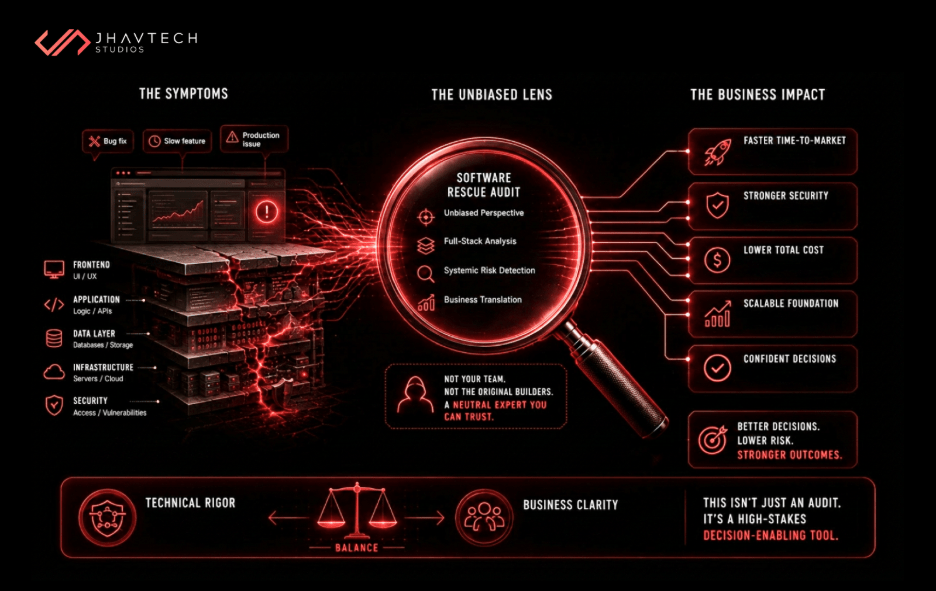
An independent software rescue audit gives you that data. It removes the politics, the developer defensiveness, and the founder's emotional attachment to the existing system, and replaces all of it with a clear picture of where things stand.
How to Choose the Right Team for a Software Rescue Audit
Not all auditing teams are created equal. Here's what to look for when evaluating who should conduct your 48-hour code audit or broader software risk assessment:
Independence. The team conducting the audit should have no vested interest in the outcome. If you hire the same agency that built the software to audit it, you're unlikely to get an objective assessment. Look for a team that's separate from your existing development arrangement.
Full-stack depth. Surface-level audits that only look at the front-end miss most of the real problems. The audit team needs to be able to examine backend architecture, database design, API structure, DevOps pipelines, and security configuration.
Business context, not just technical fluency. The best audits connect technical findings to business impact. A vulnerability is serious not just because it's a security risk in the abstract, but because it could expose your users' data and trigger regulatory consequences. Code that's difficult to maintain matters because it slows your time-to-market and increases developer costs. The audit report should make these connections explicit.
A track record with comparable projects. Ask to see examples of past audit engagements — and specifically, ask about outcomes. Did the client's project recover? What was the recovery timeline? What did the audit enable that wasn't possible before?
From Audit to Action — What Happens Next
A 48-hour code audit isn't a destination; it's a decision-enabling tool. Once you have the findings in hand, you're in a position to make one of three calls:
- Optimise. The foundations are sound but specific areas need attention. You can do this with your existing team, guided by the audit's prioritised fix list.
- Rescue. The project has significant structural issues that your current team doesn't have the capacity or expertise to address without outside support. You bring in a specialist rescue team to work alongside or in place of your current developers for a defined period.
- Rebuild. In some cases, typically where the architecture is fundamentally incompatible with the product's direction, a targeted rebuild of certain components (or the whole system) is the most cost-effective path. This isn't failure; it's sound engineering judgment.
Whichever path is right for your situation, the worst outcome is choosing none of them and continuing to invest in a project without knowing what you're actually working with.
Frequently Asked Questions
.webp)
.png)
.png)


.webp)
.webp)
.webp)
.webp)
.webp)
.webp)

.webp)
.webp)




.png)
.png)
.png)

.png)
.png)
.png)
.png)
.png)
.png)
.png)


.png)
.png)

.png)


.png)
.png)
.png)
.png)
.png)
.png)
.png)
.png)
.png)
.png)
.png)

.png)
.png)

.png)
.png)
.png)
.png)
.png)
.png)
.png)


.png)
.png)
.png)
.png)
.png)
.png)
.png)
.png)
.png)
.png)

.png)
.png)
.png)

.png)