.svg)
.svg)


10 Common MVP Mistakes That Burn Startup Budgets
.png)
Building a Minimum Viable Product is supposed to save you money... not drain it. Yet most startups make the same costly MVP mistakes before they ever reach their first 100 users. This guide breaks down the 10 most damaging errors in MVP planning and execution, backed by real data, so you can protect your runway and build something people actually want. Whether you're pre-launch or already stuck in a development spiral, this is required reading for any founder, product lead, or technical decision-maker.
You have a great idea. You've raised some funding or at least convinced yourself the idea is worth betting on. You hire a dev team or maybe you're building it yourself and you tell everyone: "We're keeping it lean. Just an MVP."
Six months later, you've spent $80,000, your launch date has moved three times, and what you have still doesn't feel ready to show users. Sound familiar?
This is the quiet crisis that plays out in startups every day. The Minimum Viable Product — one of the most powerful concepts in modern product development — gets misunderstood, misapplied, and ultimately turned into exactly what it was meant to prevent: startup product waste.
According to CB Insights, 43% of startups fail due to poor product-market fit: the single biggest killer of early-stage companies. And a 2026 analysis of startup failure data confirms that bad MVP planning sits squarely at the root of that problem. You can't find product-market fit if you build the wrong thing, in the wrong way, for the wrong audience.
Here are the 10 most common MVP mistakes we see at Jhavtech Studios and exactly how to avoid them.
Mistake #1 — Treating MVP as an Excuse to Build Everything (Just Smaller)
The word "minimum" in MVP is doing a lot of heavy lifting that most founders ignore.
A Minimum Viable Product is not a stripped-down version of your full product vision. It's the simplest possible thing that lets you test a specific hypothesis about your business. But what happens in practice? Founders scope out a 40-feature roadmap, cut it to 20, and call it an MVP. That's not lean thinking, it's just slower, more expensive, and still wrong.
Every unnecessary feature at the MVP stage costs you money, time, and focus. Worse, it buries the one or two core value propositions that would tell you whether your idea actually works.
Fix it: Before a single line of code is written, define the one problem your MVP is solving and the one metric that would prove it's working. Everything else gets cut.
Mistake #2 — Skipping User Research Before Development
This is where bad MVP planning starts; not in the code, but in the assumptions.
Too many founders treat their own experience as market research. They've lived the problem, so they assume they know the solution. What they don't account for is that they are not their users. Their pain points, vocabulary, and workarounds are not universal.
Talking to potential users before you build isn't just good practice. It's the difference between building something people want and something you think they want. The research doesn't have to be expensive. Ten to fifteen structured interviews with your target audience will surface more useful product direction than months of internal debate.
Related reading: Our breakdown of why most Australian startups fail before their product gains traction gets into this in detail, and the patterns are sobering.
Mistake #3 — Choosing the Wrong Development Partner
This one is responsible for more blown budgets than almost anything else on this list.
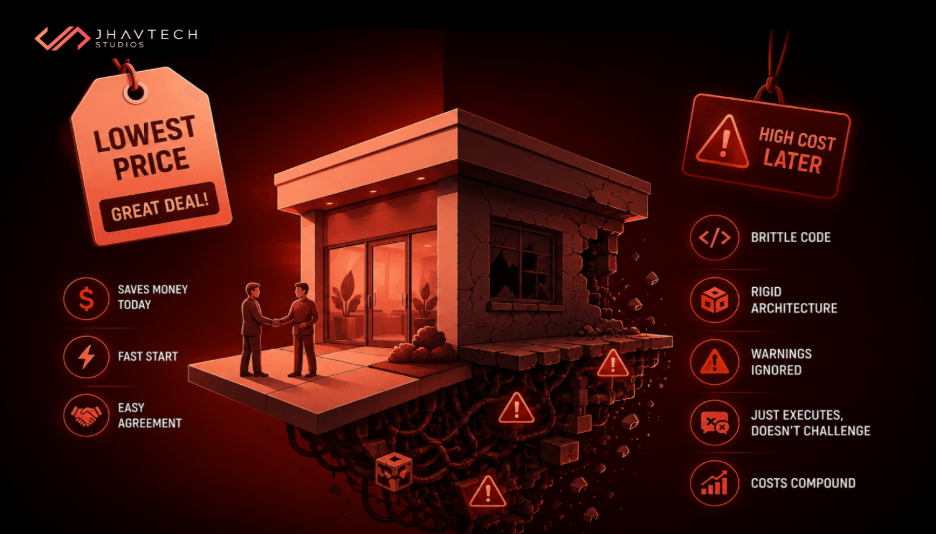
Startups are cost-sensitive, which is understandable. But the cheapest available developer and the right development partner are rarely the same thing. A junior freelancer or an overseas agency that doesn't ask hard questions about your product strategy will build exactly what you describe, not what you need.
The result? Code that works on paper but doesn't scale, a product architecture that becomes expensive to change, and no one in your corner flagging the technical decisions that will hurt you in six months.
We've written extensively on what a 48-hour code audit reveals that your team might be missing and the surprises are rarely pleasant when a project comes to us mid-spiral.
When evaluating development partners, ask specifically about their discovery and validation process. If they start building before they've challenged your assumptions, keep looking.
Mistake #4 — Over-Engineering the Technical Architecture
There's a particular trap that catches technically savvy founders hard: building for scale before you've earned the right to scale.
We see MVPs built on microservices architectures that would comfortably support 10 million users... for a product that currently has zero. The team spent three months on infrastructure that a simple monolith would have handled, and they burned through a significant chunk of runway doing it.
This is sometimes called premature optimisation. And while it comes from a good place, the reality is that the vast majority of MVPs never reach the scale that would justify that investment. According to Startup Genome's research on premature scaling, premature scaling is implicated in 70% of startup failures.
Our recent piece on why scaling your app too early can destroy product performance is a must-read if your team is already having those conversations.
Fix it: Build for your next 1,000 users, not your next 1,000,000. Revisit architecture when you have a problem that’s worth solving.
Mistake #5 — Confusing a Prototype with a Validated MVP
A clickable prototype that looks great in Figma is not the same as a working MVP that tests real user behaviour.
This distinction matters enormously for budget decisions. Founders sometimes show a prototype to investors, get positive reactions, and interpret that as validation. It isn't. A prototype tells you that people find the concept plausible. An MVP tells you whether they'll actually use it — repeatedly, without hand-holding.
Failed product validation using a prototype as a substitute for a real product is one of the more expensive mistakes on this list, because it sends you into full development with false confidence. The test of a real MVP isn't "does it look good in a demo?" It's "will a stranger use this without us in the room, and come back tomorrow?"
Mistake #6 — Not Defining Success Metrics Before Launch
If you don't know what success looks like before you launch, you won't recognise it when you see it and you won't recognise failure either.
This sounds basic. Most founders nod along and then launch without a single defined KPI. Three months later, they're making product decisions based on gut feel and the loudest user feedback, rather than data.
Define your North Star Metric. This is the single number that best represents the core value your product delivers. Define it before you write a line of code then build your MVP around producing evidence that moves that metric.
Common examples:
- A marketplace: weekly active buyers
- A SaaS tool: number of actions completed per session
- A consumer app: Day 7 retention rate
Keep in mind that without this anchor, every feature debate becomes a political argument instead of a data-driven decision.
Mistake #7 — Building for Every Platform at Once
"Should we build iOS, Android, and web for launch?"
The answer is almost always no, at least not for an MVP. Cross-platform development sounds efficient in theory, but it multiplies your complexity, cost, and time-to-market at exactly the stage where speed matters most.
Pick the platform where your target users live. If you're building for enterprise professionals, that's likely web or desktop. If you're targeting younger consumers in Australia, iOS likely has higher early-adopter density. Build there, validate, then expand.
MVP budget issues caused by multi-platform launches are common and avoidable. A well-built single-platform product that validates your core assumption is worth ten times more than a half-baked product spread across every surface.
For startups that do need a mobile presence, our cross-platform app development expertise can help you make the right call for your specific audience and constraints, without over-investing before you've validated demand.
Mistake #8 — Ignoring Technical Debt Until It Becomes a Crisis
MVP-stage shortcuts are sometimes necessary. Moving fast matters. But there's a difference between informed shortcuts and undisciplined development that buries problems until they become catastrophic.
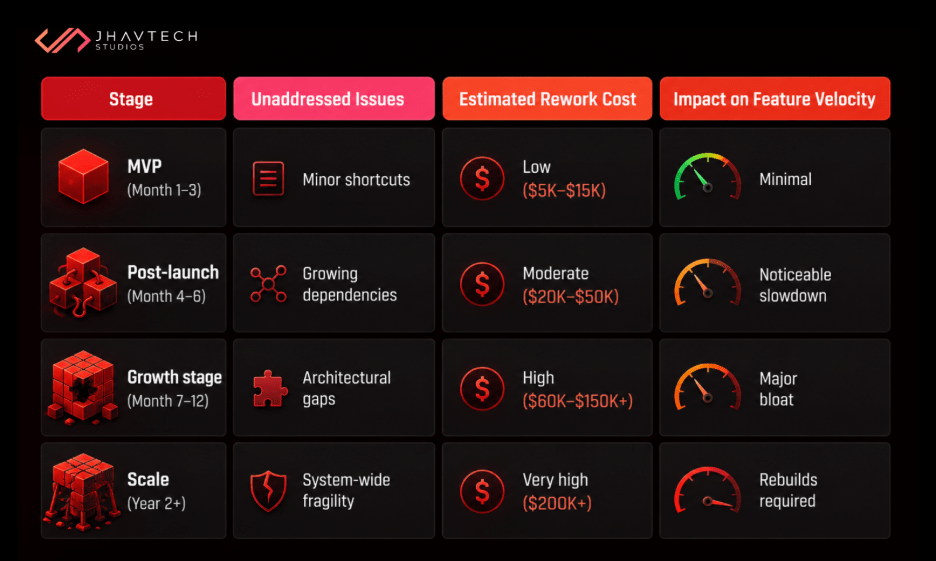
Technical debt is the hidden tax on every future feature. The longer it accumulates, the more expensive it becomes to address, and at some point, it can make a product literally impossible to scale or maintain without a near-complete rebuild.
Here's a rough illustration of how technical debt compounds over time:
Technical Debt Compound Cost Table
A structured code review at key milestones can catch this before it compounds. Our free code review service gives you a clear picture of where your codebase stands and what it'll cost you if you keep going without addressing it.
Mistake #9 — Launching Without a Feedback Loop
Building an MVP is only half the job. The other half is systematically collecting and acting on what real users show you.
Many startups launch their MVP, watch users interact with it (or not), and then continue building new features based on their original roadmap, completely bypassing what the data is telling them. This is the behaviour that turns MVP budget issues into full-blown product failures.
An effective feedback loop doesn't require an expensive research operation. It requires:
✅ MVP Launch Feedback Checklist
☐ Session recording tool installed (e.g., Hotjar, FullStory)
☐ In-app feedback mechanism live on day one
☐ Analytics events tracking key user actions
☐ Weekly user interview cadence scheduled
☐ Retention metrics reviewed every 7 days
☐ A defined pivot/persevere review scheduled at 30 and 60 days
☐ A single person accountable for synthesising feedback into the roadmap
If you can't answer "what did we learn from users this week?" — your feedback loop isn't working.
Mistake #10 — Treating a Failing MVP as a Project Rescue Problem, Not a Product Problem
When an MVP isn't gaining traction, the instinct is often to blame the execution: the dev team, the code quality, the design. Sometimes that's true. But more often, the real issue is a product strategy problem — a fundamental mismatch between what was built and what the market actually wants.
Rescuing the code of an MVP that was built on wrong assumptions won't save it. What saves it is an honest reassessment: is this a build problem, or a product problem?
If your MVP is stalled, here's a useful diagnostic:
- Are users trying it and not returning? → Product-market fit issue.
- Are users not finding it at all? → Distribution/marketing problem.
- Are users finding bugs and rough edges that prevent use? → Execution issue worth rescuing.
The third scenario is where a technical rescue genuinely helps. If you're in that situation, our emergency product stabilisation and rebuild service is designed specifically to get stalled or broken products back on track... fast.
The Bigger Picture: Why These MVP Mistakes Keep Happening
The ten mistakes above aren't random. They cluster around a few root causes that show up in startup after startup.
The first is speed bias or the cultural pressure to ship fast, which overrides the discipline to ship right. MVPs get misused as a justification for skipping validation, structure, and planning that would actually save time.
The second is founder distance from the user. The further a founding team is from the actual pain of the people they're building for, the more likely they are to build something technically impressive but practically useless.
The third is misaligned incentives in the build process. Developers get paid to build. If the commercial structure doesn't reward the development partner for pointing out when something shouldn't be built, they won't.
Fixing this doesn't require a bigger budget. It requires better thinking before a single feature is scoped.
Frequently Asked Questions
.webp)
.webp)
.webp)

.png)
.png)
.png)
.png)
.png)
.png)
.png)
.png)
.png)
.png)
.png)

.png)
.png)
.png)
.png)
.png)
.png)
.png)
.png)
.png)

.png)
.png)
.png)
.png)
.png)
.png)
.png)
.png)
.png)
.png)
.png)
.png)
.png)
.png)
.png)
.png)
.png)

.png)
.png)
.png)

.png)
.png)
.png)
.png)

.png)


.png)

.png)



.png)



.png)




.png)

.png)


.png)

.png)

.png)
.png)