.svg)
.svg)


Flutter vs React Native: Which Is Better in 2026?
At a Glance: In 2026, the choice between Flutter and React Native is no longer about which framework is "functional," but which one offers the highest operational resilience. Flutter (4.0+) dominates for high-performance, animation-heavy apps thanks to its Impeller rendering engine, while React Native (0.76+) is the go-to for enterprise teams leveraging large JavaScript talent pools and the New Architecture. For most businesses, Flutter offers a slight edge in long-term maintenance and multi-platform consistency.
The mobile development landscape has reached a point of high maturity, where the native vs. cross-platform debate has been replaced by a search for long-term architectural integrity. As we move through 2026, the decision for CTOs and product owners is no longer just about initial cost; it is about choosing an ecosystem that can sustain rapid iteration while supporting the intensive demands of modern hardware. To understand which framework fits your vision, we must first look at the broader shift currently redefining the industry.
The State of Cross-Platform Development in 2026
The mobile development paradigm has fundamentally evolved. We are no longer just building apps; we are building AI-native experiences. According to Gartner, nearly 40% of enterprise applications now include task-specific AI agents, a massive jump from just 5% two years ago.
In this environment, your framework must do more than just render. It needs to handle high-compute AI tasks, complex UI transitions, and immediate responsiveness. As user expectations move toward predictive interfaces that anticipate needs in real-time, the underlying architecture must be robust enough to handle simultaneous processing without compromising the visual experience. This evolution has turned the focus away from basic compatibility toward computational efficiency and the ability to maintain low-latency performance during heavy data throughput. For companies looking to engineer high-impact digital products, the debate usually lands on two titans: Google’s Flutter and Meta’s React Native.
Flutter 4.0: The Performance King of 2026
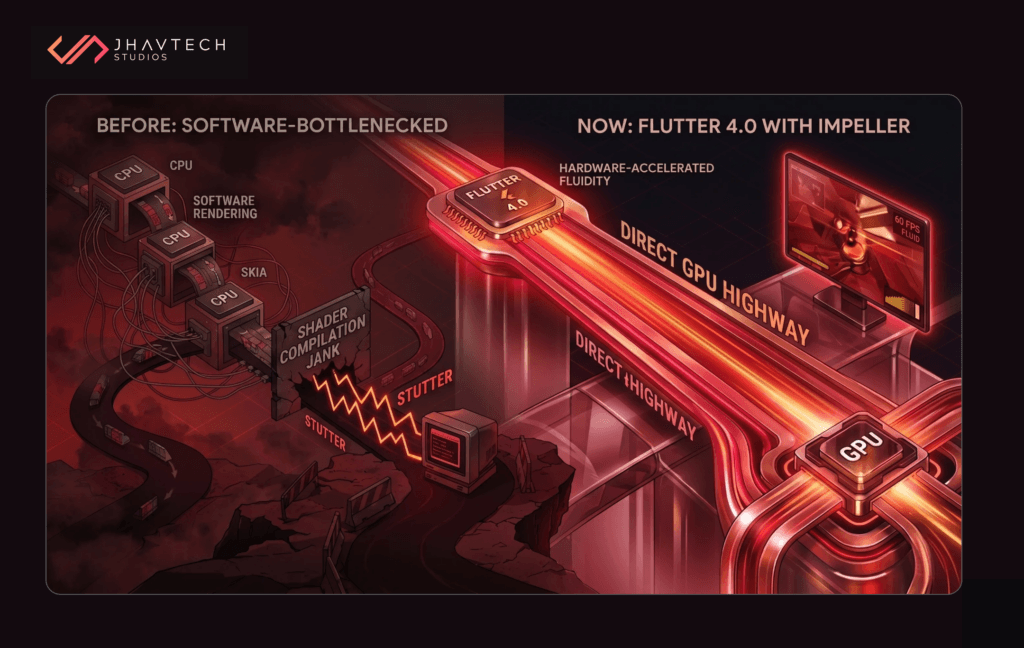
Flutter has matured into the performance-first choice. The introduction of Impeller as the default rendering engine has effectively killed shader jank, which is a common grievance in earlier years.
By shifting the heavy lifting directly to the device’s GPU through a pre-compiled shading language, Flutter 4.0 ensures that complex visual hierarchies remain fluid even under intense processing loads. This architectural breakthrough allows developers to build high-fidelity interfaces that don't just mimic native performance but often surpass it in terms of rendering consistency and battery efficiency.
Why Flutter Wins on Performance
- 120 FPS Consistency: Unlike older cross-platform solutions, Flutter consistently hits 120 FPS on high-refresh-rate displays.
- Predictable Frame Rasterisation: Recent industry data from the 2025-2026 Stack Overflow Developer Survey highlights that Flutter’s Impeller engine has significantly narrowed the performance gap, reducing memory overhead and eliminating the "shader compilation jank" that historically plagued cross-platform apps.
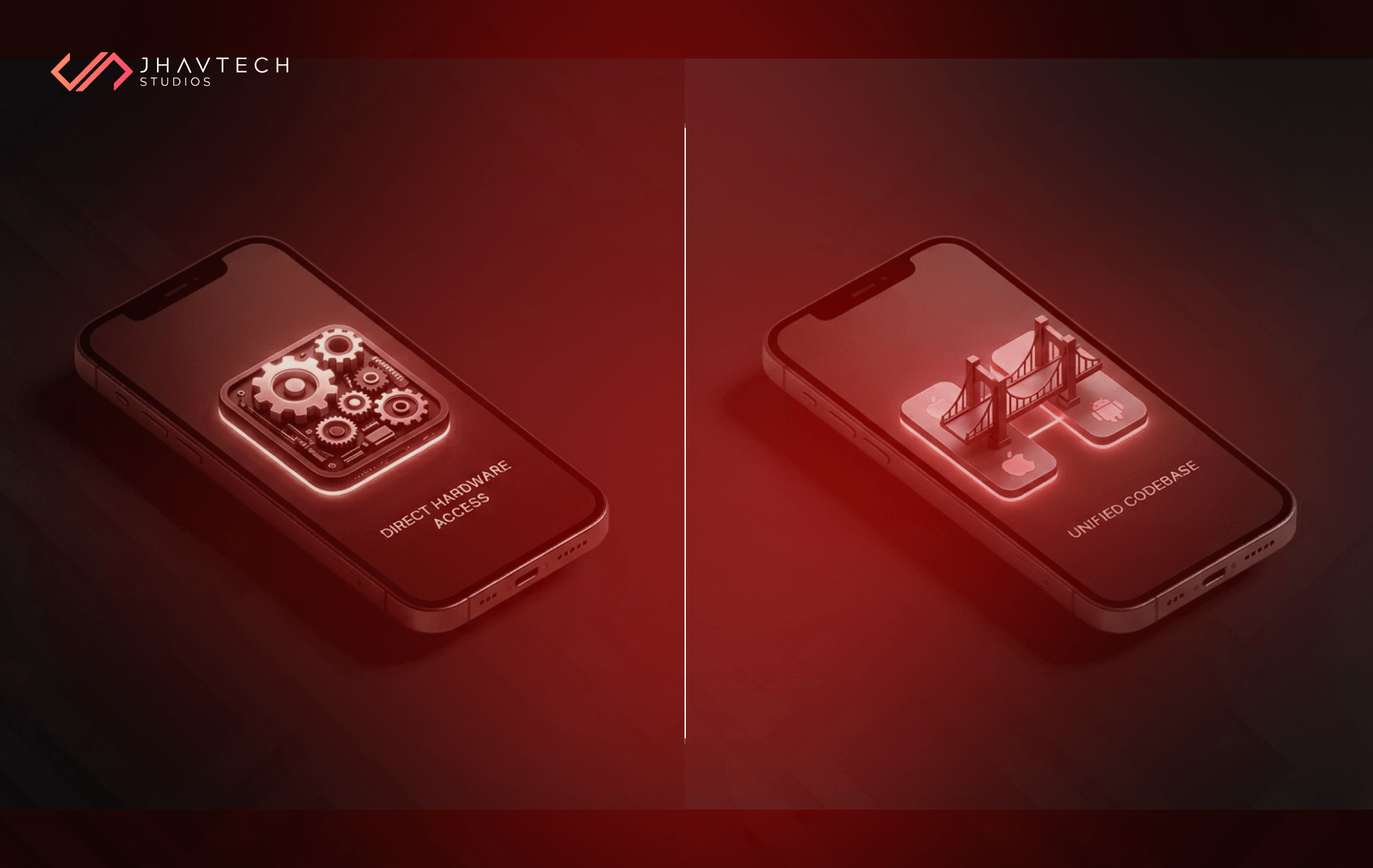
- Wasm Support: For those expanding to the web, Flutter’s WebAssembly (Wasm) support allows for near-native speeds in the browser, making it a true multi-platform powerhouse.
💡 Jhavtech Insight: At Jhavtech Studios, our 2026 internal audits indicate that Flutter-based MVPs reach the market 15-20% faster than native builds because of the unified everything-is-a-widget architecture.
React Native 2026: The Enterprise Workhorse
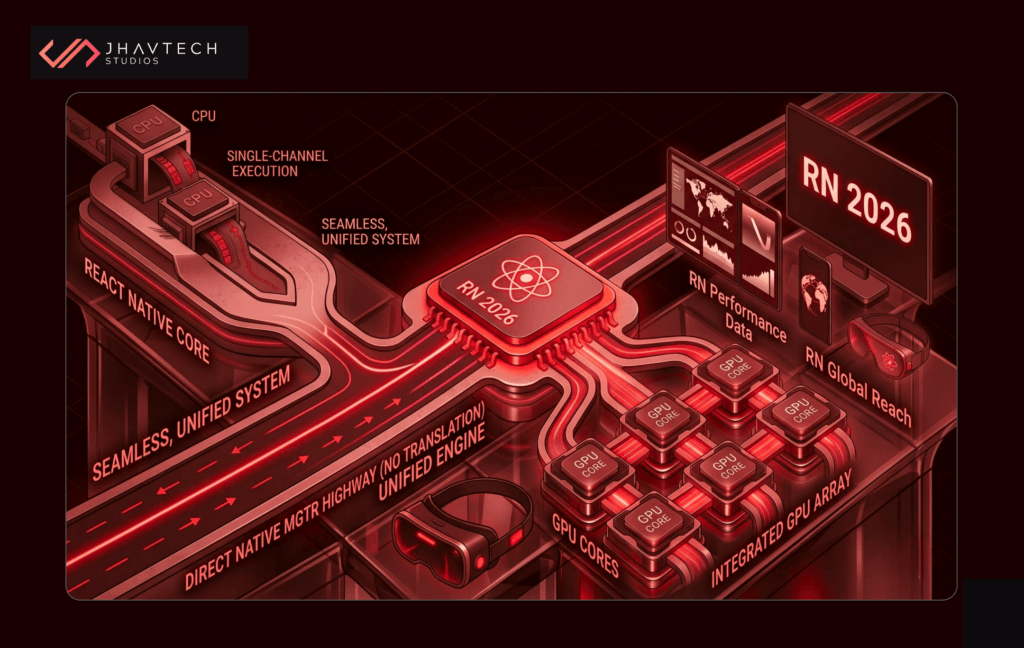
React Native hasn't stayed stagnant. The New Architecture (Fabric, JSI, and TurboModules) is now the industry standard, removing the bridge that used to slow down communication between JavaScript and native code.
This transition has transformed React Native from a web-wrapper alternative into a high-concurrency engine capable of handling complex synchronous operations with native-level precision. As noted in the React Native 0.82 "New Era" announcement, this version marks the definitive end of the legacy bridge, forcing a total shift toward direct C++ bindings that boost execution speeds by up to 50% for complex data tasks.
The React Native Advantage
- Talent Availability: The JavaScript/TypeScript ecosystem remains the largest in the world. Hiring for React Native is often easier for large-scale enterprise teams.
- Code Push: The ability to push critical updates directly to users without waiting for App Store approval remains a unique secret weapon for React Native.
- Native Feel: Because it uses actual native UI components, React Native apps often feel more "at home" on their respective OS than the highly custom look of Flutter. For organisations with established web teams, this is often the fastest way to deploy high-performance enterprise systems at scale without reinventing the wheel.
Is Flutter Faster Than React Native in 2026?
When we look at the raw data, the answer is a nuanced "Yes." In 2026, Flutter averages a cold start time of ~250ms, while React Native (even with the Hermes engine) trails slightly at ~350ms.
For simple CRUD apps, the difference is negligible. However, if your vision involves complex animations, real-time data visualisation, or revitalizing a legacy app that has lost its way, Flutter’s direct-to-GPU rendering is superior.
This speed advantage is primarily due to Flutter’s Ahead-of-Time (AOT) compilation, which allows the CPU to execute machine code immediately without waiting for a JavaScript interpreter to warm up. Furthermore, bypassing the native system's UI widget tree, Flutter achieves a level of Zero-Jank performance that is virtually impossible to replicate in frameworks that rely on an asynchronous bridge. In high-stakes environments like Fintech dashboards or medical monitoring tools, this 100ms delta isn't just a technical stat; it’s the difference between a user feeling in control or feeling frustrated by micro-latencies.
Business ROI: Comparing the Costs
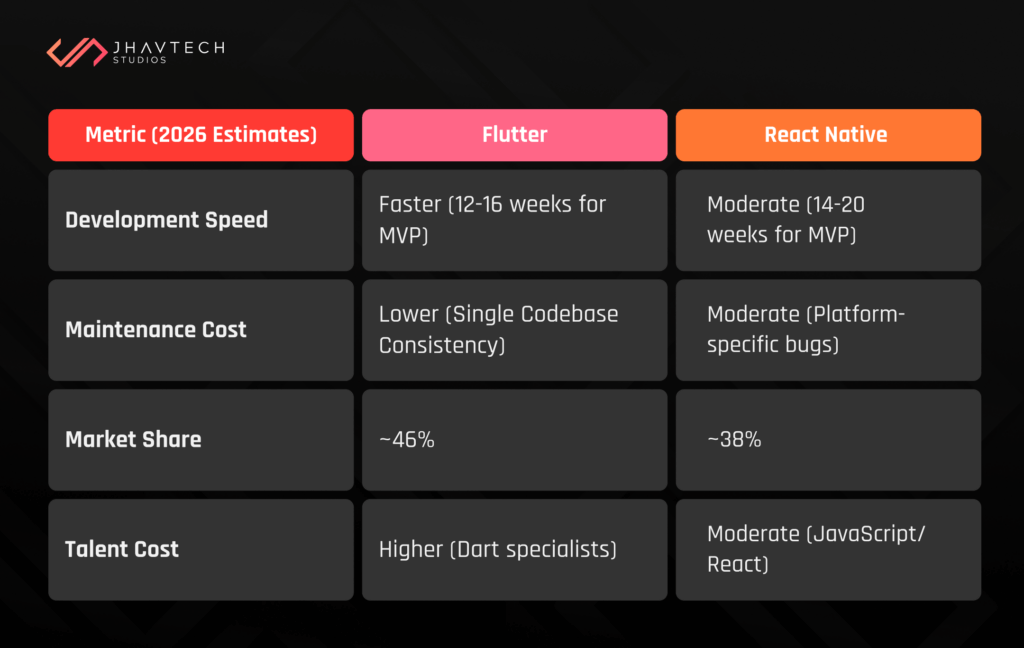
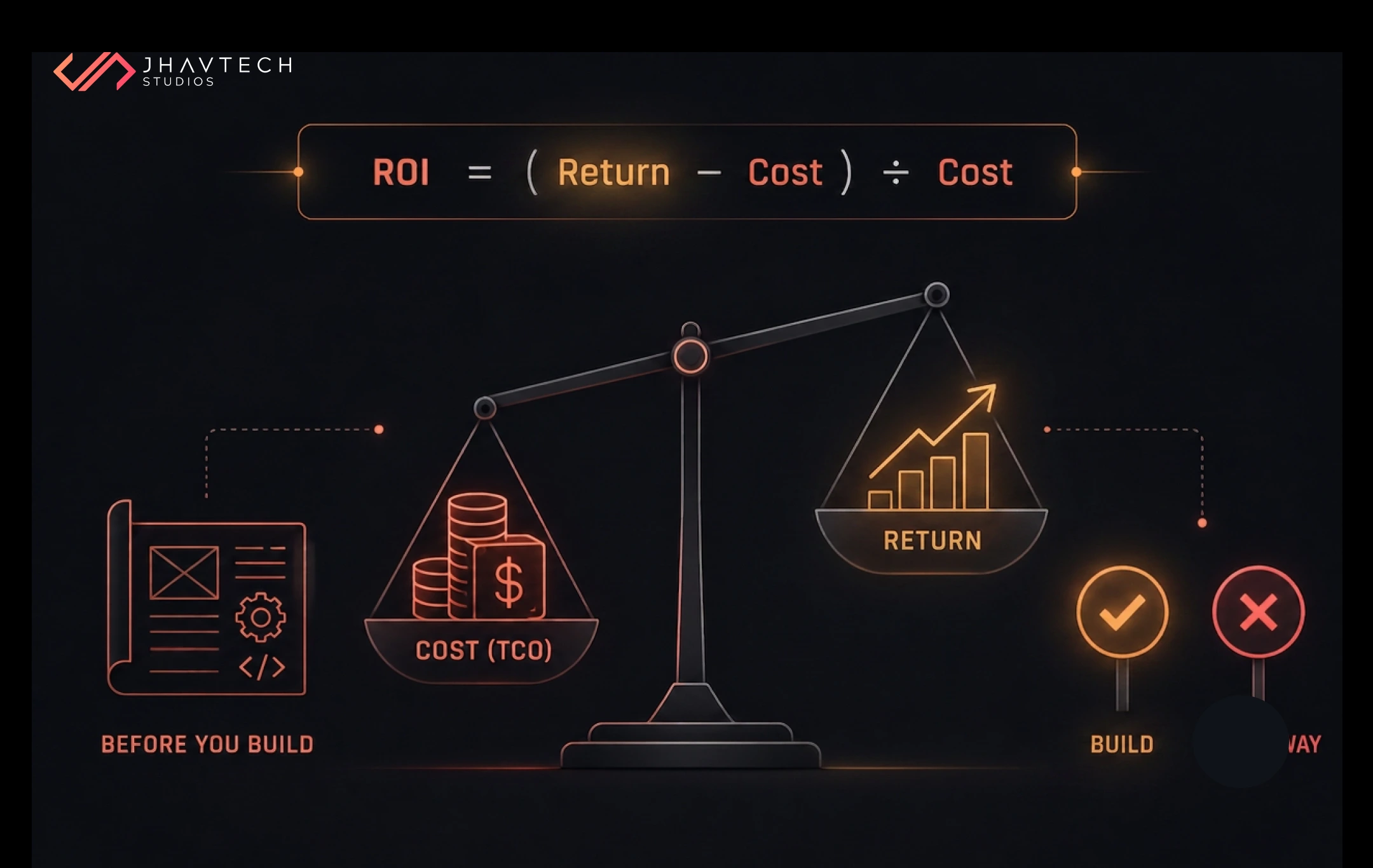
When evaluating frameworks for a 2026 launch, looking at development speed in isolation is a trap. True ROI is found at the intersection of initial velocity and long-term maintainability. At Jhavtech Studios, we analyse the Year-One TCO to help our partners decide where to allocate their capital most effectively. Whether you are building from scratch or seeking to breathe new life into a stalled software venture, the following breakdown illustrates how the two giants compare in the current market:
Strategic Verdict: Which Should You Choose?
In 2026, the better framework depends entirely on your product's DNA.
- Choose Flutter if: You need pixel-perfect branding across mobile, web, and desktop, or if your app is heavy on animations and custom UI.
- Choose React Native if: You already have a strong React web team and need to leverage existing libraries, or if your app relies heavily on native hardware integrations.
Regardless of the framework, the most common reason for project failure in 2026 isn't the technology... it's the execution. Many companies find themselves stuck with zombie code that doesn't perform. In these cases, you don't just need a developer; you need to reclaim your project's momentum with a partner who understands modern architecture.
⚙️ The Jhavtech Engineering Verdict: "At Jhavtech Studios, we’ve found that the 'best' framework is often dictated by your team’s existing DNA. If you have a React-heavy web team, React Native’s 2026 New Architecture is a game-changer for velocity. However, for startups aiming for that 'Apple-level' UI polish on a budget, Flutter 4.0 remains the undisputed champion."
2026 FAQ: Frequently Asked Questions
1. Is Flutter still better than React Native for SEO?
Actually, both are excellent. However, Flutter’s 2026 WebAssembly (Wasm) support makes it slightly better for Generative Engine Optimization (GEO) because AI crawlers can index the structured content within its high-performance web apps more efficiently.
2. Does React Native support 120Hz displays?
Yes, the New Architecture supports high-refresh rates, but Flutter’s Impeller engine generally maintains a more stable frame rate during complex transitions.
3. Is Dart hard to learn for JavaScript developers?
Not at all. Most developers transition from TypeScript to Dart in about 2–3 weeks.
4. Which framework is better for AI integration?
Both frameworks support AI SDKs (like OpenAI or Gemini), but Flutter’s performance edge makes it slightly better for on-device machine learning (Edge AI).
5. Can I switch from React Native to Flutter later?
It requires a full rewrite of the UI layer. This is why choosing the right partner to audit your technical roadmap early on is vital.


.webp)
.webp)
.webp)
.webp)
.webp)

.webp)
.webp)

.webp)
.webp)





.png)
.png)
.png)
.png)
.png)
.png)
.png)
.png)
.png)
.png)
.png)
.png)
.png)

.png)
.png)
.png)



.png)
.png)
.png)
.png)
.png)
.png)
.png)
.png)
.png)
.png)
.png)

.png)

.png)
.png)
.png)
.png)
.png)
.png)
.png)
.png)
.png)
.png)
.png)
.png)
.png)
.png)
.png)
.png)
.png)
.png)

.png)
.png)
.png)

.png)