.svg)
.svg)


Why Startup Apps Fail — And When to Call a Software Rescue Team
.png)
You’ve got the million-dollar idea. You’ve pitched to investors. You’ve even built an MVP. But somewhere between the launch and the first hundred users, things go sideways. The app crashes. Features don’t work as expected. Users leave. Investors lose confidence.
Welcome to the graveyard of startups buried under bad software decisions.
If you're wondering, “Is it the idea… or is it the code?” — this blog is for you. Let’s uncover why startup app failure is more common than you think and how software rescue services can turn things around.
Why Software Quality Is Crucial to Startup Success
In a startup, your software is your business. Whether it’s a mobile app, web platform, SaaS tool, or internal system — poor functionality, buggy interfaces, or confusing user flows can kill momentum faster than a lack of funding.
According to a 2023 report from CB Insights, 38% of startups fail because they run out of cash, and 20% cite technology-related issues, such as product flaws or poor user experience (UX), as a contributing factor. The reality is bad code doesn't just affect usability — it can undermine the very foundation of your business.
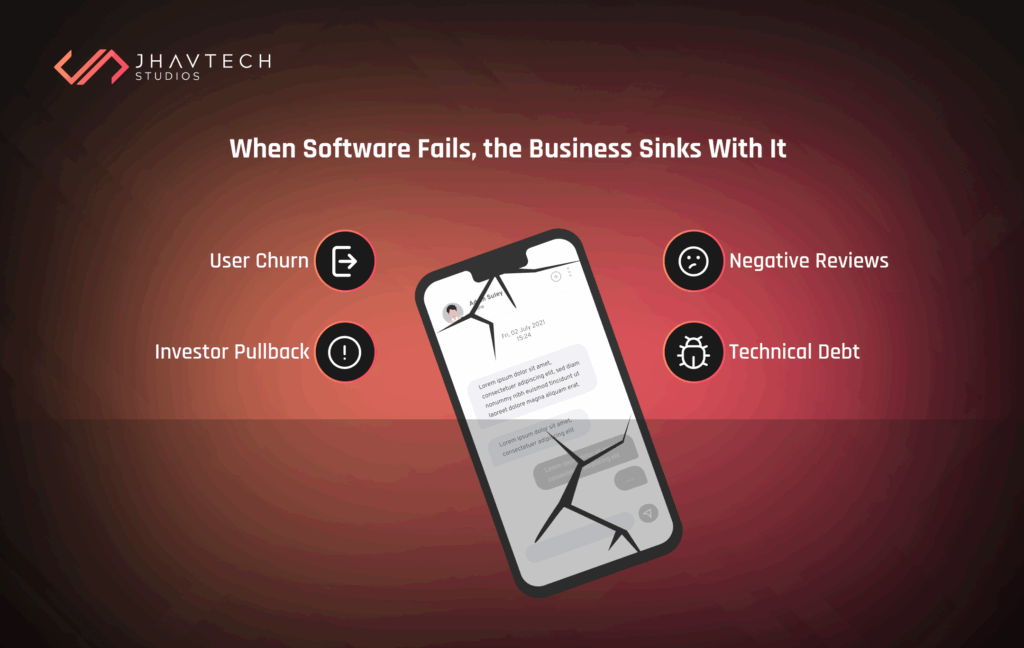
Startup app failure often stems from broken trust with early adopters and stakeholders, escalating budgets from endless rework, missed product-market fit milestones, and ultimately, negative reviews and uninstalls that kill growth. These issues have a compounding effect, especially for startups relying on user adoption to attract additional funding or partnerships.
Need a second opinion on your current platform? Try our software rescue services to identify, repair, or rebuild failing apps.
The Real Cost of Startup App Failure
Many founders underestimate the impact of software issues until it’s too late. A poorly designed, buggy, or unstable app can destroy user trust and team morale. Beyond that, it can prompt investors to reconsider their backing.
The table below highlights the typical consequences of software failure in early-stage startups:
Consequence Impact on Startup User Churn Users abandon the app after initial use Investor Pullback Funding stalls due to product underperformance Negative App Store Reviews Damages brand credibility and discoverability Technical Debt Escalating dev costs and slow development cycle
These setbacks are not just financial—they’re strategic. When an app fails, the startup often loses its window of opportunity, its first-mover advantage, or its competitive edge.
Top Questions Users Ask
Why do most tech startups fail?
Most tech startups fail due to a combination of factors—bad software execution, lack of product-market fit, and poor user experience are among the most common. Even with a great idea, if the app crashes, loads slowly, or confuses users, retention drops and growth stalls. According to CB Insights, 20% of failed startups blame tech issues, while 35% fail due to no market need. A flawed app magnifies both problems.
How can I tell if my startup has software problems?
Several red flags signal deeper tech issues. These include frequent bug reports, crashes across devices, delayed feature releases, and consistent negative feedback in app stores or user surveys. If you're constantly firefighting issues instead of shipping new features, it's likely a software quality problem. Poor scalability and mounting technical debt are also signs that your app needs a closer look.
Should I rebuild or fix my app?
That depends on the quality of your existing codebase and your long-term goals. If the architecture is fundamentally flawed or can’t support future growth, a rebuild might be more cost-effective. However, if the issues are isolated or the core system is solid, strategic fixes can get you back on track faster.
Top Software Mistakes That Lead to Failure
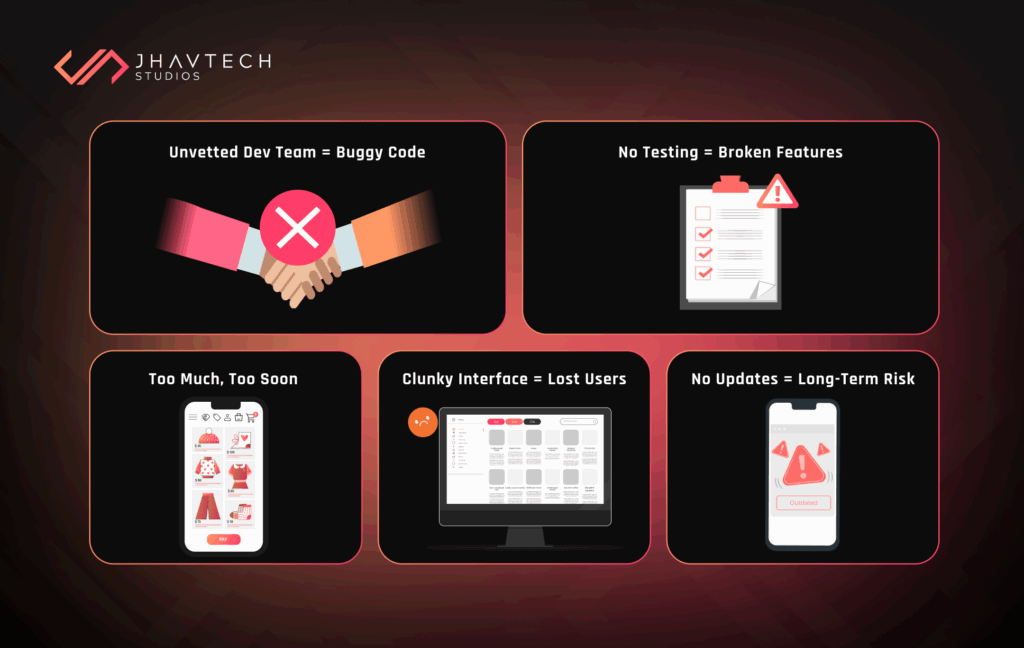
1. Hiring the Wrong Development Team
Startups often choose the cheapest or fastest option without properly evaluating the team. Unfortunately, what looks like a cost-saving move can result in bloated, buggy code that requires expensive fixes later. For instance, a 2022 Clutch survey revealed that 43% of startups that outsourced development overseas needed to rebuild their product within 12 months.
Choosing the right development partner means looking beyond cost. It means selecting a team that understands startup culture, has experience delivering MVPs, and offers strategic guidance—not just code.
Fix: Vet developers thoroughly. Ask for code samples. Work with a specialised, local team like Jhavtech Studios that understands startup needs across Melbourne, Sydney, and Brisbane.
2. Skipping QA and Testing
In the rush to launch, quality assurance (QA) is often sacrificed. But broken features don’t just inconvenience users—they drive them away. QA issues are the second most common reason for poor app reviews, especially on Android.
According to TechCrunch, apps that include automated testing and regression tests from early development stages experience 40% fewer post-launch bug reports.
Fix: Incorporate automated testing, regression testing, and user acceptance testing into every sprint cycle. A well-tested product builds user trust from day one.
3. Over-Engineering the MVP
Trying to build every feature from Day 1 stretches your budget and delays your launch. It also increases complexity and potential bugs. A Harvard Business Review article from 2023 emphasised that startups who focus on a minimum viable product (MVP) that delivers core value are 50% more likely to reach product-market fit within 12 months.
Fix: Focus on the core value proposition. Build a lean MVP that solves one key problem. Collect real user feedback before investing in additional features. Remember, simplicity often leads to clarity—especially in early-stage apps.
4. Poor UX/UI Design
Even with solid code, a clunky or outdated interface will turn users away. A 2022 Adobe study found that 38% of users will stop engaging with a website or app if the layout is unattractive.
Design isn’t just aesthetics—it’s functionality. A well-designed interface reduces cognitive load, speeds up onboarding, and enhances retention.
Fix: Invest in UX/UI early. A fresh, intuitive interface builds trust and drives conversions. Jhavtech specialises in mobile UX/UI designs tailored to startups looking to scale.
5. No Maintenance or Version Control
Without structured versioning and updates, your app becomes harder to manage over time. Legacy code, missing documentation, and inconsistent releases can turn even small updates into high-risk moves.
Neglecting maintenance often results in security vulnerabilities, compatibility issues, and user dissatisfaction—especially as operating systems evolve.
Fix: Use agile methodologies, Git for version control, and allocate a monthly budget for maintenance and performance monitoring. Make ongoing iteration a core part of your roadmap.
What Are Software Rescue Services (And When to Use Them)?
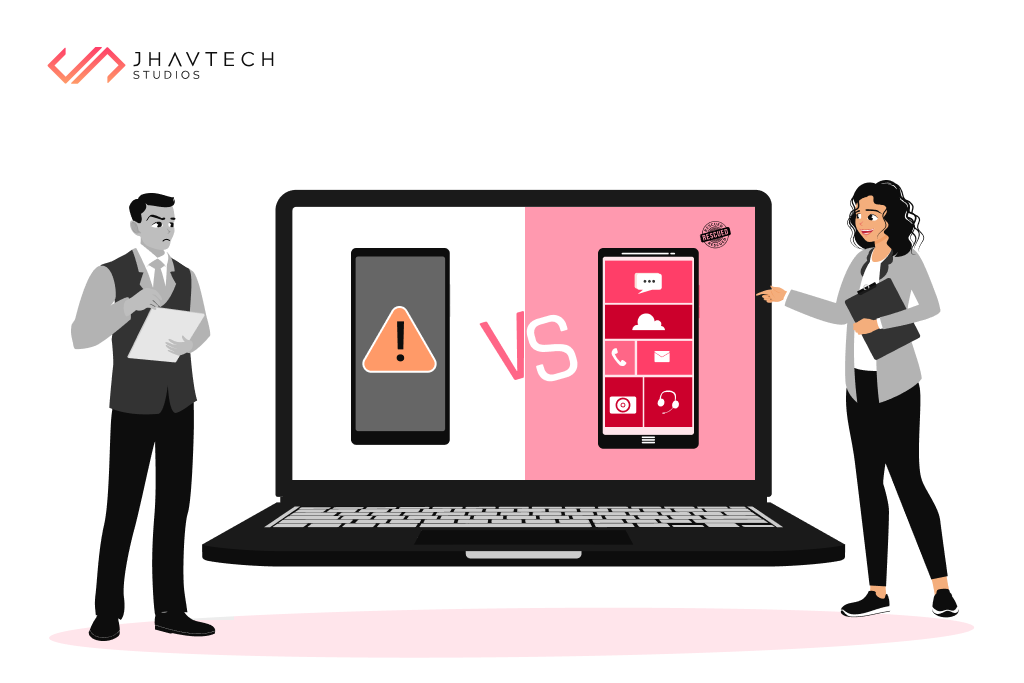
Software rescue services are specialised interventions for apps that are failing, underperforming, or simply not scalable. They go beyond patching bugs and involve a full audit and recovery plan.
A typical rescue service will:
- Audit your codebase and software architecture
- Identify performance bottlenecks and usability flaws
- Refactor or rebuild problematic components
- Relaunch with a stable, updated platform that meets user expectations
These services are essential when technical debt overwhelms development, when existing vendors can’t deliver, or when timelines become unsustainable.
You should consider a software rescue project if:
- Your users constantly report bugs
- Your app crashes on new operating systems or devices
- Your current dev team struggles to deliver
- You're burning time and cash with no traction
- Your roadmap is on hold due to technical limitations
Startup Horror Story: What NOT to Do
One Melbourne-based startup spent $60,000 building a fitness app overseas. At launch:
- It failed to sync with Apple Health
- Crashed on Android 11
- Had onboarding bugs that blocked user registration
Within three months:
- Investors pulled back
- The app was removed from both app stores
- The brand reputation tanked
Jhavtech was brought in under a software rescue contract. We audited the backend, rebuilt it using Flutter, cleaned up the frontend UI, and relaunched. Within eight weeks, the app had a 4.6-star rating and regained traction.
This transformation wasn’t just technical—it was strategic. The revised version of the app aligned with user expectations, supported current devices, and enabled faster iteration for future features.
How to Future-Proof Your Startup’s App
Avoid startup app failure by embedding quality, strategy, and flexibility into your product development lifecycle. Here's a summary of what you should do:
Best PracticeBenefit Discovery Workshop Aligns vision, scope, and tech risks early Trusted Development Team Faster delivery and reliable output UX/UI Investment Better user engagement and trust Agile Testing and Iteration Catches bugs early and improves time to market Real-Time Feedback Monitoring Guides roadmap based on user behavior Software Rescue Plan Prepares for pivots or critical interventions
Thinking of launching a mobile app in Melbourne, Sydney, or Brisbane? See how we support startups in your area:
Final Thoughts: Don’t Let Bad Software Sink Your Startup
If you’re a startup, your software is your business. Treating it as an afterthought is a costly mistake. Invest in the right tech partners, prioritise user experience, and keep a software rescue strategy in your back pocket.
Failure isn’t final. It’s a chance to pivot with the right support.
Let’s talk. Contact us or schedule a free project assessment today.

.webp)
.png)
.png)

.png)
.png)
.png)
.png)
.png)
.png)
.png)
.png)
.png)
.png)
.png)


.png)

.png)
.png)
.png)
.png)
.png)
.png)
.png)

.png)
.png)
.png)
.png)
.png)
.png)
.png)
.png)
.png)
.png)

.png)
.png)
.png)

.png)
.png)
.png)
.png)

.png)
.png)
.png)


.png)
.png)
.png)
.png)

.png)


.png)

.png)




.png)



.png)





.png)

.png)




.png)

.png)

.png)
.png)