.svg)
.svg)


The digital romance industry is a paradox: while the global revenue for matchmaking services continues to climb, the graveyard of defunct startups grows even faster. In the realm of dating app development, the barrier to entry is deceptively low, but the barrier to retention is an Everest-sized hurdle. Nearly 90% of new dating platforms fail within their first twelve months, often due to a fundamental misunderstanding of “The Network Effect” and a failure to address the evolving psychology of the 2026 dater.
At Jhavtech Studios, we’ve moved beyond the era of simple “swipe-and-match” interfaces. To survive today, a platform must solve the modern crises of “User Burnout” and “Ghosting” through sophisticated engineering and strategic market entry.
⚡ Key Takeaway: The 12-Month Survival Guide
Most dating apps fail due to “The Ghost Town Effect” (low liquidity) and high Technical Debt. To succeed, focus on a hyper-niche market, implement AI-driven verification to build trust, and ensure your dating app development roadmap prioritises user retention over simple vanity metrics like total downloads.
The Three Strategic Killers of Dating App Development
Through our extensive work in mobile app development in Melbourne, our engineering team has identified three recurring “silent killers” that drain venture capital and kill momentum before the first anniversary.
1. The Liquidity Trap (The “Ghost Town” Effect)
A dating app is, at its core, a two-sided marketplace. If a user in Melbourne opens an app and only sees three profiles within a 50km radius, they delete the app instantly and rarely return. This lack of “liquidity” is the primary reason for early-stage failure.
💡 The Jhavtech Insight: We recommend the “Hyper-Local Saturation” strategy. Do not launch nationally. Saturate a specific 10-block radius, a niche hobbyist group, or a single university campus first. Achieving 100% liquidity in a small pond is better than 0.1% liquidity in an ocean.
2. High Customer Acquisition Cost (CAC) vs. Low LTV
According to 2026 market benchmarks, the average cost to acquire a paying dating app user has risen significantly as social media ad spaces become more crowded. Many founders acquire users for $10+ each, only for them to churn in 48 hours.
🛠️ The Technical Fix: Shift from “Match-Making” to “Meaningful Interaction.” Use Agentic Workflows — AI assistants that suggest specific icebreakers based on shared interests—to increase the “Time to First Message.” This metric is the strongest predictor of long-term user retention.
3. The Trust Deficit: Security and Catfishing
In 2026, user safety is no longer a luxury. With Grindr recently facing a €5.7 million fine for data-privacy breaches, the cost of a security lapse is now existential.
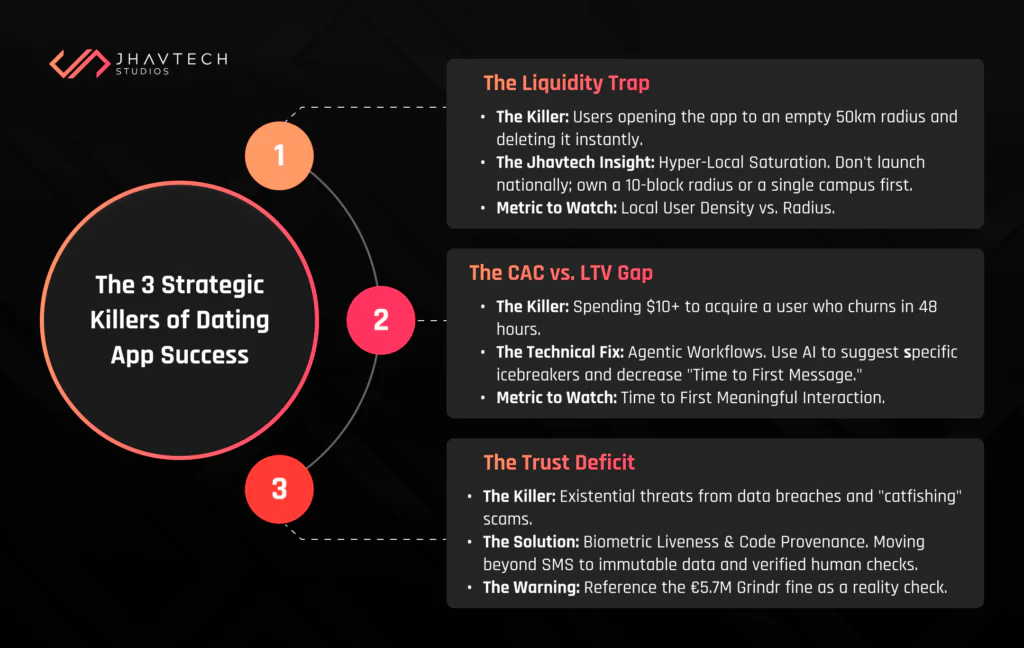
⚠️ The Solution: Move beyond simple SMS verification. Implement Biometric Liveness Checks and Code Provenance protocols to ensure that user data is immutable and every profile is a verified human.
Moving Beyond the Swipe: Solving “The Paradox of Choice”
The “Tinder-fatigue” of previous years has evolved into a full-scale rejection of infinite swiping. Successful dating app development now moves away from quantity and toward curated, high-quality interactions.
Semantic Matching and NLP
Instead of basic filters like age and height, our team utilises Natural Language Processing (NLP) to analyse user bios and prompt responses. This creates “Semantic Entities” of compatibility. If User A mentions a love for “indie cinematography” and User B mentions “A24 films,” the algorithm understands the connection even without matching keywords. This requires a robust custom software development approach that goes beyond off-the-shelf templates.
Anti-Ghosting Algorithms
Ghosting is the number one reason users abandon platforms. We’ve developed proprietary logic that de-prioritises “serial swipers” (users who match but never message) and rewards active engagers. By subtly throttling the visibility of low-effort users, you maintain a healthy, responsive ecosystem.
Architectural Integrity: Avoiding Technical Debt
One of the most expensive mistakes a founder can make is rushing a “buggy” MVP (Minimum Viable Product) to market using offshore templates. In a world of polished, high-performance apps, “Minimum” does not mean “Broken.”
Technical Debt is the hidden interest you pay when you choose a quick, dirty fix over a scalable solution. To avoid this, your dating app development should focus on three pillars:
- Scalable Cloud Infrastructure: Your backend must be capable of handling 10,000 concurrent “Real-Time Messaging” (RTM) events without a millisecond of lag.
- Privacy by Design: Implementing end-to-end encryption for private chats is mandatory from day one to comply with GDPR and international privacy standards.
- Modular Feature Sets: Build your app like Lego bricks. This allows you to iterate on your matching algorithm or add video-chat features without needing to rewrite the entire codebase.
The 2026 Pivot: Why AI Agents Are the Future of Dating
The most successful apps in 2026 are not just directories; they are facilitators. We are seeing a massive shift toward Agentic Workflows within apps. Imagine an AI wingman that doesn’t just show you a profile, but says: “Hey, you both recently visited the same hiking trail in the Dandenongs. Would you like me to suggest a great coffee spot nearby for a quick meet-up?”
This level of utility transforms the app from a “distraction” into a “valuable tool.” It solves the awkwardness of the first message and drives real-world conversion—which, ironically, is what makes a user recommend your app to their friends. To execute this, you need a partner specialising in AI and Machine Learning to ensure the suggestions feel organic, not intrusive.
Monetisation Strategies That Don’t Kill Growth
Most apps fail because their paywalls are too aggressive, too early. In dating app development, you must balance “Free Value” with “Premium Utility.”
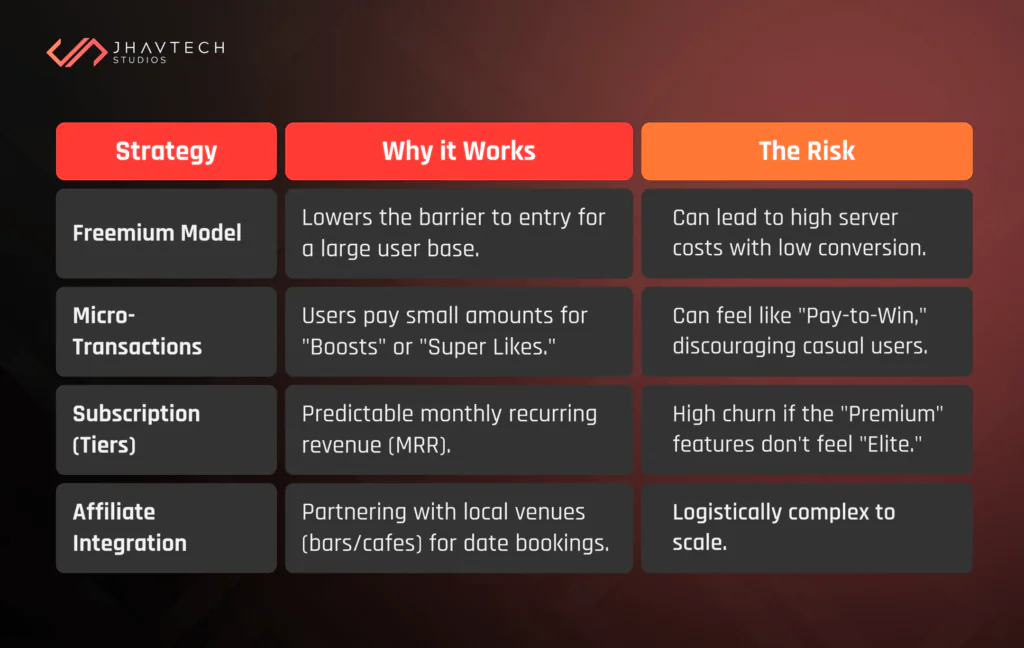
At Jhavtech, we recommend a hybrid approach: focus on user growth for the first 6 months, then introduce “Value-Add” micro-transactions that enhance the user experience rather than gating it. This requires expert UI/UX design services to ensure the monetization feels like a feature, not a barrier.
Final Thoughts… Is Your Vision Ready for the Market?
The difference between a failed startup and the next big platform is a partner who understands both the code and the culture. Don’t let your project become a statistic by falling into the same traps as those before you. Success in dating app development requires a blend of psychological insight, rigorous security, and scalable architecture.
Whether you are looking to disrupt the industry with a niche concept or integrate the latest AI matching tech, our team at Jhavtech Studios is ready to turn your vision into a sustainable, scalable reality. We don’t just build apps; we build ecosystems where connections happen.
Stop fighting “The Liquidity Trap” and start building a high-performance ecosystem. From Biometric Liveness Checks to Anti-Ghosting Algorithms, we build the tech that keeps users engaged.