.svg)
.svg)


The Fastest Way to Validate a SaaS Idea Without Wasting Money
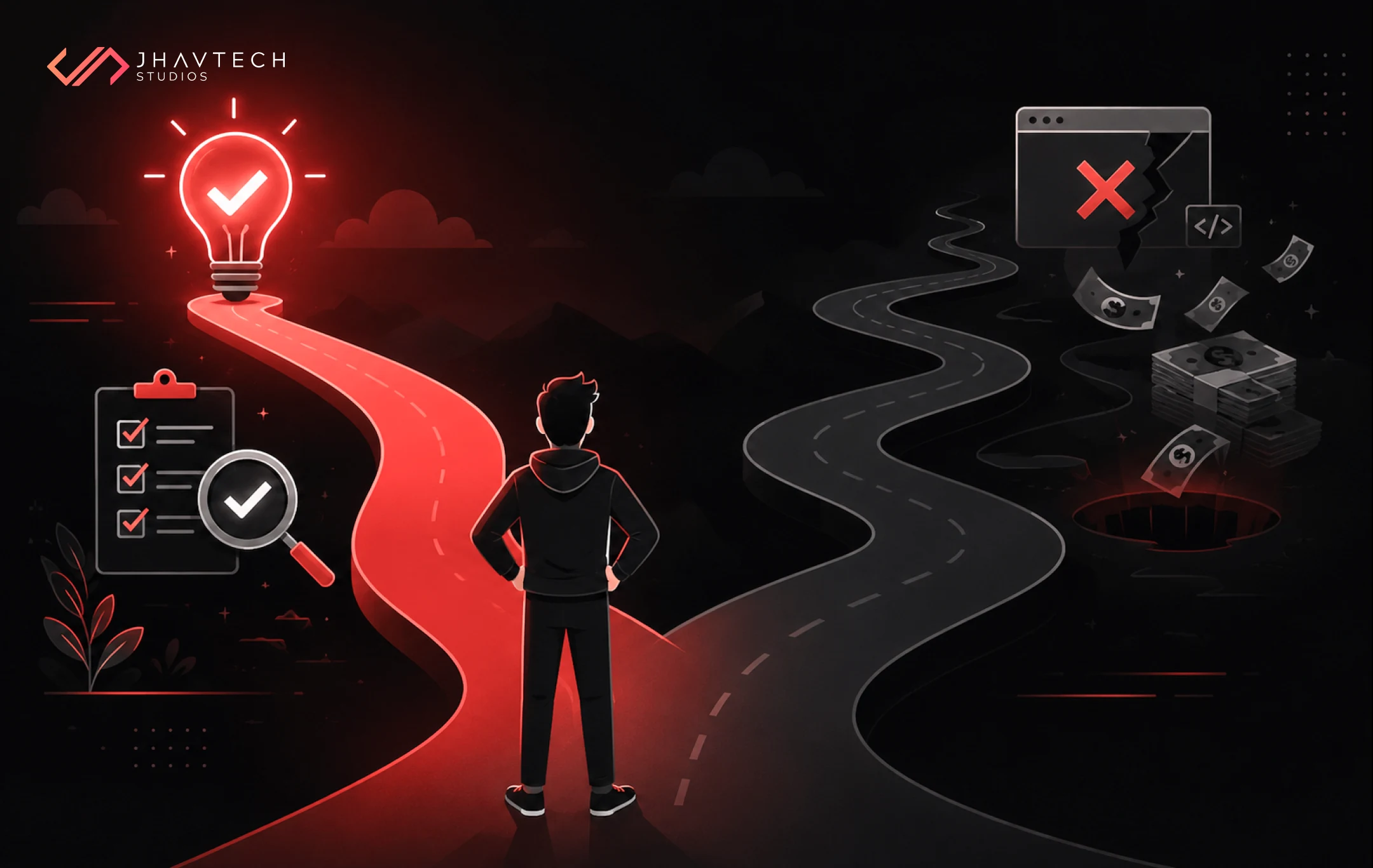
Most SaaS ideas do not fail because the tech was bad. They fail because nobody checked, early enough, whether people actually wanted the thing. This blog walks you through a fast, low-cost SaaS idea validation process: problem interviews, smoke tests, concierge MVPs, and paid pilots, in that order, so you spend money building only after real customers have told you to. You will also get a comparison table of validation methods, a founder checklist, and a look at what to do once your idea is validated and it is time to build.
Here is the uncomfortable truth nobody puts on a pitch deck: building a product is the easy part now. AI tools, no-code platforms, and offshore dev teams have made it cheaper than ever to ship something. Which is exactly why validation has become the real bottleneck. If you can build anything in weeks, the only question that matters is whether you are building the right thing.
This is not a theoretical problem. According to CB Insights' analysis of hundreds of venture-backed startup post-mortems, poor product-market fit is cited as a factor in roughly 43% of startup failures, ahead of running out of cash, being outcompeted, or losing key team members. Running out of money is usually the final symptom, not the root cause. The root cause, in most cases, is that founders built something before they confirmed anyone needed it.
And yet, formal validation is still the exception rather than the rule. Harvard Business School research led by senior lecturer Shikhar Ghosh, based on a study of over 2,000 venture-backed companies, found that roughly 75% never return cash to their investors. These were not underfunded companies. They had passed investor scrutiny and had capital in the bank. Capital was never the constraint. The missing step, in case after case, was structured validation before the build.
This blog breaks down how to validate a SaaS idea properly, using methods that take days or weeks instead of months, and cost hundreds of dollars instead of tens of thousands. It is the same SaaS validation and lean MVP development approach the team at Jhavtech Studios walks Australian founders through before any code gets written.
Why Most SaaS Ideas Fail Before They Even Launch
The SaaS market itself is not the problem. Global SaaS spending is projected to climb past $465 billion in 2026, and B2B SaaS companies alone raised well over $75 billion in funding in 2025. Capital is available. Demand for software is growing. The issue is that access to funding gets confused with proof of demand.
Founders today can raise a seed round on a pitch deck and a clickable prototype faster than ever before. The time from "idea" to "funded" has compressed significantly over the past decade. That speed is a gift and a trap. It means a founder can move from concept to a fully built product without ever being forced to answer the one question that actually predicts survival: will someone pay for this?
The pattern almost always looks the same:
- A founder notices a problem or assumes one exists.
- They build an MVP based on that assumption, often with AI-assisted tools that make building deceptively fast.
- They launch to underwhelming signups or silence.
- They spend the next six months trying to fix a product that was never wanted in the first place.
Every step in that sequence feels like progress. The failure was baked in at step one.

Why Many Australian Startups Stall Before Gaining Traction
This pattern is not unique to Silicon Valley. Australia's startup ecosystem has its own version of the same story: a founder in Melbourne, Sydney, or Brisbane raises a modest pre-seed round, builds for six to nine months, and launches to a market that was never properly tested. We unpacked this in more detail in our look at why Australian startups fail before their product gains traction, and the root cause tracks almost exactly with the global CB Insights data. Local factors make it worse in specific ways: a smaller domestic market means less room for trial and error, and Australian dollar runway does not stretch as far against the offshore developer rates many early-stage founders are quoted. For SaaS founders building for the Australian market, or an Australian company building for a global one, SaaS idea validation is not optional polish. It is the difference between a 12-month runway that lasts and one that does not.
What Does SaaS Idea Validation Actually Mean?
SaaS idea validation is not asking your friends and family what they think of your idea. It is not a survey with leading questions. It is a structured startup validation strategy that produces evidence: real conversations, real commitments, and ideally, real money, before a single line of production code gets written.
Good validation answers three questions in order:
- Is this problem painful enough that people are actively trying to solve it already?
- Does my proposed solution match how they would want it solved?
- Will they pay a specific price for it, right now, not "eventually"?
If you cannot answer yes to all three with evidence (not opinions) you are not ready to build. You are ready to validate more.
What Is the Fastest Path to SaaS Idea Validation?
Here is a lean SaaS development sequence that founders and product teams use to validate ideas in weeks, not quarters, without burning the whole budget on a build that might not land. It is the same sequence Jhavtech Studios uses with early-stage clients before scoping any SaaS validation and MVP development engagement.
How do you run structured problem interviews for SaaS validation?
Before you talk about your solution at all, talk to 15 to 20 people in your target market about the problem itself. Ask how they currently handle it, what it costs them in time or money, and what they have already tried. If nobody describes real pain, or if everyone shrugs, that is your answer, and it is far cheaper to hear it now than after development.
What is a smoke test landing page and how do you build one?
A single landing page describing your SaaS product, with a clear call to action (join the waitlist, request early access, or even reserve your spot for $1), tells you far more than a survey ever will. Run a small amount of paid traffic to it. Conversion rate on that page is a real behavioural signal, not an opinion.
How do you run a concierge MVP before writing any code?
Before automating anything, deliver the outcome manually to a handful of early users. Spreadsheets, email, and manual work behind the scenes are fine at this stage. You are testing whether the outcome is valuable, not whether your software architecture is elegant.
How do you secure a paid pilot before building your SaaS product?
This is the step most founders skip, and it is the one that matters most. Ask 5 to 10 target customers to pay something, even a modest deposit, for early access. People who will not pull out a card rarely convert once the product is live either. A paid pilot is the strongest customer validation method available before you write real product code.
Which SaaS Validation Method Gives You the Strongest Signal?
Not every validation method deserves equal trust. Some only tell you what people are willing to say. Others tell you what people are willing to do, or pay for, which is a far more reliable predictor of whether your SaaS idea will actually work. The table below lines up the most common methods by cost, time, and how strong a signal each one really gives you.
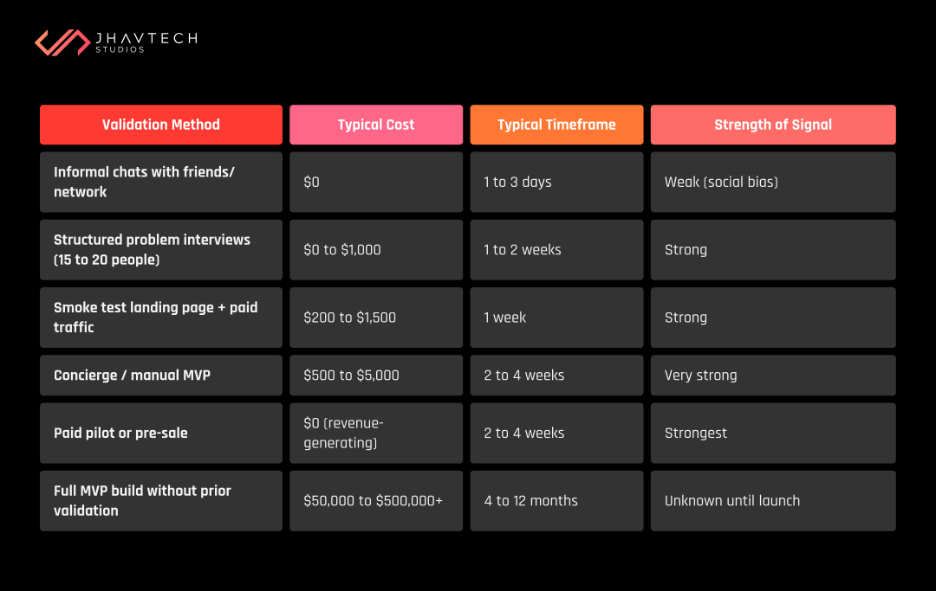
The pattern in that table is the entire point of this blog. Every validation method above the full build costs a fraction of the price and delivers a clearer signal, faster.
How Does Lean SaaS Development Keep You from Overbuilding?
Once your problem interviews, smoke test, and pilot all point the same direction, resist the urge to build everything you have imagined. Lean SaaS development means shipping the smallest version that delivers the core value you validated, and nothing else. Every extra feature is a guess you have not tested yet. This is the lean software development philosophy Jhavtech Studios applies to every MVP development engagement, Australian startup or otherwise: validate first, scope second, build third.
This is also where a clickable prototype earns its keep. A prototype lets you simulate the full MVP experience with users before a developer writes a single line of backend code, which is exactly why every startup needs a prototype before coding. It turns an idea into a tangible asset you can test, refine, and pitch with confidence.
When you are ready to move from validated concept to a real, working product, the build itself deserves the same discipline you applied to validation. That is where having a team that specialises in shaping raw ideas into scalable, user-ready products, rather than a generic build shop, makes the difference between a fast, focused MVP and a bloated one. If that is the stage you are at, it is worth exploring how the Jhavtech Studios team can turn your validated concept into a live product without the usual scope creep.
What Does an MVP Launch Strategy Look Like After Validation?
A validated idea still needs a disciplined build process, or you risk undoing all the good validation work. A tight MVP launch strategy typically follows a 90-day arc: weeks 1 to 3 for scoping and design based on validation findings, weeks 4 to 9 for building the core validated feature set only, and the final weeks for a controlled launch to your pilot users before opening more broadly. This is the same MVP development framework Jhavtech Studios runs with founders across Australia. We break it down in detail in our piece on the 90-day MVP strategy smart startups are using to validate faster.
Before you kick off a build, run through this checklist:
SaaS Idea Validation Checklist
If you cannot check most of these boxes, you are not behind schedule by building more slowly. You are ahead of schedule by not building the wrong thing.
It is also worth knowing what typically derails this process. We documented the patterns most often behind blown MVP budgets in our guide to common MVP mistakes that burn startup budgets, and separately looked at why so many local ventures stall before they gain any real traction in our analysis of why Australian startups fail before their product gains traction. Both are worth a read before you finalise scope.
What If Validation Reveals a Problem with Your Existing Build?
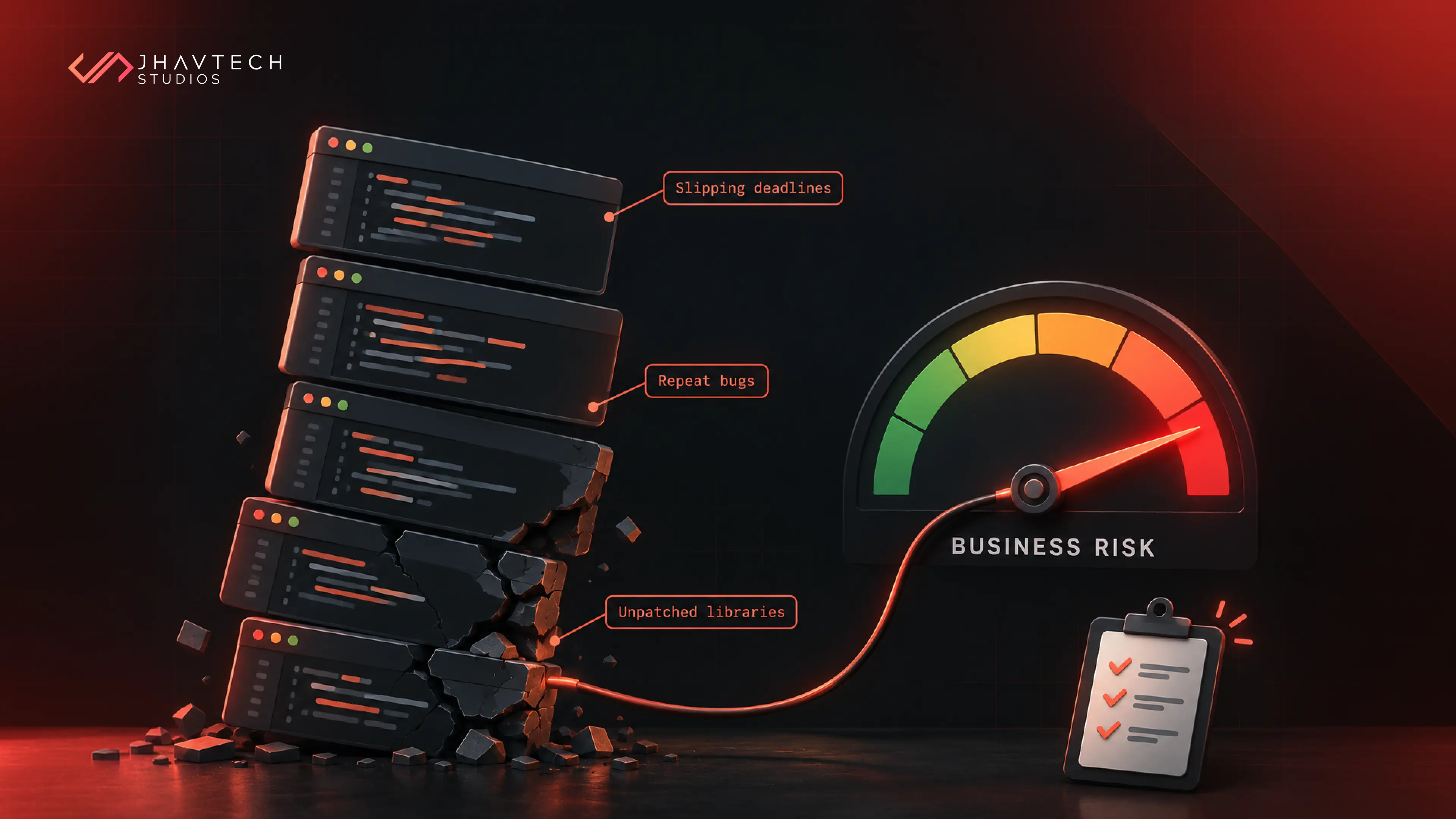
Sometimes validation does not point you toward a green-field build. It points you toward fixing something that already exists. If your team already has a partially built product that is not performing, or an old prototype that needs a serious second opinion before more money goes into it, that is a different conversation. Bringing in a team that can audit, stabilise, and rebuild a stalled or struggling project can save months of wasted effort compared to starting over. And if you simply want an independent, no-obligation look at the codebase you already have before you commit further budget, a free code review is often the fastest way to know exactly where you stand.
Frequently Asked Questions

.webp)

.png)
.png)
.png)

.png)
.png)
.png)

.png)
.png)
.png)
.png)
.png)
.png)
.png)
.png)
.png)
.png)
.png)
.png)

.png)
.png)
.png)
.png)
.png)
.png)
.png)
.png)
.png)

.png)
.png)
.png)
.png)
.png)
.png)
.png)
.png)
.png)
.png)
.png)
.png)
.png)
.png)
.png)
.png)
.png)
.png)
.png)
.png)


.png)
.png)
.png)

.png)

.png)


.png)


.png)



.png)



.png)



.png)

.png)

.png)