.svg)
.svg)


MVP vs Full Product: What Should Startups Build First?
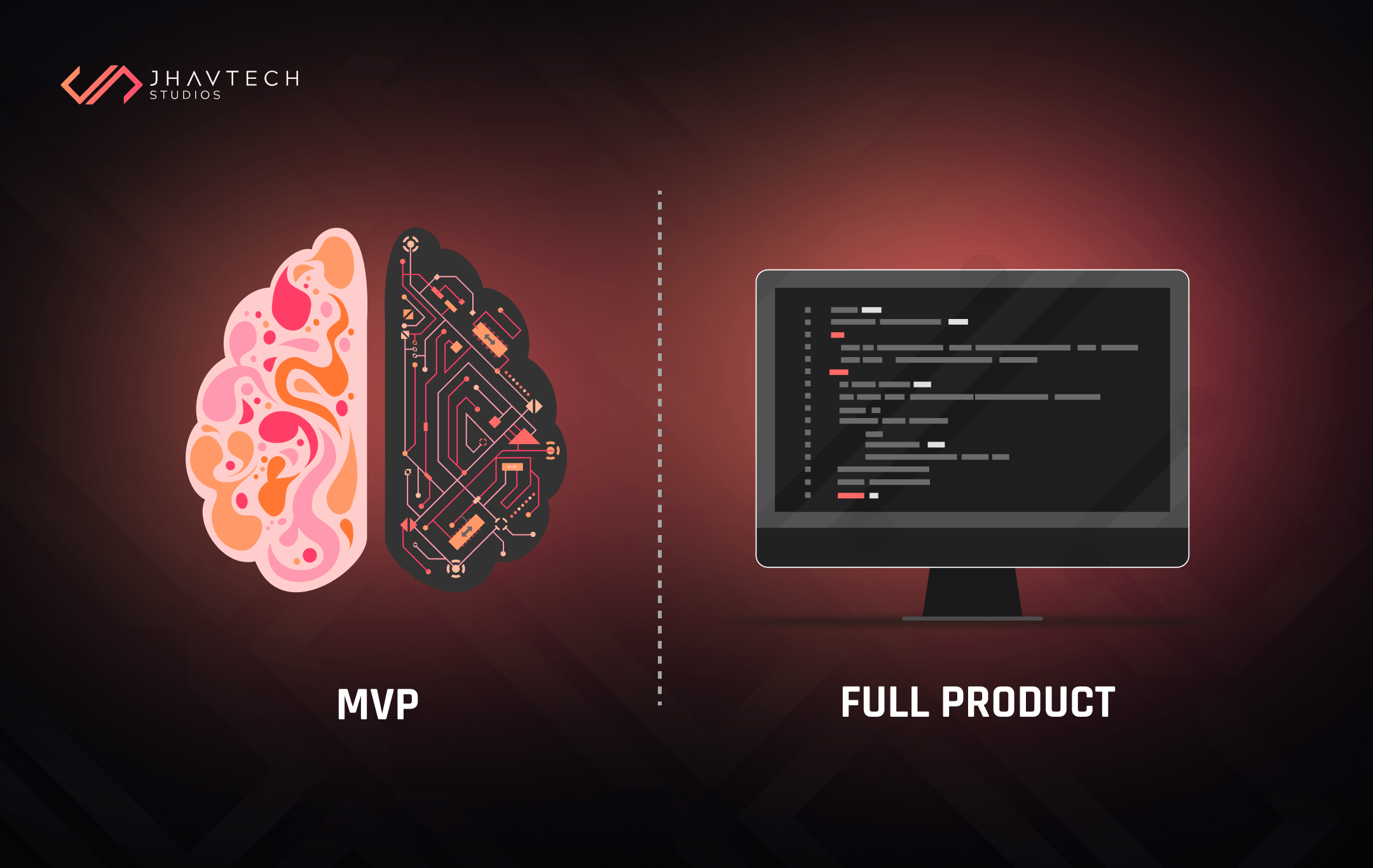
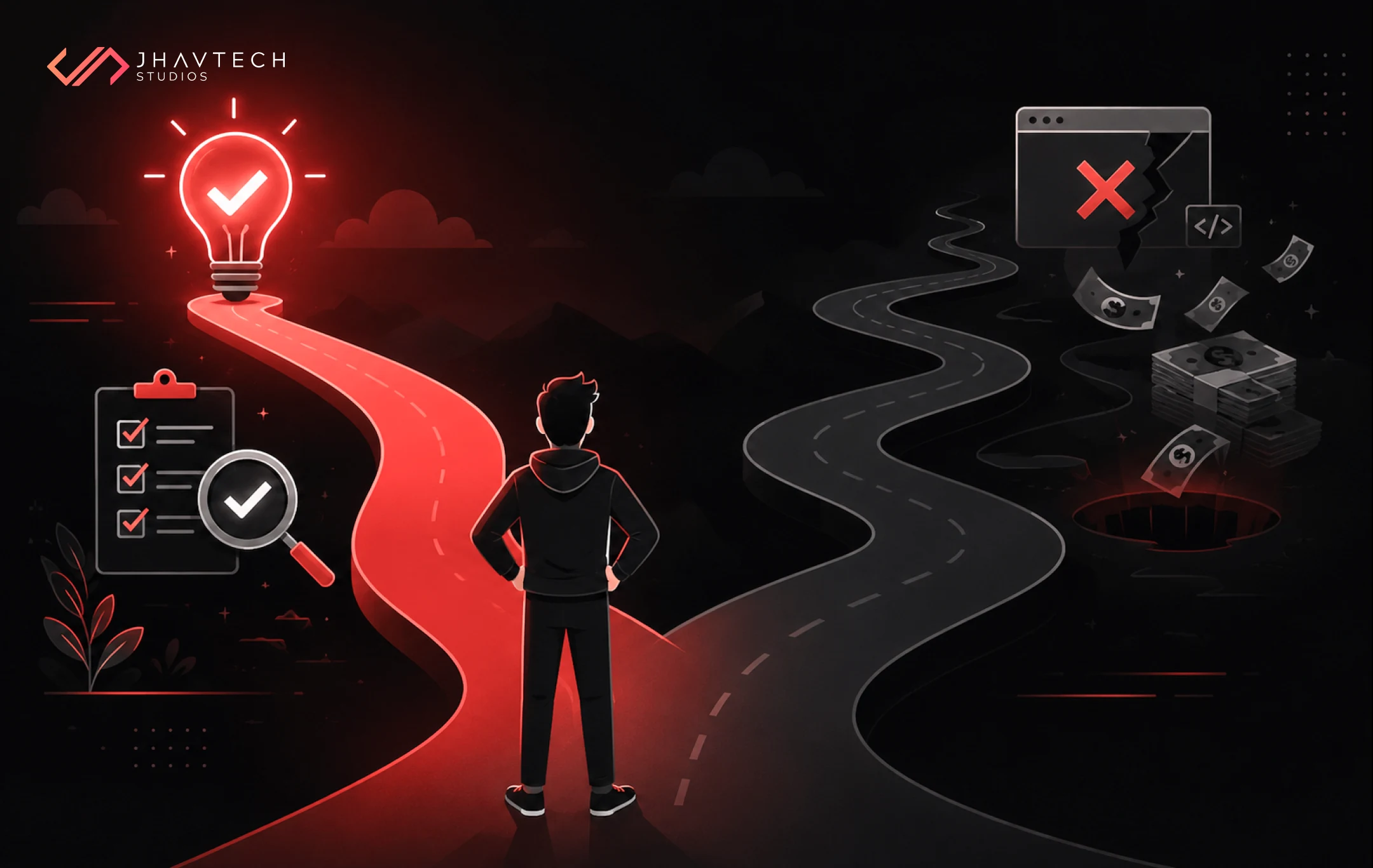
In the fast-paced realm of digital innovation, the distance between a great idea and a failed startup is often measured by a single decision: scope. For founders, the urge to launch a feature-rich, polished masterpiece is magnetic. However, in an era where 90% of startups fail, often due to a lack of market need, the "build it and they will come" philosophy is a dangerous gamble.
The debate of MVP vs Full Product Development isn't just about budget; it’s about strategic timing. At Jhavtech Studios, we’ve seen that the most successful ventures aren't those with the most features, but those that solve the right problem at the right time.
Defining the Contenders: MVP vs Full Product Development
To make an informed choice, we must first define what these paths actually look like in 2026. The tech landscape has shifted; with the rise of AI-driven development and instant user expectations, the barrier to entry is higher than ever. It is no longer enough to just build something; you must choose between a strategy of rapid market entry or one of comprehensive market dominance.
Understanding these two frameworks requires looking past the code. It’s a choice between validation (MVP) and sovereignty (Full Product). One is designed to answer the question, "Should this exist?" while the other answers, "How do we lead the industry?"
What is a Minimum Viable Product (MVP)?
An MVP is the leanest version of your product that allows you to collect the maximum amount of validated learning about customers with the least effort. It isn't a half-baked product; it is a focused one. It solves one core problem for one specific audience.
What is a Full-Scale Product?
Full Product Development involves building a comprehensive solution with a complete feature set, advanced UI/UX transitions, integrations, and high-level scalability from day one.
💡 Key Insight: The primary difference between an MVP and a full product is the goal. An MVP is built for validation and learning, while a full product is built for scaling and market dominance.
The Case for the MVP: Why Lean is Often Leading
For most startups, the MVP is the superior entry point. According to the 2025 Startup Genome Report, startups that scale prematurely (by building too many features too early) grow 20 times slower than those that focus on core validation.
1. Reduced Financial Risk
By focusing on the blueprint for launching a market-ready app on a budget, you minimise "sunk costs" if the market requires a pivot later. Instead of exhausting your entire seed round on a guess, this lean approach preserves your runway, allowing you to reallocate capital toward features that users have actually proven they want.
2. Faster Time-to-Market (TTM)
Speed is a competitive advantage. You can leapfrog the competition with a 90-day custom build, gathering real-world data while others are still drawing wireframes. In a landscape where market trends shift overnight, being the first to capture user attention gives you a first-mover data advantage that slow-moving incumbents simply cannot match.
3. Avoiding the Feature Fallacy
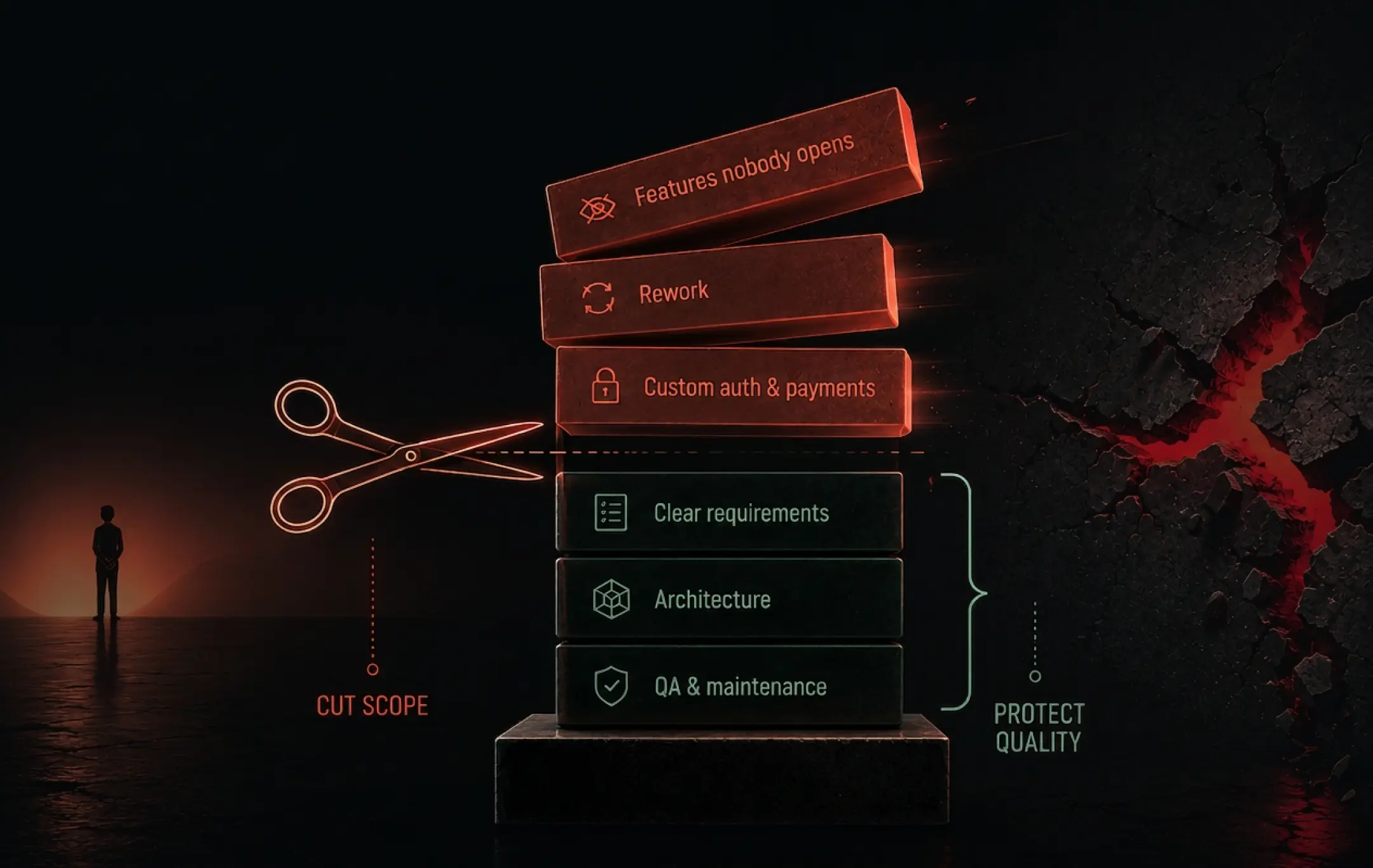
Data from Pendo's industry research suggests that up to 80% of features in a typical software product are rarely or never used, resulting in billions of dollars in wasted R&D every year.
When Should You Build a Full Product First?
While the MVP is the gold standard for most startups, there are scenarios where [committing to an enterprise-grade software rollout] is the safer, more strategic move:
- Regulated Industries: FinTech, Healthcare, or MedTech platforms often require rigorous security protocols and full legal compliance before the very first user can log in.
- High Market Certainty: If you are entering a mature market with established table stakes (features users expect as standard), launching without them could damage your brand's credibility.
- Brand Reputation: Established enterprises launching a new sub-brand often cannot afford the work-in-progress feel of a traditional MVP.
The Strategic Comparison: MVP vs Full Product
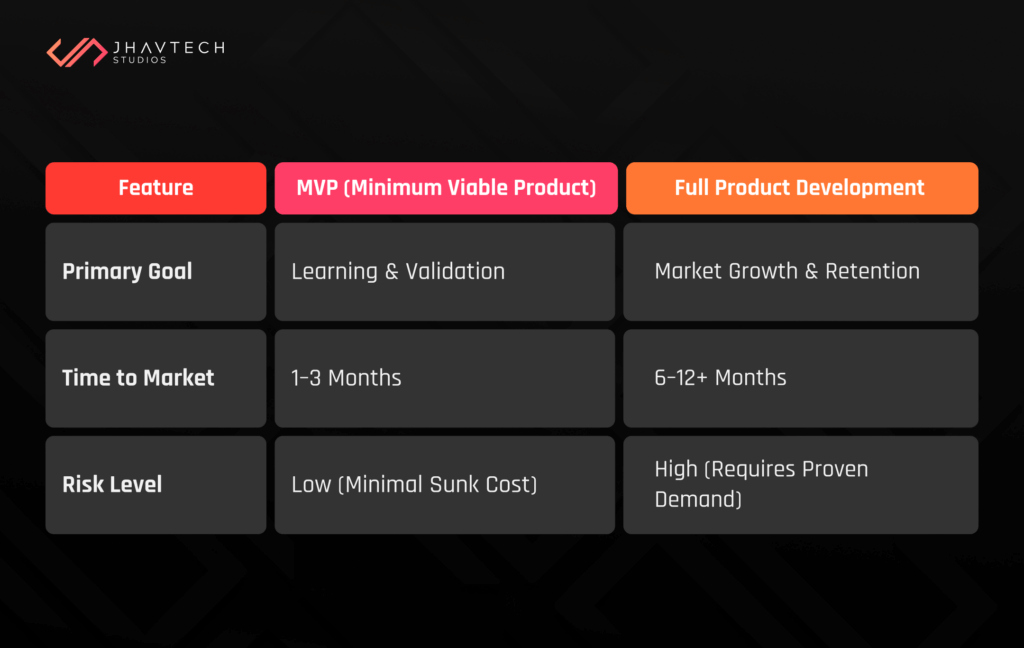
Deciding between these two paths requires a cold, hard look at your resources and your risk tolerance. The choice isn't just about what you want to build, but how much market friction you are willing to endure. While an MVP prioritises agility and feedback loops, a full-scale build prioritises market dominance and robust user retention from day one.
The following matrix breaks down the key performance indicators (KPIs) you need to consider before signing off on your development roadmap:
The Danger of "The Middle Ground" (And How to Recover)
Many startups spend six months building a Maximum Viable Product, only to realise the architecture is flawed. This leads to software rot.
If you find yourself with a bloated project, you may need a surgical recovery plan for a failing software project to strip back the noise. We often help founders stop the bleeding on a stalled tech build by refocusing on a lean, functional core.
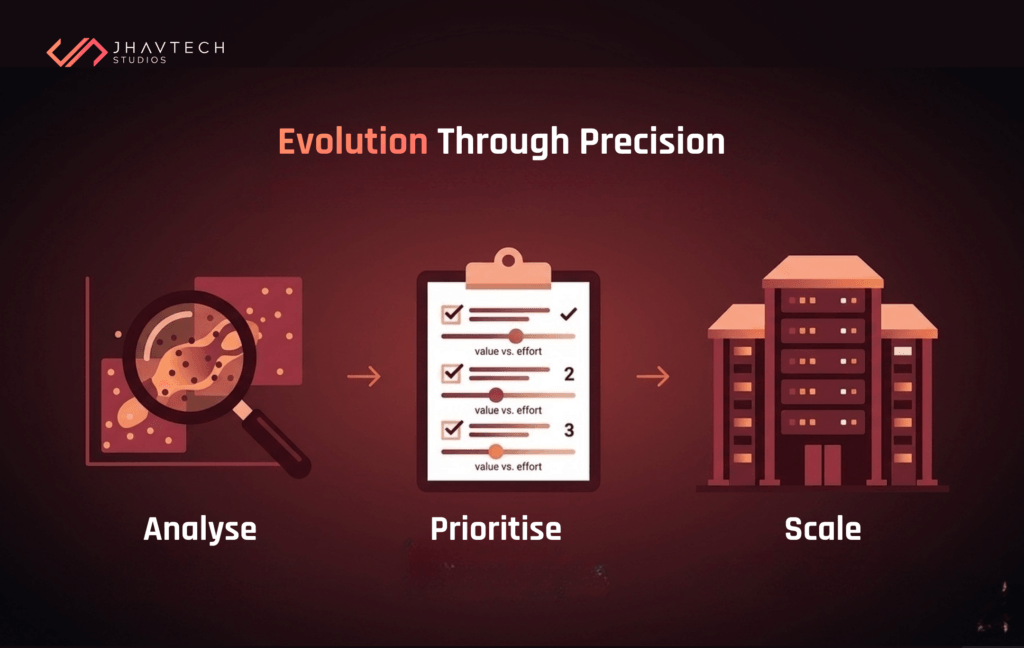
How to Transition from MVP to Full Product
Once your core hypothesis is validated, the transition isn't a single event, but a series of calculated sprints. You are moving from a proof of concept to a permanent solution, which requires a shift in both mindset and technical rigor.
1. Analyse the Data
Don’t rely on anecdotal evidence; watch what users do, not what they say. Use heatmaps and session recordings to identify where users are dropping off or which hidden features they are using most frequently. This raw data becomes the foundation for your next development phase.
2. Prioritise the Backlog
Your post-launch wishlist is likely long, but resources are still finite. Rank your features by ROI, specifically looking for the intersection of high user value and low development complexity. This ensures you are constantly investing in features that actually drive growth rather than building for the sake of building.
3. Scale the Infrastructure
The hacks used to get your MVP live won't support 10,000 concurrent users. This is the moment to transition to a pro-level app architecture built for massive scale. You must address technical debt now so that your backend doesn't crumble just as your marketing efforts start to pay off.
Common Pitfalls in MVP Development
Choosing the MVP route is a smart move, but lean can easily turn into broken if not executed with precision. Most startup failures in this phase aren't caused by a lack of vision, but by a misunderstanding of what a viable product actually requires.
1. The "M" is Too Minimum
There is a fine line between a focused product and a useless one. If your MVP is so bare-bones that it fails to solve the user's primary pain point, you won't get valid data; you’ll just get high bounce rates. Your goal is to provide a functional slice of the final vision, not a collection of broken half-features.
2. Building on Bad Foundations
Just because an MVP is built quickly doesn't mean it should be built poorly. Ensuring you have the same high-performance code quality used by top-tier startups for your next big idea prevents a scenario where you have to throw everything away and start over once you find success. Technical debt is like high-interest credit card debt; if you don't manage it early, it will eventually stall your growth entirely.
3. Ignoring the Feedback Loop
The biggest mistake founders make is treating the MVP launch as the finish line. An MVP is a scientific experiment. If you aren't actively tracking user behavior and interviewing early adopters, you are essentially flying blind. The value of an MVP isn't the code itself; it's the data that tells you what to build next.
Final Thoughts: Start Small, Think Big
The choice between an MVP and Full Product Development isn't about the size of your ambition. It’s about the precision of your execution. Protect your capital and build based on reality.
If you are ready to start, our guide on how to build an MVP in 30 days provides the tactical roadmap you need.
At Jhavtech Studios, we help founders navigate this crossroads. Whether you are looking for the secret to building an app that actually sticks or you need to rescue a software project before it hits a dead end, our team ensures your technology serves your business.
Frequently Asked Questions
Is an MVP cheaper than a full-scale product?
Yes, significantly. An MVP typically focuses on the core 20% of features that provide 80% of the user value. This approach reduces initial development hours, shortens the QA phase, and minimises cloud infrastructure costs, allowing startups to preserve capital for marketing and future iterations.
Can an MVP be a high-quality mobile app?
Absolutely. Minimum" does not mean low quality. Most industry leaders, from Uber to Instagram, began as highly polished but feature-limited mobile MVPs. If you want to know how to turn a mobile concept into a top-rated app, the secret lies in perfecting one core user flow rather than launching ten mediocre features.
What is the biggest risk of building a full product first?
The primary risk is Market Misalignment. Founders often spend 6–12 months building a comprehensive suite of features only to discover that users only wanted one specific tool. This results in massive technical debt and sunk costs that can be fatal for early-stage startups.
How do I know when my MVP is ready to become a full product?
The transition should be data-driven. When your MVP achieves a high retention rate (users coming back repeatedly) and you have a backlog of feature requests from actual paying customers, it is time to move toward pro-level app architecture built for massive scale.
Does an MVP include a finished UI/UX design?
An MVP should have a professional, intuitive UI, but it doesn't need the bells and whistles of a final product (like complex animations or deep personalisation). The focus is on usability and ensuring the user can solve their problem with as little friction as possible.
.webp)
.webp)

.png)
.png)

.png)
.png)
.png)
.png)
.png)
.png)
.png)
.png)

.png)
.png)
.png)
.png)
.png)
.png)
.png)
.png)
.png)
.png)
.png)
.png)
.png)
.png)
.png)
.png)
.png)

.png)
.png)
.png)
.png)



.png)




.png)


.png)

.png)

.png)


.png)
.png)

.png)
.png)

.png)
.png)

.png)


.png)
.png)