.svg)
.svg)


The 2026 Guide to Building Investor-Ready SaaS Products
.webp)
This blog breaks down exactly what it takes to build an investor-ready SaaS product in 2026. You'll learn which SaaS metrics for venture capital matter most before a cheque gets written, what technical and structural foundations your scalable SaaS platform needs to survive due diligence, and how to position your product for funding at every stage... from pre-seed to Series A and beyond. Whether you're building from scratch, preparing your first raise, or trying to fix a product that's stalled, this guide gives you the strategic clarity to move faster and smarter. Australian software development for SaaS startups is a core focus here, so expect practical, locally-grounded advice alongside global benchmarks.
Why Raising Capital for a SaaS Product Is Harder Than It Was Two Years Ago
Let's face it: raising capital for a SaaS product is harder than it was two years ago. The days of pitching a polished deck, showing a few hundred users, and walking away with a term sheet are largely behind us. Investors in 2026 are more selective, more data-literate, and more laser-focused on capital efficiency than at any point in recent memory.
Here's what the numbers say. According to Tracxn's 2026 SaaS market data, SaaS companies raised $178 billion in equity funding in just the first four months of 2026 alone, highlighting a 151% jump compared to the same period in 2025. That number sounds encouraging. It isn't a green light. Investors are concentrating larger bets on fewer, better-positioned companies, not spreading capital more generously.
Meanwhile, SaaS funding data from SaaSUltra shows the global SaaS market is projected to reach $512 billion in 2026, on its way to $908 billion by 2030 at an 18.7% CAGR. Massive opportunity. Fierce competition for investor attention.
The question isn't "Is there funding available?" There clearly is. The question is: "Does my SaaS product deserve it?" This guide will help you build one that does.
What Investors Mean When They Say "Scalable" and How to Pass Technical Due Diligence for SaaS Series A
Founders drop the word scalable into every pitch deck, but VCs check under the hood. In 2026, knowing how to pass technical due diligence for SaaS Series A is a non-negotiable skill, and most founders underestimate how rigorous that process has become. Your product needs to handle rapid growth in users, data, and transactions without requiring a proportional increase in engineering headcount or infrastructure spend. Clean code wins deals. Messy architecture kills them quietly.
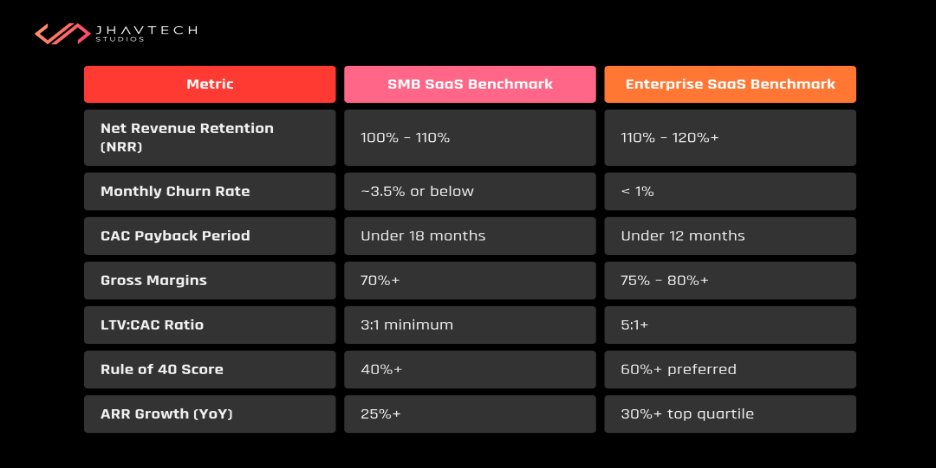
A SaaS business with gross margins of 70% or higher and infrastructure costs that grow slower than revenue is the model investors want to back. If your architecture means you need to double your DevOps team every time your user base doubles, that's a red flag, not just operationally, but financially. The antidote is investing in proper DevOps solutions from the start, where automation, CI/CD pipelines, and infrastructure-as-code absorb growth without headcount ballooning alongside it.
The Technical Foundation That Signals Scalability
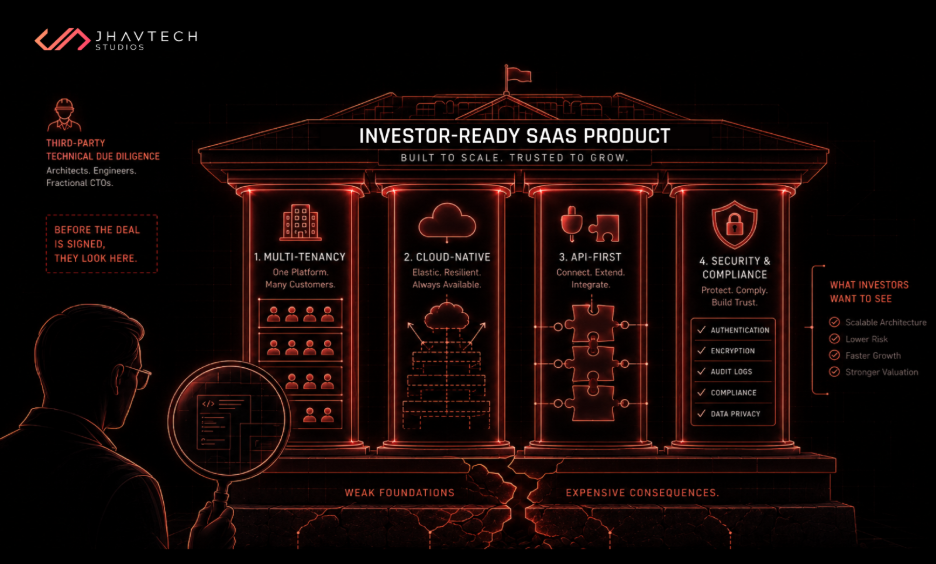
When founders bring their codebases to us at Jhavtech, the first thing we look for isn't the feature set. It's whether the multi-tenant architecture will hold up under an enterprise stress test. Investors increasingly bring in third-party engineers or fractional CTOs to review exactly this before they finalise a round. Here's what they're checking:
- Multi-tenancy by design. Your platform should serve multiple customers from shared infrastructure without data leakage or performance degradation across tenants. This is foundational to SaaS unit economics and non-negotiable for enterprise deals.
- Cloud-native infrastructure. AWS, Google Cloud, or Azure with auto-scaling, containerisation (Docker/Kubernetes), and infrastructure-as-code. It signals you can absorb traffic spikes without manual firefighting.
- API-first architecture. Products built around clean, well-documented APIs are easier to integrate, extend, and eventually white-label or sell upmarket. It also makes your GTM motion faster because integration partners can self-serve.
- Security and compliance posture. SOC 2 Type II, GDPR readiness, and encryption at rest and in transit are non-negotiable at the enterprise level and increasingly expected even for SMB-focused products. Missing this in your data room is a red flag that slows or kills a deal.
"In our work rescuing stalled SaaS platforms across Australia, we find that more than 60% of architectural bottlenecks stem from early-stage decisions made in a hurry: single-tenant setups, tightly coupled services, or a complete absence of automated testing. These aren't insurmountable, but they do need to be addressed before a raise, not during one." — Jhavtech Studios Engineering Team
If you're unsure whether your current codebase meets these standards, getting an independent technical audit before your raise can save you from discovering expensive problems mid-diligence. Catching architectural debt early is always cheaper than rearchitecting under investor scrutiny.
SaaS Metrics for Venture Capital 2026: The Numbers That Make or Break a Pitch
You can have a beautiful product, a passionate team, and a massive TAM — but if you can't articulate your SaaS metrics for venture capital clearly and confidently, sophisticated investors will move on. Here's the core metrics framework that defines investor-ready SaaS in 2026.
MRR, ARR, and the ARR Bridge
Monthly Recurring Revenue (MRR) is the total predictable revenue your business generates each month from active subscriptions, before churn and including expansions.
MRR and ARR (Annual Recurring Revenue, which is MRR x 12) are your starting points, but investors don't want the headline number — they want the story behind it.Studies show that investors expect you to walk them through an "ARR bridge", which is a clear reconciliation of opening ARR, new business, expansion revenue, contraction, and churn. That single table tells them more about your business health than almost anything else in your pitch deck.
Once you cross approximately $1M ARR, the conversation shifts from MRR to ARR. Learn to produce an ARR bridge in your sleep before you enter any investor meeting.
Net Revenue Retention (NRR): The Metric That Changes Valuations
Net Revenue Retention (NRR) measures the percentage of recurring revenue retained from existing customers over a given period, including expansions, downgrades, and churn.
NRR is arguably the single most important metric a 2026 investor looks at. An NRR above 100% means your installed base grows on its own. You generate more revenue from existing customers each year even if new customer acquisition flatlines entirely. That's the dream scenario for capital efficiency. Snowflake's pre-IPO NRR was famously 158%, which is a significant reason its valuation commanded such a premium.
NRR drives outsized valuation multiples precisely because it captures compounding growth from within your customer base. It’s growth that doesn't require proportional sales and marketing spend.
Churn: The Silent Killer That Compounds Against You
Churn rate is the percentage of customers or revenue lost within a given period due to cancellations and downgrades.
Churn is deceptively dangerous because it compounds. Note that the average B2B SaaS churn rate sits at 3.5% per month. Anything meaningfully above that benchmark and investors will view your growth as a tech debt time bomb — you're filling the bucket faster than it drains, but the underlying retention problem will eventually win. Fix the leak before you invest in a bigger hose.
2026 SaaS Benchmark Table: What "Good" Looks Like by Segment
The 2026 Investor-Ready SaaS Checklist
Use this as a diagnostic, not a formality. If you can genuinely check every box, you're in a strong position to pursue funding. If you can't, you know exactly where to focus next.
At Jhavtech, when we conduct a technical audit of a SaaS product ahead of a funding raise, this checklist maps directly to what we examine, particularly the architecture, security, and product-market fit rows, which are the ones most likely to surface deal-blocking issues.
Building for Product-Market Fit Before You Build for Scale
One of the most common and costly mistakes in SaaS startup development is optimising for scale before you've genuinely validated product-market fit. Founders build elaborate infrastructure, enterprise-grade feature sets, and multi-region deployments when they have 50 paying customers. Investors know the difference. And they price the difference into their terms.
Here's a practical PMF signal: if your first 20 customers have near-zero churn after six months and are actively referring others without being asked, you likely have it. If customers are churning before 90 days, no amount of new features or marketing spend fixes that. The product hasn't yet solved the core problem well enough to hold people.
The product growth strategy that works in 2026 follows a simple sequence: nail retention first, then layer in acquisition. Investors want to see that your growth is repeatable and efficient, not that you're burning rate to replace churned customers with new ones at the same velocity.
We covered this in depth in our recent post on the fastest way to validate a SaaS idea without wasting money. If you're still in early validation mode, read that first.
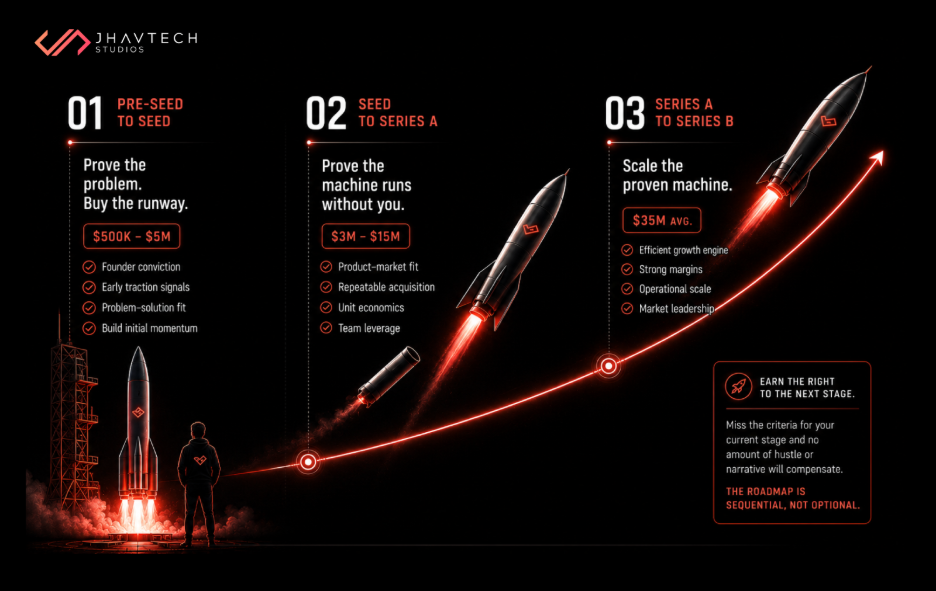
Startup Funding Preparation: The Stage-by-Stage Growth Roadmap
What does the growth trajectory actually look like in 2026 if you're targeting venture capital? Here's a clear-eyed breakdown by stage.
Pre-Seed to Seed ($500K–$5M): Buying Yourself the Right to Prove It
At this stage, investors are primarily buying into the founder and the problem, with early signals of the solution. You need a working product (not a prototype), at least some paying customers, and a clear hypothesis about your ICP. Revenue figures matter less than directional signals. Are customers using it? Paying without heavy discounting? Telling others?
The seed raise in 2026 requires planning for a 24-month runway, because as SaaSUltra reports, the average time from seed to Series A has lengthened considerably. Plan for longer than you think you need.
Seed to Series A ($3M–$15M): Proving the Machine Runs Without You
The average Series A round for SaaS in 2025 sat around $12 million. To get there, you typically need $1.5M–$3M ARR minimum, a demonstrable and repeatable go-to-market motion, and clean unit economics. Series A investors are pattern-matching for one thing: evidence that growth is system-driven, not founder-driven hustle. Your metrics need to show that a sales hire, a new marketing channel, or a product-led loop is doing the heavy lifting.
This is also where your technical infrastructure gets scrutinised hardest. If your codebase has accumulated significant technical debt, a structured software recovery process before your raise can make the difference between a clean diligence process and one that stalls or kills the deal.
Series A to Series B ($35M Average): Scaling the Proven Machine
At this stage, you're expected to have a proven GTM playbook, a sales team with predictable pipeline, and a product roadmap directly tied to revenue expansion. Gross margins should be at or approaching 75–80%. NRR should be above 110% for enterprise. The burn multiple (i.e. how many dollars of net new ARR you generate for every dollar of cash burned) should be moving toward 1x or below. Bessemer Venture Partners' efficiency score framework is the benchmark most Series B investors use when stress-testing your financial story at this stage.
How Poor Architecture Derails Startup Funding Preparation
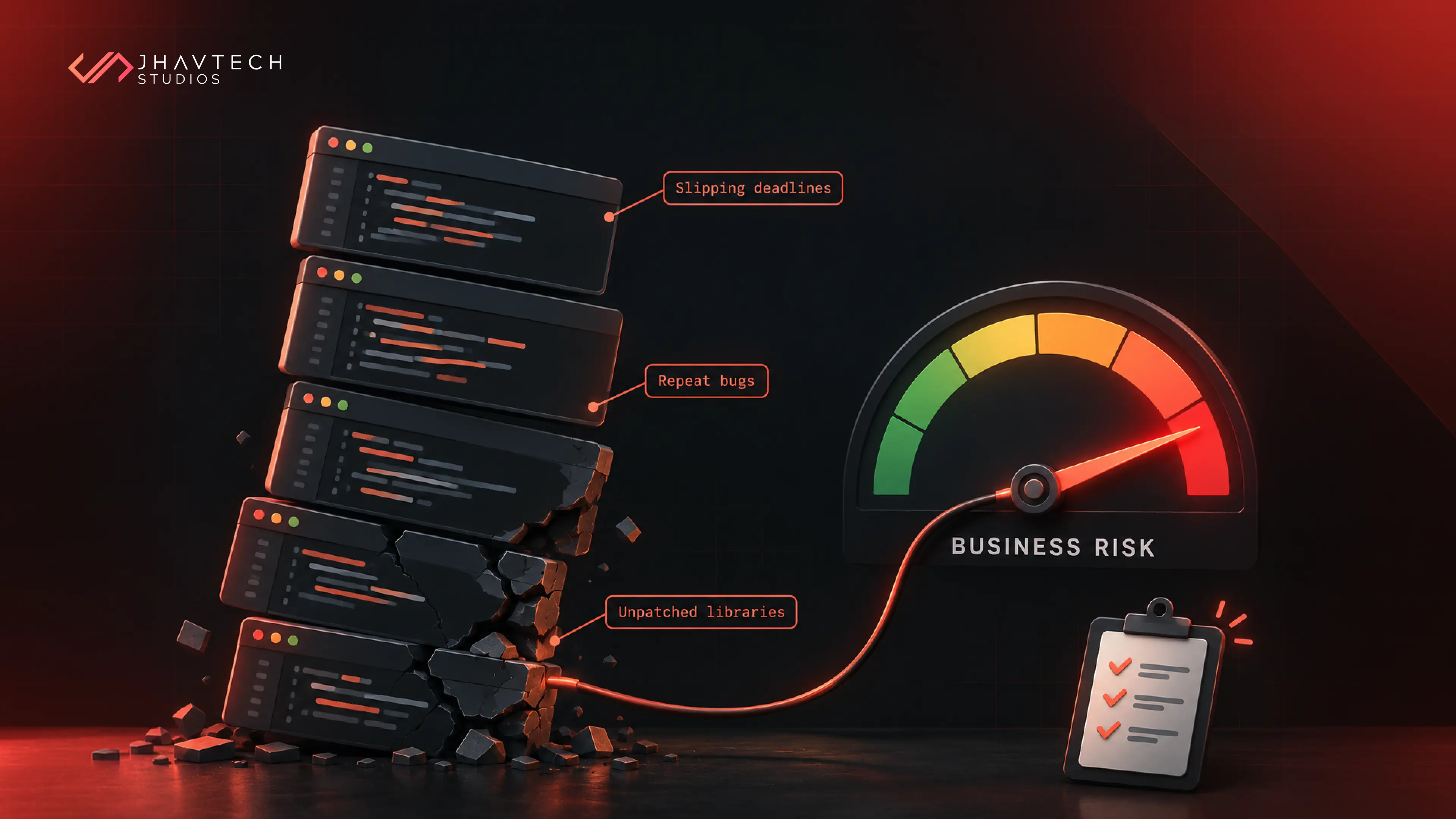
Here's something that doesn't get enough airtime: poor software architecture is one of the most underrated deal-killers in SaaS fundraising. Investors aren't just buying your revenue today — they're buying your ability to grow it efficiently. A fragile legacy monolith that requires a full rewrite to support enterprise clients or international expansion gets priced into the deal. Sometimes it kills the deal entirely.
We went deep on this in our recent post on how poor software architecture creates long-term business risks. The short version: architectural decisions made at speed in early development become expensive constraints at growth stage. The startups that fare best in technical due diligence are those that made deliberate, documented architectural decisions from the beginning, and kept documentation current.
Common architectural red flags that surface during SaaS Series A technical due diligence:
- Single-tenant architecture. Every customer runs their own instance. Infrastructure costs scale linearly with customers. This is the opposite of what investors want to see in a SaaS unit economics model.
- No API layer. The frontend talks directly to the database. Integrations and enterprise sales become almost impossible without significant rework. Term sheet gymnastics won't fix a structural integration problem.
- Hardcoded business logic. Logic scattered across the codebase rather than centralised in a service layer makes iteration slow, testing unreliable, and onboarding new engineers painful and expensive.
- No automated test coverage. Deployments rely on manual QA. As the codebase grows, release cycles slow and defect rates climb, both of which show up in your product velocity and your team's burn rate.
If you're recognising your product in any of these, the issues are fixable. Starting with a product built to reach users across every touchpoint from the ground up is always preferable to retrofitting scalability into an architecture that was never designed for it.
Frequently Asked Questions


.webp)

.png)
.png)
.png)
.png)

.png)
.png)
.png)

.png)
.png)
.png)
.png)
.png)
.png)
.png)
.png)
.png)
.png)
.png)
.png)


.png)
.png)
.png)
.png)
.png)
.png)
.png)
.png)
.png)

.png)
.png)
.png)
.png)
.png)
.png)
.png)
.png)
.png)
.png)
.png)
.png)
.png)

.png)
.png)
.png)
.png)

.png)
.png)
.png)


.png)
.png)
.png)

.png)

.png)


.png)


.png)





.png)



.png)






.png)

.png)