.svg)
.svg)


AI Wrote the Code. Humans Own the Consequences.
.png)
The promise of 2026 was supposed to be the "zero-touch" development era. With the rise of advanced generative models and agentic workflows, shipping a new feature is now as simple as a well-crafted prompt. But as the industry moves faster, a dangerous gap is widening between who creates the code and who carries the risk.
At Jhavtech Studios, we’ve seen the fallout: startups shipping AI-generated features only to face catastrophic security breaches, or "brittle" architecture that collapses under the first sign of real-world load. The reality is simple: AI wrote the code, but humans own the consequences.
⚡ Key Takeaway: The 2026 Accountability Gap
As of March 2026, the global regulatory landscape has shifted. With the EU AI Act’s transparency rules in full effect and the Colorado AI Act set for implementation in June 2026, the legal standard is clear: Organisations are "deployers" with full liability for AI-generated outputs. Jhavtech Studios mitigates this through a human-in-the-loop framework, ensuring every line of AI-assisted code undergoes rigorous provenance verification and security auditing.
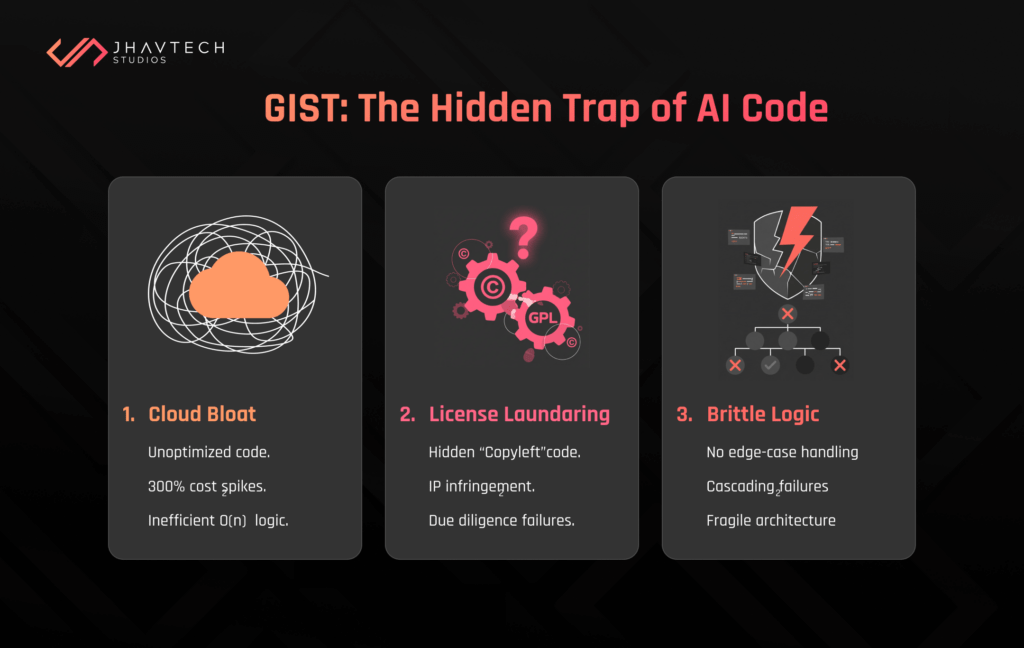
The Illusion of Efficiency: The Hidden Trap of GIST (GenAI-Induced Technical Debt)
AI is excellent at generating code that looks functional but is architecturally "hollow." Researchers in early 2026 have identified a new, pervasive phenomenon: GenAI-Induced Self-admitted Technical Debt (GIST). This occurs when developers incorporate AI suggestions while explicitly expressing uncertainty about their correctness in the code comments, essentially "kicking the can" down the road.
1. Unoptimised Resource Consumption and "Cloud Bloat"
AI models prioritise the most common way to solve a problem based on training data, not the most efficient way for your specific stack. In 2026, "Cloud Bloat" has become a primary driver of technical debt. Large Language Models (LLMs) often generate Python or Node.js scripts that ignore memory management or use inefficient O(n²) algorithms where O(n log n) was required.
At Jhavtech, we have observed cases where unverified AI logic caused cloud hosting costs to spike by 300% because the code wasn't optimised for modern containerised environments. Our "Human-in-the-loop" process catches these architectural inefficiencies before they hit your monthly AWS or Azure bill.
2. The 2026 Licensing Surge: A Minefield for AI Code Ownership
The 2026 OSSRA (Open Source Security and Risk Analysis) Report recently documented a historic surge in licensing conflicts. This is largely driven by "license laundering," where AI assistants generate code snippets derived from "Copyleft" sources (like GPL) without retaining the original license headers.
Without a verification process, you may be unknowingly committing code to your repository that violates third-party copyrights. This complicates AI code ownership and can render your software "un-sellable" during a technical due diligence phase of an acquisition or VC funding round. Jhavtech ensures every module has a clear "provenance trail," protecting your intellectual property.
3. The "Brittle" Logic Problem and Edge-Case Failure
AI code works perfectly for the "happy path" or the scenario the prompt specifically described. However, it frequently fails to account for edge cases, error handling, or "graceful degradation." When unexpected user data enters the flow, these AI-generated modules often lack the robust try-catch blocks and validation logic that a seasoned Senior Engineer would instinctively include.
This creates a 'brittle' codebase that is prone to cascading failures during peak traffic or unexpected user inputs. We’ve explored this further in our guide on The Hidden Risk of Letting AI Write Your Startup's Codebase, which details the architectural cost of 'vibe coding'.
The Security Reality: Who is Responsible for Vulnerabilities?
One of the most frequent questions we receive at Jhavtech is: Who is responsible for security vulnerabilities in AI-generated code?
The answer is now legally settled across most major jurisdictions. In the eyes of the Texas Responsible AI Governance Act (TRAIGA), which went into effect in January 2026, and updated Australian consumer protections, the business "deployer" is 100% responsible. There is no "AI defense" in court.
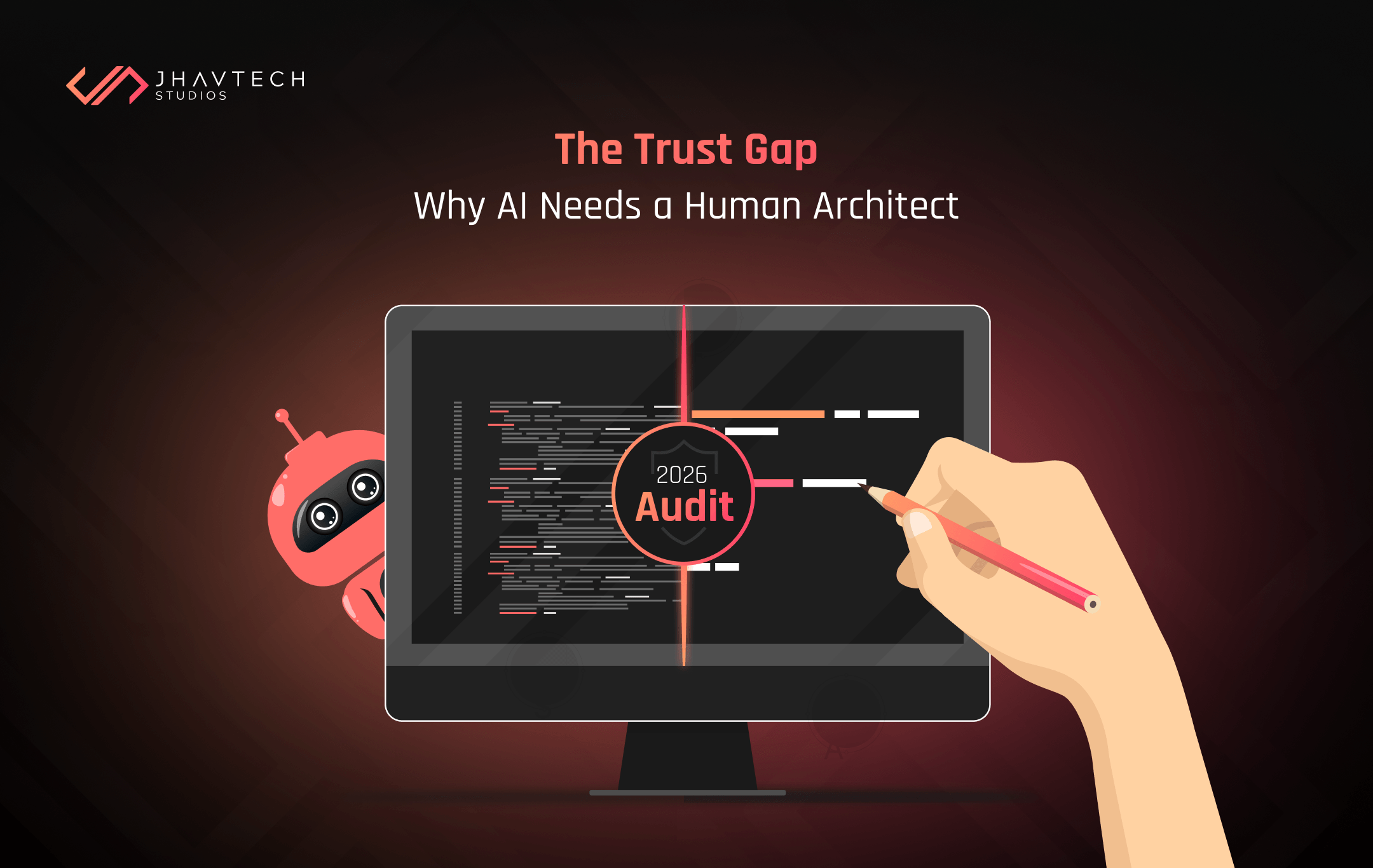
Ultimately, the legal and financial responsibility lies with the entity that publishes the software. This is why we recommend that any company utilising automated tools should first undergo a Free Code Review to identify hidden vulnerabilities before they become public liabilities.
The Rise of AI-Generated "Dependency Confusion"
A common 2026 threat is the "hallucinated" library. AI models often suggest non-existent packages or outdated libraries that have since been deprecated. Hackers now monitor AI trends, identify these "hallucinated" names, and upload malicious packages with those exact names to public registries like NPM or PyPI.
If your developer blindly "accepts" an AI suggestion, they might be importing a Trojan horse directly into your core infrastructure. This is known as a "Dependency Confusion" attack, and the 2026 OSSRA Report notes that vulnerabilities per codebase have more than doubled due to these types of AI-accelerated supply chain risks.
Cyber Insurance and the "Audit Trail" Requirement
Cybersecurity insurance providers in 2026 are tightening their policies. If you cannot prove a human-led audit of your AI-assisted codebase, they may deny coverage in the event of a breach. They view unverified AI code as a "known risk," similar to leaving a server room door unlocked. Jhavtech Studios helps clients mitigate this by providing a transparent audit trail of all AI-assisted modules.
Automation Bias: The Psychological Trap for Engineering Teams
One of the most dangerous consequences of AI in the workplace is Automation Bias, pertaining to the tendency for humans to favor suggestions from automated systems even when they contradict common sense.
When a developer is under pressure to meet a deadline, they are more likely to "Accept All" from an AI co-pilot without fully reading the logic. This bypasses the critical thinking phase of engineering. At Jhavtech, we train our engineers to treat AI code as "untrusted third-party code" until it passes through our internal validation pipeline. We foster a culture where questioning the machine is the standard, not the exception.
Implementing a "Zero-Trust" AI Development Policy
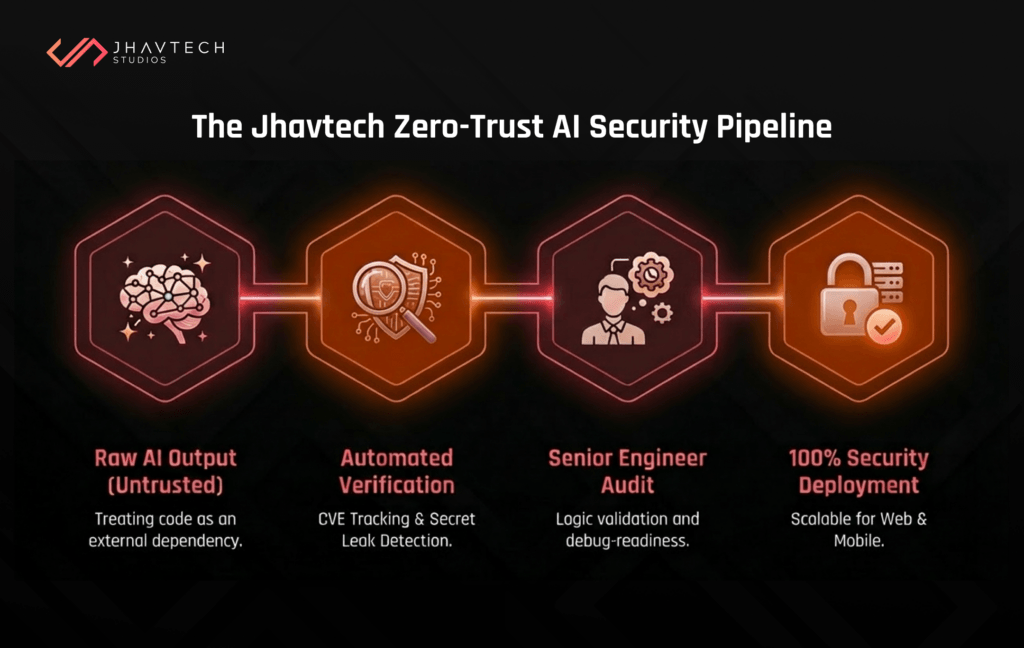
To manage AI-generated code liability effectively, Jhavtech Studios utilises a "Zero-Trust" policy toward machine-generated logic. We treat AI code as an external dependency that requires its own security lifecycle.
Whether you are building a web platform or looking for mobile application development services, human oversight is the only way to ensure 100% security.
Software Composition Analysis (SCA) and Secret Scanning
We utilise advanced SCA tools to scan every AI-suggested module for:
- CVE Tracking: Checking against 2026 global vulnerability databases to ensure no "zombie components" or deprecated libraries are introduced.
- Secret Leaks: Ensuring the AI didn't accidentally include hardcoded API keys, passwords, or credentials—a common AI "shortcut" that leads to instant breaches.
- Epistemic Debt Management: We prevent "Epistemic Debt," where a team deploys a system that no one actually understands how to debug. By maintaining human oversight, we ensure Jhavtech engineers remain the masters of the codebase.
The Legal Landscape: Indemnification and Contracts
In 2026, the contractual language surrounding software development has changed. Many "budget" agencies now include clauses that limit their liability for AI-generated errors.
At Jhavtech, we stand by our work. Because we employ a rigorous human-in-the-loop process, we provide our clients with the confidence that their code is professionally vetted. We don't hide behind "the AI did it." We take full responsibility for the products we ship, providing the legal and operational indemnification that modern enterprises require.
Beyond the Prompt: Why Jhavtech Studios is the Choice for 2026
We protect our clients’ interests by implementing three core pillars of risk management that typical 'AI-first' agencies ignore. At Jhavtech, we don't just generate lines of code; we provide comprehensive AI software development services that prioritise architectural integrity and human oversight over raw, unverified output.
- Architectural Integrity: We use AI to accelerate rote tasks like boilerplate generation, unit testing, and documentation. However, the high-level architectural decisions remain 100% human-centric.
- Rigorous Prompt Governance: We avoid the "garbage in, garbage out" cycle by training our team in advanced prompt engineering that prioritises security, performance, and long-term maintainability over raw speed.
- The Jhavtech "Human-Centric" Audit: Every line of code is treated as "guilty until proven innocent" by our specialised QA teams, ensuring that the software we deliver is as robust as it is innovative.
Conclusion: The Future of Responsible Engineering
AI is the most significant leap in productivity in history, but the companies that will thrive in 2026 are not those that use the most AI, but those that manage AI with the most discipline.
The "consequences" of code—security, scalability, and legal ownership—cannot be outsourced to a machine. They require the steady hand of an experienced engineering partner. At Jhavtech Studios, we bridge the gap between AI's potential and the human responsibility required to make it work in the real world. We don't just ship code; we ship peace of mind.
Is Your Codebase a Business Liability?
Don't gamble your company’s future on unverified AI logic. Whether you are building a new platform from scratch or auditing an existing codebase for AI-driven technical debt, our senior engineers are here to help. We specialise in securing AI-assisted software to ensure your IP is protected and your systems are resilient.
.webp)
.png)

.png)
.png)
.png)
.png)
.png)
.png)
.png)
.png)
.png)
.png)
.png)

.png)
.png)
.png)
.png)
.png)
.png)
.png)
.png)
.png)

.png)
.png)
.png)
.png)
.png)
.png)
.png)
.png)
.png)
.png)
.png)
.png)
.png)
.png)
.png)
.png)
.png)
.png)
.png)
.png)

.png)
.png)
.png)
.png)
.png)
.png)
.png)
.png)


.png)


.png)

.png)

.png)

.png)

.png)
.png)