.svg)
.svg)


The startup world in 2026 feels a bit like the Wild West, but with better coffee and much faster internet. If you have been paying attention to the tech landscape, you have probably noticed that the old “move fast and break things” mantra has evolved. Today, it is more like “move at the speed of light, but do not lose the soul of your product.”
We have officially moved past the era of simply “using AI.” In 2026, the novelty of a chatbot has worn off. According to recent 2026 industry reports, over 75% of businesses are now using generative AI for core operations, but there is a massive catch: only about 35% of users actually trust AI-generated content without human verification. The gap between “automated” and “authentic” is where the most successful companies are winning.
At Jhavtech Studios, we have seen this shift firsthand. It is no longer enough to have a great codebase; you need a strategy that balances efficiency with a distinct brand identity. Welcome to the era of the AI-augmented startup stack.
What exactly is an AI-Augmented Startup Stack?
For years, a startup stack was a collection of programming languages, databases, and hosting providers. You had your MEAN stack or your LAMP stack. But in 2026, the AI-first business architecture is the foundational layer of any modern company. It is a three-pronged approach that combines the raw processing power of artificial intelligence, the strategic oversight of humans, and the subjective excellence of “taste.”
This stack is not just about writing code faster. It is about integrating AI and machine learning into the very fabric of your business logic. The urgency for a robust AI-augmented startup stack is backed by Gartner’s 2026 AI agent forecast, which predicts that 40% of enterprise applications will soon feature task-specific autonomous agents. For a startup, this means your startup stack must be modular, agent-ready, and, most importantly, guided by human intuition.
The Rise of Vibe Coding and the Death of “Good Enough”
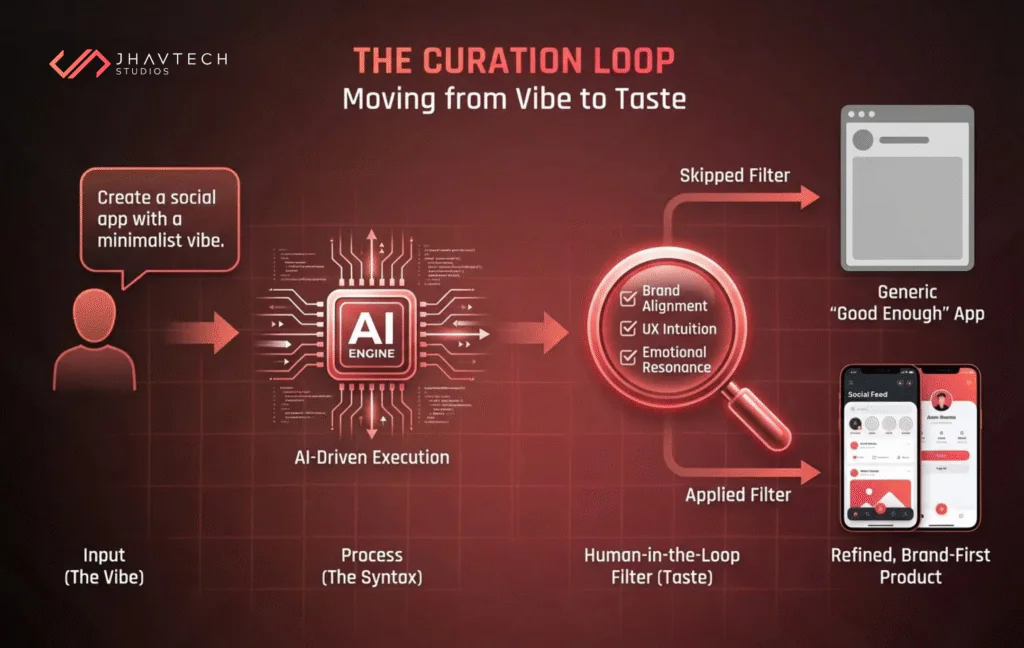
You might have heard the term “vibe coding” floating around LinkedIn or tech forums lately. Coined by industry leaders like Andrej Karpathy, vibe coding refers to a shift where developers (or even non-technical founders) use natural language to describe the “vibe” and functionality of an app, letting AI handle the heavy lifting of the syntax.
While vibe coding is a gamechanger for rapid prototyping, it comes with a hidden danger: genericism. If everyone uses the same prompts, every app starts to look and feel the same. This is where your AI-augmented startup stack needs its third ingredient: Taste.
Taste is the ability to know when a feature feels “off,” when a user interface is too cluttered, or when an AI-generated response sounds like a corporate robot. It is the “human-in-the-loop” factor that ensures your product resonates with actual people.
Why “Taste” is Your New Competitive Advantage
In a world where software is cheaper and faster to build than ever, the barrier to entry has vanished. This has led to an explosion of “noise” in the app stores and SaaS markets. To stand out, startups must answer a critical question: How to maintain brand taste in AI-generated content?
Digital marketing trends in 2026 show that brand voice is now a ranking signal for search engines. If your content sounds like a generic LLM output, you will get buried. Successful founders are using their AI-augmented startup stack to handle the volume, while they focus on the “curation.”
Think of it like a Michelin-star chef. The chef does not chop every onion or wash every pan; they have a team (and machines) for that. But the chef tastes every sauce before it leaves the kitchen. That is the role of a founder in 2026. You are the curator of the “vibe.”
Managing Technical Debt in the AI Era
One of the biggest risks of the current AI gold rush is the accumulation of technical debt. When you use AI to churn out thousands of lines of code without a clear architectural plan, you are essentially taking out a high-interest loan that you will have to pay back later.
At Jhavtech Studios, we often get calls for a software project rescue because a startup built their entire MVP using autonomous agents that did not account for scalability or security. In fact, studies show that high technical debt environments can waste 30% to 40% of a company’s change budget.
Your AI-augmented startup stack should include DevOps solutions that are designed to handle AI-generated artifacts. This means automated testing, robust CI/CD pipelines, and regular human audits to ensure the code remains maintainable as you grow.
Common AI Integration Pitfalls: Beyond the Hype
Building an AI-augmented startup stack is as much about what you don’t build as what you do. In the rush to achieve “AI-powered” status, many founders fall into traps that don’t just slow them down… they create structural failures that eventually require a full-scale software project rescue.
The “Generic API” Trap and Automated Technical Debt
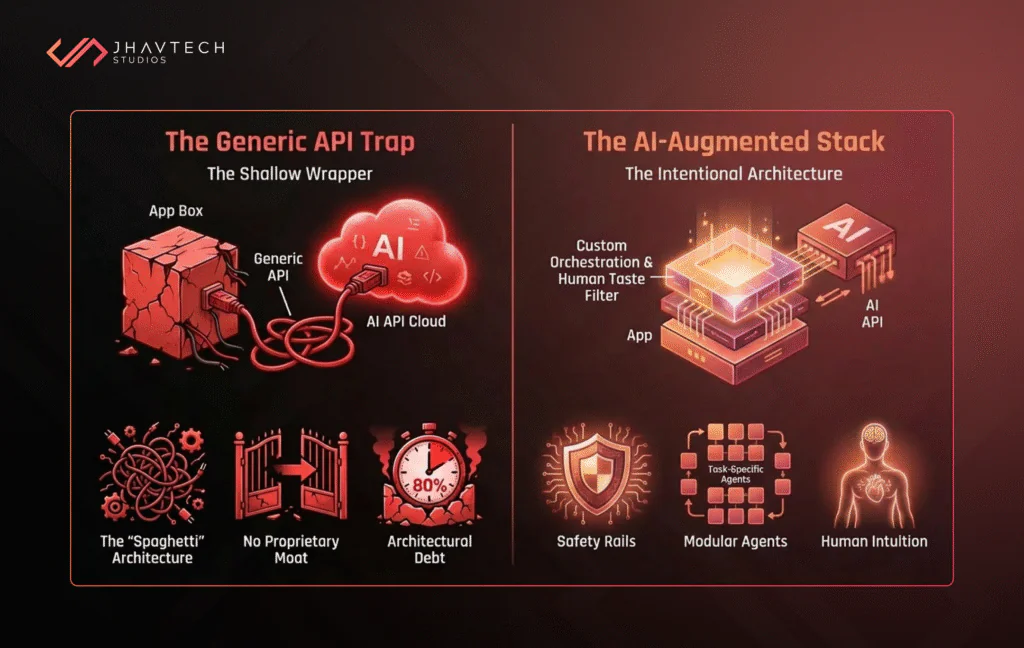
The most common mistake in 2026 is treating AI as a “black box” plugged in via a few generic API calls. While it is easy to send a prompt to a foundation model and display the result, this creates a shallow integration. Without a custom orchestration layer, your app becomes a “wrapper” with no proprietary moat.
More dangerously, relying on generic AI outputs to write core business logic often leads to a massive accumulation of technical debt. Experts predict that by the end of 2026, 80% of technical debt will be architectural, meaning the very foundation of how your AI interacts with your data is flawed. When AI generates code without a human “taste” filter, it often ignores modularity and security protocols, creating a “spaghetti” architecture that is nearly impossible to scale or audit.
Why Project Rescues Start with a Lack of “Taste”
When we at Jhavtech are called in for a software project rescue, the root cause is rarely just “bad code.” Usually, it is a lack of “Taste” in the initial architecture. A project without taste is one where AI was forced into the product where a simple heuristic or a rule-based system would have sufficed.
“Taste” in architecture means knowing where the AI should stop and where human intuition should take over. For example, using AI to categorise support tickets is efficient; using it to autonomously draft and send legal responses without human oversight is a disaster waiting to happen. Startups that fail often ignore this boundary, leading to “hallucination-heavy” products that erode user trust. A successful AI-augmented startup stack uses DevOps solutions to build safety rails around the AI, ensuring that every automated decision is curated by the brand’s unique standards.
The Essential Components of the 2026 Stack
If you are building an AI-augmented startup stack today, here is what your foundation should look like:
1. Human-in-the-loop AI workflows Automation.
It’s great, but certain decisions need a human touch. Whether it is approving a high-value transaction or verifying a piece of legal advice generated by a model, human-in-the-loop AI workflows ensure that your startup remains ethical and accurate.
2. Domain-specific AI integration Generic Models.
These are for generic companies. To win in 2026, you need domain-specific AI integration. This means taking a base model and fine-tuning it on your proprietary data or industry-specific knowledge. Whether you are in fintech, healthcare, or retail, your AI should speak the language of your customers.
3. Agile Infrastructure.
Your stack needs to be ready for the “Agentic” shift. This involves moving away from monolithic architectures toward modular systems where different AI agents can communicate and execute tasks. This is where professional app developers become invaluable—they build the “orchestration layer” that allows your AI to function safely and effectively.
Why Custom App Development Still Matters
With all this talk of AI, you might wonder if you still need a dedicated team of app developers. The answer is a resounding yes, but their role has changed. They are no longer just “code monkeys”; they are architects and problem solvers.
In app development today, the focus has shifted from “How do we build this?” to “How do we make this scale and stay secure?” When you work with a studio like Jhavtech, you are not just getting code; you are getting a partner who understands how to build a sustainable AI-augmented startup stack. We help you navigate the complexities of integration, ensuring that your AI features do not become a liability.
Looking Ahead: The Future of Startup Tech Stacks 2026
As we look toward the second half of the year, the trend is clear: the most successful startups will be those that embrace the AI-augmented startup stack while doubling down on human creativity. We are seeing a “flight to quality” where users are willing to pay a premium for products that feel “human-made” or at least “human-curated.”
The future of startup tech stacks 2026 is not about replacing your team with algorithms. it is about giving your team “superpowers.” It is about using AI to handle the mundane, so your humans can focus on the extraordinary.
Final Thoughts: Building with Intent
Building a startup in 2026 is an exhilarating challenge. You have more tools at your disposal than any generation of entrepreneurs before you. But with that power comes the responsibility to build with intent.
By focusing on an AI-augmented startup stack, you are setting your business up for long-term success. You are ensuring that you can iterate at lightning speed without sacrificing the “taste” that makes your brand unique. You are managing your technical debt proactively, and you are leveraging AI and machine learning to create real value for your users.
At Jhavtech Studios, we specialise in helping founders navigate this new reality. From software project rescue to building high-performance DevOps solutions, we are here to ensure your technical foundation is as strong as your vision.
Are you ready to build the next generation of software? Contact us today! Whether you are looking for expert app developers to bring your vision to life or need a comprehensive AI-augmented startup stack strategy, Jhavtech Studios is here to help.