What Drives Software Development Costs Up After a Project Has Started?
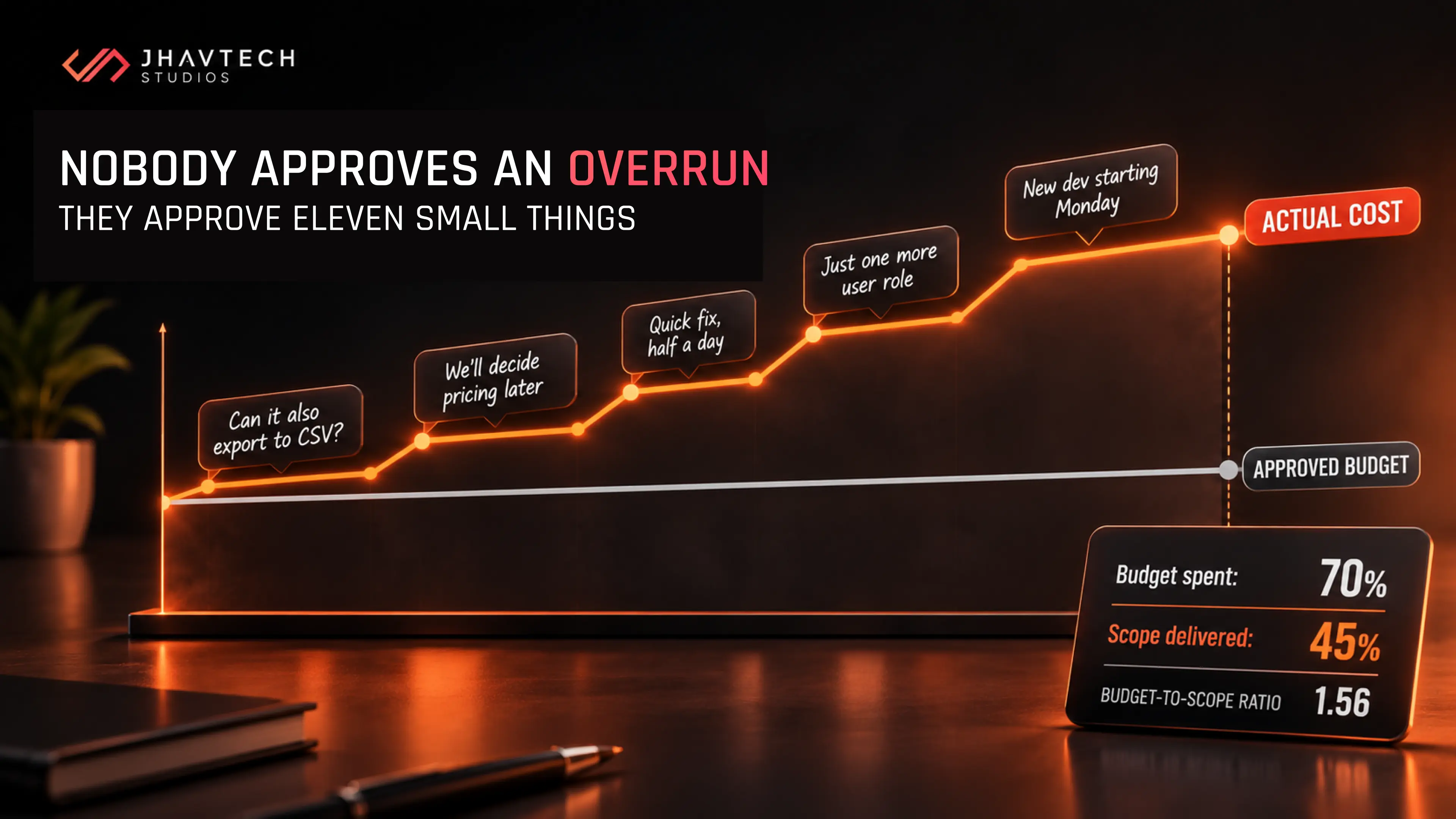
The quote said AUD $180,000. Eleven weeks in, the forecast on the spreadsheet says $247,000, and nobody in the room can point to the week it moved.
This is the part of software development cost that catches founders out. Not the original estimate, which was argued over line by line and signed off by two people who understood it. The part that arrives afterwards, in pieces small enough that each one looked affordable on the day it was approved.
At Jhavtech Studios we see this from the inside fairly often, because by the time a project lands on our desk for rescue, the numbers have usually been moving for a while. The pattern is remarkably consistent, and so are the seven things causing it.
We have rescued more than thirty of these, and the pattern barely changes. The original quote was reasonable, the developers were competent, the client was not difficult. Nobody was keeping a running total of what had been agreed along the way, usually because each thing agreed was small. Across those rescues we have recovered over $1.5 million for clients, and the average time to get a stalled project moving again is about three and a half weeks. Drift takes months to build and weeks to reverse, provided somebody looks at it.
Summary: What You Need to Know
- Software development cost rarely jumps. It drifts. Overruns are built out of changes that each looked reasonable on the day somebody said yes to them.
- Seven drivers cause most of it: scope creep, requirements that were deferred rather than decided, software rework, integration surprises, change request management that exists in name only, slow decisions, and team handovers nobody priced.
- PMI's Pulse of the Profession 2026 found that 81% of project professionals say projects have become more complex in recent years, and roughly 31% of complex projects miss part of their intended benefits, more than double the rate for projects overall.
- The table below shows what the same change costs depending on when it lands. The 12-point checklist, and the Budget-to-Scope Ratio we use in Jhavtech Studios rescue audits tell you whether your budget has already started moving.
- Most project budget overruns are visible six to eight weeks before they appear on an invoice, provided somebody is looking in the right place.
Why Software Development Costs Escalate After a Project Starts
Short answer: the estimate was not wrong. The assumptions underneath it were, and software development costs escalate at the moment one of those assumptions breaks without anyone pricing the consequence.
An estimate is not a price, whatever the PDF looks like. It is a pile of assumptions with a dollar figure stapled to the front of it, and most of those assumptions never get written anywhere the client can read them.
Assumptions like: the payment provider's documentation is current. Your team will sign off designs within five working days. There is one user role, not four. The data in the old system is clean enough to migrate without a scrubbing exercise.
One of those turns out to be false and the price built on top of it quietly stops being true. Which is not usually a developer failing to deliver. It is new information turning up after the paperwork was signed, and if you have built software before, you will know that is the normal weather rather than a storm.
Businesses that land near budget do not have better estimators. They just notice an assumption breaking in week three rather than week fourteen, which sounds like a small distinction and is not. If you want the mechanics of that first number, our breakdown of how to put a realistic timeline on a build covers what should sit underneath it.
1. How Do Scope Creep Costs Push a Software Budget Up?
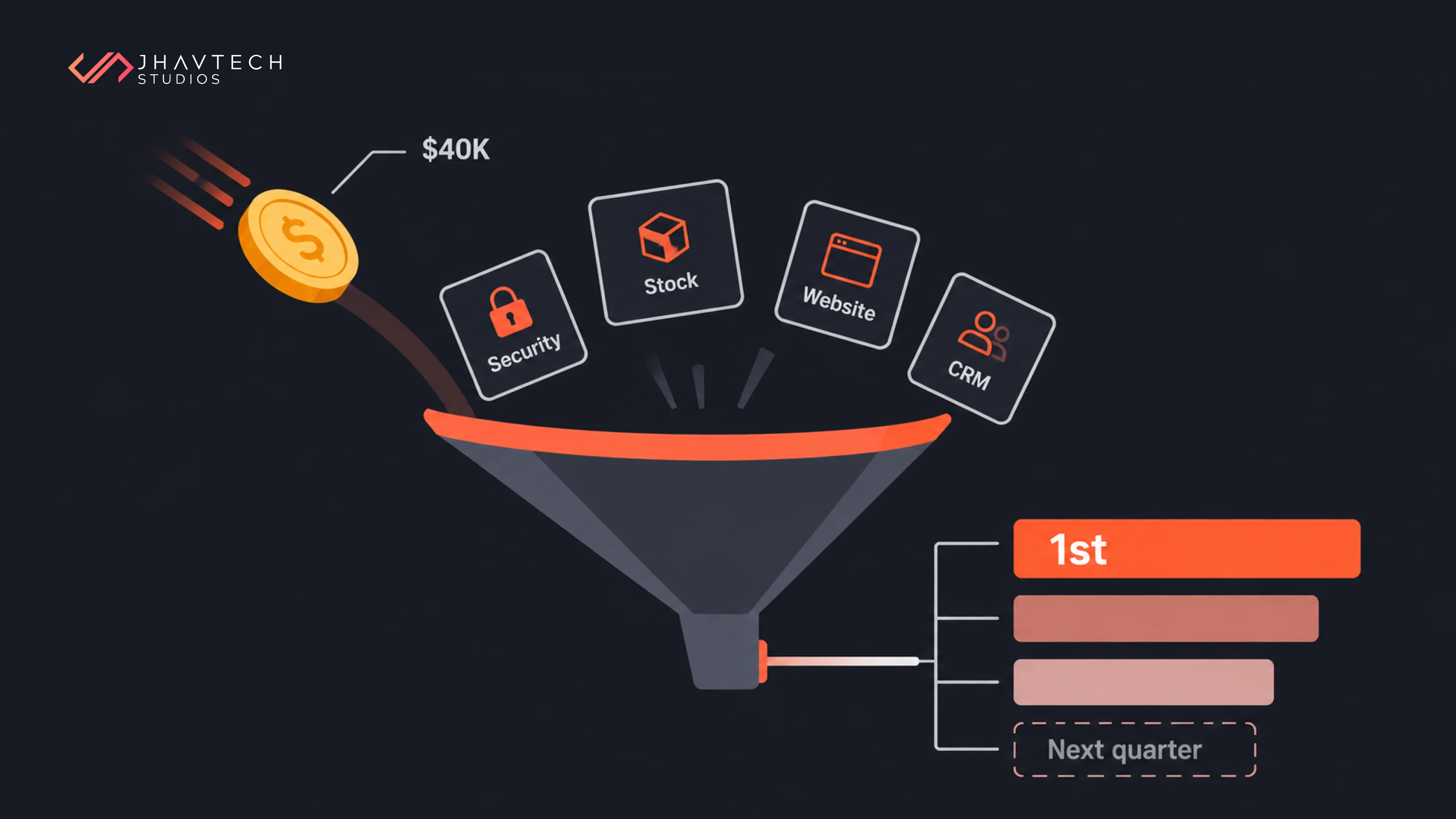
Short answer: one request at a time. Scope creep costs accumulate because each addition gets approved in isolation by someone trying to be helpful, and nobody keeps a running total until the invoice arrives.
Nobody walks into a meeting and asks for a 30% budget increase. They ask whether the export could also do CSV, since the finance team uses Excel anyway.
It is a fair question. The answer is probably yes, and probably not expensive. The problem is the twelfth one.
Scope creep costs accumulate because each request is evaluated on its own, in isolation, usually in a chat thread, usually by someone who wants to be helpful. Half a day here. A day and a half there. Nobody tracks the running total because no single item ever felt large enough to warrant tracking.
Then the invoice arrives and everyone is surprised, including the development team, who have been quietly absorbing a fair bit of it.
There is a second cost underneath that one, and it almost never gets counted. Every feature you add has to be designed, built, tested, documented and then supported for as long as it lives in the product, and the building is the cheap bit. Two days of development usually drags another day of everything else behind it. Then it keeps billing you quietly, forever.
The fix is not saying no more often. Keep one list that's visible to everybody, with a running dollar figure at the bottom of it. That is the whole mechanism. What tends to happen next is that a third of the requests withdraw themselves, because the person asking can finally see what they would be jumping ahead of.
2. Requirements That Were Deferred, Not Decided
Short answer: a deferred decision is a purchase on credit. The same choice made in discovery costs roughly a fifth of what it costs once there is working code built around the gap it left.
There is a phrase that costs Australian SMEs more money than any other sentence in software: "we'll work that out later".
It sounds pragmatic. Keep momentum, settle the detail closer to the time. What it does in practice is push a decision from the cheapest moment in the project to the most expensive one.
Take pricing tiers. If you decide during discovery that you will have three tiers with annual billing and a 14-day trial, a developer builds that. If you leave it open because sales is still testing the market, the developer builds something generic enough to flex, which costs more upfront, and then you decide in week nine on seat-based pricing with mid-cycle upgrades, which the generic thing was never shaped for. You have now paid twice and you are behind.
The same applies to user permissions, approval workflows, GST and BAS handling, Privacy Act obligations about where customer data is allowed to sit, and anything touching how figures get reported to a board or an accountant. These are business decisions wearing technical clothing, and a development team cannot make them for you. When they are left open, the team either guesses or stops, and both options show up on your invoice.
This is the argument for doing the thinking before the building, which our piece on why a proper discovery phase pays for itself goes into properly.

3. Software Rework: Paying Twice for the Same Screen
Short answer: software rework is work you have already paid for once. It shows up as falling sprint output rather than as a line on an invoice, which is why it runs for months before anyone names it.
Rework is the quietest line item in any overrun, largely because it never turns up as a line item. What you see instead is a sprint that delivered less than the one before it. Nobody can quite say why.
It comes from a requirement that moved after the work was finished, or a defect nobody caught until QA, or code thrown together under deadline pressure that now has to be unpicked before anything else can sit on top of it. Usually some mix of all three, in whatever proportion your last six months produced.
The scale of this is not a matter of opinion. The Consortium for Information and Software Quality put the annual cost of poor software quality in the United States at roughly US$2.41 trillion, with a further US$1.52 trillion sitting in accumulated technical debt, counted separately (CISQ, Cost of Poor Software Quality in the US). Those are national figures, and they are not abstractions. They are made up of thousands of projects where somebody paid for the same feature twice.
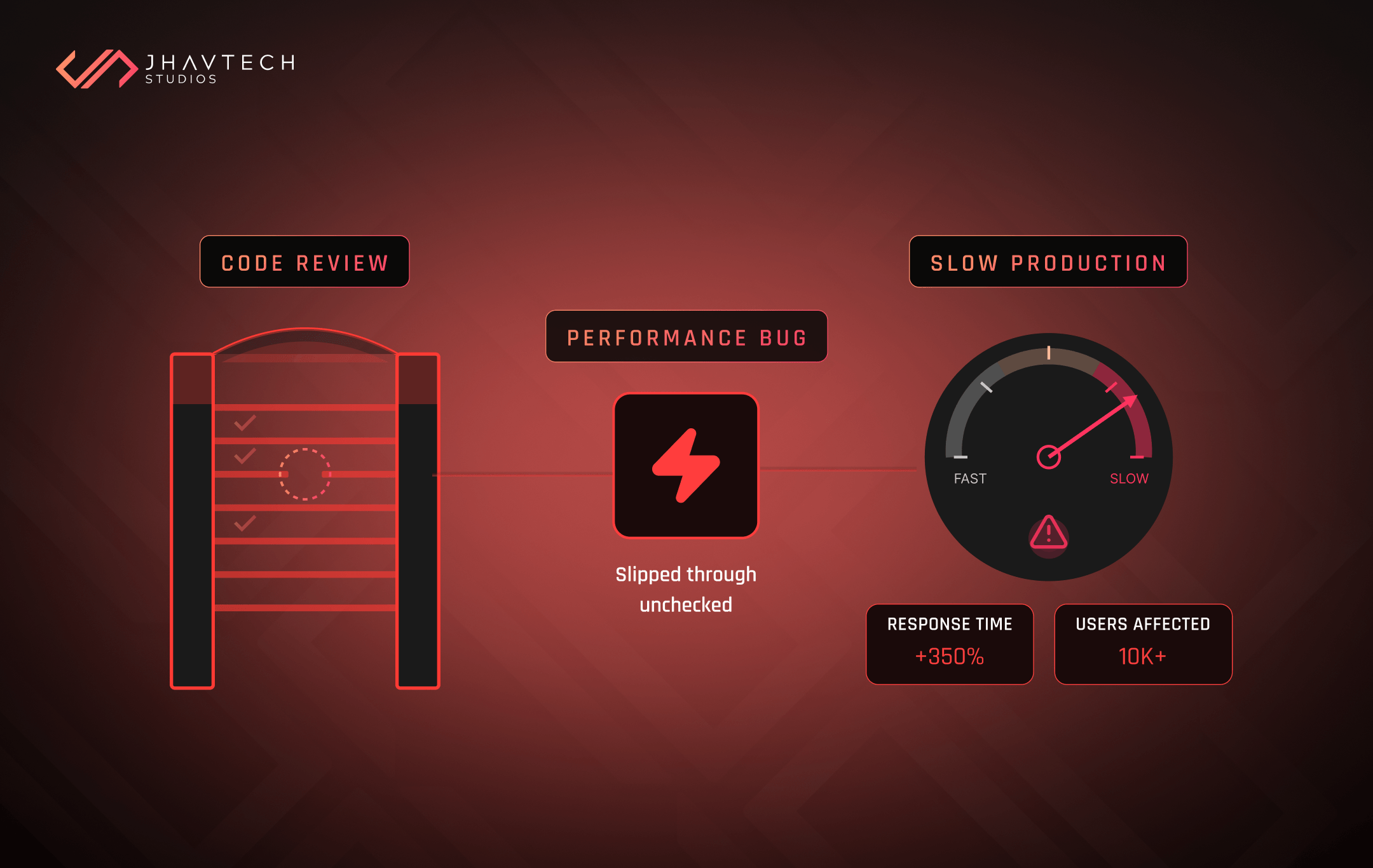
There is a 2026 version of this worth knowing about, and its baseline was set in late 2025. Google's DORA research, drawn from nearly 5,000 technology professionals, found that AI adoption has flipped to a positive relationship with delivery throughput while still correlating with greater delivery instability, meaning more change failures and more rework (DORA 2025 State of AI-assisted Software Development). That relationship has carried into 2026 rather than reversed, and the mechanism is plain enough. Code arrives faster. Some of it arrives faster than your review and testing capacity can absorb, and the difference comes back as rework later in the project, usually at the worst possible moment.
So, if your team is shipping fast while the bug backlog grows at the same clip, you are not going faster. You are borrowing. The interest turns up in next quarter's budget. We put dollar figures against this in our breakdown of the seven ways technical debt drains a development budget.
4. The Integration Everyone Assumed Would Be Simple
Short answer: integrations are priced off documentation and built against production, and the gap between those two is where the unbudgeted weeks live.
Integrations get estimated off documentation and built against reality, which are two very different things.
The documentation says the accounting platform exposes an invoices endpoint. It does. What the documentation does not mention is that the endpoint rate-limits at a level your import volume will exceed on day one, that the sandbox behaves differently from production in two specific ways, and that the field you need for reconciliation only populates if the invoice was created through their web interface rather than their API.
None of that is anyone's fault. It is still three weeks nobody budgeted for, though.
Two habits cut this right down. Build a throwaway proof of concept against the live system before the integration gets priced rather than after, because two days spent there routinely saves three weeks later on. Then ask your development team to list every external dependency in the build and mark which ones they have personally hit with real credentials, as opposed to read about. The ones they have only read about are where your money is going.
This matters more for anything with a mobile front end, where you are integrating with app store rules, device permissions and payment platforms that all change without asking you first. If that is the build you are planning, it is worth putting the next release on a foundation designed to carry those dependencies rather than discovering them one at a time.
5. Change Request Management That Only Exists on Paper
Short answer: most contracts have a change request clause nobody uses, because invoking it feels adversarial while the relationship is still good. The cost of that politeness compounds weekly.
Almost every contract has a change request clause. Almost nobody uses it, because using it feels adversarial when the relationship is going well.
So, requests arrive by email, by phone, in a stand-up, in a Slack thread at 9pm. Someone says yes. No one writes down what it will cost or what it pushes back. Six weeks later there are forty of these, the project is a month late, and the conversation about who agreed to what becomes unpleasant for everybody.
None of this needs to be bureaucratic. It is one sentence, used every time: we can do that, here is what it costs and what it moves, let me know. Three lines in a shared doc and you are done. The point is not to make change hard, it is to put the price in front of whoever is deciding, while they are deciding, instead of at the end of the quarter.
Timing is most of the cost. The same change is cheap in week one and brutal in week twelve, because of how much finished work has to be reopened around it.
What the Same Change Costs, Depending on When It Lands
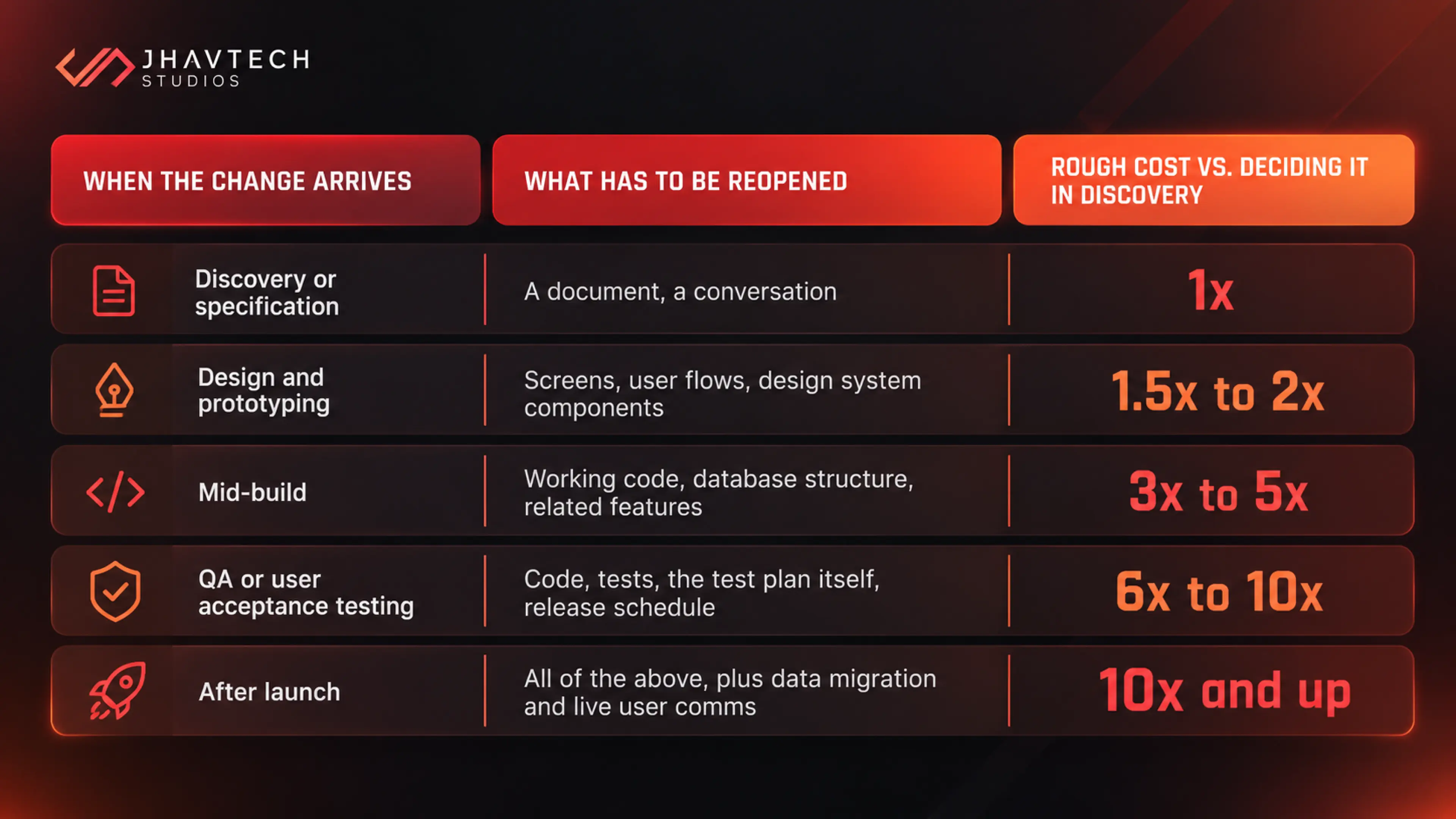
These multipliers are directional rather than precise, and they vary with architecture. The shape holds everywhere though, and it is the shape that matters: a decision deferred is a decision that gets more expensive every week it stays open. What drives the multiplier up is not the change itself but everything built on top of the assumption it breaks, because a database field that took an hour in week one now has migrations, tests and three screens depending on its shape. A loosely coupled system with good test coverage sits at the bottom of each range, and one where a single change ripples through four modules sits at the top, which is the practical argument for paying for decent architecture early. Not every change climbs at the same rate either, and the question worth asking is whether it touches the data model or only the surface, because copy and configuration stay close to flat while anything altering how data is stored climbs steeply. Batching works on the same principle: three changes released together reopen the same work once instead of three times, so holding anything non-urgent for one window routinely halves the cost of the lot.
6. Decisions Sitting in Somebody's Inbox
Short answer: a question sitting unanswered for a week on a four-person team costs about AUD $22,000 in team time, and the team usually spends it building the flexible version of both possible answers.
This is the driver clients least expect, and the one they have the most control over.
A development team working on a two-week sprint needs answers inside days, not weeks. When a question sits unanswered, the team does one of three things: they pause and work on something lower value, they guess, or they build the flexible version that handles both possible answers. All three cost money. The third one costs the most and is the hardest to spot, because it looks like progress.
Run the numbers on your own project. A team of four at a blended rate of AUD $140 an hour, which sits mid-range for a Melbourne or Sydney agency in 2026, costs you roughly $4,500 a day. A decision that sits for a week while three people find time to meet is not a free delay. It is a real expense, and it is one you are paying rather than your development partner.
The fix here is boring, which is probably why so few businesses bother with it. Name one person per decision area who can answer without convening a meeting. Set a 48-hour standard for questions from the build team. Agree in advance what the team should do when that standard is missed, so the default is not silently building the expensive option.
7. The Team Changed and Nobody Priced the Handover
Short answer: a developer joining a live codebase needs two to six weeks to become properly productive, and you pay full rate for all of it, plus the senior person answering their questions instead of building.
Developers leave. Agencies rotate staff. Contracts end. This is normal and it is survivable, but it is not free, and it is almost never in the budget.
A new developer joining a mature codebase takes somewhere between two and six weeks to become genuinely productive, depending on how well the system is documented. During that period you are paying full rate for partial output, and you are also paying the senior person who is answering their questions instead of building. Stretch it further again where the handover crosses time zones, which is the usual shape when an Australian business runs an offshore build team against an onshore product owner, because a clarifying question that should take ten minutes costs a day.
Handover cost scales directly with documentation quality, which means it is one of the few overrun drivers you can cap in advance. Insist on a current architecture overview, a readable setup guide, and a decision log explaining why things were built the way they were. Ask for it at the start of the project, not when somebody resigns.
If your project has already been through two or more teams and each one has described the previous team's work as a mess, that is a pattern rather than a coincidence, and it usually means the handover cost has been paid several times over without anyone naming it.
The 12-Point Budget Drift Checklist
This is the short version of what we run in a Jhavtech Studios budget drift audit. Tick what is true of your project this week. Four or more and your software development cost has already started moving, whether or not anybody has said so out loud.
☐ More than three approved changes have no written cost attached to them
☐ You cannot name the total value of changes approved since kickoff
☐ A decision from your side has been outstanding for more than a week
☐ The phrase "we'll work that out later" appeared in your last two meetings
☐ Sprint output has dropped for three consecutive sprints with no explanation you find convincing
☐ The bug backlog is growing faster than it is being cleared
☐ An integration has been "nearly done" for more than two weeks
☐ A developer has left or joined and no handover period was budgeted
☐ You have no single document listing every requested change
☐ Your team has started describing work as "refactoring" without an agreed scope for it
☐ Nobody can tell you the percentage of budget spent against percentage of scope delivered
☐ You have stopped asking for a revised forecast because the last two were wrong
That last one is the serious one. When a business stops asking for the number, it is usually because the answer has become uncomfortable, and that is precisely the moment the number needs an outside read.
What to Do in the Next 30 Days
Week one, count it. Pull every change request since kickoff into one list, including the ones agreed verbally. Put a cost against each. Most teams find the total sits 15% to 25% above what they thought, and the exercise takes an afternoon.
Week two, run your Budget-to-Scope Ratio. This is the first number we ask for in a Jhavtech Studios rescue audit, and it is two figures divided: percentage of budget spent over percentage of agreed scope delivered. At 70% of budget and 45% of scope your ratio is 1.56, and you have an overrun rather than a feeling about one. Anything above 1.2 across three consecutive fortnights is drift. Almost nobody tracks this, which is why almost everybody is surprised.
Week three, close the open decisions. List every question waiting on your side. Assign each to one named person with a date. This costs you nothing and it is routinely the fastest money a business saves on a live build.
Week four, get an outside read. Ask for a revised forecast from your development team, and if the gap between that and the original is large, have someone independent look at the code and the plan before you approve more spend. When deadlines keep slipping and the estimates have stopped being believable, bringing in a team that specialises in turning stalled builds around costs a fraction of what another six months of drift will.
PMI's 2026 research makes the same point from the other direction. Projects using a structured framework succeeded at 72% against 61% for those without one, yet 35% of professionals used no framework at all on their most recent complex project (PMI, Pulse of the Profession 2026). Frameworks are not expensive. Skipping them is.

How to Keep Software Development Costs from Drifting
Software development cost goes up after kickoff for reasons that are almost always visible weeks before they become expensive. Scope grows one favour at a time. Decisions get postponed into the costly end of the project. Rework eats sprints quietly. Integrations behave differently in production. Nobody writes down what the changes cost.
None of it is exotic and all of it is measurable, which is the good news buried in here somewhere. The businesses that finish close to budget are the ones that look at the number every fortnight and then do something about what it tells them, back while it is still a conversation rather than an invoice.
Frequently Asked Questions