.svg)
.svg)


How Poor Software Architecture Creates Long-Term Business Risks
.webp)
Poor software architecture doesn't cause problems immediately. It causes them 12 to 18 months later, once the codebase is too tangled to change quickly, too fragile to scale, and too undocumented for new developers to work in. This blog covers how bad software design compounds into real business risk (financial, security, and competitive), what the early warning signs look like, and what scalable architecture requires in practice. It's written for the people who feel the consequences of these decisions but rarely get to make them: founders, CTOs, and operations leads.
What Software Architecture Actually Means (In Plain English)
Software architecture is the set of decisions that determine how the different parts of your application talk to each other: the database, the servers, the APIs, the front end, and everything in between. It's the blueprint. You stop seeing it once the walls go up, but it still decides whether you can add a second floor later or whether the whole structure has to come down first.
Most founders treat it as a purely technical concern and hand it entirely to developers. That's usually where the trouble starts. Architecture decisions made in month one, often under pressure to launch fast, quietly set the ceiling on how big and how fast the business can grow three years later.
A well-planned enterprise app structure is built to anticipate growth in users, data, integrations, and regulatory scrutiny. A poorly planned one runs fine at 500 users and starts breaking somewhere around 5,000. That's why, for a new product, the smartest time to think about building mobile products with growth built in from the start is before a single line of code gets written, not after the first scaling problem shows up.
The Real Cost of Bad Software Design (Backed by Data)
This is a measurable drain on IT budgets, not a theoretical problem. The numbers below show how much of a typical technology budget already goes toward compensating for architecture decisions made years earlier.
- Deloitte's 2026 Global Technology Leadership Study found that technical debt now consumes between 21% and 40% of total IT spending at the average organisation, meaning a significant share of every technology dollar goes toward servicing old decisions instead of building new value.
- A recent Gartner study projects that architectural technical debt, the kind buried in the connections between systems rather than inside a single module, will account for roughly 80% of all technical debt by 2027. This is the category of debt that is hardest to see coming and most expensive to unwind.
- IBM's 2025 Cost of a Data Breach Report puts the global average cost of a single data breach at $4.44 million, a figure heavily influenced by systems with poor separation of concerns, weak authentication layers, and legacy components that were never designed with modern security threats in mind.
These figures translate directly into business decisions: features that get delayed, hires that get postponed, and in some cases, products that need to be rebuilt from scratch.
Bad Architecture vs Scalable Architecture: A Quick Comparison
The difference between the two rarely shows up on day one. It shows up in how the system behaves once real users, real data, and real growth start putting pressure on it.

The pattern is consistent across every row: poor architecture gets more expensive to fix the longer it's left alone, while scalable architecture gets more valuable the more it's used. One path quietly drains time, money, and confidence. The other compounds in your favor.
How Poor Architecture Quietly Becomes a Business Risk
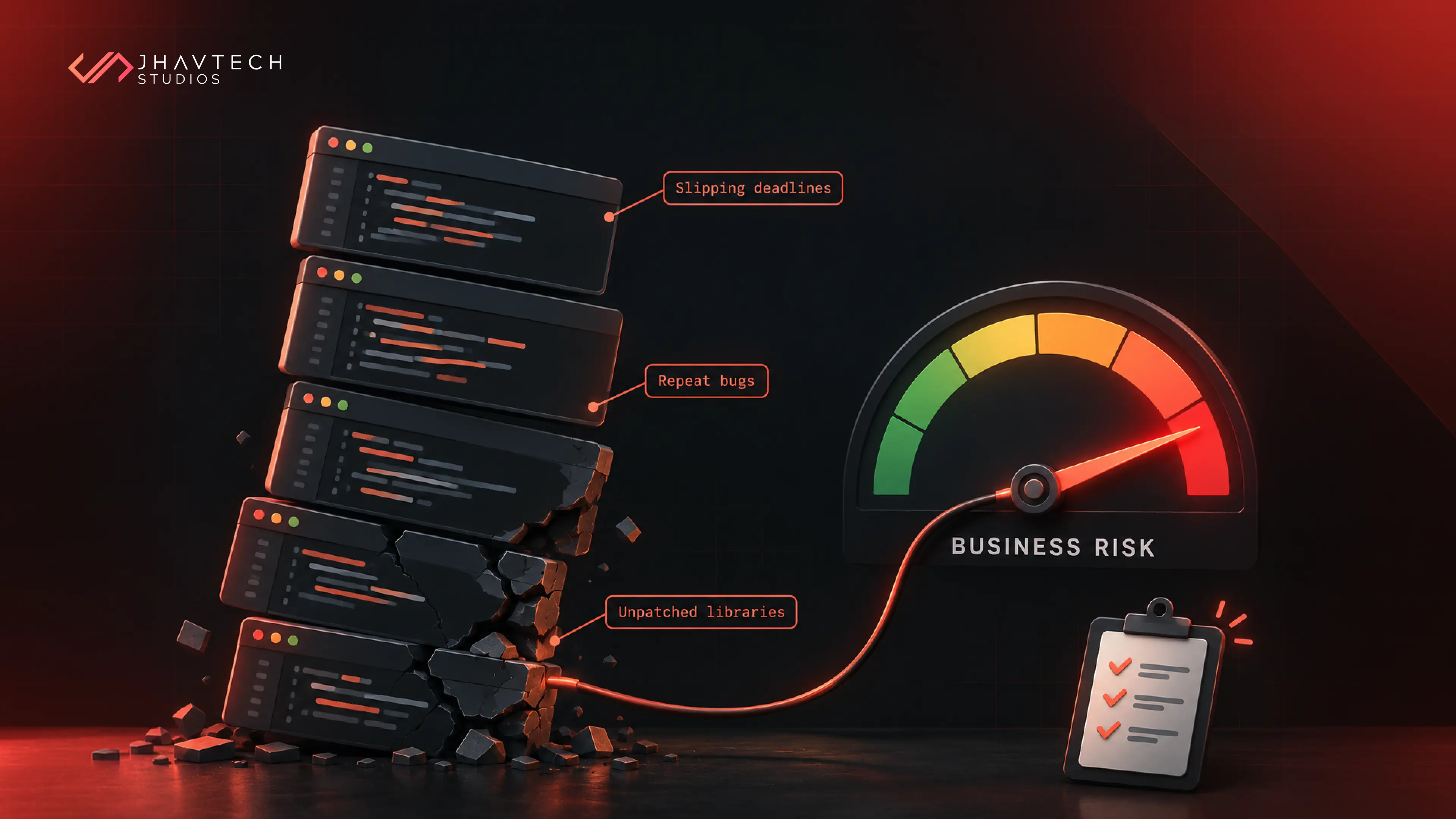
Bad architecture rarely announces itself. It builds up in layers, and each layer makes the next problem more expensive to fix. Here's how that plays out across five areas that affect the whole business, not just the engineering team.
Scalability Risk
A system built without scalable architecture in mind can handle your first thousand users just fine, then fail exactly when growth arrives. A marketing push, a press mention, or a big client rollout sends real traffic its way, and the app slows down or falls over. Rebuilding under pressure, while customers are actively trying to use the product, is one of the most expensive positions a business can put itself in. It's also one of the clearest signs legacy systems are quietly slowing down business growth long before anyone officially calls it a legacy system.
Security and Compliance Risk
Weak software infrastructure planning almost always shows up as weak security. Authentication gets bolted on after the fact instead of designed in from the start. Data flows are inconsistent, which makes it harder to prove compliance with regulations like the Australian Privacy Act, GDPR, or industry-specific rules in healthcare and finance. Given that IBM puts the average breach cost at $4.44 million, a fragmented architecture doesn't just raise the odds of a breach, it makes the damage harder to contain once one happens.
Financial Risk
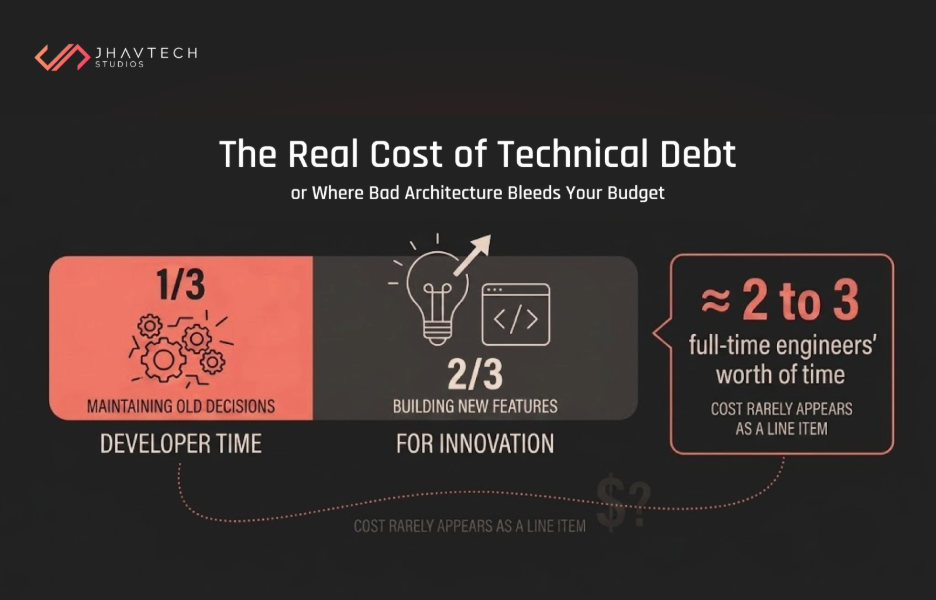
Every workaround and skipped test adds to technical debt, and that debt compounds like interest. Industry research puts the average developer's time spent working around old technical debt, rather than building anything new, at roughly a third of their week. On a typical team, that's the equivalent of two or three full-time engineers doing nothing but managing old decisions. It rarely appears as a line item, but it's a direct cost, and it often traces back to early shortcuts like cutting corners on offshore development that end up costing more in the long run.
Talent and Team Risk
Engineers leave codebases before they leave companies. A fragile, undocumented, tangled system is one of the more common reasons senior developers quit, and it's often mistaken for a management problem instead of an architecture one. Losing the engineers who understand the "why" behind old decisions makes the system riskier for whoever inherits it, and it's usually preceded by the same warning signs that software is becoming unmanageable that a CTO could have caught months earlier.
Competitive Risk
Time lost to architecture problems is time competitors spend shipping. While one team is fighting fires in a poorly structured system, a competitor with a cleaner enterprise app structure is releasing features faster and responding to market shifts sooner. Architecture debt costs money, but the bigger cost is usually time, and time is the one resource that can't be bought back.
Checklist: Is Your Software Architecture Putting Your Business at Risk?
Run through this quickly. If you tick more than two or three of these, it is worth a closer look.
What Software Infrastructure Planning Should Look Like
Fixing this is not about throwing out everything and starting over. It is about approaching software infrastructure planning as a business function, not an engineering afterthought.
- Audit before you build. Understand exactly where the current risks sit before adding a single new feature.
- Design for the business you'll be in two years, not the one you're in today. Scalable architecture accounts for growth in users, data, and integrations from the start.
- Separate concerns clearly. A well-structured enterprise app keeps its data layer, business logic, and interface loosely connected, so a change in one doesn't break the others.
- Document as you go. Architecture that lives only in one developer's head is a liability the moment that person leaves.
- Review regularly, not just when something breaks. Treat architecture reviews like financial audits: scheduled, not reactive.
Getting architecture right at the start is cheaper than fixing it later. Treating this as a business function, not an afterthought, is what separates products that scale smoothly from products that need a rebuild within two years. If that rebuild already feels inevitable, specialists who step in and turn failing projects around can help determine whether a rescue or a full rebuild is the more cost-effective path forward.
Frequently Asked Questions






.png)
.png)
.png)

.png)
.png)
.png)

.png)
.png)
.png)
.png)
.png)
.png)
.png)
.png)
.png)
.png)
.png)
.png)


.png)
.png)
.png)
.png)
.png)
.png)
.png)
.png)
.png)

.png)
.png)
.png)
.png)
.png)
.png)
.png)
.png)
.png)
.png)


.png)
.png)
.png)

.png)
.png)
.png)
.png)

.png)
.png)
.png)


.png)
.png)
.png)


.png)

.png)



.png)


.png)





.png)




.png)







.png)

.png)




.png)