How Can Businesses Prioritise Technology Investments With Limited Budgets?
SUMMARY BLOCK: What You Need to Know
- Prioritising IT investment is a sorting problem, not a math problem. Most SMEs don't have too little budget. They have too many half-funded projects running at once.
- Audit before you allocate. Twelve months of tagged technology spend almost always surfaces enough waste to fund the thing you were about to borrow for. Flexera’s 2026 survey of cloud decision makers put estimated wasted cloud spend at 29%.
- Four buckets, then a score. Sort every candidate into Keep Running, Stop the Bleeding, Make Money, and Nice to Have. Score only what survives.
- Gartner forecasts worldwide IT spending of US$6.39 trillion in 2026, up 14.5%, crossing US$7 trillion in 2027. Prices are climbing. Being late to prioritise costs more next year than it did this year.
- The ABS found 28% of Australian businesses had no measures in place to prevent cyber security incidents in 2024–25. Security is not a line item you defer to next financial year.
- The table, scoring sheet and checklist below give you something you can run in an afternoon.
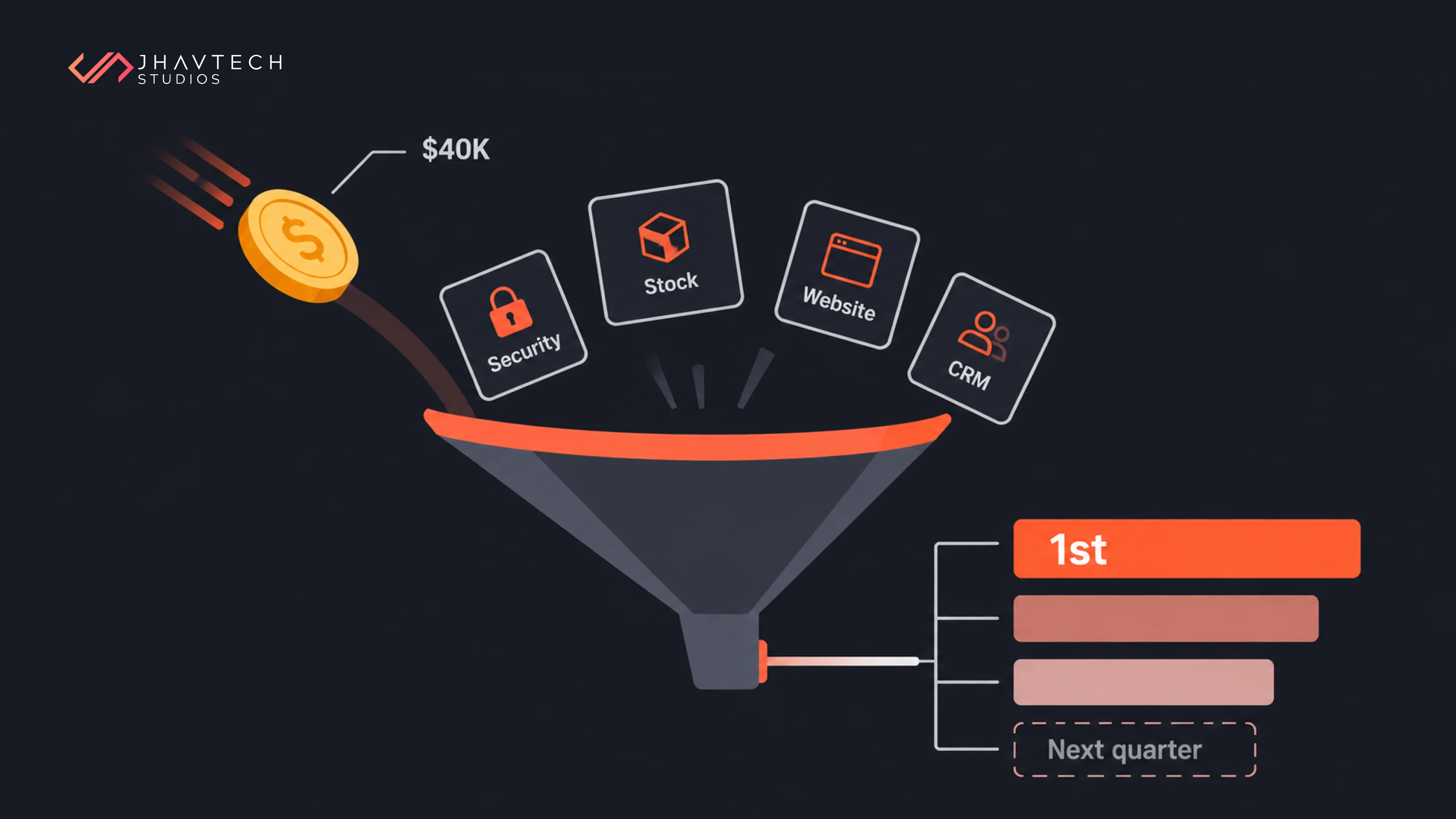
A wholesaler in Melbourne rang us in March with forty thousand dollars and four problems. Stock counts were wrong often enough that sales had stopped trusting the system. The website was five years old and slow on mobile. Nobody had looked at their backups since the office move. And the sales manager wanted a CRM, badly, because he was running the pipeline out of his own head and a notebook.
Forty thousand does not cover four projects. It covers one and a half, properly done.
What they wanted from us was a recommendation on which tool to buy. What they needed was a way to decide, because next year there would be four more problems and the same awkward arithmetic. That is the real skill when the budget is tight. Not picking the right vendor but knowing which of your problems is costing you the most right now, and having a reason you can say out loud when you tell the sales manager his CRM is waiting until next quarter.
Gartner now forecasts global IT spending will reach US$6.39 trillion in 2026, up 14.5% on the year before, and cross the US$7 trillion mark in 2027 (Gartner, “Worldwide IT Spending to Grow 15% in 2027, Totaling $7.35 Trillion”, 21 October 2026). Everyone is spending more. That does not mean you should, and it does mean the cost of choosing badly has gone up.
The Problem Is Rarely the Size of the Budget
Walk into most small businesses with a tight technology budget and you will find three or four initiatives running at once, all underfunded, none finished. The new platform is half-configured. The old one is still live because sales will not move. Somebody started a data cleanup earlier in the year and it stalled.
None of those projects are delivering value. All of them are consuming licence fees, attention, and the goodwill of the staff who keep being asked to test things.
A business doing one project properly with $40,000 beats a business doing four badly with $120,000. That sounds obvious written down. It almost never survives a management meeting where four people each have a reasonable ask.
So the question to answer first is not “what can we afford”. It is “what do we stop so one thing can finish”.
Step One: Find Out What You Are Already Paying For
Before any new IT investment gets approved, pull twelve months of technology spend into a spreadsheet. Every line. Software subscriptions, hosting, domain renewals, phone plans, the contractor who maintains the integration nobody understands, the security tool you bought after the scare in 2024.
Tag each line as Run (keeps the lights on), Improve (makes something you own better), or New (a bet). That split is your IT budget allocation, and most owners have never seen it written down. Deloitte’s CIO benchmark puts the average at 57% on business operations, 26% on incremental change and 16% on innovation (Deloitte Insights, “Technology budgets: From value preservation to value creation”). Most growing SMEs sit well above that 57%, which is why their new ideas never get funded.
This exercise pays for itself more often than not. The usual finds: seats bought for headcount you never reached, two tools doing one job because two departments bought separately, a platform that outlived the person who championed it, and cloud resources provisioned for a launch that happened eighteen months ago. Flexera’s 2026 State of the Cloud Report, drawn from more than 750 cloud decision makers, found respondents estimate 29% of cloud spend is wasted, the first rise in five years (Flexera, “Cloud Value Is Rising While AI Waste Grows”, 18 March 2026).
Cancel three subscriptions and you may have found your project budget without asking the bank.
Step Two: Sort Every Candidate into Four Buckets
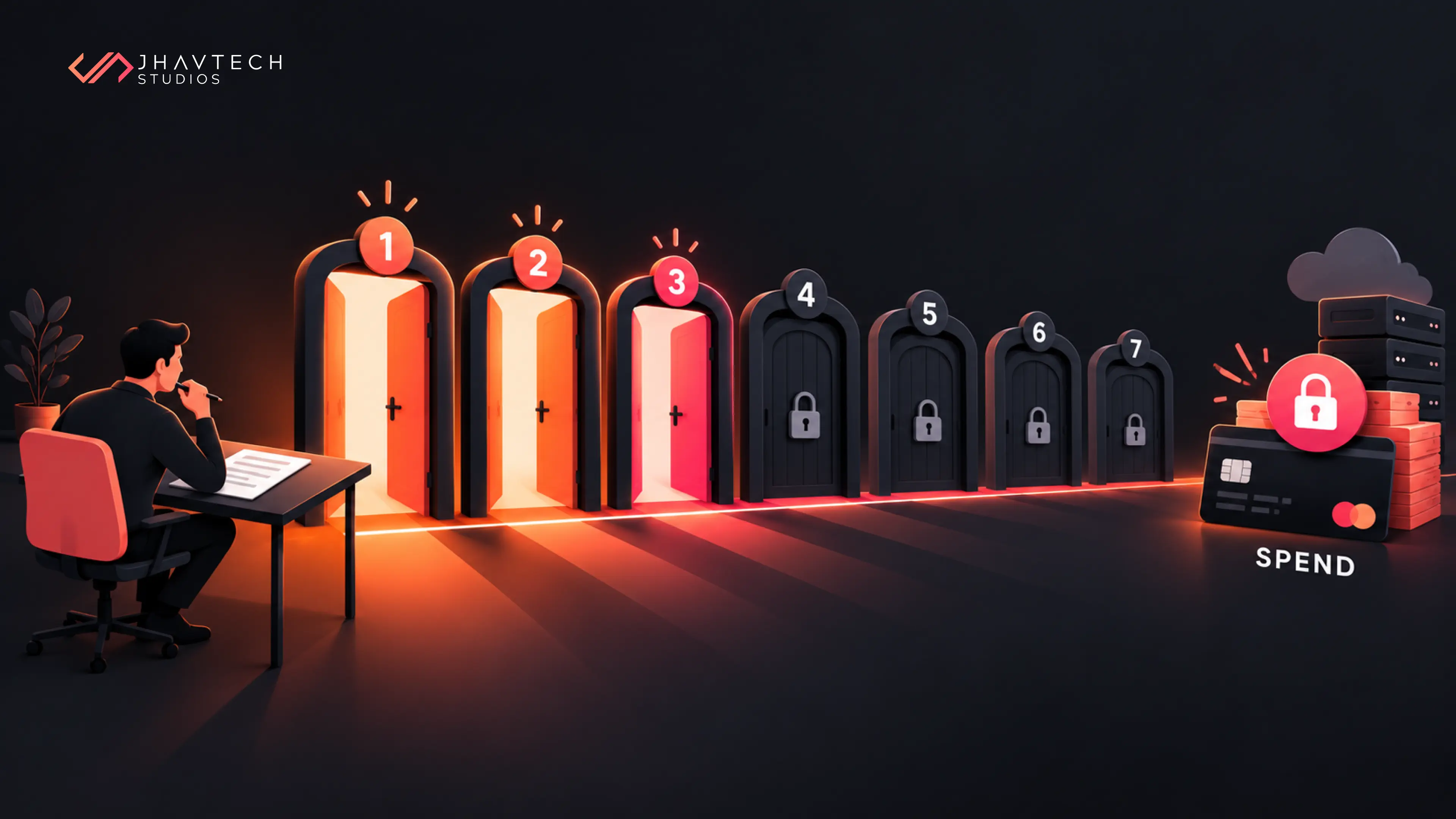
Once you know what you are spending, list everything competing for the new money. Then sort before you score. Sorting is fast and it kills most of the list. If you have not yet settled the decisions that sit upstream of this one, the seven calls worth getting right before any money moves covers them.
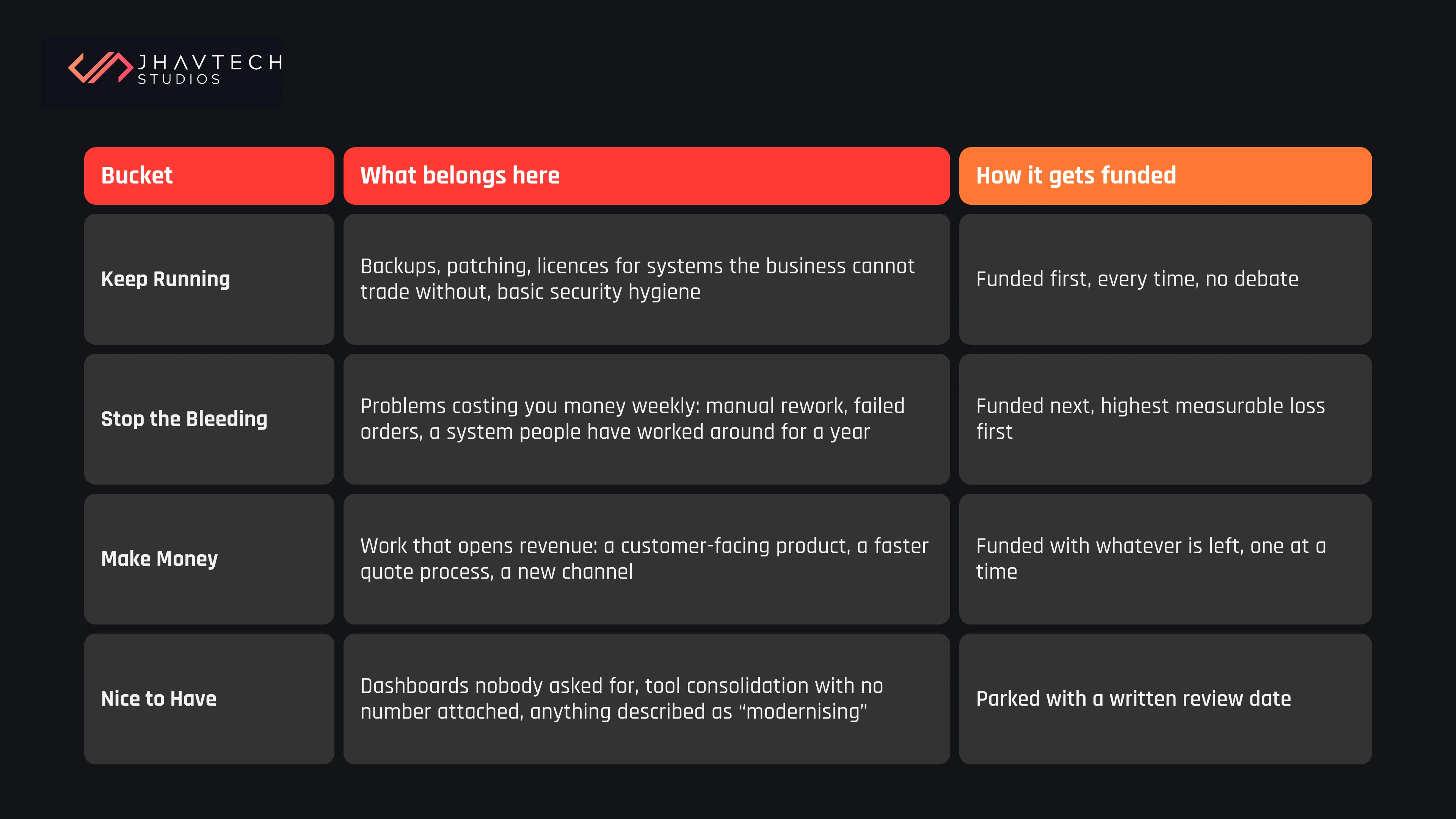
The arguments happen at the boundary between Stop the Bleeding and Make Money, and that is the useful argument to have. Everything that lands in Nice to Have gets a date, not a no. You revisit it next quarter.
One note on the first bucket. The ABS reported that 28% of Australian businesses had no measures in place to prevent cyber security incidents in 2024–25 (Australian Bureau of Statistics, “Characteristics of Australian Business, 2024–25”). The Australian Signals Directorate put the average self-reported cost of cybercrime for a small business at $56,600 per report (Australian Signals Directorate, “Annual Cyber Threat Report 2024–25”). A business that defers its Keep Running bucket to fund a growth project is not being ambitious. It is carrying an unpriced risk that is larger than the project.
Step Three: Score What Survives
Three or four candidates usually make it past the sorting. Now you score them, and the scoring has to be written down, because the whole point is having a defensible answer when someone asks why their project lost.
Do the scoring in one room, on one afternoon, with every sponsor in it. A sheet filled in privately over a week turns into a lobbying exercise, and the top score ends up belonging to whoever spoke to you last. Make people bring the evidence and not just the number, because “it takes ages” and “it took nine hours last fortnight, here is the timesheet” are not the same claim, and only one of them holds up in ninety days. Don't weight the questions. Weighting is where a decision you already made gets smuggled in. Totals often land close together, and anything inside two points is a tie, broken on what unblocks what rather than on merit. Then keep the sheet somewhere you will find it again, because the real test is not whether the winner felt right in the meeting but whether the pain you funded against actually moved.
Rate each one from 1 to 5 on five questions, then total it.
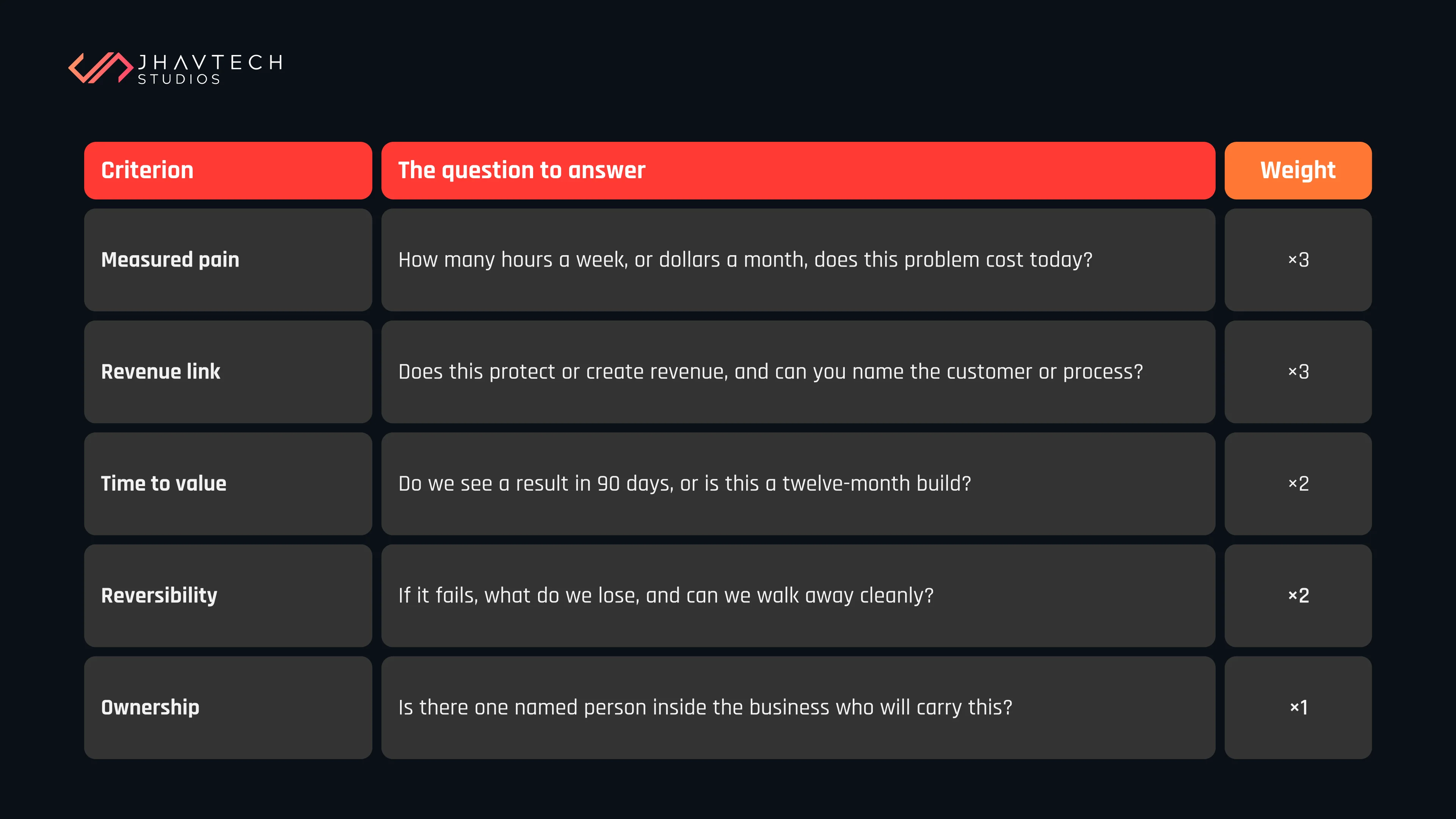
Two more rules make the score honest. Anything scoring 1 on measured pain is not ready, no matter how high it totals elsewhere, because a problem nobody has counted is a problem nobody has watched. And anything scoring 1 on ownership gets deferred until a name is attached, since committee-owned projects are the ones that are still half-done in eighteen months.
For the wholesaler, stock accuracy won on a score of 38 against the CRM’s 24. Not because inventory is more interesting, but because they had counted it: eleven hours a week of recounts plus roughly $3,000 a month in credits for short-shipped orders. The CRM had no number next to it at all.
Where Cost-Benefit Analysis Quietly Falls Apart
Small business cost-benefit analysis usually breaks in three places, and all three are on the cost side.
The first is the implementation cost nobody budgets: your own people’s time. Data migration, configuration, testing, the two weeks where everyone works two systems in parallel. For a twenty-person business this is often larger than the licence fee, and it never appears on the vendor quote.
The second is the three-year view. A platform at $900 a month is $32,400 over three years before the annual uplift clause most contracts carry. Find the escalation percentage, multiply it across the full term, and compare that number against the alternatives rather than the monthly figure in the proposal.
The third is the cost of carrying what you already have. Deferred maintenance compounds, and it compounds against your ability to ship anything new. We broke the mechanics of that down in seven ways technical debt drains a development budget, and it is worth reading before you decide a cleanup project is Nice to Have.
On the benefit side, be specific or be quiet. “Improved efficiency” is not a benefit. “Order processing drops from 22 minutes to 6, across roughly 400 orders a month” is one, and it is checkable in ninety days. Our walkthrough on putting a dollar figure on a build before you commission it covers the arithmetic in detail.
Sequencing When Everything Feels Urgent
Prioritisation produces an order, and the order matters more than the ranking.
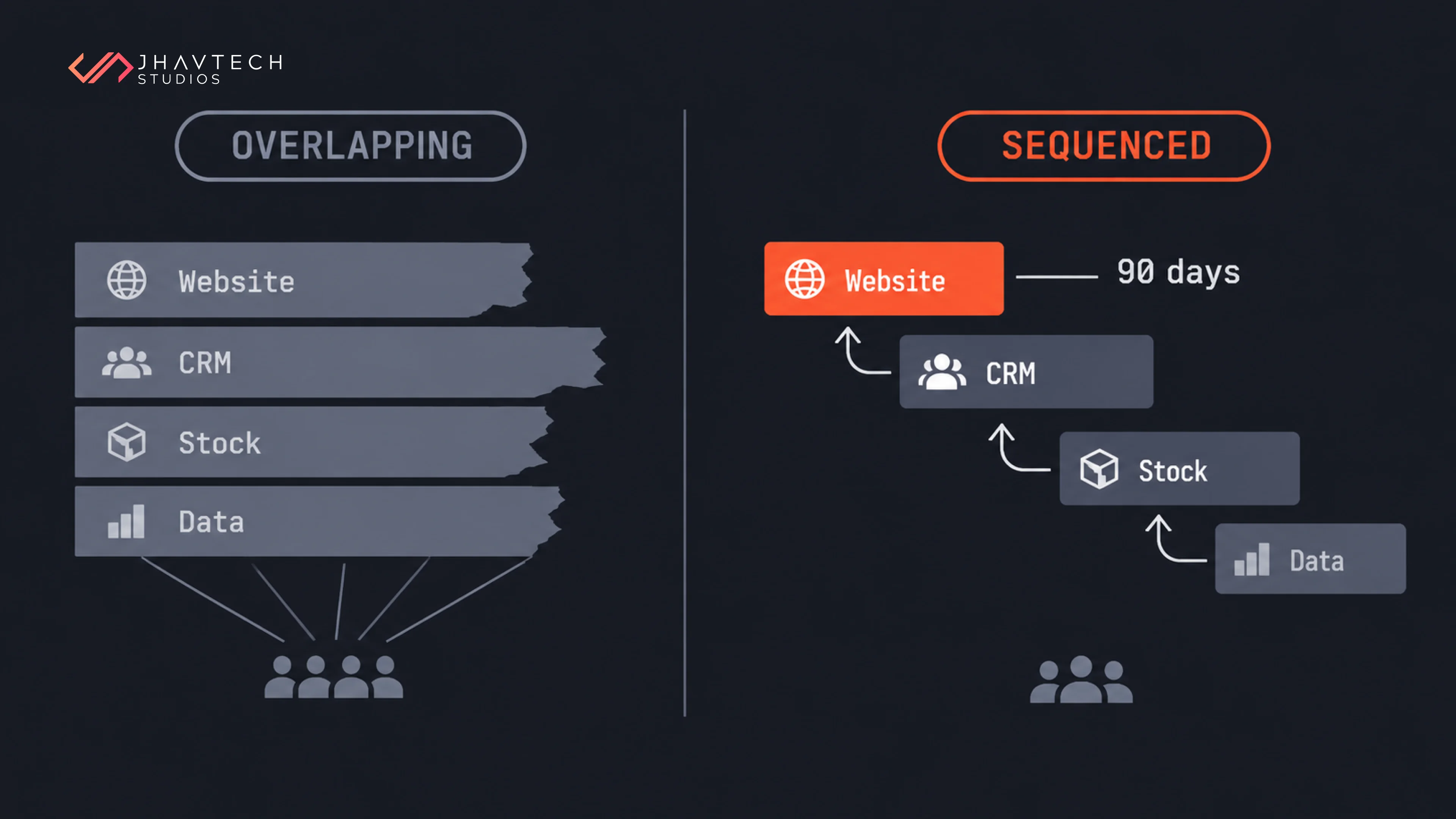
Put dependencies first. If three of your four projects assume clean customer data, the data work goes first even though it scores poorly on its own, because the other three will fail without it. This is the single most common sequencing mistake we see in SME digital transformation priorities: buying the shiny layer before fixing the foundation it sits on.
Then stagger start dates. Two projects beginning in the same month compete for the same five people, and both slip. Finish one, bank the result, start the next.
And pick something small first. A win inside ninety days buys you credibility for the longer build that follows, which matters when the next budget conversation comes around.
Technology Procurement Without Procurement Power
A small business has almost no leverage after signing and quite a lot in the fortnight before. Use it.
Ask every shortlisted vendor the same written questions and keep the answers. A demo shows you the product on its best day. A written answer is something you can hold a vendor to in month eight. Four questions carry most of the weight: how you export your data, what the annual price escalation is, who owns the code and designs for custom work, and what help you get on the way out. We covered the traps in detail in eight vendor lock-in risks worth checking before you sign.
Request a sample data export during the trial. Not a clause promising one. An actual file.
One more option people forget when money is short. You already own several systems, and the gap between them is where the manual work lives. Connecting two platforms properly often costs a fraction of replacing either and ships in weeks rather than quarters. Build custom only where the capability is genuinely yours, which is usually the thing a customer would notice if it vanished. When that thing is customer-facing and the experience is the product, that is the point where a purpose-built app your competitors cannot buy off a shelf starts to make commercial sense.
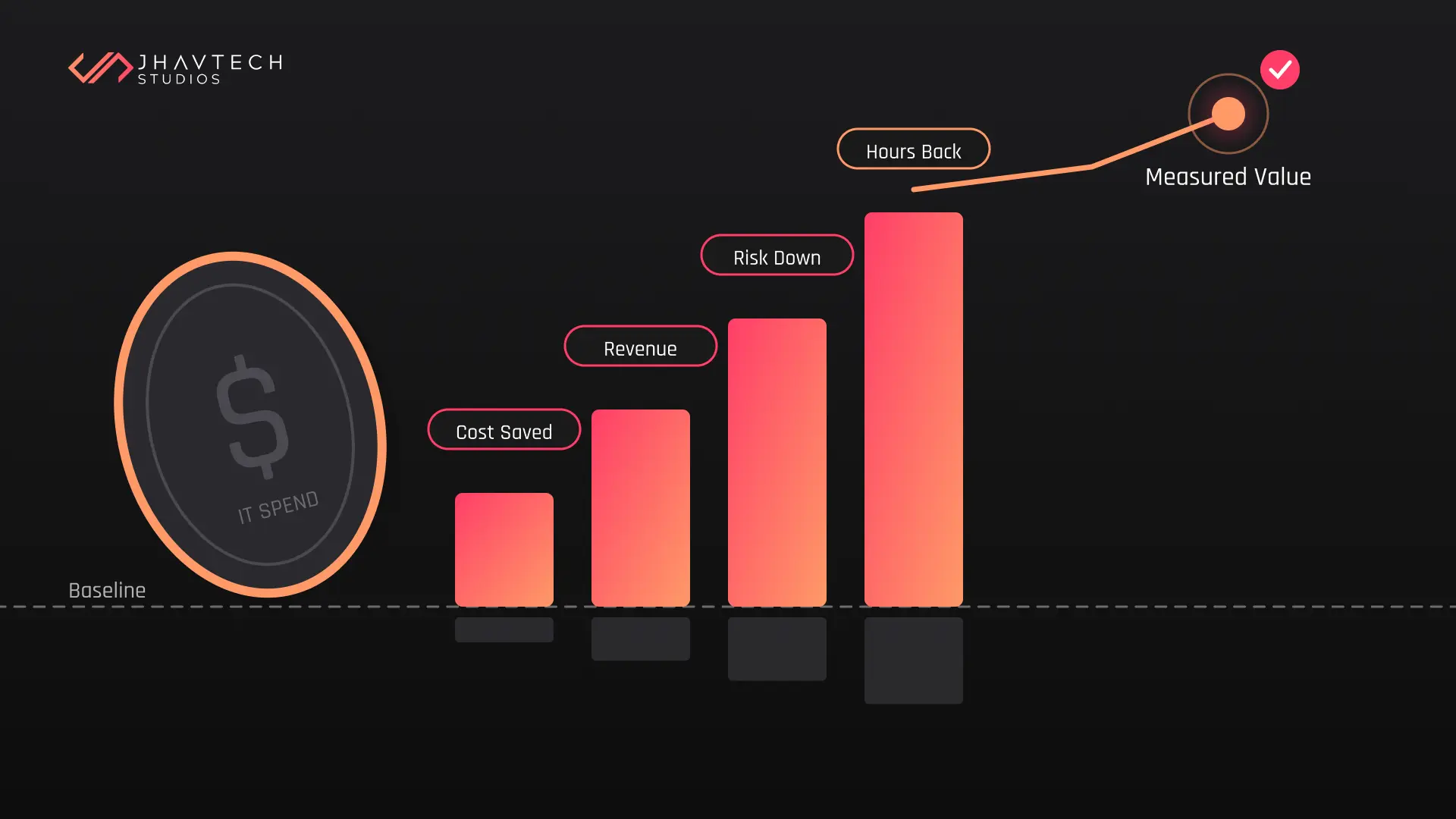
If a project you have already funded has stopped moving and the dates keep sliding, more budget rarely fixes it. A team that takes over stalled builds and gets them shipping again is usually cheaper than restarting, and considerably cheaper than a second failed attempt. And once it ships, keep measuring it. Our guide to proving what an IT investment returned covers what to baseline before go-live.
The Prioritisation Checklist
Run this before the money moves. Four or more unticked and the decision is not ready.
❑ Twelve months of technology spend is tagged into Run, Improve and New
❑ Someone has checked for duplicate or unused licences this quarter
❑ Every candidate is sorted into one of the four buckets
❑ Keep Running items are funded before anything else
❑ Each surviving candidate has a measured cost of pain, in hours or dollars
❑ Internal implementation time is in the cost, not just the licence
❑ Three-year total cost is calculated, including price escalation
❑ Dependencies are mapped and the foundation work is sequenced first
❑ One named person owns each funded project
❑ Projects have staggered start dates, not a shared one
❑ A sample data export has been requested and received
❑ A review date and reviewer are in the calendar
Eight ticks and you have a decision you can defend. Four and you have a preference.
Where This Leaves You
The businesses that get good value from technology on a modest budget are not the ones with the best vendor relationships. They are the ones who can say, in one sentence, why this project and not that one, and who finish what they start.
Spend the afternoon on the spend audit. Sort the list. Score what is left. Then fund one thing properly and leave the rest with a date.
Frequently Asked Questions