How Do You Measure AI ROI Beyond Time and Cost Savings?
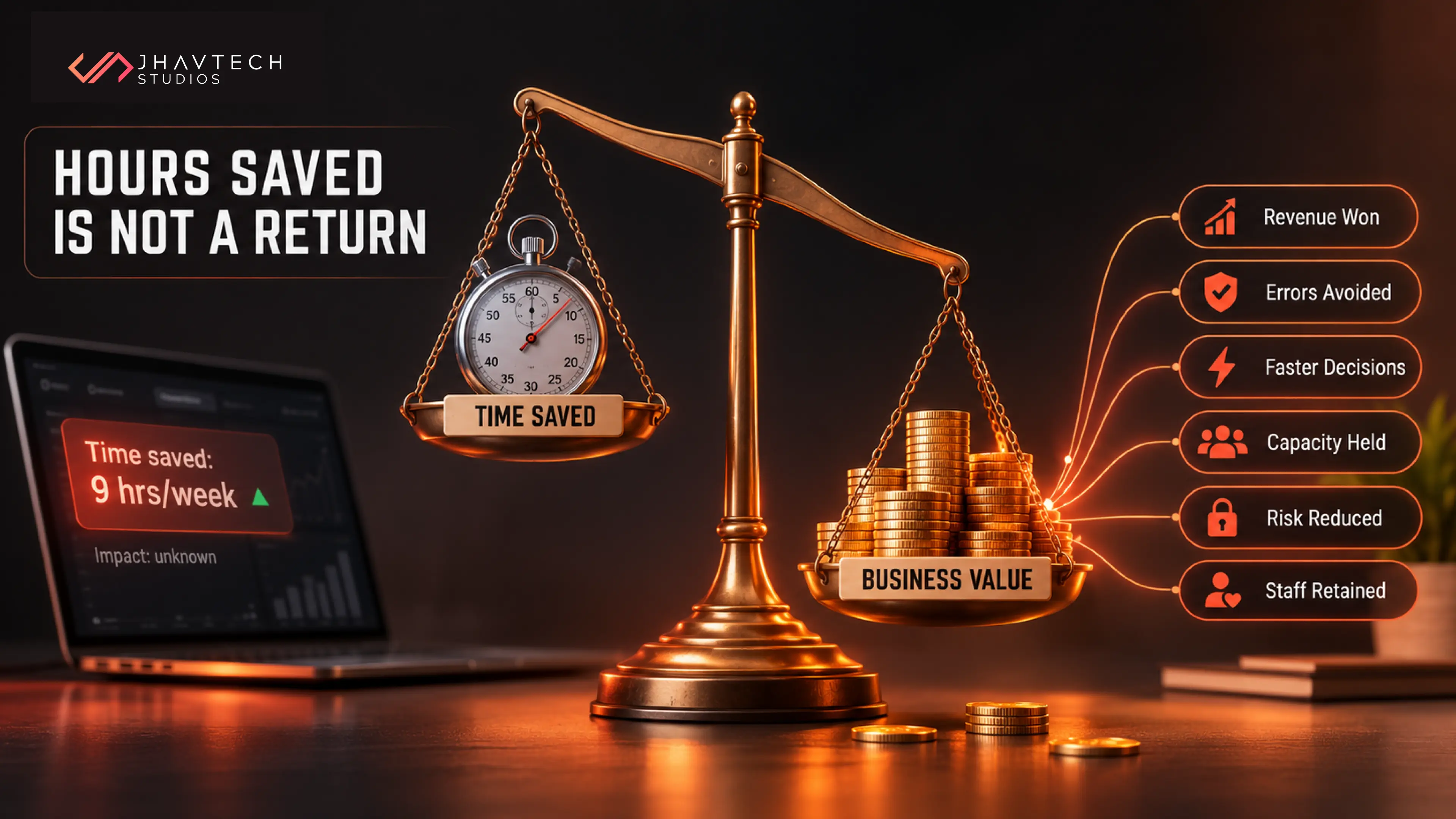
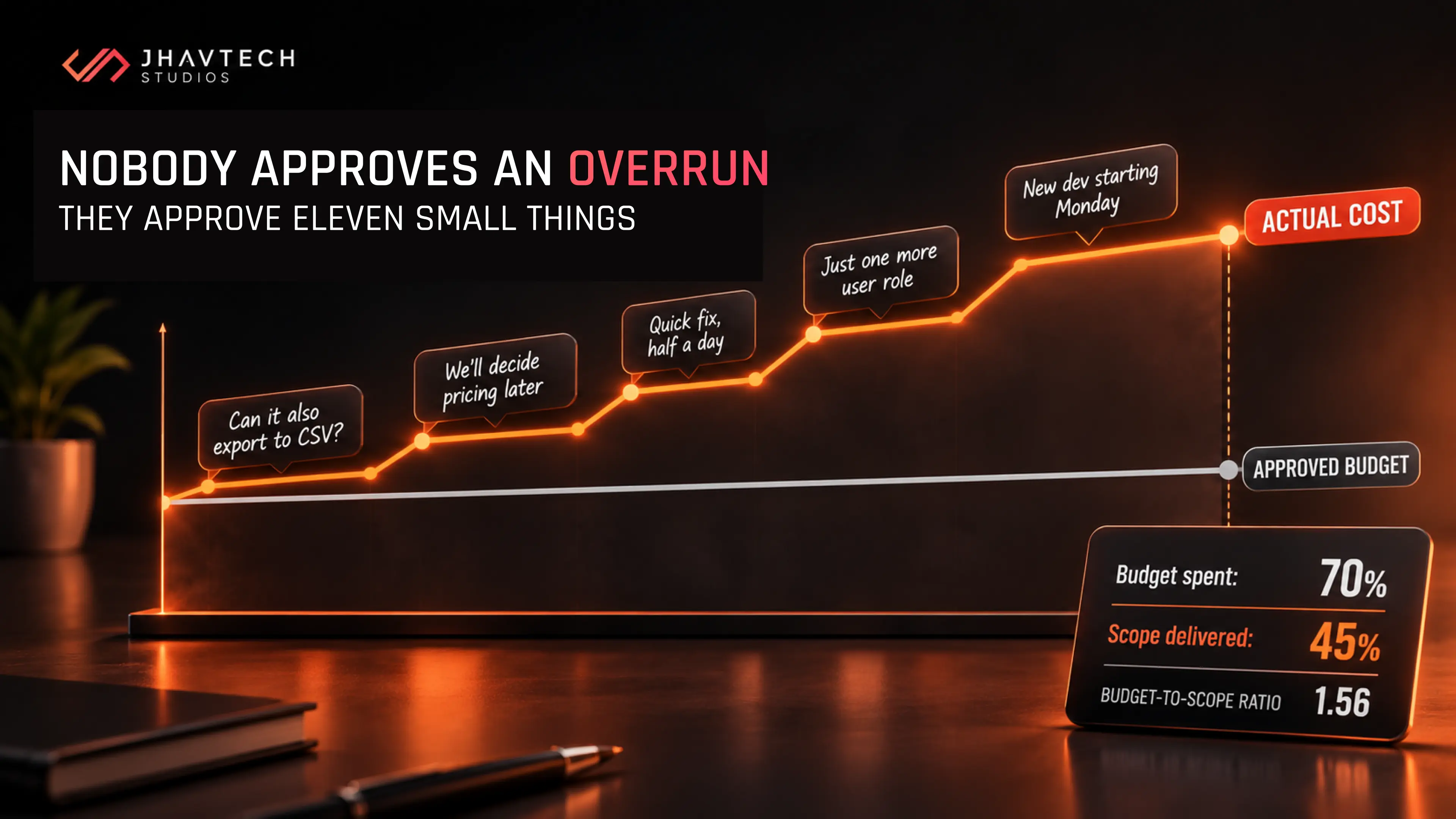
AI ROI is the quantifiable business value an artificial intelligence system returns against its total cost of ownership, including data preparation, integration, inference and ongoing monitoring. Hours saved is one input to that calculation. On its own, it proves almost nothing.
Summary: The Short Answer
Most businesses measure AI by the only number that is easy to produce: time saved. It is a weak proxy. An hour freed up is worth nothing until it replaces a hire or gets pointed at work with a price tag. To calculate AI return on investment for an SME, ignore the timesheet and measure what a customer, a supplier or an auditor would notice: revenue won, errors not paid for, decisions made sooner, capacity you held without hiring.
What you will take away from this blog post:
- Why hours saved collapses under scrutiny, and the three conditions under which it does convert to money.
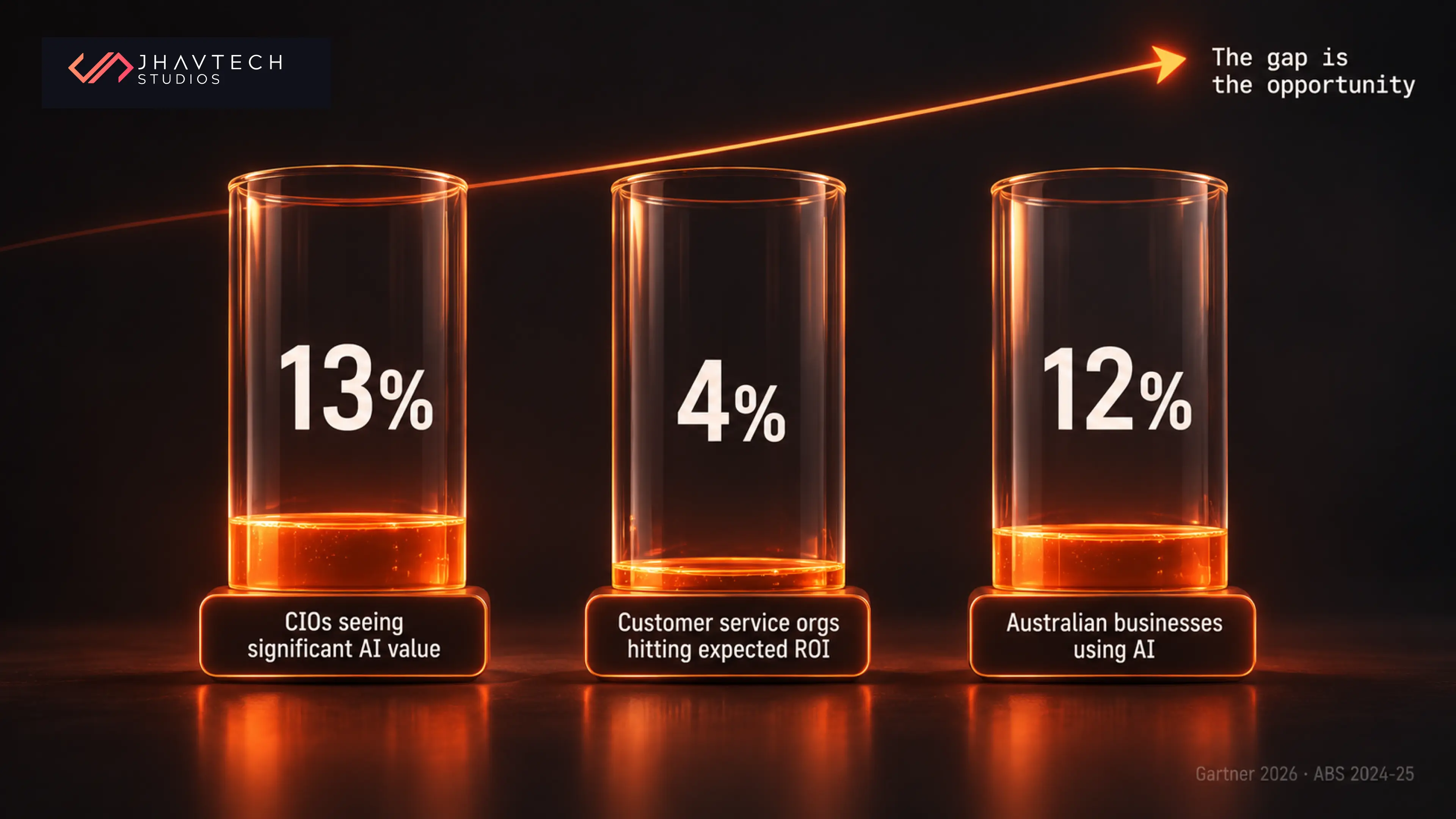
- The current scoreboard: 13% of CIOs told Gartner in October 2026 they had seen significant value from AI. In customer service, 4% hit their expected return.
- Six areas of value that never show up on a timesheet, with the AI performance metrics for business that track each one.
- A scorecard table you can hand to a board without being embarrassed.
- A 90-day measurement checklist.
- The costs most businesses forget to subtract, which is where a lot of positive-looking returns quietly die.
Hours Saved Is the Weakest Number in the Room
We get asked to review a lot of AI projects at Jhavtech Studios, usually after the pilot has gone well and before anyone has checked the arithmetic. The pattern is almost always the same. Someone reports that the new document tool saves the admin team nine hours a week. Heads nod. Nobody asks the follow-up.
What happened in those nine hours?
If the answer is a shrug, nothing was saved. Slack was redistributed. The work got more comfortable, which is a fine outcome, but it's not a return, and it should not be presented as one.
Time converts to money under three conditions and no others: you avoid a hire you were about to make, the freed capacity gets aimed at work that generates revenue, or a bottleneck that was costing you customers disappears. Miss all three and the saving lives on a slide forever.
The squeeze is real, too. Gartner’s October 2026 survey of 2,002 CIOs found 58% under heavier pressure to deliver cost savings through AI, while 51% expected AI to increase the total cost of running their technology stack. Be asked for both at once and you get a lot of projects that look efficient on paper and feel expensive in the bank account.
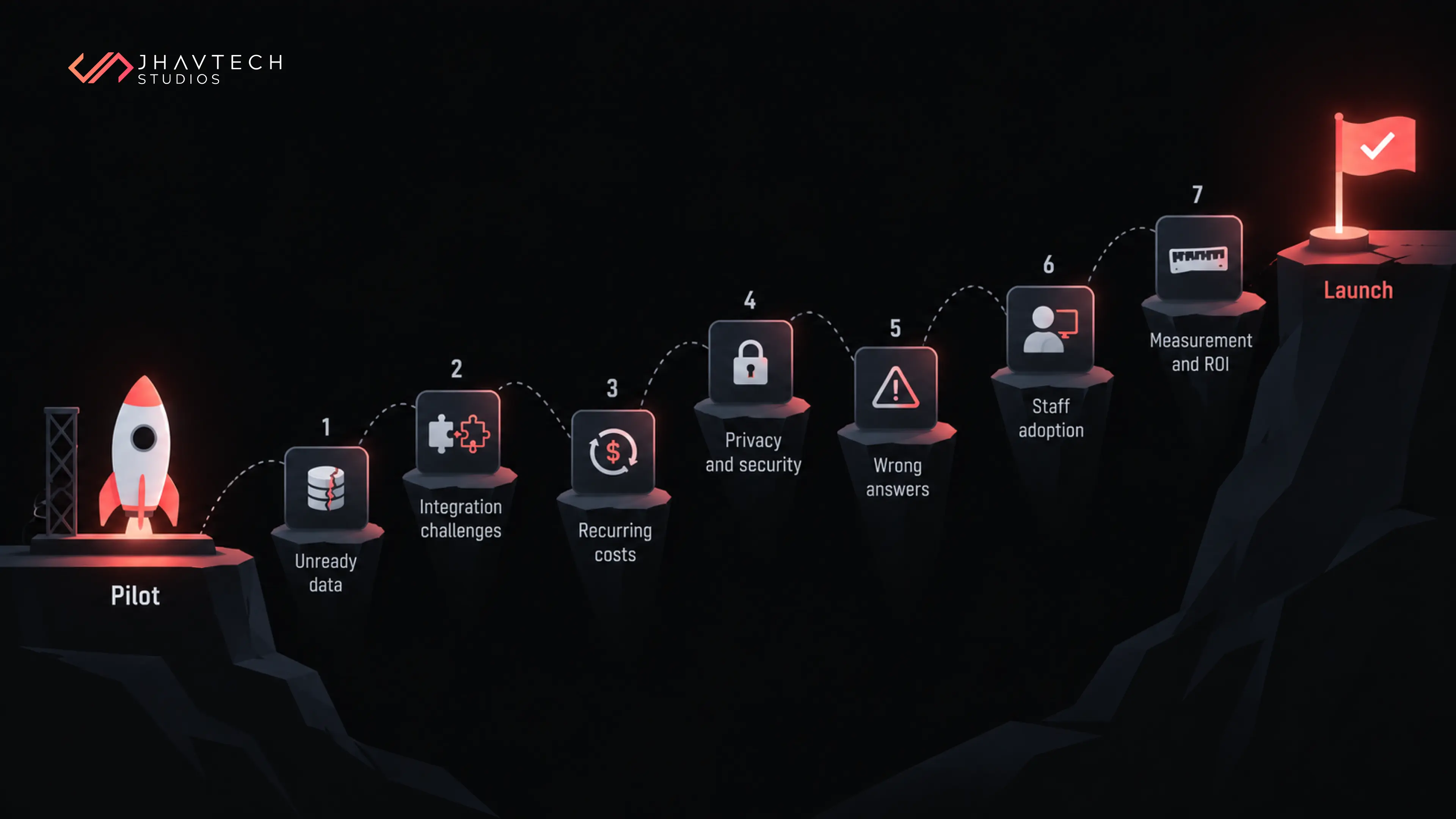
Most AI pilots fail in the spreadsheet, not the server room.
Look at Three Numbers Before You Sign Off on Any AI Build
Value is rarer than the marketing suggests. Only 13% of CIOs in that Gartner survey reported significant or transformational value from AI, and about one AI use case in five succeeds. That is not a case against AI. It is a case for narrow problems and honest measurement.
Chasing cost alone underperforms. A Gartner survey of 275 service and support leaders, conducted mid-2026 and published that November, found just 4% of customer service organisations had achieved the ROI they expected, and Gartner’s advice was to point investment at customer value creation, not only at cost reduction. Gartner also expects organisations running connected AI portfolios to generate twice the business value of those pursuing standalone use cases by 2028.
Australia is behind, which is an opportunity rather than an embarrassment. The Australian Bureau of Statistics recorded 12% of Australian businesses using AI in the workplace during 2024 to 2025. Among small businesses already doing some form of innovation, adoption ran at 19%, roughly five times the rate of small businesses doing none. Your competitors have not solved this either.
Six Places AI Value Shows Up That Your Timesheet Will Never Catch
1. Revenue you would not otherwise have won
A quoting tool that returns a priced proposal in four minutes rather than two days is not a labour saving. It is a win-rate change, because the first quote through the door converts better than the third.
Track quote-to-close percentage, average deal size and time from enquiry to proposal. A building services client lifting close rate from 22% to 27% on identical lead volume has produced a number that no efficiency metric would ever have surfaced. That is machine learning business value in the only form a board recognises.
2. The cost of errors you stopped paying for
Mistakes carry a price almost nobody has totalled. Credit notes, rework, freight on returns, the hour a senior person spends on the phone apologising.
Count the error rate before and after, then multiply by what one error costs end to end. People are routinely shocked by the multiplier. A misrouted order is rarely a $40 problem once you include everything it drags behind it.
3. Decision latency
How long does it take between something happening and your business acting on it? If stock-out risk currently appears in a Monday report and a model now flags it on Thursday afternoon, you have bought four days of reaction time every single week.
This is the hardest metric to fake. The decision either happened sooner or it did not.
4. Capacity you did not have to buy
The honest version of the headcount argument, and the strongest shape of return on automation for a growing SME. You did not cut anyone. You grew 40% in volume and kept the same team.
Measure output per employee against your own baseline. Orders per head, tickets closed per head, jobs scheduled per head. Then put that trend line next to what your hiring plan said you would need by now.
5. Risk and compliance
Harder to price, impossible to leave out. Consistent audit trails, fewer compliance exceptions, less dependency on the one person who knows how the pricing exceptions work. Put a conservative figure on it rather than omitting it. Your finance lead can already estimate the cost of a single breach.
6. The one that surprises people: retention
Staff leave over repetitive work before they leave over pay. If the grinding part of a role is gone, turnover in that team is a measurable AI outcome. Nobody puts it in the business case. It is often the biggest line in it.
An AI ROI Scorecard You Can Put in Front of a Board
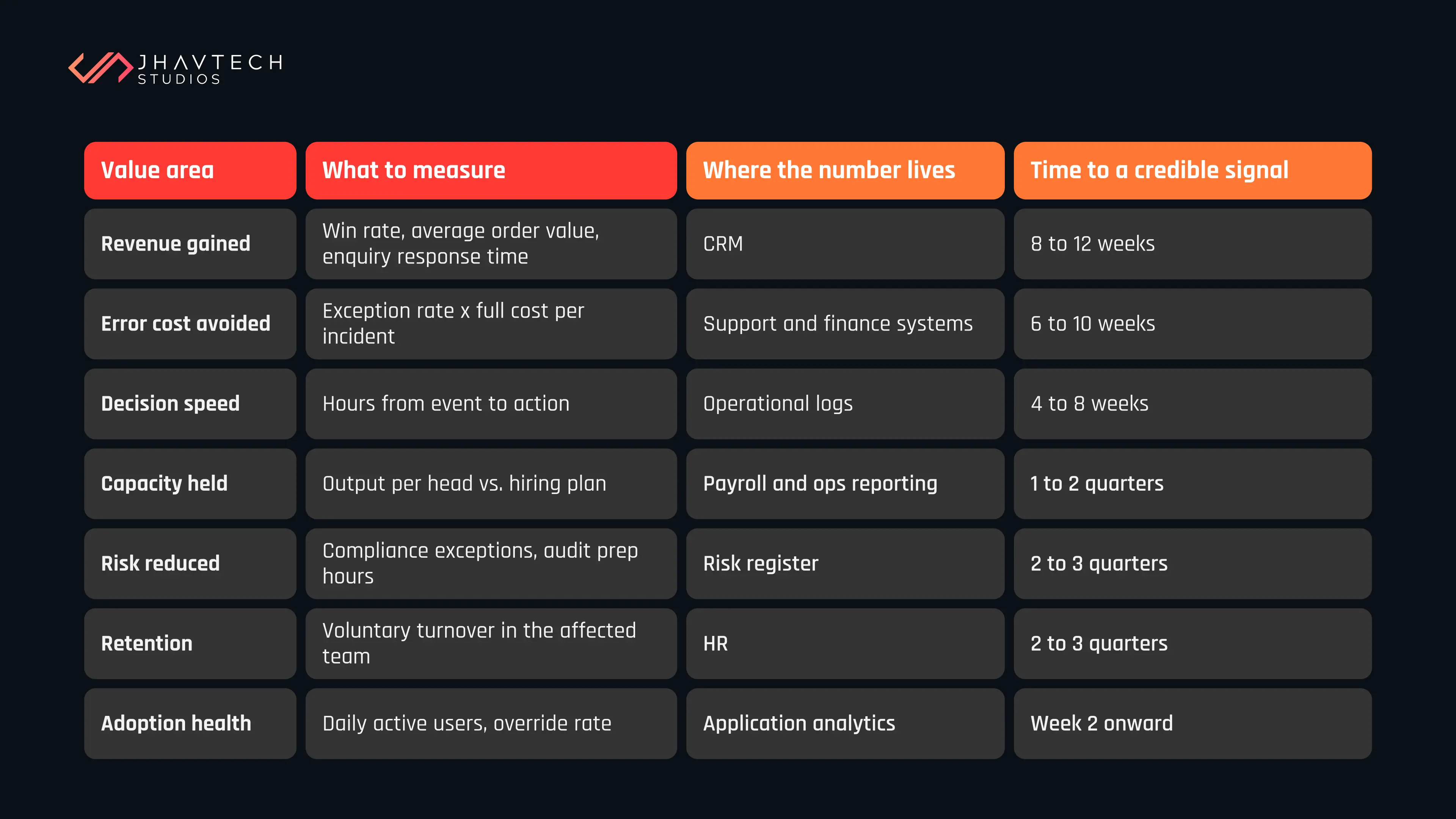
That last row is the one everyone skips and the one that predicts the rest. When override rates climb and daily use drops, every other number on that page is about to go backwards. Staff route around systems they do not trust long before anyone files a ticket.
Set the Baseline Before You Build, Because Nobody Will Remember Later
When we audit client systems, the first thing we look for is not the model. It is whether anyone wrote down what the process looked like beforehand.
Usually nobody did. So the comparison becomes a vibe, and six months later the finance director asks for evidence and receives an anecdote.
Fixing this costs one afternoon. Sit with the people doing the task and write down the numbers: how many of these do we handle a week, how long does each take, how often do we get one wrong, what does a wrong one cost us all in, how many do we currently turn away. That page is worth more than any vendor benchmark you will be shown. It is the whole difference between a defensible AI ROI figure and a hopeful one, and the exercise generalises well beyond AI, as we covered in our piece on measuring the business value of IT investments.
Agree the stop condition while you are all still in the room. What number would make you kill this? Gartner found only 31% of organisations had criteria for halting AI pilots and just 17% had rules for ending deployed projects that were not delivering value. Projects without a stopping rule do not fail cleanly. They linger, absorb budget, and become the reason your next proposal gets knocked back.
The 90-Day Measurement Checklist
Run this before you approve any AI spend. Fewer than seven ticks and the measurement plan is not ready, whatever state the build is in.
❑ The baseline is written down with real numbers, dated, before anything ships
❑ One primary business metric is named, and it is not hours saved
❑ Adoption and override rate are being logged from day one
❑ Full cost is captured, including inference, integration, monitoring and training
❑ A named person in the business owns the outcome, not the delivery
❑ Measurement dates sit in the calendar at 30, 60 and 90 days
❑ The people doing the work have seen a prototype and complained about it
❑ A stop condition is written down and agreed by someone with authority
❑ Someone can explain the result to a non-technical director in two sentences
The Costs That Quietly Kill a Positive Return
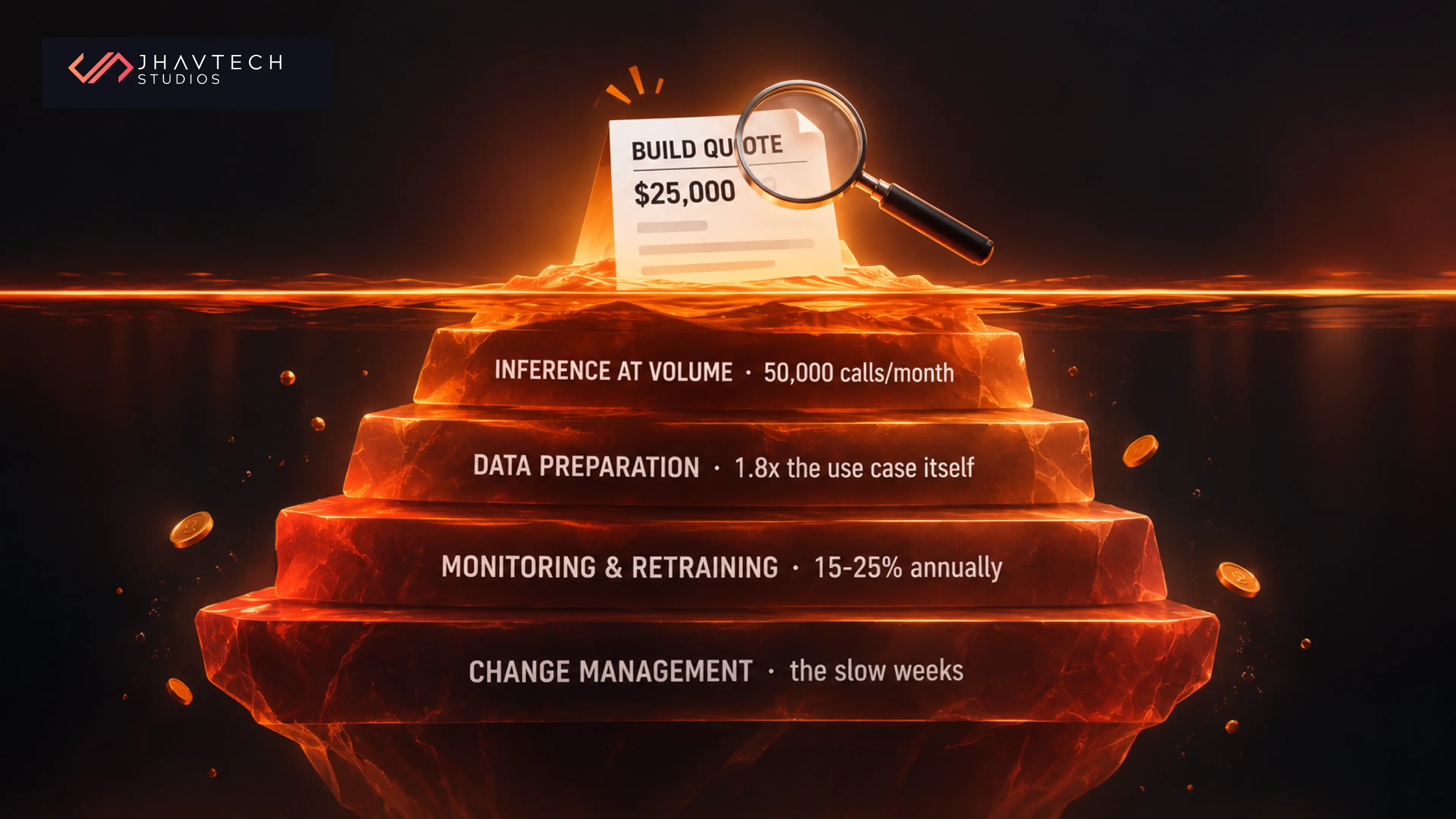
An AI return calculated against the build quote alone is fiction. Four line items go missing almost every time.
- Inference at volume. Per-call pricing that looks trivial across a pilot becomes a pointed question from finance at 50,000 calls a month.
- Data preparation. Usually the single largest cost and almost never in the original quote. Gartner has noted that AI-forward organisations invest close to 1.8 times more in foundations like data and knowledge than in the use cases themselves.
- Monitoring and retraining. Budget 15% to 25% of the build annually. Models drift as your business changes around them, and the outputs still sound confident while quietly becoming wrong.
- Change management. Training, documentation, and the awkward weeks where everyone works slower because the process moved.
There is a fifth cost nobody prices: a correct prediction sitting in a dashboard that nobody opens. Value lands at the moment of a decision, which means the output has to appear inside the tool the person already has open. For field teams, trades and anyone customer-facing, that tool is a phone. It is why so many of these features end up needing a properly built app wrapped around them rather than another web portal with a login nobody remembers.
And when a build has already passed the point where another status meeting helps, the measurable move is bringing in a team that takes over stalled projects and gets them shipping again, not extending the timeline a fourth time and hoping. We wrote about the usual causes in why AI projects fail to deliver the results businesses expect.
Presenting This to a Board or an Investor
One page. Three columns: what we spent, what changed, what we do next. Lead with the business metric, not the technology, and put the baseline next to the result so the comparison is visible rather than asserted.
Be upfront about what has not landed. Gartner reported in October 2026 that 44% of CEOs struggle to demonstrate AI-driven financial returns to stakeholders. In that room, a leader with honest numbers and a written stop condition reads as credible. A leader with a time-saving estimate and enthusiasm does not.
If you are building the financial case from scratch, our walkthrough on calculating software ROI before you build covers the arithmetic properly.
None of this is complicated. It is just unglamorous, and it happens before the fun part, which is exactly why it gets skipped. The teams at Jhavtech Studios who have watched AI builds succeed and fail across Australian startups and SMEs will tell you the difference was almost never the model. It was whether anyone bothered to measure the right thing on the way in.
Frequently Asked Questions