.svg)
.svg)


How to Estimate Software Development Timelines Without Guessing
What is a software development timeline?
A software development timeline is a phase-by-phase schedule that estimates how long it will take to plan, design, build, test, secure and release a software product. Reliable timelines express each phase as a range, account for risk and dependencies, and include contingency buffer rather than one guessed date.
Key Takeaways
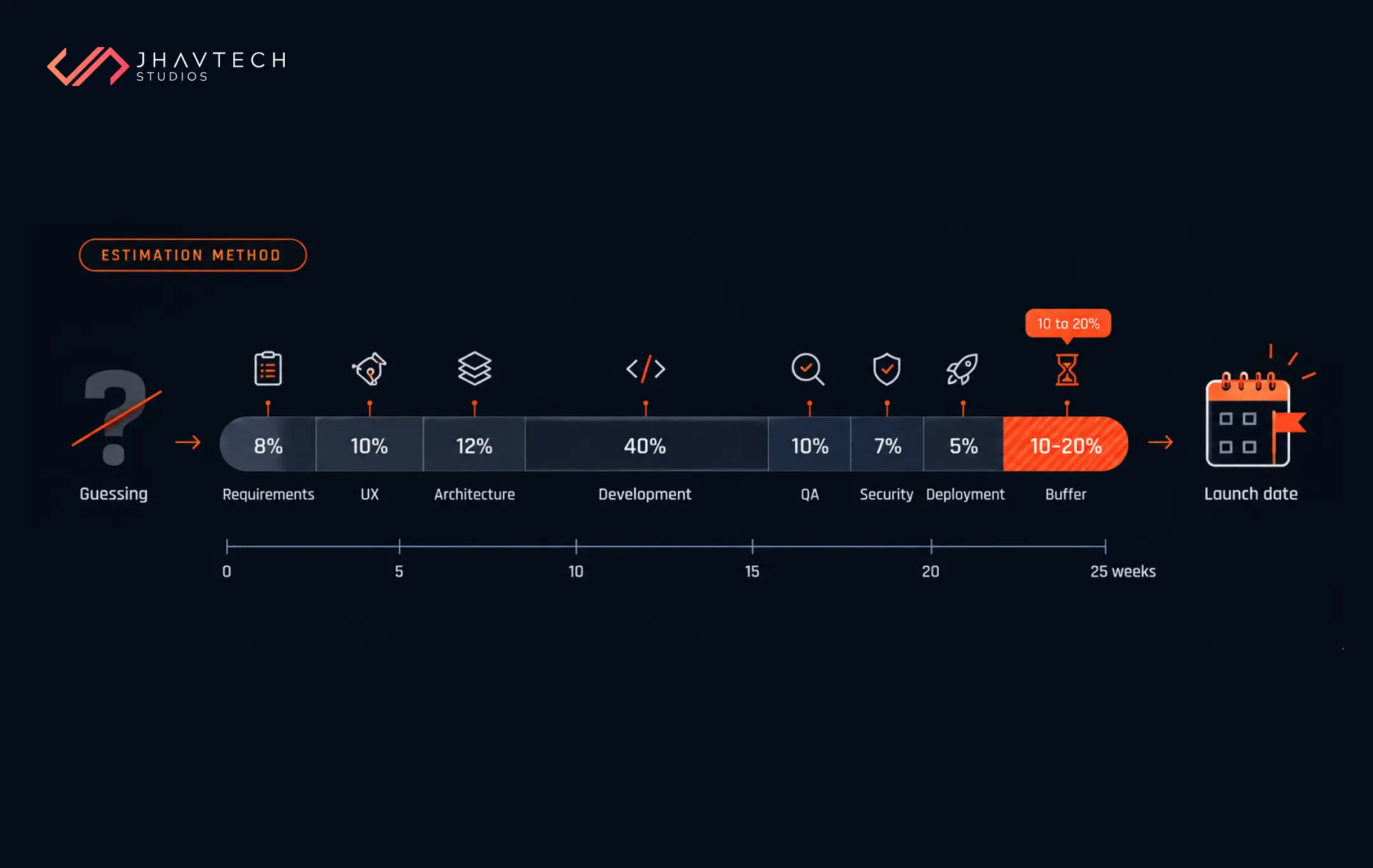
A dependable software development time estimate is built phase by phase, not pulled from a gut feeling. Split the project into eight stages (Requirements, UX, Architecture, Development, QA, Security, Deployment and Buffer), estimate each one as a range, then add contingency based on risk. As a rough guide, a focused MVP takes 8 to 14 weeks, a mid-complexity custom product takes 4 to 7 months, and complex platforms often run 7 to 12 months or longer. At Jhavtech Studios, we build a 10 to 20 percent buffer into every estimate and test risky third-party APIs before quoting, because integrations and legacy code cause more schedule slippage than anything else we see.
Ask ten development agencies how long your project will take and you'll probably get ten different answers. A few will be suspiciously low. One or two will be padded so heavily you'll wonder whether they want the job at all.
Most of those numbers are guesses. Educated ones, sometimes, but guesses all the same.
Our team has spent more than 13 years estimating, building and rescuing software for Australian startups and SMEs, delivering more than 100 projects spanning 200+ apps, with every project managed from here in Australia. We've also taken over more than 30 projects that other teams couldn't get across the line, and cleaning up someone else's missed deadlines teaches you a lot about estimation. The projects that blow out their software project timeline almost never do so because the developers were slow. They blow out because someone quoted the whole build as one lump, trusted a vendor's API documentation at face value, or assumed the existing codebase was in better shape than it was.
Below is the method we use before committing to a date. Steal it. It works whether you're building in-house, briefing an agency or trying to work out whether the quote in your inbox makes any sense.
Why Software Timelines Go Wrong So Often
Missed deadlines are the norm more often than people admit. According to PMI's Pulse of the Profession 2025, projects led by professionals with high business acumen stay on schedule 63% of the time, against 59% for everyone else. Even with capable people in charge, roughly four in ten projects miss their dates.
AI has made the picture murkier. We hear it in almost every first meeting now: surely AI means this takes half the time? A randomised controlled trial by the nonprofit research group METR found that experienced developers took 19% longer to finish tasks when allowed to use AI tools, even though they expected a 24% speed-up and still believed afterwards that AI had made them 20% faster. METR now labels the result as historical and notes it may not reflect current tools or workflows.
Our engineers use AI tools daily, and they help. Boilerplate, test scaffolding and documentation go noticeably faster. Untangling a decade-old integration with an accounting system does not. We price AI gains into the parts of a project where we've measured them, and nowhere else.
So, How Long Does Software Development Take?
It depends on complexity, integrations and how clear your requirements are. Decision makers still need a starting point, so here are realistic ranges for an Australian custom build with a small, dedicated team.
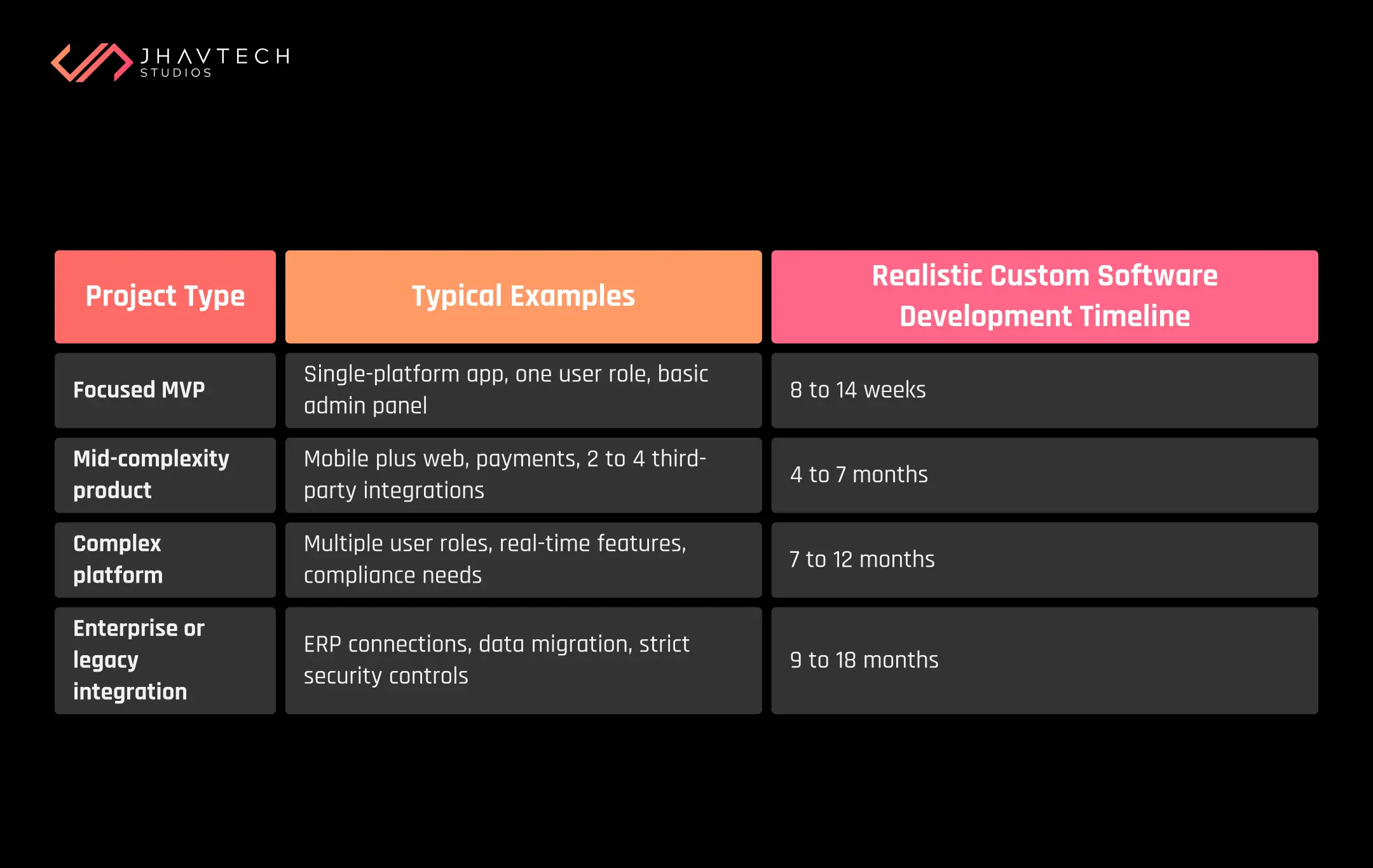
Use these as sanity checks. A date you can plan a launch around only comes from estimating the work stage by stage.
The Eight-Phase Method for an Accurate Software Development Time Estimate
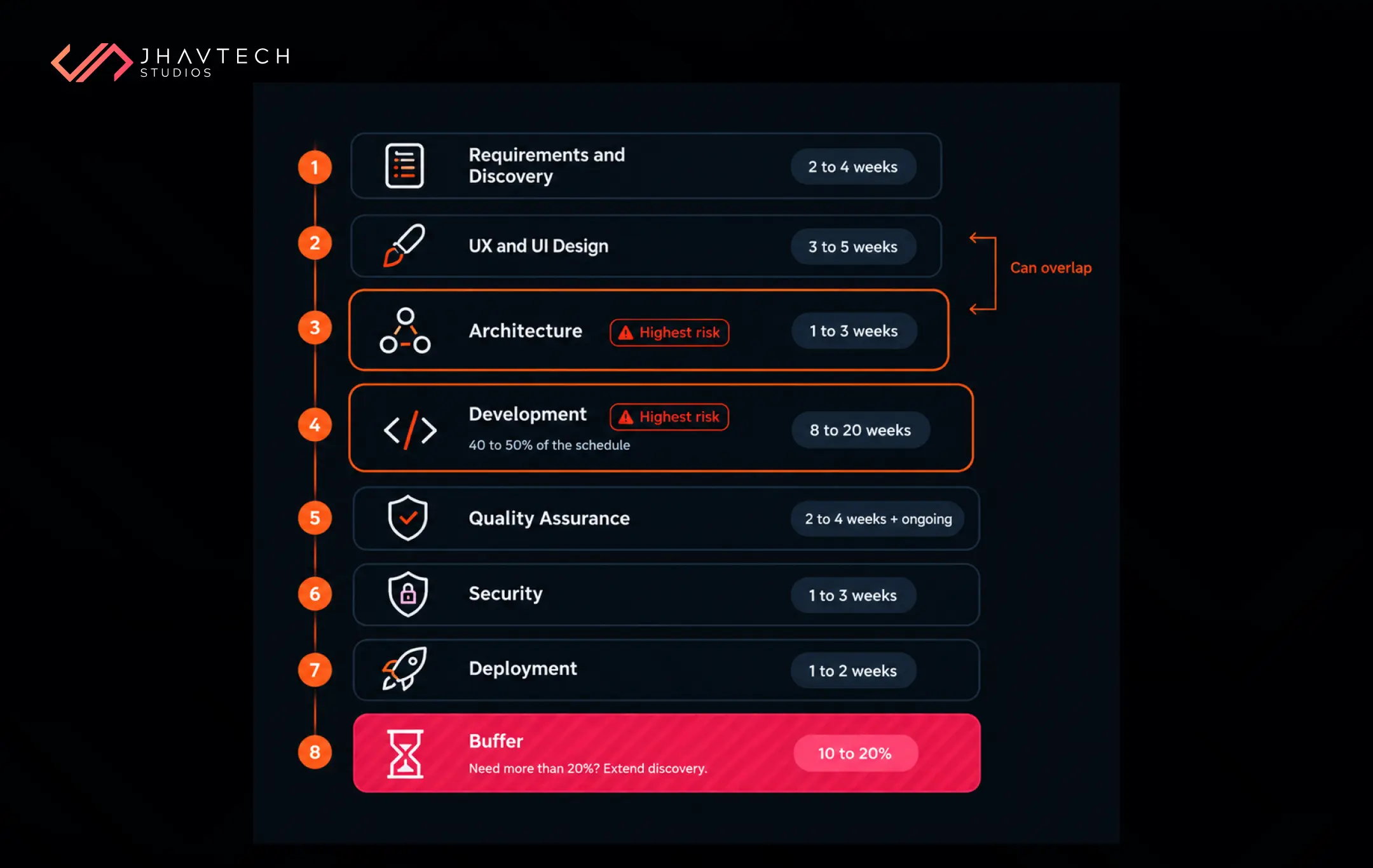
Each phase gets its own estimate, written as a range, with its assumptions noted beside it. Some phases need a quick check. Architecture and development need far more thought, because mistakes there compound quietly for months before anyone notices.
1. Requirements and Discovery
Discovery turns an idea into user stories, acceptance criteria, an integration list and a clear line around what version one includes. Skip it and your developers end up making product decisions halfway through a sprint, usually on a Friday afternoon, usually without the person who should be making them.
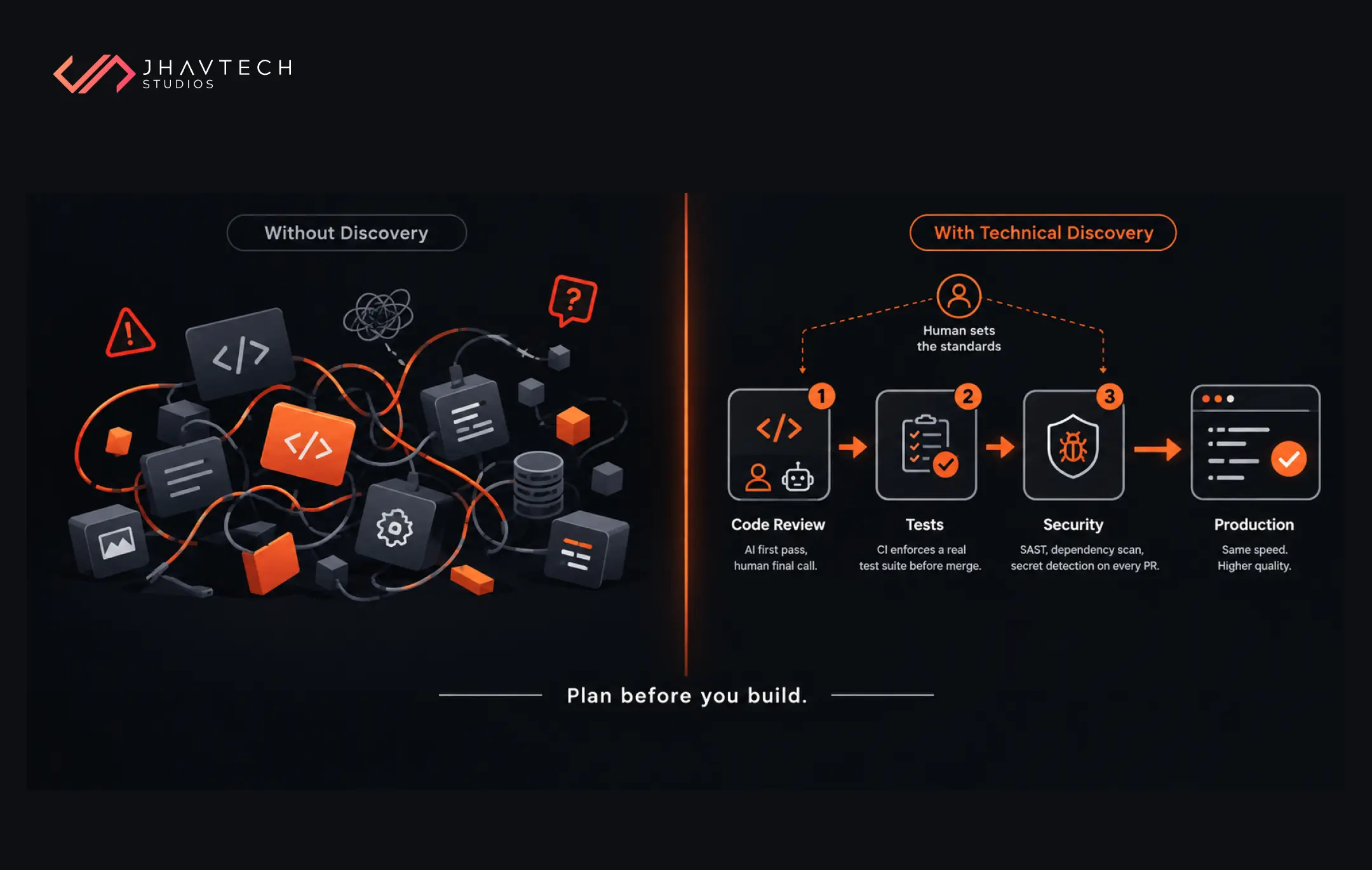
Two to four weeks is typical. Our guide to running a technical discovery phase before development goes deeper.
2. UX and UI Design
Wireframes, user flows, a clickable prototype and a design system. Three to five weeks, with at least two feedback rounds. It can overlap with architecture.
3. Architecture and Technical Planning
Architecture decisions are the hardest to reverse, and they quietly set the estimate for everything that follows. Tech stack, database design, hosting, authentication, API strategy and how the system copes when usage grows tenfold all get settled here.
Small choices ripple further than people expect. Pick a database structure that suits your transactional screens but chokes on reporting, and six months later someone is building a data pipeline nobody budgeted for. Promise offline mode in a field-service app without planning sync properly, and you've signed up for weeks of conflict-resolution logic, plus the joy of explaining to a client why two technicians edited the same job sheet in a basement with no signal.
Our rule is simple: the riskiest assumption gets tested before anyone quotes. We run short, time-boxed spikes (small throwaway prototypes) against anything that could sink the schedule. If the product depends on a payroll provider's API or an ageing ERP system, three days proving the connection works is far cheaper than discovering in week twelve that it doesn't.
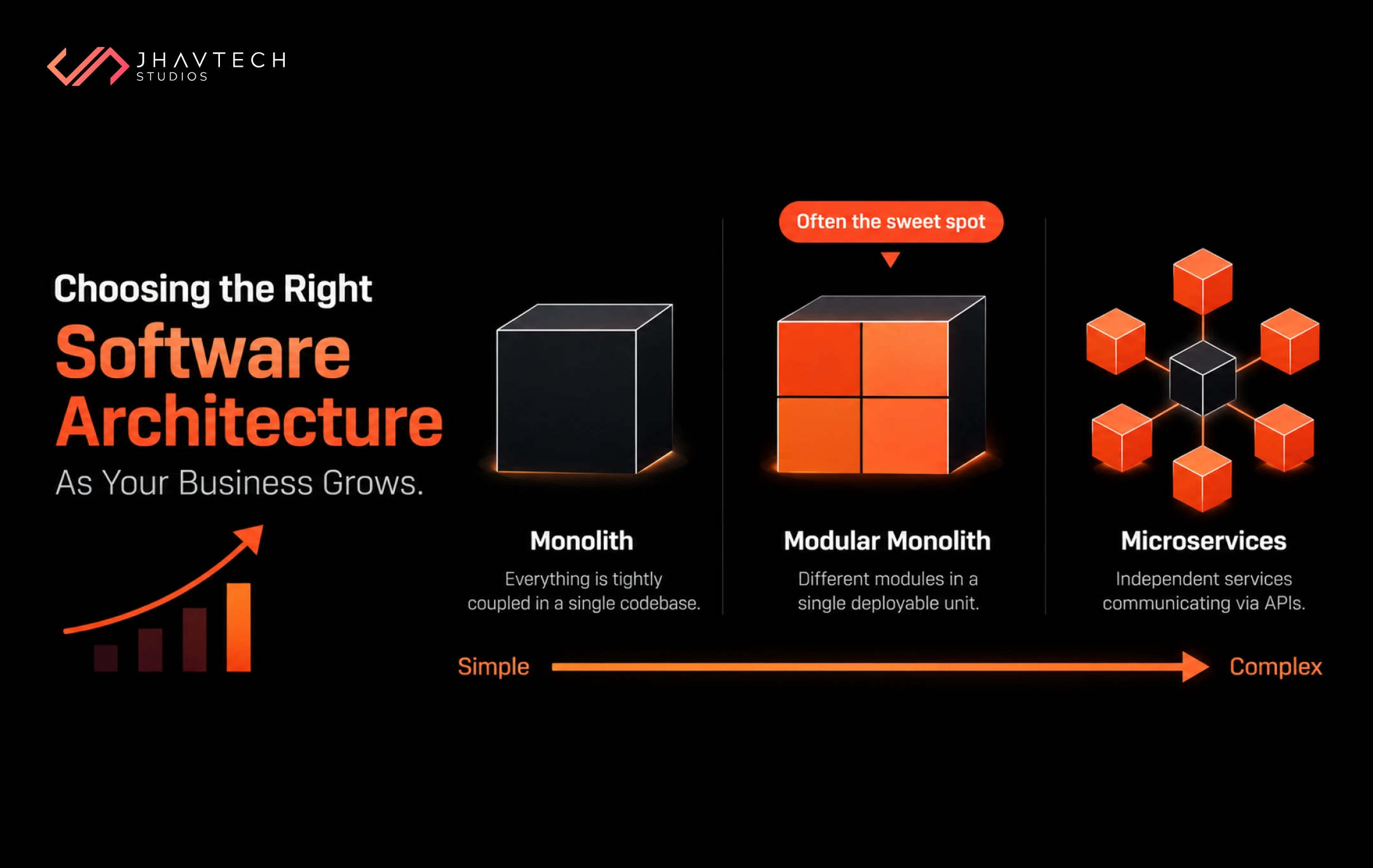
Budget one to three weeks. If you're weighing monoliths against microservices, our article on choosing the right software architecture for a growing business sets out the trade-offs.
4. Development
Development usually takes 40 to 50 percent of the schedule, somewhere between 8 and 20 weeks for most SME projects. We estimate it feature by feature, never as one total, because a login screen, a payments flow and a reporting dashboard carry completely different levels of risk.
Adding developers won't compress the timeline in a straight line. Fred Brooks pointed out decades ago that adding people to a late project tends to make it later, and nothing about modern tooling has changed that. Onboarding and coordination eat the time you hoped to save.
Integrations and legacy code are where most of the pain lives, so they get their own section below.
5. Quality Assurance
Testing should run throughout development, followed by a dedicated stabilisation period of two to four weeks for regression, device testing and user acceptance. If QA accounts for less than about 15 percent of an estimate, your customers will end up doing the testing for you, and they'll leave reviews about it.
6. Security
Security is the line most often missing from quotes, and in 2026 that's hard to justify. The Australian Signals Directorate's 2024-25 Annual Cyber Threat Report found that ASD received more than 84,700 cybercrime reports, roughly one every six minutes, and the average self-reported cost per report for small businesses rose 14 percent to $56,600.
Allow time for threat modelling, dependency scanning and penetration testing. Then allow time again for fixing what those tests turn up. Remediation is the bit people forget, and on older codebases it's rarely a quick patch. One to three weeks covers most projects, with more for health, finance or anything holding sensitive personal data.
7. Deployment and Release
Infrastructure, CI/CD pipelines, data migration, monitoring and go-live support usually take a week or two. Mobile launches add app store review, which has a habit of rejecting a build days before a launch event. Having taken more than 200 apps through the process, we guide every client through App Store and Google Play submission, and when we're building iOS and Android products around realistic launch dates, we plan for at least one rejection cycle as standard.
8. Buffer: Why We Build In 10 to 20 Percent
Every Jhavtech estimate carries a visible buffer of 10 to 20 percent. Clients can see it as its own line item, and we explain exactly why it's there.
A well-scoped build with known integrations sits near 10 percent. We move towards 20 percent when a project touches legacy systems, relies on a third-party API we haven't worked with before, or involves data migration from a source nobody fully understands.
What happens when a project seems to need more than 20 percent? We stop and extend discovery instead. A buffer that large tells us the unknowns haven't been found yet, and padding the quote just hides that from the client. It's a harder conversation up front, but a far easier one than explaining a three-month slip later.
Stubborn APIs and Messy Legacy Code: Where Timelines Really Break
Documentation describes how an API is supposed to behave. Production shows you how it behaves on a Tuesday morning under load. Those two things are not always related.
Here's a scenario that plays out more often than it should. A logistics platform connects to a carrier's API. The sandbox accepts as many requests as the team can throw at it, so everyone assumes production will too. Production caps requests at a fraction of that per minute, and nobody finds out until the nightly sync starts failing at 2am. The fix usually means rebuilding the sync around a queue with incremental updates and retry logic, which can easily cost a fortnight. With a buffer in place, that fortnight gets absorbed. Without one, it's a missed launch.
Scenarios like this are why experienced teams test integrations before anyone commits to a date. During discovery, engineers connect to every critical third-party API with real credentials wherever the provider allows it, and record rate limits, authentication quirks and error behaviour. Riskier integrations then carry more buffer than well-understood ones. In the build itself, third-party calls should sit behind an adapter layer with queuing and retries, so a provider's bad day doesn't become your users' bad day.
Legacy code is its own beast. Abandoned code with no documentation is one of the four situations our rescue service is built around, alongside missed deadlines, team breakdowns and unstable software. The code is rarely impossible to work with. It's unknown, and unknowns are what wreck estimates.
So, when we inherit a project, nobody gets a date until we've done a full evaluation of what's been built and why it went wrong. Only then do we commit to a roadmap with timelines attached. Across our rescue work, the average time to get a project back on track is 3.5 weeks, and that number exists because we refuse to guess first.
If you've inherited code and suspect it's in rough shape, a senior engineer's review of your codebase, free and back within 48 hours, gives you an A to F quality score, your top five critical issues, an API and backend structure check and a go/no-go recommendation before you commit to a date.
Sample Phase Breakdown for a Six-Month Build
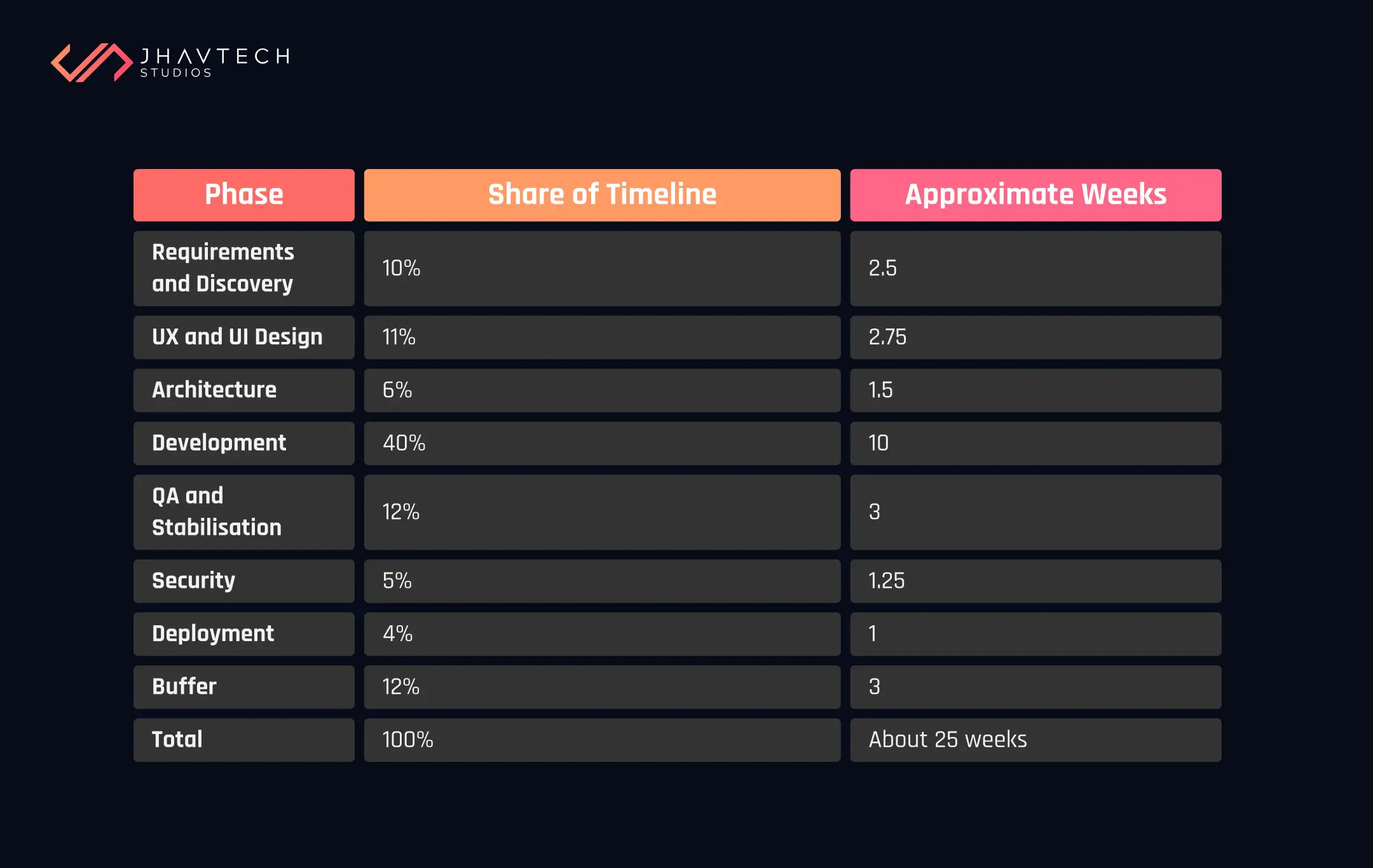
In this example, the 3-week buffer works out at roughly 14 percent of the planned work, which sits in the middle of our 10 to 20 percent range. Some phases overlap in practice, so the real calendar can come in shorter. Make sure any overlap is planned rather than hoped for.
Three Techniques That Replace Guesswork
Three-Point Estimates
For every feature, write down three numbers: optimistic (O), most likely (M) and pessimistic (P). Then apply the PERT formula:
Expected time = (O + 4M + P) ÷ 6
A payments integration might take 6 weeks if everything goes smoothly, 9 weeks in the most likely case and 18 weeks if the provider's API turns difficult. The expected figure works out at (6 + 36 + 18) ÷ 6 = 10 weeks. Most people's instinct is to quote the 6 or the 9. That instinct is how projects end up late before a line of code exists.
Reference Projects
Ask how long similar features took on past builds and ask for evidence. Historical data beats optimism.
Re-Estimate at Every Milestone
Barry Boehm's research, later popularised by Steve McConnell as the cone of uncertainty, showed that estimates made at the idea stage can be out by a factor of four in either direction. The range narrows as requirements, designs and architecture firm up.
We re-estimate after discovery, after design sign-off and at the midpoint of development, and we share every revision with the client. Nobody likes surprises. Early ones are at least fixable.
Your Pre-Estimate Checklist
Before you accept any timeline, make sure you can tick every box.
☐ Core user roles and user journeys are documented
☐ Version one scope is separated from nice-to-have features
☐ Every third-party integration is listed and tested against real credentials where possible
☐ Known API rate limits and authentication requirements are recorded
☐ Target platforms are confirmed (iOS, Android, web, desktop)
☐ Any existing codebase has been reviewed before quoting
☐ Data migration needs are identified and sized
☐ Compliance and privacy obligations are known
☐ Security testing and remediation appear in the plan
☐ QA has its own line item
☐ Each phase is estimated as a range, not a single date
☐ Buffer is visible and matched to project risk
☐ A stakeholder with decision authority is available for weekly reviews
That last box gets ignored all the time. Slow sign-off on the client side can add weeks without a single line of code changing.
Red Flags in a Timeline Quote
A single fixed date with no listed assumptions should make you nervous. So should a quote with no discovery phase, no security line, or a development figure that covers everything in one breath. If a vendor can't explain how they reached their number or hasn't asked to see your existing code before quoting on it, the number probably won't hold.
Already mid-project with dates that keep sliding? We run weekly meetings and fortnightly demos on every takeover, and an independent review can get a stalled or overdue build back on track far faster than another round of hopeful status updates.
The Bottom Line
A software development timeline you can rely on is the product of discipline more than talent. Break the work into phases. Estimate each as a range. Test the scary integrations early, read the old code before you promise anything, and keep your buffer honest and visible.
Your timeline then becomes a planning tool rather than a promise waiting to be broken. Budgeting gets easier too, which matters when you're trying to calculate the ROI of custom software before you build it.
Frequently Asked Questions
.webp)


.png)
.png)
.png)
.png)
.png)
.png)
.png)
.png)
.png)
.png)
.png)
.png)


.png)
.png)
.png)
.png)
.png)
.png)
.png)
.png)
.png)

.png)
.png)
.png)
.png)
.png)
.png)
.png)
.png)
.png)
.png)
.png)
.png)
.png)

.png)
.png)
.png)
.png)

.png)
.png)
.png)


.png)
.png)
.png)
.png)

.png)


.png)


.png)




.png)



.png)





.png)

.png)




.png)

.png)

.png)