.svg)
.svg)


The Future is NOW: Futuristic Technologies That Already Exist
.png)
The pace at which technology is evolving and redefining every aspect of our lives is mind-boggling. Think about it. Futurist speaker Thomas Frey pointed out that prior to 2007, our phones were just that…phones! They didn’t have the capacity to stream every song in the planet or tell us how to beat traffic on the way to the office. And now? Our phones do everything! We use it to manage our finances. It keeps us entertained in a gazillion ways. It can even check our heart rate, and so much more.
As a matter of fact, a lot of things that were solely in the imagination of science-fiction writers are now part and parcel of our daily lives. In this post we’ll take a look at some of the futuristic things that actually exist today.
Real Use Cases for Augmented Reality (AR)
Augmented reality is now having a huge impact on major industries across the globe. It is emerging as a key driver of the tech economy. In fact, it is estimated that by this year, the total value of the AR market will reach a staggering $100 billion.
The reason behind this is that AR apps, glasses, and headsets are expected to add value to virtually every industry. AR is showing huge potential in solving some of the biggest problems and it is now making a massive impact across the board.
Here are some of the best use cases for AR technology…
Retail
In our current retail setting, shoppers are using their phones more than ever to compare prices or search for additional information on products they wish to purchase. A perfect example of a popular brand making the most of this trend is American motorcycle manufacturer Harley Davidson. With the help of AR application company Marxent, they developed an app that customers can use in-store. Users can view a bike they are interested in buying and customize it using the app to determine the colors and features they like. The app allowed customers to try out different body types, lights, seats, and other options for a truly custom motorcycle design
Business Logistics
Augmented reality presents a wide range of opportunities to boost efficiency and cost savings in different areas of business logistics. These include transportation, route-optimization, and warehousing. The world's leading logistics company DHL has already implemented the use of AR through its ‘vision picking’ program which utilizes the latest version of Google’s smart glasses. The lenses show to workers the shortest route in a warehouse to locate a certain item that needs to be shipped. Workers can also scan, sort, and move items without needing a handheld scanner or referencing hard-copy forms.
Classroom Education
Gadgets like tablets are now widespread in many schools. Educators view this as an excellent opportunity to ramp up students’ learning experience with augmented reality. For instance, the Aurasma app is already being used so students can view their classes via tablet or smartphone for a richer learning environment. Students in a music class can see musical notes in real time as they learn to play a particular instrument, or those studying astronomy can see a full configuration of the solar system. The app is free for both Android and iOS-based mobile devices.
Tourism Industry
Technology has been a big boost for the tourism industry over the past couple of years, from informative sites like Lonely Planet and review sites like TripAdvisor. But augmented reality offers a huge opportunity for travel companies to give tourists a more immersive experience even before they travel. If you’re planning to visit Australia, you can take a virtual "Walkabout" across the country using AR glasses before booking a flight to Sydney. Imagine taking a leisurely stroll around London or Paris to see the most popular attractions you intend to visit. Augmented reality has made selling trips and vacations a whole lot easier.
Public Safety
In case of an emergency nowadays, people instinctively reach for their smartphones to know what's going on and if their loved ones are safe. In addition, first responders rush to the scene of a crime, fire or earthquake then try to find out who needs help, and the best way to get victims to safety. Augmented reality is showing huge potential in solving pieces of the public safety puzzle. Emergency workers wearing AR glasses can be notified to danger zones and show in real-time those in need of assistance without compromising their own safety. For individuals in danger, geolocation enabled AR can show them the best route to safe spots and areas with medics or firefighters.
Real Use Cases for Virtual Reality (VR)
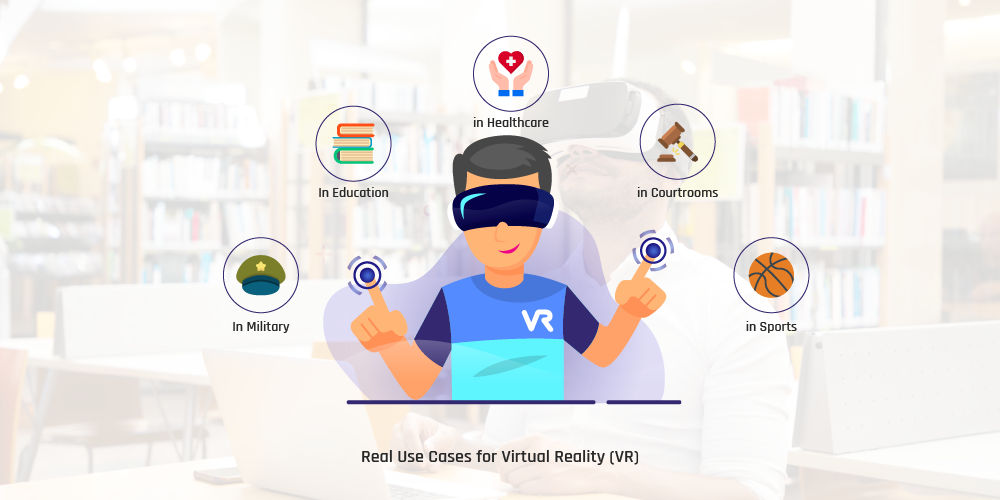
Virtual reality presents a huge potential in transforming how people and businesses interact with each other. Although this ground breaking technology has been largely associated with the gaming industry, it is increasingly being applied in different fields to manipulate physical surroundings. Here are a few examples on how VR is allowing users to experience their environment in more immersive ways.
Virtual Reality in the Military
The military of first world countries have adopted the use of VR in their training as it allows them to undergo a wide range of simulations. VR can immerse a trainee into different scenarios for various training purposes. The military is using it for flight simulations, medic training, battlefield simulations, virtual boot camps, among other things. VR is fully immersive and capable of safely replicating dangerous situations to train soldiers without putting them at risk until they’re ready for actual combat.
Virtual Reality in Education
The uses of virtual reality now extend to schools as the technology is increasingly being adopted for teaching and learning. Students can interact with each other in a three-dimensional setting. They can also be taken on virtual field trips to museums, and even going back in time to learn about different eras. By making virtual field trips and simulations of complex concepts accessible to everyone, VR can make cognitive learning faster and more effective. Cerevrum and Unimersiv are examples of two such apps that offer an extensive resource of educational VR content online.
VR can be particularly useful for students with special needs, such as those dealing with autism. Research revealed that virtual reality can be used as a motivating platform to practice social skills for kids, including those with Autism Spectrum Disorders (ASD). Tech firm and NIH backed startup Floreo has developed VR scenarios that allow children to practice and learn skills like pointing, making eye contact and establishing social connections.
Virtual Reality in Education
The uses of virtual reality now extend to schools as the technology is increasingly being adopted for teaching and learning. Students can interact with each other in a three-dimensional setting. They can also be taken on virtual field trips to museums, and even going back in time to learn about different eras. By making virtual field trips and simulations of complex concepts accessible to everyone, VR can make cognitive learning faster and more effective. Cerevrum and Unimersiv are examples of two such apps that offer an extensive resource of educational VR content online.
VR can be particularly useful for students with special needs, such as those dealing with autism. Research revealed that virtual reality can be used as a motivating platform to practice social skills for kids, including those with Autism Spectrum Disorders (ASD). Tech firm and NIH backed startup Floreo has developed VR scenarios that allow children to practice and learn skills like pointing, making eye contact and establishing social connections.
Virtual Reality in Healthcare
The healthcare sector is a big adopter of VR technology, with some organizations using computer-generated images for diagnosis and treatment. VR simulations, like those developed by software companies Conquer Mobile and Surgical Theater, use actual diagnostic images from ultrasound or CAT scans to construct three dimensional models of a patient’s anatomy. These virtual models help new and seasoned surgeons in determining the safest and most effective way to locate tumors, make incisions or practice difficult surgical procedures.
Even medical and dental students are now using virtual reality to practice surgeries, allowing for a risk-free learning environment. The danger of inflicting harm or committing a mistake while practicing on real patients is therefore eliminated. Virtual patients allow students to develop skills that can be applied later in the real world. Using VR technology in the healthcare industry is now widely regarded as an effective way to improve the quality of training and it presents an excellent opportunity to optimize costs.
You may have heard or read about Microsoft HoloLens, a pair of mixed reality smartglasses which has been adapted for medical applications as CAE VimedixAR. It allows immersive simulation-based training in anatomy and ultrasound through AR for increased patient safety and enhanced learning.
Virtual Reality in Courtrooms
Jury members may no longer need to evaluate crime scenes by examining dull, two-dimensional photos. Viewing a crime scene in 3D can help them visualize how people and objects move through space. In 2014, researchers at the University of Zurich published a paper assessing the potential use of the Oculus Rift to reconstruct crime scenes discussed during trials. The researchers discovered that the use of interactive technology made it easier for jurors to visualize the details of a case and then make a decision whether a suspect is guilty or not.
Virtual Reality in Sports
Coaches and players are using VR technology to train more efficiently, as they are able to watch and experience certain scenarios repeatedly. Essentially, VR is being used as a training aid to analyze techniques and measure athletic performance. Some claim that it can also be used to improve the cognitive abilities of athletes when they suffer an injury, as VR allows them to experience gameplay situations virtually.
Similarly, virtual reality is being used to improve viewers’ experience of a sporting event. Streaming live games in virtual reality is changing the way fans enjoy their favorite games, and the way sportscasters can talk about them. Soon the selling of virtual tickets to live games will become a common practice so anyone from anywhere can ‘attend’ any sporting event. This can also allow those who can’t afford to attend live sports events to enjoy the experience remotely, either for free or at a much cheaper cost.
Real Use Cases of Artificial Intelligence (A.I.)
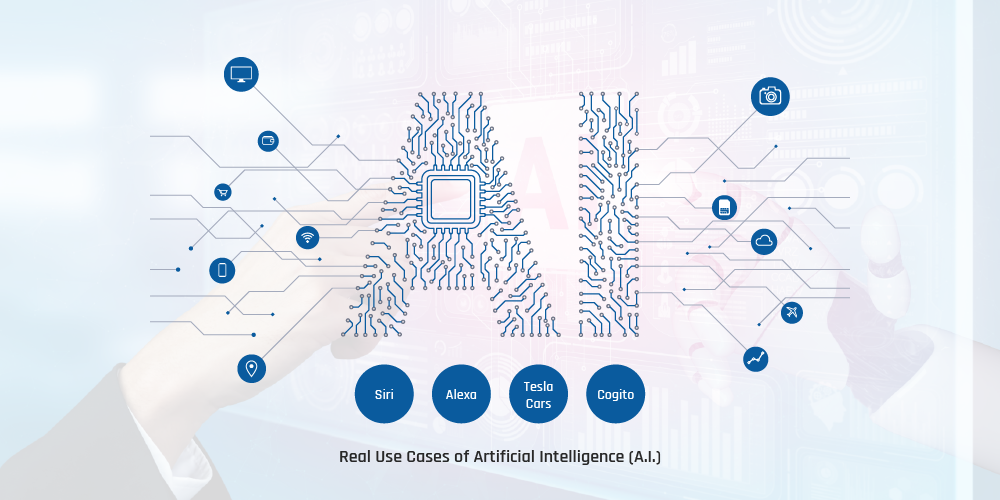
Machines are seeping their way into our daily lives, affecting key aspects of how we live, work, and play. From fundamental technologies like behavioral algorithms to suggestive online searches and self-driving cars featuring predictive capabilities, there are several real use cases of A.I today.
Siri
Apple’s popular personal assistant, Siri is the voice-activated computer that a lot of people interact with every day. Initially released on October 12, 2011 she makes use of voice queries and a natural-language user interface to make recommendations and perform actions by designating requests to a set of Internet services.
She helps with finding information, giving directions, sending messages, adding events to calendars, and so on. Siri also utilizes machine-learning technology to become smarter and better able to understand and predict questions and requests.
Alexa
Developed by Amazon and first used in the Amazon Echo smart speakers, its emergence as the smart home's hub is somewhat meteoric. When it was first unveiled, Alexa took the world by storm. Its usefulness and its ability to decipher speech is truly ground breaking. It helps us browse the web for information, schedule appointments, shop, set alarms, power our smart homes, and act as a conduit for those with limited mobility.
Customers now have hundreds of Alexa devices, including personal computers, smart TVs, smart speakers, headphones, etc. Interaction with Alexa skills almost doubled in 2019 alone. People made suggestions on how Amazon can improve the Alexa Skills Kit (ASK) and the tech giant responded last July 22 by announcing 31 new ASK features. You can read about them here.
Tesla Cars
These are quite likely among the best vehicles ever made, not only for receiving so many accolades, but because of its self-driving features, predictive capabilities, and sheer technological savvy. Anyone who’s into technology and cars wants to own a Tesla, and these rides are only getting smarter thanks to their cutting-edge updates.
In a recent Hot Chips conference, Tesla stated that its performance has improved drastically owing to the optimizations in the artificial intelligence chip. A huge quantity of transistors was used – roughly 6 billion - which comprise the processing circuitry for every AI chip. Tesla’s new AI technology aims to set a milestone for mass-market automation for today’s vehicles.
Cogito
This is one of the finest examples of the behavioral version to enhance the intelligence of customer support representatives in the market today. It is essentially a synthesis of behavioral science and machine learning aimed at enhancing customer collaboration for phone professionals. The contact center AI of Cogito can quickly analyze hundreds of conversational behaviors to deliver live in-call guidance along with real-time evaluation of customer experience. The company is continuing to prove that the future of customer experience begins with artificial intelligence and behavioral analytics.
Key Takeaways…
While all of these seem like iterations from an Issac Asimov novel, it's not the first time that futuristic technologies made it to society decades ahead of when we thought they would. Even if there’s always a ‘yeah, but’ factor to new technologies and with dozens of caveats, it’s still mind boggling to witness the realization of what was merely science fiction so long ago. And with the rapid development of new technologies and smart use of such tech, we know the future has a lot more surprises in store for all of us.

.webp)

.png)

.png)
.png)
.png)
.png)
.png)
.png)
.png)
.png)
.png)
.png)
.png)

.png)
.png)
.png)
.png)
.png)
.png)
.png)
.png)
.png)
.png)
.png)
.png)
.png)
.png)
.png)
.png)
.png)
.png)
.png)
.png)
.png)
.png)

.png)
.png)
.png)
.png)

.png)
.png)
.png)
.png)
.png)
.png)
.png)

.png)


.png)

.png)




.png)


.png)






.png)

.png)



.png)


.png)


.png)