.svg)
.svg)


7 Signs Your Development Team Is Creating Technical Debt (Without Realising It)
.png)
Technical debt is the hidden cost your software pays for every shortcut taken during development. It accumulates quietly in rushed code, skipped documentation, and deferred refactoring, until one day your team is spending more time fighting fires than building features. This guide reveals seven warning signs to watch for, and what to do before they spiral out of control.
What Is Technical Debt?
Technical debt is the accumulated cost of shortcuts, outdated code, and deferred improvements in a software system. Just like financial debt, it accrues interest over time, slowing development velocity, increasing bug rates, and making new features harder to ship. Left unmanaged, it can halt innovation entirely and require expensive, disruptive rewrites to resolve.
Why Technical Debt Is a Bigger Problem Than You Think
Here's the thing about technical debt: it doesn't announce itself. There's no alert, no error log, no Slack notification that says "Warning: your codebase is quietly becoming unmaintainable." It builds in the background, sprint after sprint, while your team stays heads-down on delivery.
And by the time most engineering leaders notice it, the damage is already done.
The scale of this problem is staggering. According to a landmark 2025 report by CAST, companies and governments worldwide would need to spend 61 billion workdays of software development time to pay off the technical debt they've accrued over the past four decades, based on an analysis of over 10 billion lines of code across 47,000 applications. Even if every, developer on the planet worked on nothing but this problem, it would still take nine years to resolve. That's not a future risk. That's happening right now, inside your codebase.
Meanwhile, Stripe's Developer Coefficient report found that 42% of professional developer time is spent managing technical debt rather than building new value. For a team of five engineers, that's roughly 84 hours per week — more than two full-time salaries — consumed by maintenance rather than innovation.
And Accenture research shows that companies with lower-than-average technical debt outperform their peers in revenue growth: 5.3% vs. 4.4% over the 2024–2026 period.
The pattern is clear. Hidden technical debt doesn't just slow you down. It costs you market share. So how do you know if your team is building it right now, without realising it? Here are the seven signs to look for.

Sign #1: Velocity Is Dropping, But Nobody Knows Why
Your team is working just as hard as they were six months ago... maybe harder. But sprint after sprint, fewer features are making it across the finish line. Estimates keep getting blown out. Simple changes take far longer than they should.
This is one of the most common early symptoms of hidden technical debt: a gradual, almost imperceptible slowdown in development velocity that engineers often attribute to project complexity rather than structural code problems.
What's actually happening is that your codebase is becoming increasingly brittle. Every new feature requires navigating a maze of interdependencies, workarounds, and undocumented assumptions. Developers spend half their time understanding existing code before they can write a single line of new code.
👀 Watch for these red flags:
- Estimates for "simple" features ballooning without explanation
- Developers frequently needing to touch many unrelated files to make one change
- New team members taking unusually long to become productive
- A growing backlog of "while I was in there..." bug reports
If your sprint burndown charts look like a hockey stick, flat for weeks, then a frantic rush at the end; poor software architecture is likely a contributor.
Sign #2: Your Bug Count Is Growing Faster Than Your Feature Count
A healthy software product ships features and resolves bugs in a reasonable ratio. When the bug count starts climbing disproportionately, especially when bugs are appearing in areas that weren't recently modified, that's a strong signal of deeper code quality issues.
Technical debt creates a fragile system. Changes ripple through the codebase in unexpected ways. A fix in one module breaks something in another. Regression testing catches some of it, but not all, especially if your test coverage is thin (which it often is in high-debt codebases, because writing good tests takes time teams under pressure rarely have).
The insidious part is that bug-fixing itself accelerates debt accumulation. Under pressure to ship fixes quickly, developers apply patches rather than addressing root causes. Each patch adds another layer of complexity. Before long, you're not maintaining a product; you're maintaining a patchwork quilt of workarounds held together by institutional memory and optimism.
If your team is regularly fixing bugs that come back in a different form, that's not bad luck. That's bad software architecture compounding on itself.
Sign #3: Onboarding a New Developer Takes Months, Not Weeks
Think about the last time you brought a new engineer onto the team. How long did it take them to make their first meaningful contribution? How much of their onboarding was spent reading actual documentation vs. asking senior developers to "explain how this part works"?
Poor onboarding efficiency is a reliable proxy metric for technical debt. Well-architected systems with good documentation, clear naming conventions, and consistent patterns can onboard developers in weeks. Debt-laden codebases can take three to six months — sometimes longer.
The cost here is compounded. Every hour a senior engineer spends explaining undocumented system behaviour is an hour not spent on new development. The knowledge bottleneck creates a key-person dependency risk: when the one engineer who "knows how the billing module really works" goes on leave, delivery stops.
This is especially critical for teams building scalable digital products, whether that's a platform product, an enterprise SaaS tool, or a custom app serving thousands of end-users. Knowledge silos kill scalability at the human layer long before they kill it at the infrastructure layer.
Signs of onboarding-related debt:
- No up-to-date architecture documentation
- Business logic buried in code comments rather than proper documentation
- Tribal knowledge concentrated in one or two people
- README files that haven't been updated since the initial commit

Sign #4: Deployments Are Infrequent and Stressful Events
How often does your team deploy to production? Weekly? Monthly? Once a quarter? And when they do, is it a smooth, automated process, or an all-hands-on-deck event that everyone dreads?
High-performing engineering teams using modern DevOps practices deploy to production multiple times per day with confidence. If your team is treating deployments like major surgery with frozen development windows, manual testing marathons, and post-deployment war rooms, your software engineering efficiency has a serious technical debt problem.
The root causes are usually interconnected:
- Tightly coupled architecture that makes it impossible to deploy one component without risking others
- Insufficient automated test coverage that forces reliance on manual QA
- Missing or broken CI/CD pipelines that slow down feedback loops
- Environment inconsistencies between development, staging, and production
This is where software scalability problems become undeniable. A team that can't deploy confidently and frequently can't respond to market feedback. They can't ship hotfixes quickly. They can't compete with leaner, better-structured competitors who are iterating daily.
Sign #5: Your Team Has "No-Go Zones" in the Codebase
Every development team has them: parts of the codebase that nobody wants to touch. The legacy authentication module. The payment processing service that was written five years ago and "just works." The API integration layer that's had seventeen hotfixes applied and lost all coherent structure along the way.
These no-go zones are among the most dangerous forms of hidden technical debt because they create a false sense of security. The code runs, so it seems fine. But what it really is, is a landmine that’s functional until the day it isn't, and catastrophically fragile when it breaks.
No-go zones accumulate for several predictable reasons:
- Fear of regression: Changing the code risks breaking something that currently works
- Loss of original context: The developers who wrote it have moved on, and nobody fully understands it
- Accumulated complexity: Patches on patches have made the logic impenetrable
- Lack of test coverage: There's nothing to catch regressions if someone does try to refactor
This is precisely the kind of problem that lands teams in crisis mode and it's one of the most common drivers behind software project rescues and emergency stabilisation engagements. What starts as a performance quirk in an untouchable module becomes a production outage at the worst possible moment.
If your engineers are routing around parts of the codebase rather than through them, those areas need urgent attention.
Sign #6: Security and Compliance Updates Are Always "Deprioritised"
This one is subtle, but critically important. When technical debt runs deep, security patching and compliance work consistently falls to the bottom of the backlog, not because anyone actively decided it wasn't important, but because the sheer volume of "keeping the lights on" work crowds it out.
The cycle looks like this:
- A security vulnerability is identified in a dependency
- Patching requires touching deeply coupled, poorly documented code
- The risk of introducing a regression feels higher than the (seemingly theoretical) risk of the vulnerability
- The patch is deferred to "next sprint"
- Next sprint never comes
This is how organisations end up running end-of-life libraries, unpatched frameworks, and deprecated SDKs in production — not through negligence, but through accumulated engineering inefficiency that makes the cost of doing the right thing feel impossibly high.
For a sobering perspective on the scale of this: the US alone faces annual losses of $2.41 trillion attributable to poor software quality, with a significant portion directly traceable to the security exposure created by legacy debt.
Regulatory compliance (i.e. GDPR, PCI-DSS, HIPAA, SOC 2) adds another layer of risk. Debt-laden systems are disproportionately difficult to audit and certify and increasingly attract scrutiny from regulators who expect modern engineering practices.

Sign #7: Every New Feature Requires a Disclaimer
Pay attention to how your engineers talk about upcoming work. If every new feature estimate comes with a list of caveats: "that'll be hard because of how the authentication system is structured" or "we'd need to refactor the data layer before we can properly do that" — your architecture is holding you back.
This is the most direct manifestation of bad software architecture limiting business agility. The engineering team isn't being pessimistic. They're accurately reporting that the system's foundation makes change expensive.
In a well-architected codebase with appropriate modularity, adding a new feature means building on top of stable, well-defined interfaces. In a debt-laden system, it means navigating undocumented assumptions, fighting with tightly coupled components, and frequently re-doing work because the underlying structure can't support the intended design.
The business implication is direct: software scalability problems at the architecture level translate directly into slower product roadmaps, higher development costs, and reduced competitive responsiveness. When your competitors can ship a feature in two weeks that takes your team three months, the market notices regardless of how talented your engineers are.
If you're regularly hearing things like "we'd love to do that, but the codebase makes it really complex," it's time for a hard conversation about refactoring investment.
How to Start Addressing Technical Debt Strategically
Acknowledging the problem is step one. The harder part is building a plan that actually gets traction without grinding delivery to a halt.
Here's a proven framework that engineering leaders are using in 2026:
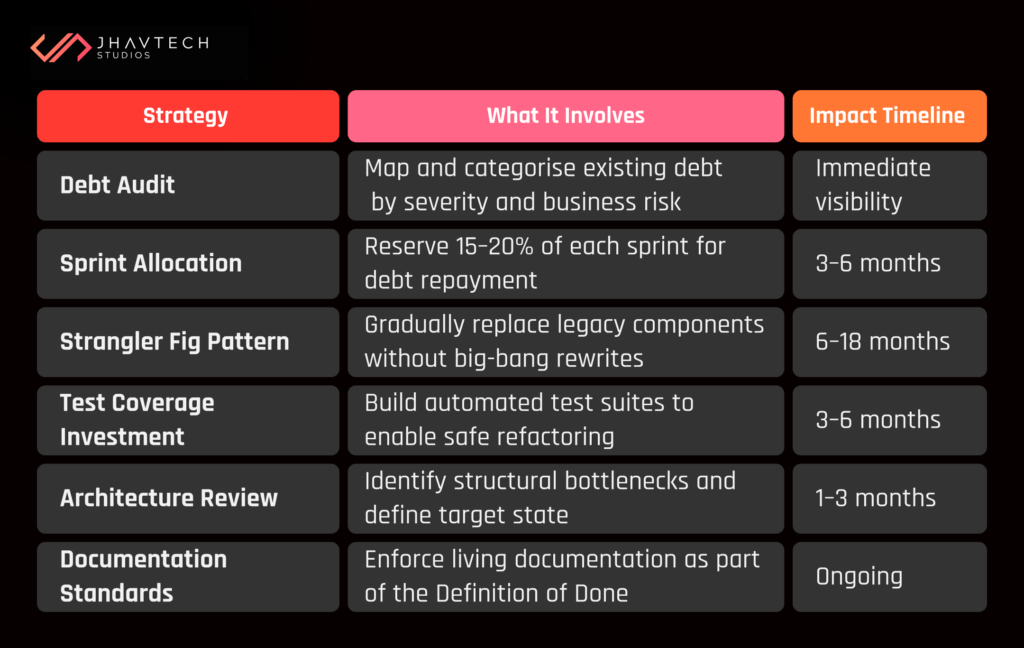
Accenture research recommends allocating approximately 15% of IT budgets to technical debt remediation, particularly for organisations running active development programs. Teams that do this consistently outperform peers in both product quality and revenue growth.
The key insight is that debt repayment doesn't have to be a separate, painful initiative. Embedded consistently into your development cadence, it becomes part of how the team works and not an interruption to it.
When the Debt Is Already Too Deep: What to Do
Sometimes the accumulation has gone on long enough that incremental refactoring isn't realistic. The codebase is too fragile, the architecture too broken, the no-go zones too extensive. In these situations, a more intensive intervention is needed.
This might look like a structured code audit and stabilisation engagement, a component-level rewrite with careful migration planning, or a complete platform re-architecture with data migration. These aren't decisions to take lightly but neither is continuing to operate on a foundation that's actively limiting the business.
Our in-depth guide on technical debt management during project turnarounds covers the strategies that work in these high-stakes scenarios, including how to communicate the business case for remediation investment to non-technical stakeholders.
For teams dealing with performance problems specifically, the Top 10 Code Review Mistakes That Let Performance Issues Slip is essential reading. It covers the structural review gaps that allow technical debt to grow undetected sprint after sprint.
And if you want to understand how code review discipline fits into a long-term debt prevention strategy, Why Your App Needs a Professional Code Review breaks it down in practical terms.
Frequently Asked Questions








.png)
.png)
.png)
.png)
.png)
.png)
.png)
.png)
.png)
.png)
.png)


.png)

.png)
.png)
.png)
.png)
.png)
.png)
.png)
.png)

.png)
.png)
.png)
.png)
.png)
.png)
.png)
.png)
.png)
.png)


.png)
.png)
.png)

.png)
.png)
.png)
.png)

.png)
.png)
.png)


.png)
.png)
.png)


.png)

.png)



.png)


.png)





.png)




.png)







.png)

.png)




.png)


.png)



.png)
.png)