.svg)
.svg)


In-House vs Outsourced Development: Pros & Cons for Australian Businesses in 2026
.png)
You've got the budget, the idea, and the pressure to move. Now comes the call that shapes everything: do you build an in-house team or hand this off to an external partner? Choose wrong and you'll burn months, money, and goodwill before a single line of code ships.
Building a digital product in Australia right now is not straightforward. You have the idea, maybe even the budget, but somewhere between the initial plan and the first line of code, you hit a wall: do we build a team in-house, or do we hand this off to an external partner?
It sounds like a simple either/or question. It isn't. The answer shapes your timeline, your budget, your IP ownership, your compliance obligations under Australian law, and honestly, your sanity over the next twelve to eighteen months.
This guide is written specifically for Australian founders, product leads, and business owners navigating this decision in 2026. We're not recycling US-centric salary figures or pointing you at Eastern European dev shops. We're talking about the actual landscape you're operating in — local talent costs in AUD, the very real skills shortage hitting Australian tech teams, and the legal considerations that global articles consistently skip. Let's get into it.
Why This Decision Hits Differently in Australia
Most in-house vs outsourced development articles are written with Silicon Valley or London in mind. The context is different here, and it matters.
Australia is facing a tech talent crunch that has no quick fix. According to nXscale's analysis of ACS Digital Pulse data, Australia needs 312,000 additional tech workers by 2030, which translates to roughly 60,000 new professionals entering the workforce every year. Meanwhile, only around 7,000 IT graduates enter the market annually. The maths simply don't work.
The flow-on effect? Salaries have ballooned. According to Indeed Australia, the average software engineer now earns around A$109,869 per year, with senior engineers in Melbourne and Sydney commanding A$150,000–$190,000+. Add superannuation (now 11.5%), benefits, recruitment costs, and onboarding time, and the true cost of a single in-house hire is substantially higher than that headline figure suggests.
Recruiting a senior developer in Australia can also take six months or longer. That's six months of delayed builds, growing backlogs, and product roadmaps slipping while the market moves. This isn't a doom-and-gloom take. It's the reality shaping why so many Australian businesses are rethinking their development model right now.
What "In-House" Actually Costs in Australia
When people say in-house development is the safer option, they're usually thinking about control and communication. Both are real advantages. But the cost picture is more complicated than it looks.
The Real Numbers
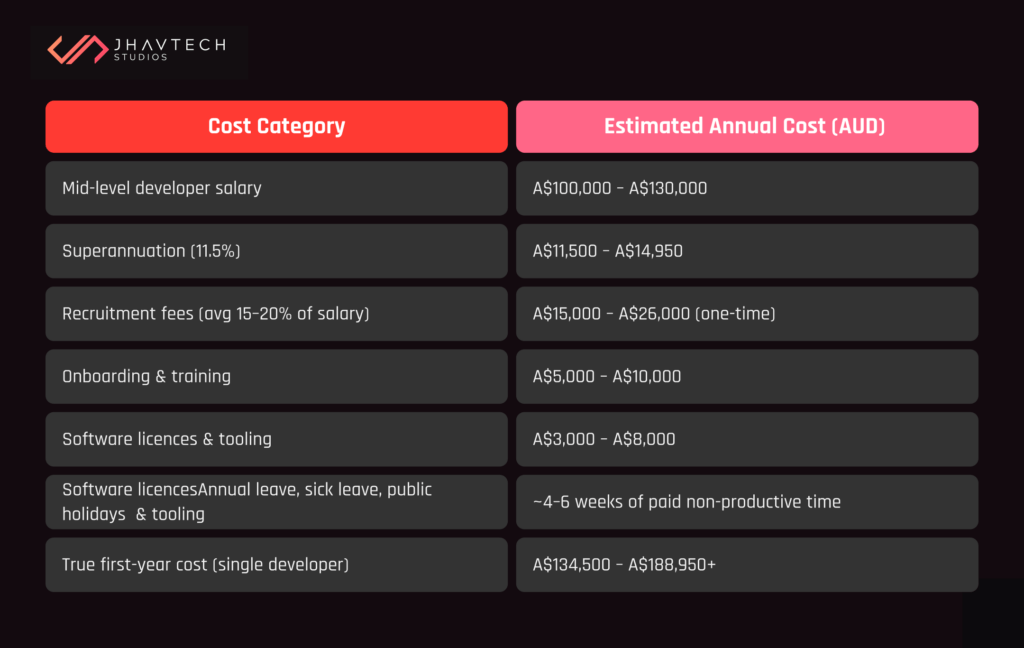
And that's for one person, at one seniority level. A modest product team consisting of a frontend dev, a backend dev, and a QA engineer, easily tips over A$400,000 per year before you've launched a single feature.
What In-House Gets You
None of this means in-house is wrong. There are genuine, meaningful advantages:
- Deep product knowledge. Developers who live with your product every day understand its quirks, edge cases, and strategic direction in a way external teams rarely match.
- Cultural alignment. Your in-house team absorbs your values, your communication style, and your priorities (no briefing document required).
- IP and data security. For businesses in regulated industries (fintech, healthtech, legaltech), keeping development internal simplifies compliance under the Australian Privacy Act and sector-specific frameworks like the Consumer Data Right (CDR).
- Long-term compounding value. The institutional knowledge your team builds doesn't walk out the door at the end of a contract.
If your app is the core of your business, not a side feature, not an MVP experiment, and you have continuous development needs, in-house remains a strong choice. The problem is the entry cost and the time it takes to get there.
What Outsourced Development Looks Like for Australian Businesses
Outsourcing in the Australian context means something specific. When local businesses go external, they're typically choosing between three models:
- Australian-based agencies — highest cost (A$150–A$200/hour), but same timezone, same regulatory understanding, easiest communication
- Nearshore teams — Philippines, Vietnam, India — strong English proficiency, close enough time zones for real overlap (2–4 hours difference from AEST), costs 50–75% lower than local senior rates
- Offshore teams further afield — Eastern Europe, Latin America — lower cost again, but larger time zone gaps and more active management required
What Outsourcing Gets You
The talent shortage argument for outsourcing is unusually strong in Australia. Flexisource IT's 2026 Skills Gap analysis found that offshore development teams for Australian businesses can be assembled in 4–6 weeks as compared to 6+ months to recruit a single senior developer locally. For a startup burning through runway, that gap is existential.
Other advantages:
- Immediate access to specialists — AI/ML engineers, DevOps architects, UX specialists — roles that are nearly impossible to fill locally at competitive rates
- Scalability — ramp up for a major release, scale back during quieter periods, without redundancy conversations
- Cost predictability — fixed-scope contracts and SLAs make budget planning cleaner than an open-ended employment relationship
- 24/7 productivity — teams across time zones mean progress continues while your local team sleeps
If you're at the stage where you need to turn a digital idea into a live, market-ready product without the overhead of building a permanent team, this is where a skilled external partner earns its keep fast.
The Legal Stuff Australian Businesses Can't Ignore
This is the section most global guides skip entirely. Don't skip it.
If You Hire In-House
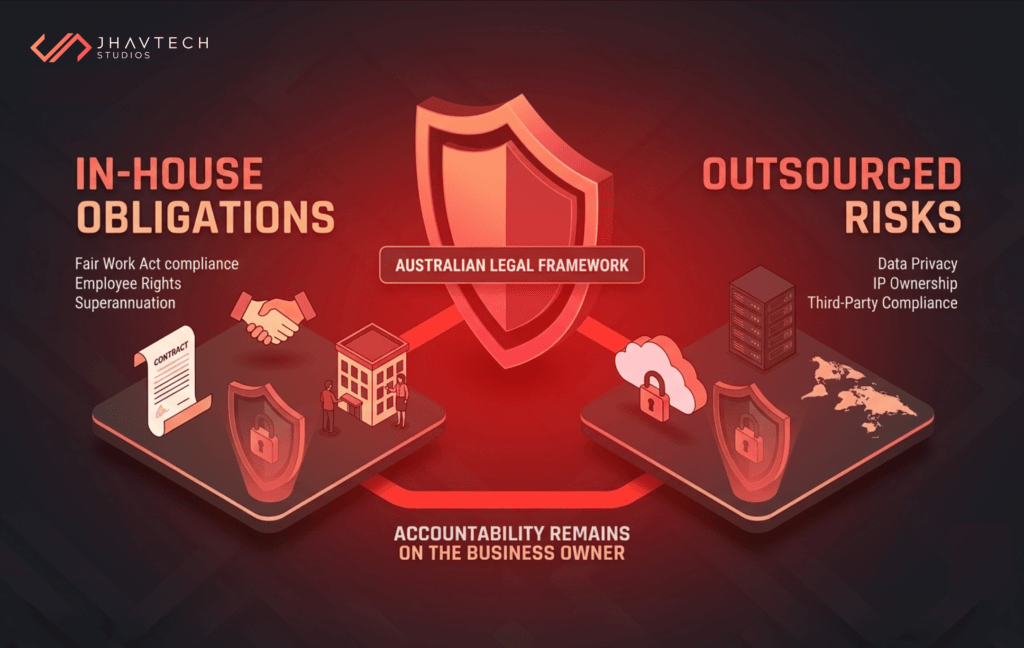
You're bound by the Fair Work Act 2009. That means minimum wage obligations, leave entitlements (annual leave, personal/carer's leave, parental leave), unfair dismissal protections, and mandatory superannuation contributions. These aren't negotiable, and getting them wrong is expensive.
If You Outsource
Different obligations apply, and they're equally important:
- Australian Privacy Act 1988 — if your outsourced team handles personal data of Australian users, you remain accountable as the data controller, regardless of where the team is based. Your contract must address this explicitly.
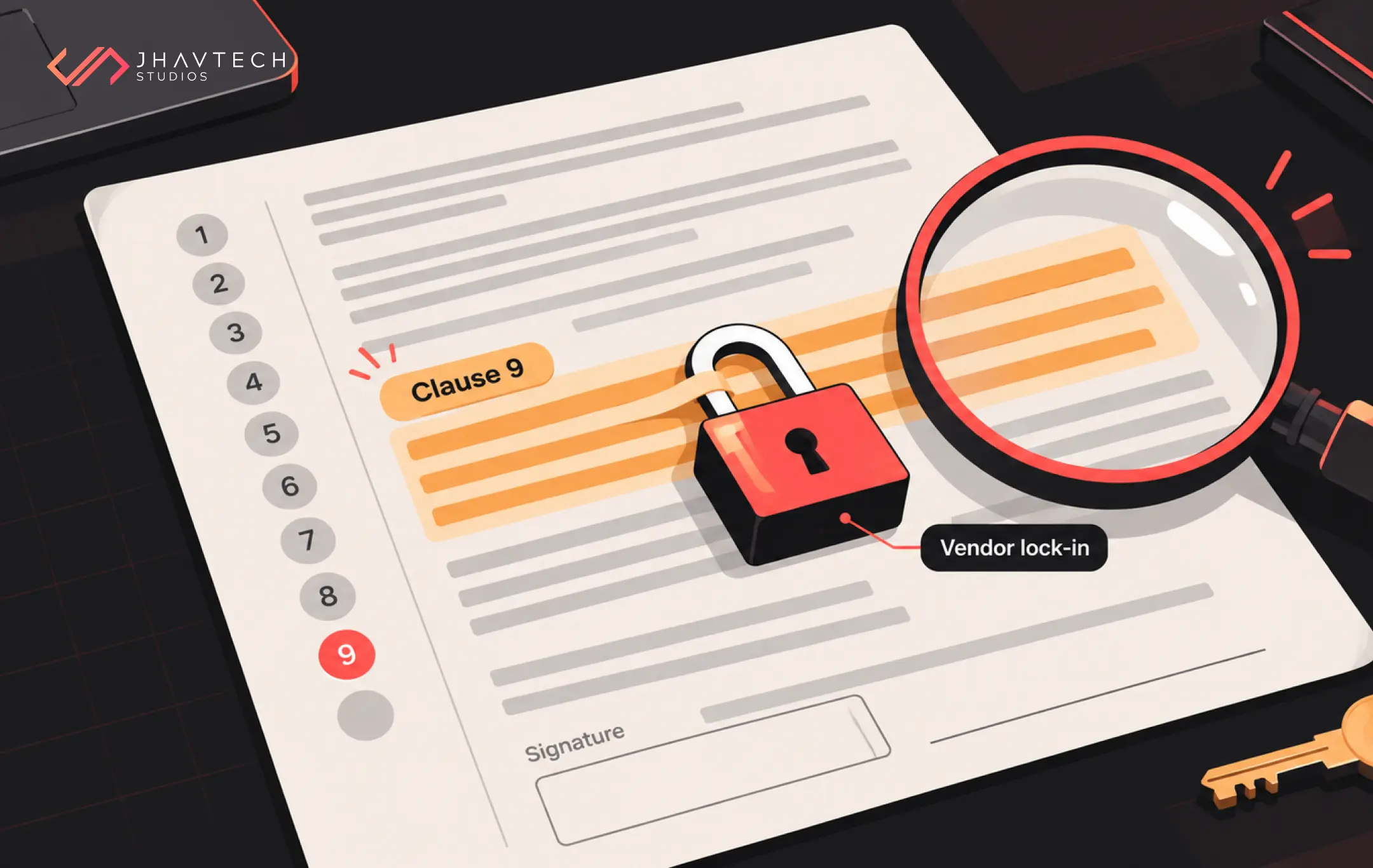
- Intellectual property ownership — Australian contract law does not automatically vest IP in the commissioning party. Your development agreement must clearly state that all code, assets, and deliverables are your property upon payment.
- Contractor classification — be careful about how you structure arrangements with individual freelancers. The ATO has specific rules around sham contracting that can expose you to back-paid entitlements and penalties.
Getting an IP and data clause reviewed by an Australian tech lawyer before signing any outsourcing agreement is money well spent.
Head-to-Head: Quick Decision Checklist
✅ In-House is probably right if you:
[ ] Have continuous, ongoing development needs (not a one-off project)
[ ] Are building proprietary technology that is your core competitive advantage
[ ] Handle sensitive personal or financial data under strict AU regulatory requirements
[ ] Have the budget for A$400,000+ per year in team costs from day one
[ ] Can afford a 4–6 month hiring runway before development begins
[ ] Have a technical founder or CTO who can lead and manage the team
✅ Outsourcing is probably right if you:
[ ] Need to move to market in weeks, not months
[ ] Are building an MVP or a defined-scope product
[ ] Need specialist skills (AI, cloud, security) unavailable locally at scale
[ ] Want to test a digital concept before committing to a permanent team
[ ] Have budget constraints that make A$130K+ developer salaries impractical right now
[ ] Want to scale team size up or down based on project phases
The Hybrid Model: What Most Successful Australian Businesses Are Actually Doing
Here's the honest picture. The companies getting this right in 2026 aren't choosing one model and sticking to it religiously. They're running a hybrid and it's not a compromise, it's a strategy.
A typical structure: one or two senior internal people (a product lead, a technical lead) who own the vision, the architecture decisions, and the relationship with the business — backed by an outsourced team handling execution, feature development, QA, and specialist workstreams.
This model gives you:
- IP and strategic control without paying to staff every role permanently
- Execution speed without sacrificing quality oversight
- The ability to absorb outsourced knowledge into your internal team over time
The Australian businesses doing this well tend to treat their outsourced partner as an extension of the team, not a vendor. Same sprint cycles, same stand-ups, same tools. The distinction between "us" and "them" disappears fast when the processes are tight.
How to Choose the Right Outsourcing Partner (If That's Your Direction)
- Not all external development partners are equal. A few things matter more than anything else when evaluating options for an Australian business:
- Timezone and communication overlap. A 10-hour gap can work with the right async processes, but real-time collaboration during at least 2–3 hours of your working day is worth paying for. Philippines, Vietnam, and India check this box for AEST-based teams.
- Portfolio in your vertical. An agency with ten fintech apps under their belt understands compliance, security, and user trust in a way a generalist shop doesn't. Ask for case studies in your category, not just their best work.
- References you can actually call. Ask for two or three past clients (ideally Australian) and have a real conversation about how things went when something broke or went sideways. That's where you learn what a partner is actually like.
- How they handle IP and data. Any reputable partner should have NDAs and IP assignment clauses ready before you are. If they hesitate or treat this as unusual, walk away.
Frequently Asked Questions
.png)

.png)
.png)
.png)
.png)

.png)
.png)
.png)

.png)
.png)
.png)
.png)
.png)
.png)
.png)
.png)
.png)
.png)
.png)
.png)


.png)
.png)
.png)
.png)
.png)
.png)
.png)
.png)
.png)

.png)
.png)
.png)
.png)
.png)
.png)
.png)
.png)
.png)
.png)
.png)
.png)
.png)

.png)
.png)
.png)
.png)

.png)
.png)
.png)


.png)
.png)
.png)
.png)

.png)


.png)


.png)




.png)



.png)






.png)

.png)