.svg)
.svg)


Healthcare Apps Programming Languages: Java vs Python vs Flutter in 2025
.png)
The global healthcare industry is undergoing one of the fastest digital transformations in history. From telemedicine platforms that connect patients with doctors in seconds, to AI-driven diagnostics capable of predicting diseases, and even fitness tracking apps helping people live healthier lifestyles—healthcare apps are now central to how we access, deliver, and manage care.
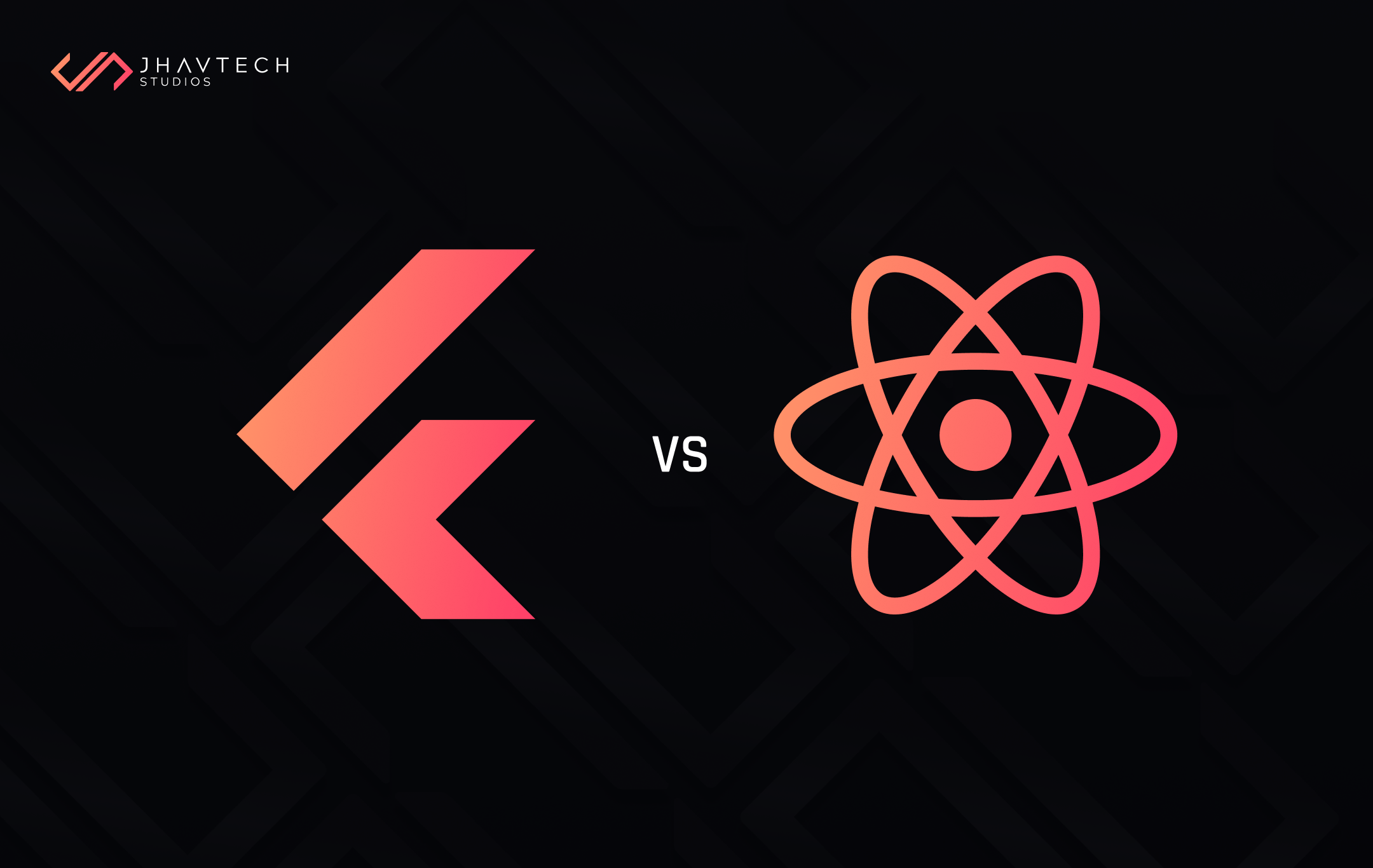
But there’s one critical decision that shapes the success of every healthcare app: the choice of programming language. In 2025, developers and healthcare providers are asking the same question—Java vs Python vs Flutter, which is best for healthcare apps?
This blog will break down the strengths and limitations of these technologies, highlight key healthcare app programming languages, and guide you through choosing the right one for your project. By the end, you’ll know which option (or combination) aligns with your goals, whether you’re a startup building an MVP or a healthcare provider scaling enterprise-grade solutions.
Why Programming Language Matters in Healthcare App Development
Building a healthcare app isn’t like developing a social media or shopping platform—it comes with unique demands. Here’s why choosing the right programming language matters:
Performance & Speed
Healthcare apps process real-time data, such as patient vitals and medical imaging. Even milliseconds of delay can have consequences. A fast and efficient language ensures life-saving information reaches doctors and patients without delay, enabling timely interventions.
Security & Compliance
Healthcare apps must follow HIPAA, GDPR, and Australia’s Privacy Act to safeguard sensitive patient records. Choosing a language with strong encryption libraries and built-in security frameworks reduces compliance risks and builds user trust.
Integration Capabilities
From Electronic Health Records (EHRs) to wearables like Fitbits and Apple Watches, interoperability is critical. A language that supports multiple APIs and healthcare standards simplifies data sharing and creates a unified patient view.
Scalability
Apps should handle growing user bases and large datasets without crashing. The right language allows healthcare platforms to evolve smoothly as more patients and hospitals adopt digital solutions.
Cross-Platform Needs
Australians expect seamless access on both Android and iOS devices. Languages with strong cross-platform support ensure consistent performance and user experience across all devices.
According to a 2024 Accenture study, more than 74% of patients now prefer digital-first interactions for basic healthcare needs. This makes the programming language decision even more strategic—it’s not just about code, but about trust, compliance, and patient experience.
Java for Healthcare Apps
Java has been a cornerstone of healthcare app development for decades, especially for enterprise-grade systems. Its proven stability, mature ecosystem, and long-standing adoption in mission-critical software make it a trusted choice for building secure, scalable, and regulation-compliant healthcare applications.
Strengths
- Stability & Reliability – Ideal for complex healthcare solutions that require zero downtime. Hospitals and clinics can confidently rely on Java applications for continuous operation without fear of unexpected crashes.
- Security – Offers robust security libraries that simplify HIPAA compliance. This makes Java a go-to language for protecting sensitive patient data and ensuring regulatory requirements are consistently met.
- Integration-Friendly – Widely used in IoT-driven patient monitoring and medical device software. Its ability to seamlessly integrate with APIs, hardware, and third-party systems ensures smooth interoperability in healthcare ecosystems.
- Android Dominance – With Android holding a majority market share in Australia, Java remains critical for mobile healthcare apps. This allows developers to build apps that reach the widest possible patient and practitioner audience.
Limitations
- Longer Development Cycles – More time-consuming compared to newer frameworks. This can increase project costs and delay time-to-market, which may be a challenge for startups needing faster deployment.
- Resource Heavy – Demands more memory and processing power. In practice, this means apps may require more robust server infrastructure and optimised code to run efficiently.
Best Use Cases
Android telemedicine apps, Electronic Health Record (EHR) systems, and IoT-enabled patient monitoring.
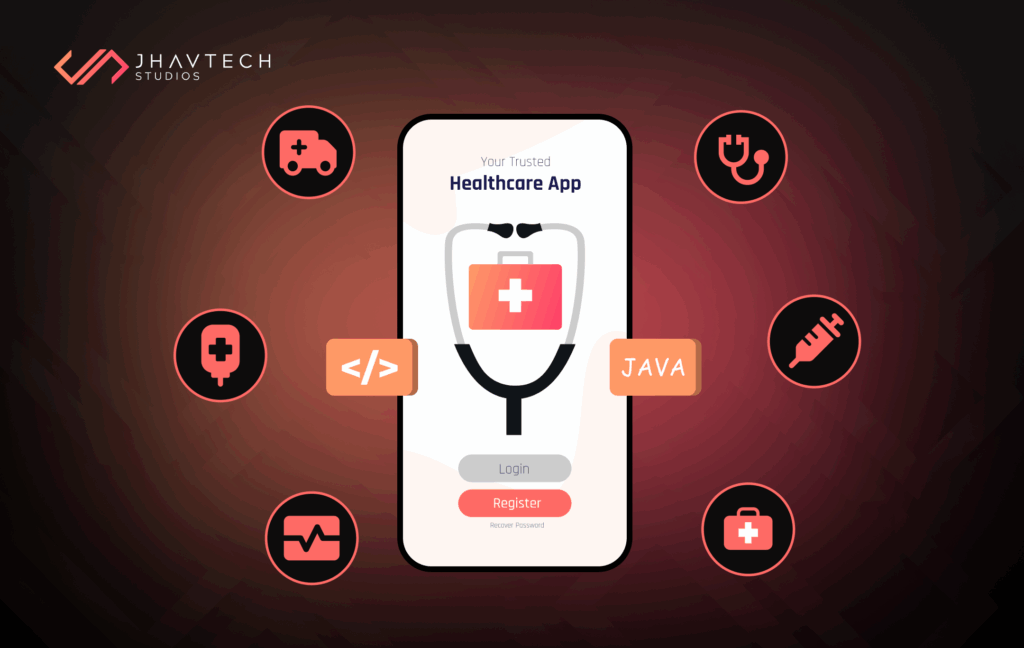
Python for Healthcare Apps
Python has gained popularity in healthcare app development thanks to its simplicity, versatility, and vast ecosystem of libraries for AI, data analytics, and machine learning. It’s often the first choice for building data-driven healthcare solutions that require rapid prototyping and innovation.
Strengths
- Ease of Learning & Development – Python’s simple syntax speeds up development. This allows healthcare startups to get their products to market faster with smaller development teams.
- Data Science & AI Capabilities – Ideal for healthcare apps involving diagnostics, predictive analytics, and patient data insights. Its powerful libraries like TensorFlow and Pandas make complex computations easier to implement.
- Rapid Prototyping – Perfect for testing and iterating on new healthcare concepts. Developers can quickly create MVPs and gather feedback before committing to full-scale production.
- Interoperability – Works well with APIs and third-party healthcare systems. This makes it easy to integrate patient portals, EHR systems, and medical devices into one seamless ecosystem.
Limitations
- Performance Limitations – Slower execution speed compared to compiled languages like Java. For real-time patient monitoring, additional optimisation or hybrid approaches might be necessary.
- Mobile App Development – Not natively supported for mobile development. Developers often need frameworks like Kivy or third-party tools, which may limit performance and native capabilities.
Best Use Cases
AI-driven diagnostics, healthcare analytics dashboards, and telemedicine chatbots.
Flutter for Healthcare Apps
Flutter, Google’s cross-platform UI toolkit, has become a go-to choice for building visually rich healthcare apps with a single codebase. Its ability to deliver native-like performance for both iOS and Android makes it appealing for cost-efficient and fast deployments.
Strengths
- Cross-Platform Efficiency – Single codebase for iOS and Android reduces development time while maintaining high-quality UI/UX design. This dramatically cuts costs for healthcare providers targeting multiple platforms.
- Fast Development with Hot Reload – Enables instant UI changes during development. This speeds up design iterations and improves collaboration between developers and healthcare stakeholders.
- Rich UI Components – Ideal for patient-facing apps with interactive dashboards. Flutter’s widgets create visually appealing and user-friendly interfaces for better patient engagement.
- Integration Capabilities – Supports integration with APIs and backend systems. Developers can easily connect to healthcare databases, payment systems, and IoT devices.
Limitations
- Relatively New Technology – Smaller developer community compared to Java or Python. This can mean fewer ready-made healthcare-specific libraries or third-party tools.
- App Size & Performance – Flutter apps may have larger file sizes. This can be a drawback for users with limited device storage or slower networks.
Best Use Cases
Some of the most popular healthcare app ideas include patient engagement tools, telehealth video consultation platforms, and appointment booking systems.
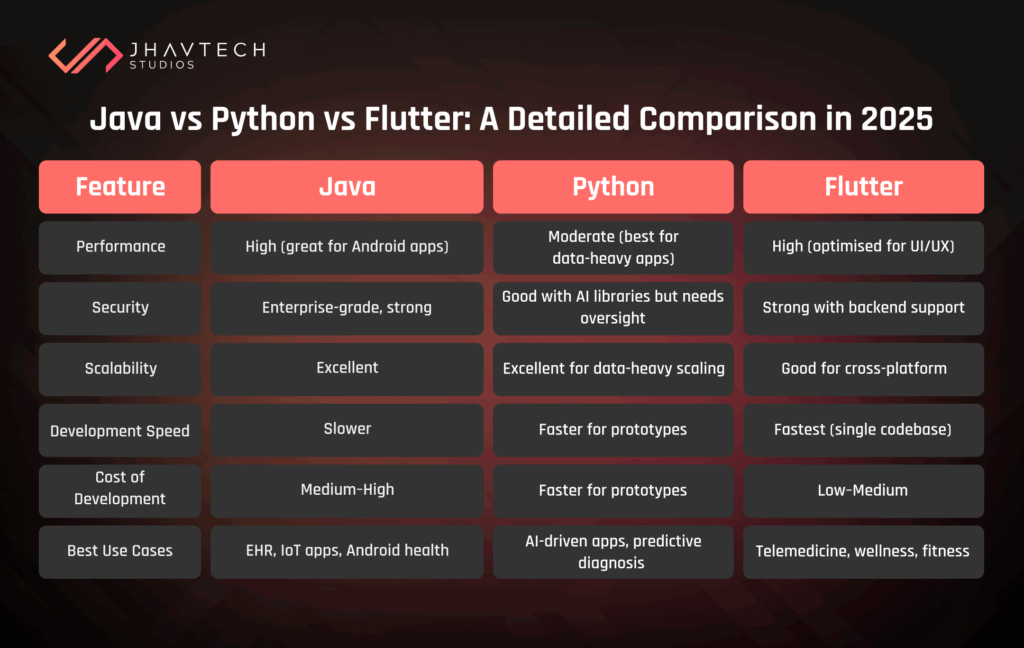
Java vs Python vs Flutter: A Detailed Comparison in 2025
Here’s a side-by-side breakdown of how these programming languages stack up for healthcare apps:
Which One Should You Choose in 2025?
Choose Python if your healthcare app relies on AI, predictive analytics, or big data insights.
Choose Java if you need a secure, scalable Android-based healthcare system.
Choose Flutter if you want a cost-effective, cross-platform solution with fast deployment.
Many modern healthcare apps use a hybrid approach:
- Flutter for the patient-facing interface.
- Python for AI-driven diagnosis.
- Java for backend integration with medical devices.
This multi-layered strategy provides flexibility, speed, and compliance—a win for both patients and healthcare providers. In 2025, the best choice often isn’t about picking a single technology but aligning the strengths of each with your app’s unique requirements. By combining them, healthcare companies can accelerate development, ensure security, and create a seamless user experience that improves patient outcomes.
Future Trends in Healthcare App Development
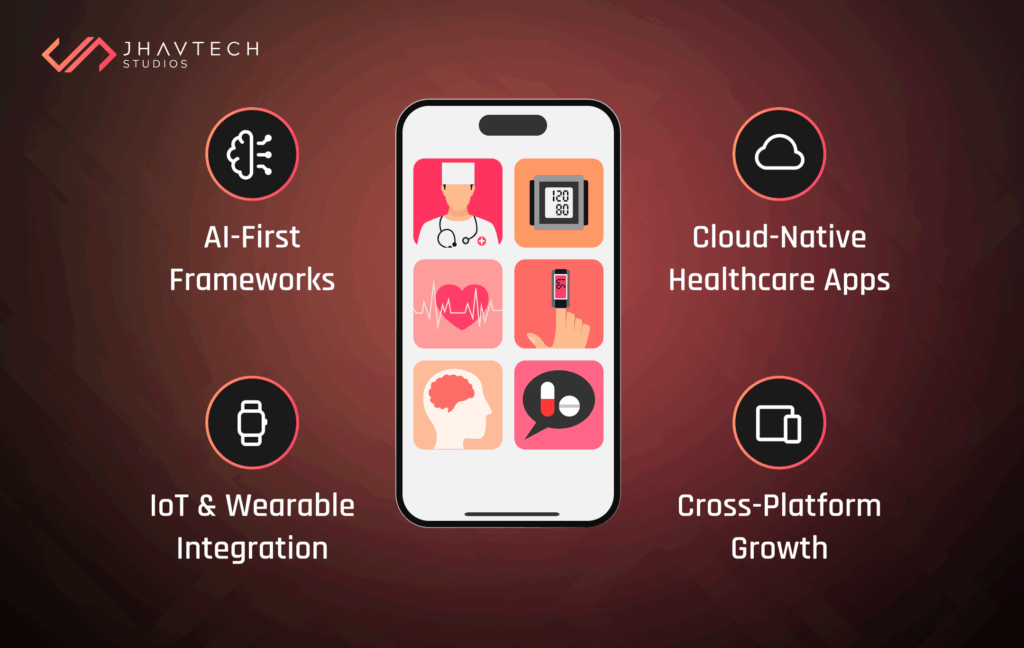
Healthcare app development is evolving rapidly, shaped by advances in AI, cloud computing, and patient-focused technologies. As we move into 2025 and beyond, developers and healthcare providers must prepare for innovations that will redefine how patients access care and how doctors deliver it. Below are the key trends driving this transformation.
AI-First Frameworks
Expect more apps powered by predictive AI for diagnostics and patient care. AI-driven chatbots, symptom checkers, and decision-support systems are becoming mainstream. In fact, physician AI adoption rates jumped from 38% in 2023 to 66% in 2024 across clinical documentation and diagnosis workflows, highlighting how AI is moving beyond theory into everyday clinical practice.
Cloud-Native Healthcare Apps
Cloud adoption is no longer optional—it’s the backbone of scalability and secure data sharing. With healthcare providers needing instant access to patient data across multiple facilities, cloud-native architectures ensure compliance, reliability, and cost efficiency.
IoT & Wearable Integration
From heart rate monitors to sleep trackers, remote patient monitoring is on the rise. In Australia, the remote patient monitoring software and services market reached USD 245 million in 2023 and is projected to grow to USD 1.8 billion by 2030, representing a whopping CAGR of 32.9%. Grand View Research These technologies are providing continuous data streams that can trigger early interventions, reduce hospital stays, and markedly improve patient outcomes. Telemedicine adoption statistics show that global usage soared in recent years—highlighting how vital telehealth has become to modern healthcare delivery.
Cross-Platform Growth
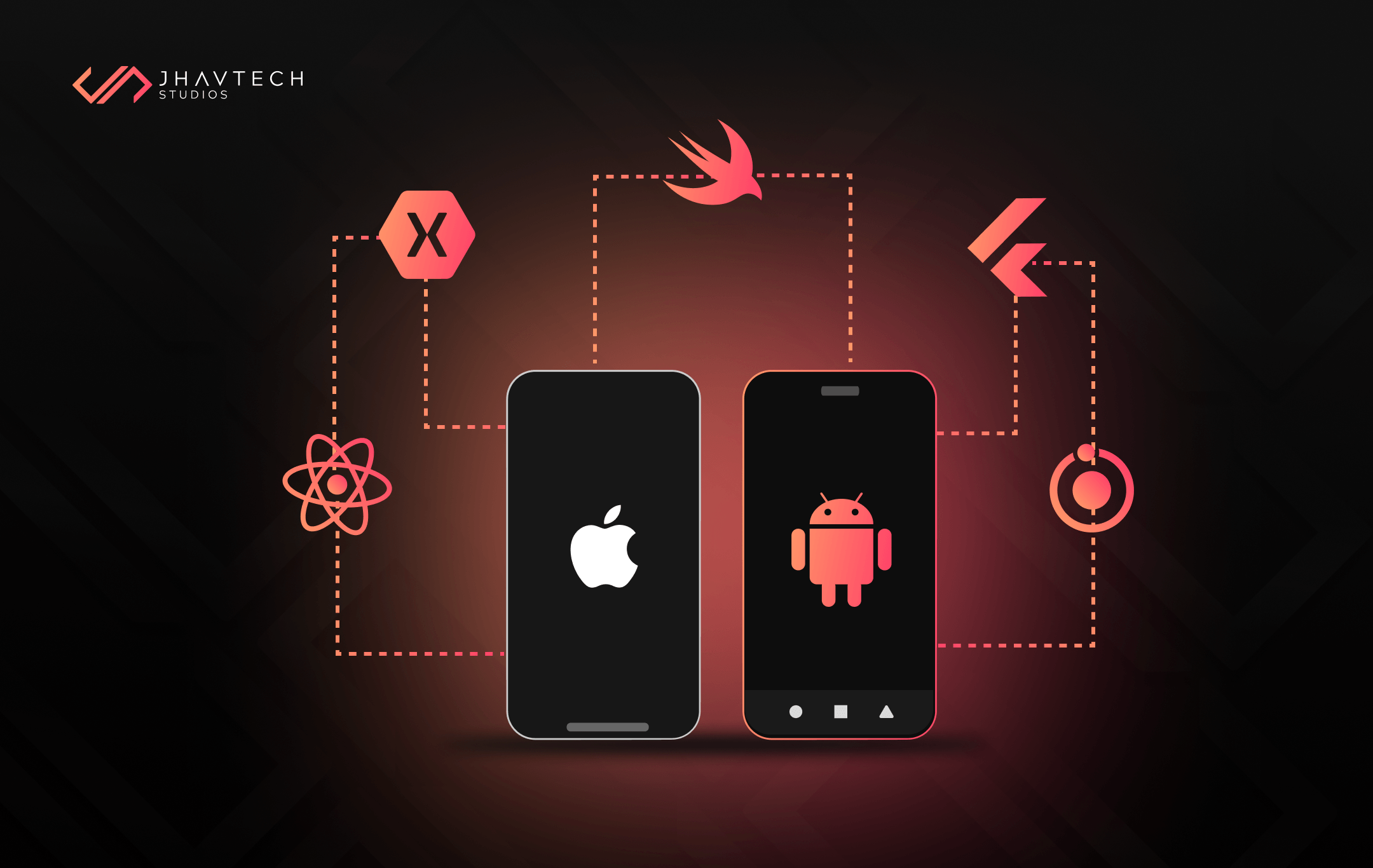
Frameworks like Flutter will continue to reduce costs and speed up time-to-market, allowing providers to roll out updates faster and reach both iOS and Android users seamlessly. Hybrid app development will also gain traction, offering healthcare companies the flexibility to deliver high-quality apps without the overhead of building fully native solutions for each platform.
A report by Grand View Research predicts that the global healthcare apps market will reach USD 250 billion by 2030, driven by AI, telemedicine, and wearables. Australia is expected to play a significant role in this growth thanks to its strong digital health initiatives and government-backed innovation programs.
Final Thoughts
In 2025, the debate of Java vs Python vs Flutter for healthcare apps isn’t about one being “better” universally—it’s about choosing the right tool for the right job:
- AI & data science needs → Python
- Enterprise-grade Android apps → Java
- Cross-platform solutions → Flutter
Often, the smartest approach is to combine these technologies for maximum impact. With healthcare apps driving digital transformation in Australia and beyond, now is the perfect time to build scalable, secure, and patient-friendly solutions.
Whether you’re building a telemedicine platform, a predictive analytics dashboard, or a patient engagement app, choosing the right technology stack will define your success. For expert guidance and end-to-end development support, explore Jhavtech Studios’ Healthcare Application Development Service—our team specialises in creating safe, innovative, and human-centric healthcare apps tailored to your needs.
Frequently Asked Questions
1. Which programming language is best for healthcare app development in 2025?
It depends on your project: Java for enterprise-grade apps, Python for AI and data analytics, and Flutter for cross-platform solutions.
2. Why is Python popular in healthcare AI apps?
Python’s powerful AI/ML libraries like TensorFlow and Keras make it ideal for predictive analytics, diagnostics, and big data healthcare apps.
3. Can Flutter handle HIPAA-compliant healthcare apps?
Yes, but compliance depends on backend infrastructure, not just the framework itself.
4. Is Java still relevant for building healthcare applications?
Absolutely. Java remains a reliable choice for Android healthcare apps and backend integrations with IoT devices.
5. What factors should startups consider before choosing a language for healthcare apps?
Performance, compliance, scalability, target audience, development cost, and speed-to-market should all be considered before making a decision.

.png)
.png)
.png)
.png)
.png)
.png)
.png)
.png)
.png)
.png)
.png)
.png)
.png)
.png)
.png)
.png)
.png)
.png)
.png)
.png)
.png)
.png)
.png)
.png)
.png)
.png)
.png)
.png)
.png)
.png)
.png)
.png)
.png)
.png)
.png)
.png)
.png)

.png)
.png)
.png)
.png)
.png)
.png)
.png)

.png)


.png)

.png)



.png)



.png)




.png)

.png)

.png)
.png)
.png)
.png)