.svg)
.svg)


Why Your Development Team Keeps Missing Delivery Deadlines

Missed deadlines are rarely about lazy developers or bad luck. They're almost always a symptom of deeper software delivery issues, including vague requirements, sprint overcommitment, technical debt, and bottlenecks that never get measured. This blog breaks down why deadlines slip, what the 2025-2026 data says about agile development problems, and the practical fixes that actually hold up under real-world pressure.
If you've sat in one more "retro" where everyone nods, agrees to "communicate better," and then misses the next sprint anyway, you already know that most advice on this topic doesn't fix anything. It just renames the problem.
Here's the uncomfortable truth: project failure rates have stayed stubbornly high, and the gap between what teams plan to deliver and what actually ships is bigger than most expect. And it's not just legacy enterprises with bloated bureaucracy. Lean, fast-moving startups and SMEs hit the same wall, often harder, because they don't have the budget cushion to absorb a blown deadline.
This isn't another listicle telling you to improve communication. It's a breakdown of the real, structural reasons software delivery issues keep recurring, backed by recent research, and what you can do about them before your next sprint planning session.
The Real Numbers Behind Missed Deadlines
Let's start with the data, because gut feelings about "why we're always late" tend to be wrong, and the actual research points somewhere more specific than "the team needs to work harder."
A 2025 industry survey found that 81% of business decision-makers in the UK and 89% in the USA are concerned about on-time delivery of their software projects, which tells you this isn't a you problem, it's an industry-wide pattern.
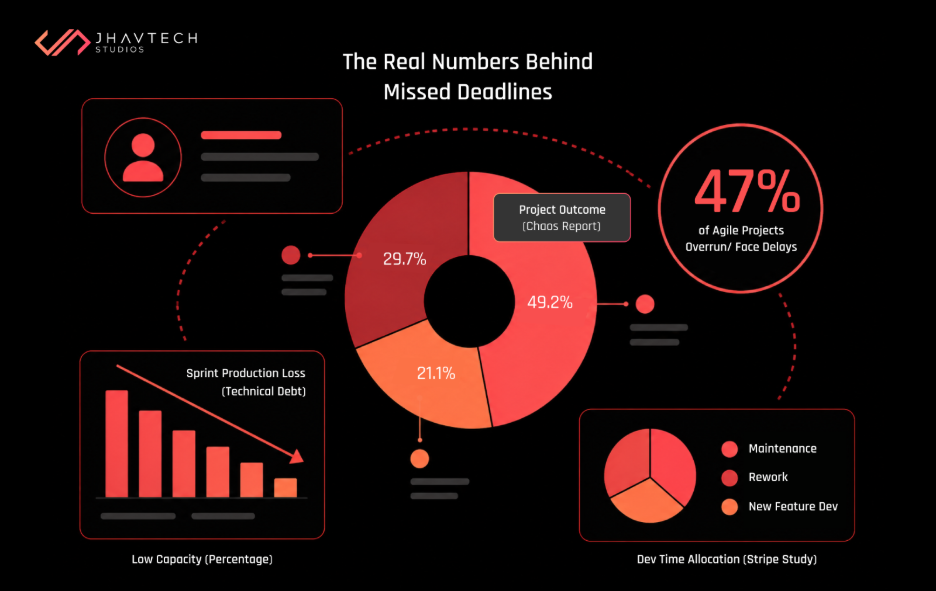
The CHAOS Report, one of the longest-running studies on software project outcomes, found that only 29.7% of software development projects were fully successful in meeting time, budget, and quality goals, with 49.2% challenged and 21.1% outright failed. Put differently: roughly seven in ten software projects don't hit all three targets cleanly.
Sprint-level data tells a similar story. Research on agile teams found that nearly 47% of agile projects face budget overruns, delays, or customer dissatisfaction, even though agile was supposed to be the methodology that fixed this. That's the part that should make every engineering leader pause: "we're agile now" was never a guarantee against sprint delays.
And then there's the quiet productivity killer almost nobody puts on a roadmap: technical debt. Stripe's widely cited Developer Coefficient Study found that engineering teams lose a significant share of working time to maintenance and rework caused by technical debt rather than new feature development, and more recent analysis suggests the share has only grown as codebases and toolchains have gotten more complex. If a third (or more) of your team's capacity is quietly being eaten by bugs and workarounds, missed deadlines aren't a mystery. They're arithmetic.
It's Rarely One Big Failure. It's Five Small Ones Compounding
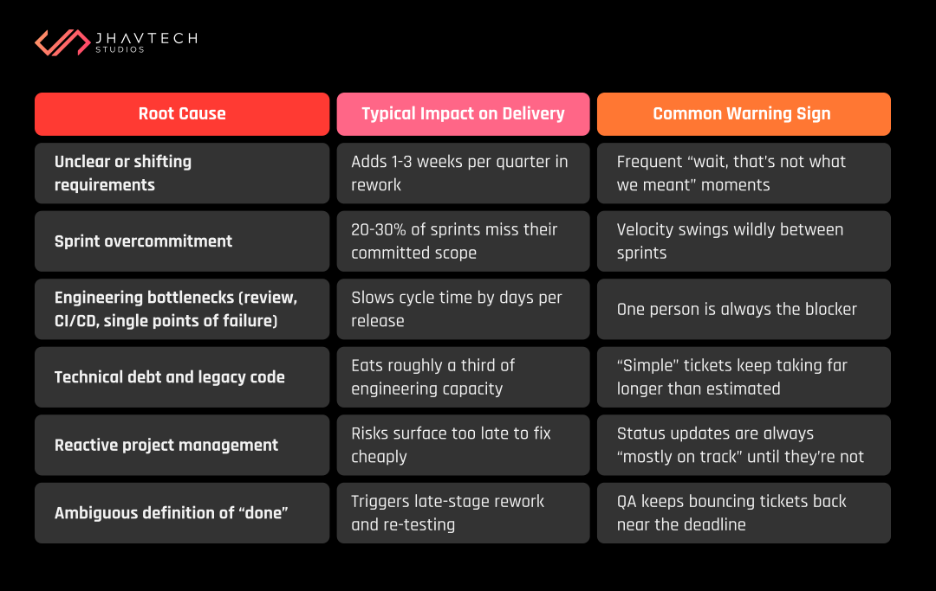
Deadlines don't usually get missed because of one catastrophic mistake. They slip because five or six small, survivable issues stack on top of each other until the cumulative drag becomes undeniable. Here's the breakdown engineering leaders most often overlook.
1. Requirements Were Never Actually Locked
"We'll figure out the details as we go" sounds agile. In practice, it's how scope creep enters through the back door. Every quick clarification mid-sprint is a tiny re-plan that nobody accounts for in the original estimate.
2. Sprint Planning Is Optimism, Not Forecasting
Most sprint delays don't come from one disastrous sprint. They come from teams consistently estimating as if nothing will go wrong, then being surprised when something always does. If your velocity chart looks like a heart monitor instead of a trend line, this is usually why.
3. Engineering Bottlenecks Hide in Plain Sight
A single overloaded reviewer, one engineer who's the only person who understands a critical module, or a CI/CD pipeline that takes 40 minutes per run: these are classic engineering bottlenecks. They don't show up as blockers in your tracker because everyone's gotten used to working around them.
4. Technical Debt Is Quietly Taxing Every Sprint
Every shortcut taken to hit a deadline becomes a small tax on every future sprint. Teams rarely notice this in the moment. They notice it eighteen months later when a simple feature takes three weeks because nobody can safely touch the surrounding code.
5. Project Management Issues Mask the Real Bottleneck
When the project management layer is reactive rather than predictive, problems only get visibility after they've already caused a delay. By the time a status report flags a risk, the team has often already lost the days needed to course-correct.
Where the Time Actually Goes (A Quick Breakdown)
To make this concrete, here's a simplified breakdown of where development capacity tends to disappear in teams that consistently miss deadlines, based on patterns reported across the studies cited above.
Where the Time Actually Goes (A Quick Breakdown)
How to Actually Fix This (Not Just Talk About It)
Knowing the causes is the easy part. Here's what separates teams that fix this from teams that keep having the same retro every quarter.
Audit Before You Reorganise
Don't restructure your whole team or switch project management tools before you know exactly where the time is going. A short, structured audit, reviewing sprint history, code quality, and delivery cadence, usually surfaces the real bottleneck in days, not months. This is precisely the kind of diagnostic work our software project rescue team runs for clients whose timelines have already slipped past the point of "we'll catch up next sprint."
Make Technical Debt Visible to Leadership
Technical debt stays invisible until someone puts a number on it. Track the ratio of time spent on new features versus maintenance and bug-fixing. Once leadership sees that figure in writing, debt repayment stops being "nice to have" and starts being a budget line. A structured second opinion on your codebase, through something like a professional code quality assessment, is often the fastest way to get that number.
Right-Size Your Sprints, Don't Just Shrink Them
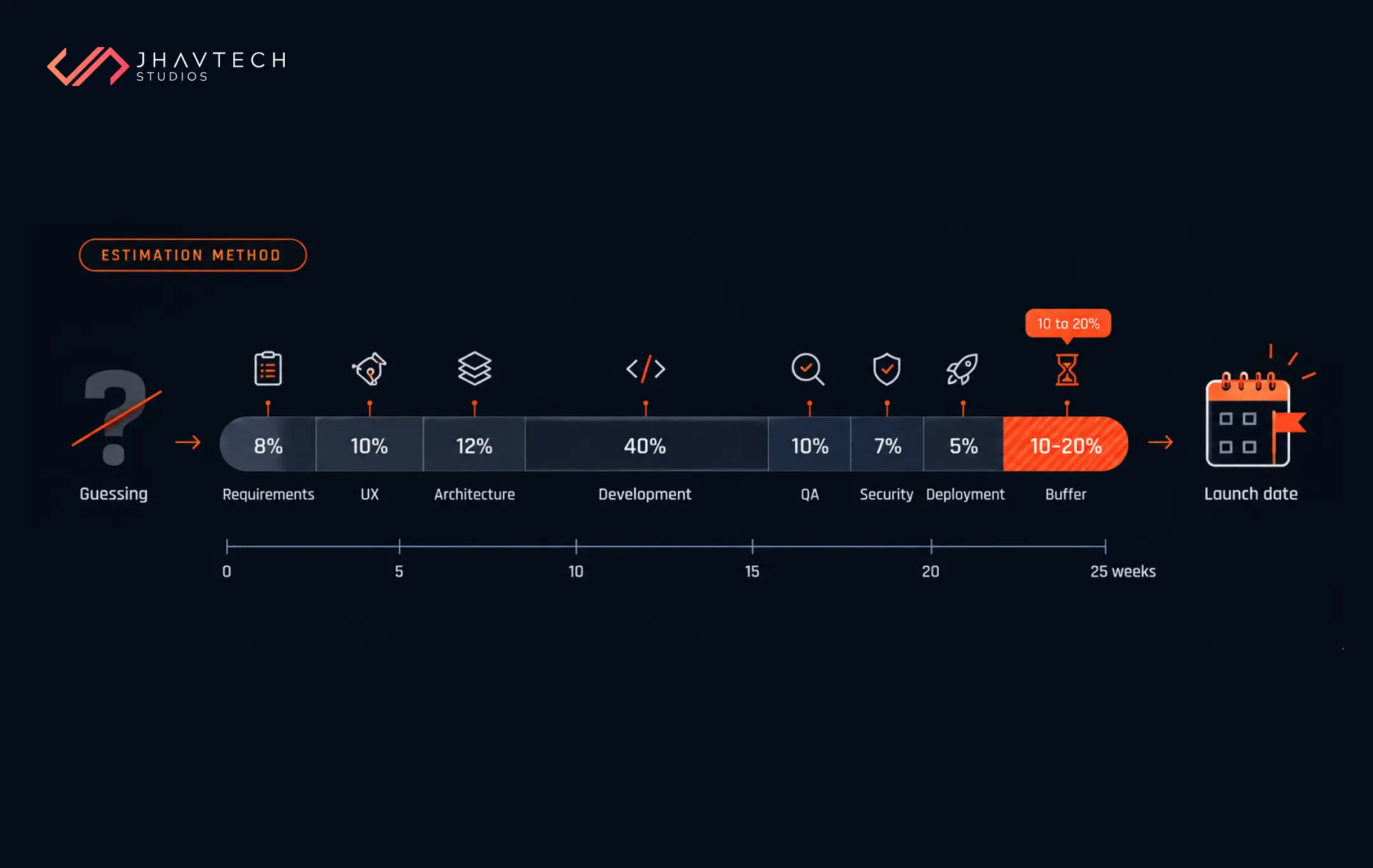
The fix for overcommitment isn't commit to less and hope. It's building estimates from actual historical velocity, not aspirational velocity, and explicitly reserving 10-20% of sprint capacity for the unplanned work that always shows up anyway.
Fix the Bottleneck, Not the Symptom
If one engineer is the review bottleneck, the fix isn't ask them to review faster. It's distributing review ownership, documenting tribal knowledge, and automating the parts of the pipeline that don't need a human gatekeeper.
Treat Definition of Done as a Contract, Not a Suggestion
Get product, engineering, and QA to agree, in writing, on what done means before the sprint starts, not during the final demo. This single habit eliminates a surprising share of last-minute scrambles.
A Quick Self-Audit Checklist
Run through this with your team. If you check more than three or four boxes, your missed deadlines aren't a fluke. They're systemic.
- Sprint scope changes mid-sprint more often than not
- Velocity varies wildly from one sprint to the next
- One or two people are the bottleneck for reviews or releases
- Nobody can say what percentage of time goes to maintenance vs. new features
- “Done” means different things to different team members
- Status reports tend to look fine right up until they don’t
- Your last three major releases all slipped by similar margins
- Onboarding a new developer takes weeks because the codebase is hard to explain
If this list feels uncomfortably familiar, you're not alone, and you're also not stuck. We've broken down the financial side of this exact problem in The Hidden Cost of Delayed Software Projects in 2026, and the warning signs that your project has crossed from behind schedule into needs intervention in How to Know If Your Software Project Needs a Rescue Team.
When the Problem Is the Product, Not Just the Process [H2]
Sometimes the deadline issue isn't process at all. It's that the team is building toward a moving target. Startups in particular tend to add scope reactively in response to investor feedback or competitor moves, which guarantees sprint delays no matter how disciplined the engineering process is. If that sounds familiar, it's worth reading Why Most Australian Startups Fail Before Their Product Gains Traction, since the pattern there overlaps heavily with chronic delivery delays.
If your roadmap depends on shipping a customer-facing mobile experience and that piece keeps slipping, it's also worth a second look at how the build is actually structured. Sometimes the fastest way to hit a delivery date is bringing in a mobile development team that ships on time rather than stretching an already-stretched internal team thinner.

The Pattern Behind Every Late Delivery [H2]
If there's one thing worth taking away from all of this, it's that software delivery issues are almost never about effort. They're about visibility. Teams that consistently hit deadlines aren't smarter or more talented. They just have clearer sightlines into where time actually goes, and they fix bottlenecks before those bottlenecks become headlines in a board meeting.
The good news: every cause on this list is fixable without a full team overhaul. Most of it starts with an honest, structured look at where your current process is leaking time.
Frequently Asked Questions




.webp)


.png)
.png)
.png)
.png)
.png)
.png)
.png)
.png)
.png)
.png)
.png)
.png)


.png)

.png)
.png)
.png)
.png)
.png)
.png)
.png)
.png)

.png)
.png)
.png)
.png)
.png)
.png)
.png)
.png)
.png)
.png)


.png)
.png)
.png)

.png)
.png)
.png)
.png)

.png)
.png)
.png)


.png)
.png)
.png)


.png)

.png)



.png)


.png)





.png)




.png)







.png)

.png)




.png)


.png)



.png)