.svg)
.svg)


Your app idea is ready. Your budget has a ceiling. Now comes the decision that shapes everything else… do you hire a freelancer or partner with a development agency? The wrong choice can cost you months, money, and momentum.
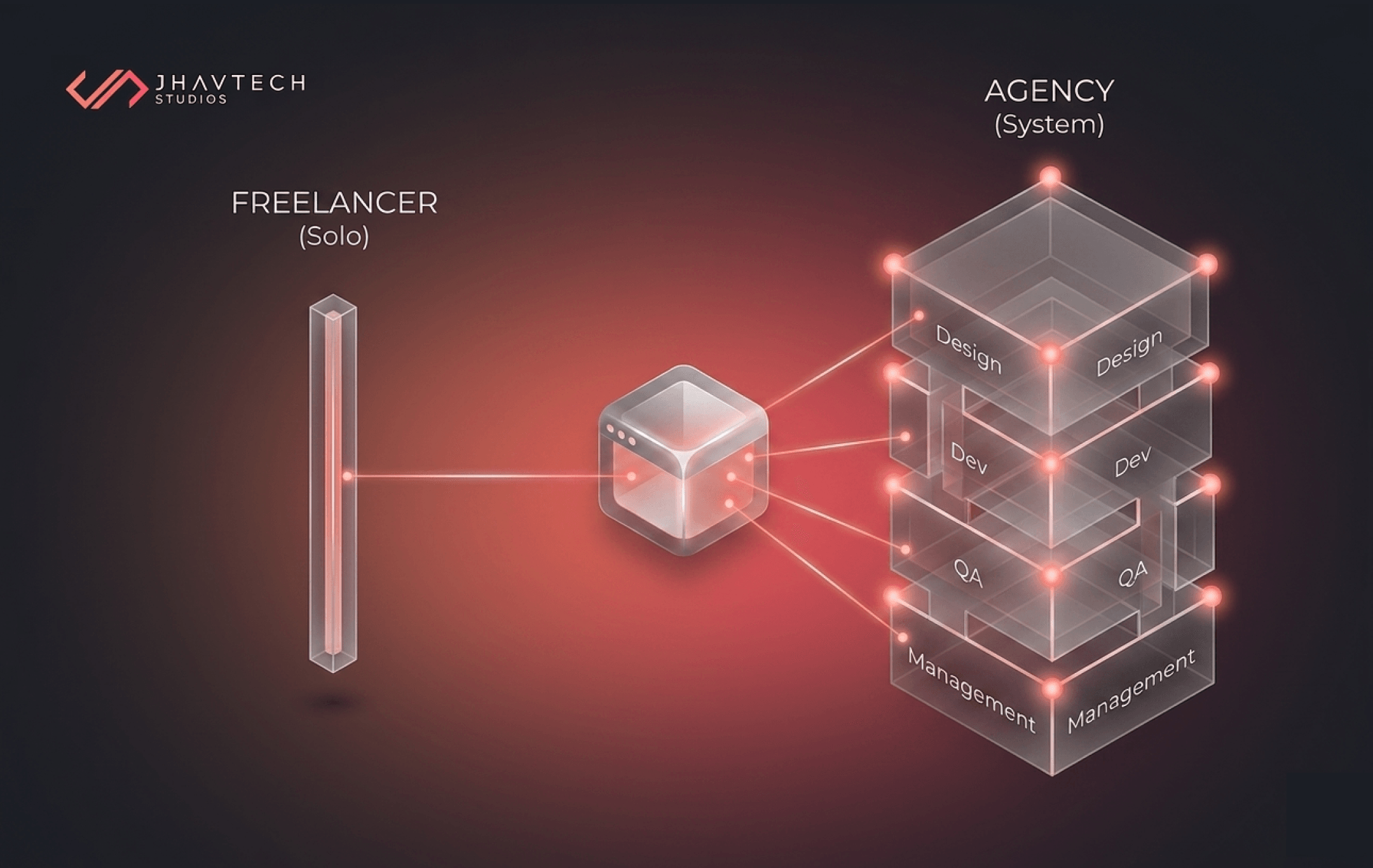
Hiring a freelancer suits small, well-defined projects with tight budgets and flexible timelines. Choosing a development agency is the smarter move for complex, scalable apps that demand a full team — designers, developers, QA, and a project manager — under one accountable roof. The right call depends on scope, risk tolerance, and long-term goals.
Why This Decision Matters More Than Ever
The stakes in mobile app development have never been higher. According to Statista, the global mobile app market is projected to surpass $673 billion in revenue by 2027 and every business racing to capture a slice of that market needs to make one foundational call: who actually builds the thing?
Meanwhile, the global freelance market is no longer a scrappy alternative. It has grown into a $1.8 trillion economy in 2026, with platforms like Upwork, Toptal, and Fiverr channeling elite talent directly to buyers. According to PR Newswire, the freelance platforms market alone is projected to hit $14.39 billion by 2030. Choosing between a freelancer and a development agency is no longer a simple cost trade-off; it’s a strategic decision with long-term product consequences.
What Are We Actually Comparing?
Before diving into costs and trade-offs, it helps to define what each model actually means in practice.
What is a freelance app developer?
A freelance app developer is a self-employed professional who takes on projects independently, typically via platforms like Upwork, Toptal, or direct referrals. They specialise in specific technologies like React Native, Flutter, Swift, Kotlin, and usually manage their own schedule, rates, and client relationships. They are a single point of accountability: one person, one skill set, one communication channel.
What is an app development agency?
An app development agency is a structured organisation that deploys a full team on your project: UI/UX designers, frontend and backend developers, QA engineers, and a project manager who acts as your single point of contact. Agencies handle the complete product lifecycle, from initial scoping and wireframing all the way through to post-launch support and iteration. If one team member goes on leave, another steps in. The project does not stop. Modern agencies don’t just write code; they utilise agentic workflows and ‘human-in-the-loop’ AI engineering to accelerate development cycles without sacrificing the architectural integrity that a lone freelancer might overlook.
The Real Cost Comparison: Hourly Rates Are Just the Beginning
The most common mistake founders make is comparing hourly rates in isolation. A freelancer billing $60/hour and an agency billing $150–$250/hour look very different, until you factor in what is missing from the freelancer’s quote.
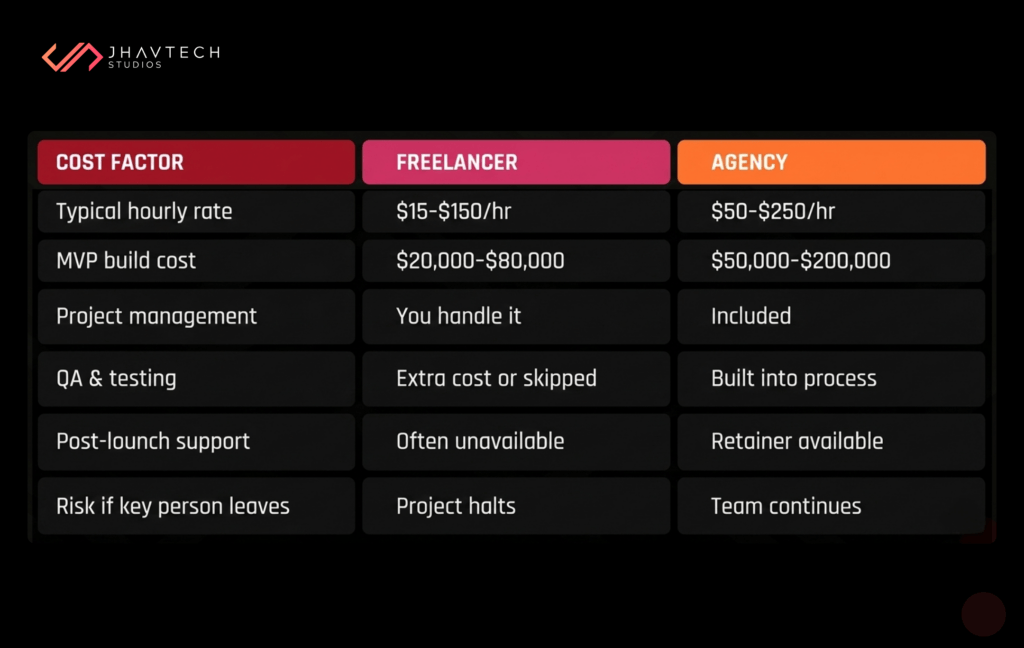
Hidden cost reality: When you hire a freelancer, you become the de facto project manager. If you spend 10–15 hours per week coordinating their work, that time has a real dollar value — one that never appears in their invoice but absolutely affects your total cost of ownership (TCO).
Ready to Build?
Stop guessing and start growing. Whether you’re starting from scratch or need to transform a struggling codebase into a market leader, our team at Jhavtech Studios is here to help.
Scalability, Speed, and Risk: The Factors Nobody Talks About
Cost is the opening chapter. But the decisions that actually define project success (or derail it) live in scalability, continuity, and risk management.
Single point of failure
Over 57% of freelancers work with more than one client simultaneously. Your project may not always be their top priority. And if your freelancer falls ill, takes on a larger contract, or simply disappears — a risk that is more common than most founders expect — your entire MVP is frozen. An agency absorbs this risk by design: one developer out means another developer in, with no disruption to your sprint cycle.
Scalability on demand
Imagine your startup just closed a funding round and needs to double development velocity before a product launch. A freelancer can extend their hours or bring in a second contractor, but now you’re managing two people. An agency adds a developer to your sprint within days using established onboarding processes. The difference in time-to-scale can be measured in weeks, not months.
Quality assurance: Who owns the bugs?
Agencies employ dedicated QA engineers who test across devices, OS versions, and edge cases before any build goes to production. Freelancers rarely have the bandwidth or the incentive to run this level of testing. On a consumer-facing app, a single critical bug at launch can permanently damage your App Store rating and user trust.
Which Should You Choose? A Decision Matrix
There is no universal winner. The right answer depends entirely on your project’s profile. Use this matrix to match your situation to the right model.
✓ Choose a Freelancer When:
- Your project is small and clearly scoped
- You need one specific expertise (e.g., a React Native module)
- You have an in-house PM to manage coordination
- Budget is the primary constraint
- Timeline is flexible
- You’re building a quick prototype or proof-of-concept
✓ Choose an Agency When:
- You need a full product, not just a feature
- Your app requires multiple disciplines (design, dev, QA)
- Accountability and IP protection are non-negotiable
- You need post-launch maintenance and iteration
- You’re targeting enterprise users or regulated industries
- Your first version needs to be launch-ready, not “good enough”
What About Platforms? Where to Find Each
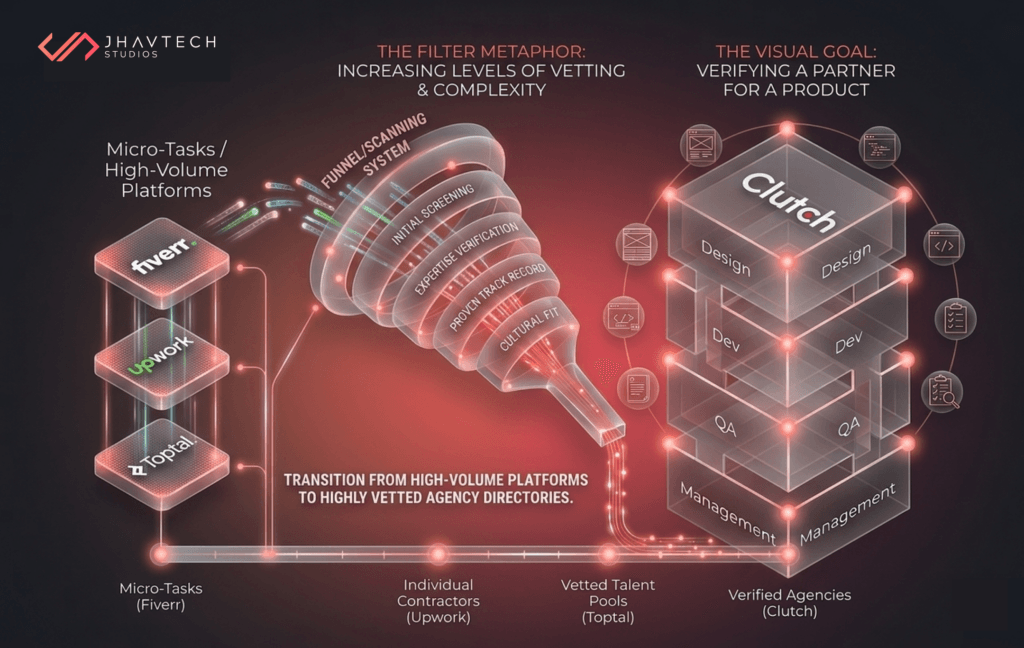
If you decide to go the freelance route, the platform you choose matters as much as the individual you hire. Toptal screens only the top 3% of applicants and is best for senior specialists on longer engagements. Upwork offers the broadest talent pool with job success scoring built in, which is ideal for mid-range projects where you want volume and vetting combined. Fiverr suits well-defined micro-tasks with fixed budgets.
For agencies, platforms like Clutch and GoodFirms publish verified client reviews and allow you to filter by industry, budget, and tech stack. This is a far more reliable signal than cold outreach or a polished sales deck.
The Third Option Nobody Mentions: The Hybrid Model
Many mature businesses combine both approaches: engage an agency for the initial MVP build where process discipline, design quality, and technical architecture set the foundation and then bring in specialised freelancers for specific feature modules once the core product is stable. This is particularly effective for teams scaling post-launch who need targeted expertise without full-team overhead.
The smartest founders we work with treat their first app as an investment in a long-term product asset, not a one-time transaction. Whether that means committing to turning your vision into a fully engineered digital product from day one, or bringing in an experienced team to get a stalled or broken build back on track, the underlying principle is the same: your app deserves more than a gamble on availability.
What Should You Choose for Your App Project in 2026?
If your app is your primary business vehicle, if it needs to scale, attract users, process payments, integrate APIs, or represent your brand in a competitive market, the answer is almost always a development agency. Not because freelancers lack skill, but because apps are systems, not tasks. Building a system requires a team.
If you’re testing a hypothesis, building a proof-of-concept, or adding one specific feature to an existing product, a well-vetted freelancer on Toptal or Upwork can absolutely deliver. Just go in with your eyes open: scope it tightly, define your deliverables in writing, and have a contingency plan if they go quiet.
💡 Bottom line: Freelancers build features. Agencies build products. Know which one you need before you sign anything.
About Jhavtech Studios
We partner with startups and growing businesses to design, build, and scale mobile applications that users actually want to use. From greenfield builds to inheriting messy codebases that need a fresh set of expert hands, we bring structure, speed, and accountability to every engagement.
Frequently Asked Questions
Should I hire a freelancer or agency for my app?
Hire a freelancer if your project is small, clearly scoped, and budget is your primary constraint. Choose a development agency if you need a complete product with design, development, QA, and post-launch support under one accountable team. For most consumer-facing or revenue-generating apps, an agency is the lower-risk choice.
Is it cheaper to hire a freelancer or an agency for app development?
Freelancers typically charge 40–60% less per hour than agencies. However, total cost of ownership (TCO) often narrows this gap significantly. When you factor in your own time managing the freelancer, the cost of rework, missed QA, and potential project abandonment, agencies frequently deliver better value for complex builds.
What is the difference between a freelancer and an app development agency?
A freelancer is a solo professional with a specific skill set working independently. An agency is a structured team (i.e. developers, designers, QA engineers, and a project manager) that takes ownership of the entire product lifecycle. Agencies offer redundancy, accountability, and structured delivery processes that a single freelancer cannot match.
When should you hire an agency instead of a freelancer?
You should hire an agency when your app requires multiple disciplines, needs to launch reliably, involves IP or user data that must be contractually protected, or when you lack the in-house capacity to manage a freelancer’s work. Any app that is central to your business model warrants an agency-level investment.
Can you use both a freelancer and an agency on the same app project?
Yes, the hybrid model is increasingly common and effective. Many teams engage an agency for the MVP build and core architecture, then bring in specialized freelancers for specific features or integrations post-launch. This balances cost efficiency with quality assurance and architectural integrity.