.svg)
.svg)


Securing investment is no longer just about a compelling pitch deck and a total addressable market slide. In 2026, venture capitalists and angel investors are scrutinising your startup technology stack with the same rigour they apply to your financials. This blog breaks down exactly what savvy investors look for — from scalable software architecture and security posture to technical debt and app performance — and what you can do to make your tech decisions investor-ready. Whether you’re gearing up for a seed round or a Series A, this guide will help you see your own infrastructure through an investor’s eyes.
Why Your Tech Stack Is Now a Financial Document
There’s a conversation that keeps happening in pitch rooms that most founders don’t expect. The investor flips past the market analysis and the revenue projections, then asks: “Walk me through your architecture.” This isn’t a curveball. It’s a signal that the rules of due diligence have changed.
Deloitte’s 2026 M&A Trends Pulse Survey found that access to technology now ranks among the top two drivers behind cross-border acquisitions; a clear signal that technical infrastructure is no longer a secondary concern in deal evaluation. And with 97% of dealmakers now using AI or advanced analytics in their due diligence process, the scrutiny applied to a startup’s technology stack has never been sharper.
The logic is simple. A startup’s technology stack is the engine under the hood. A beautiful car with a failing engine is still a liability. Investors, particularly at the seed to Series B stage, have been burned enough times to know that retrofitting a poorly designed system is often more expensive than building from scratch.
So what are they actually evaluating when they look at your stack?
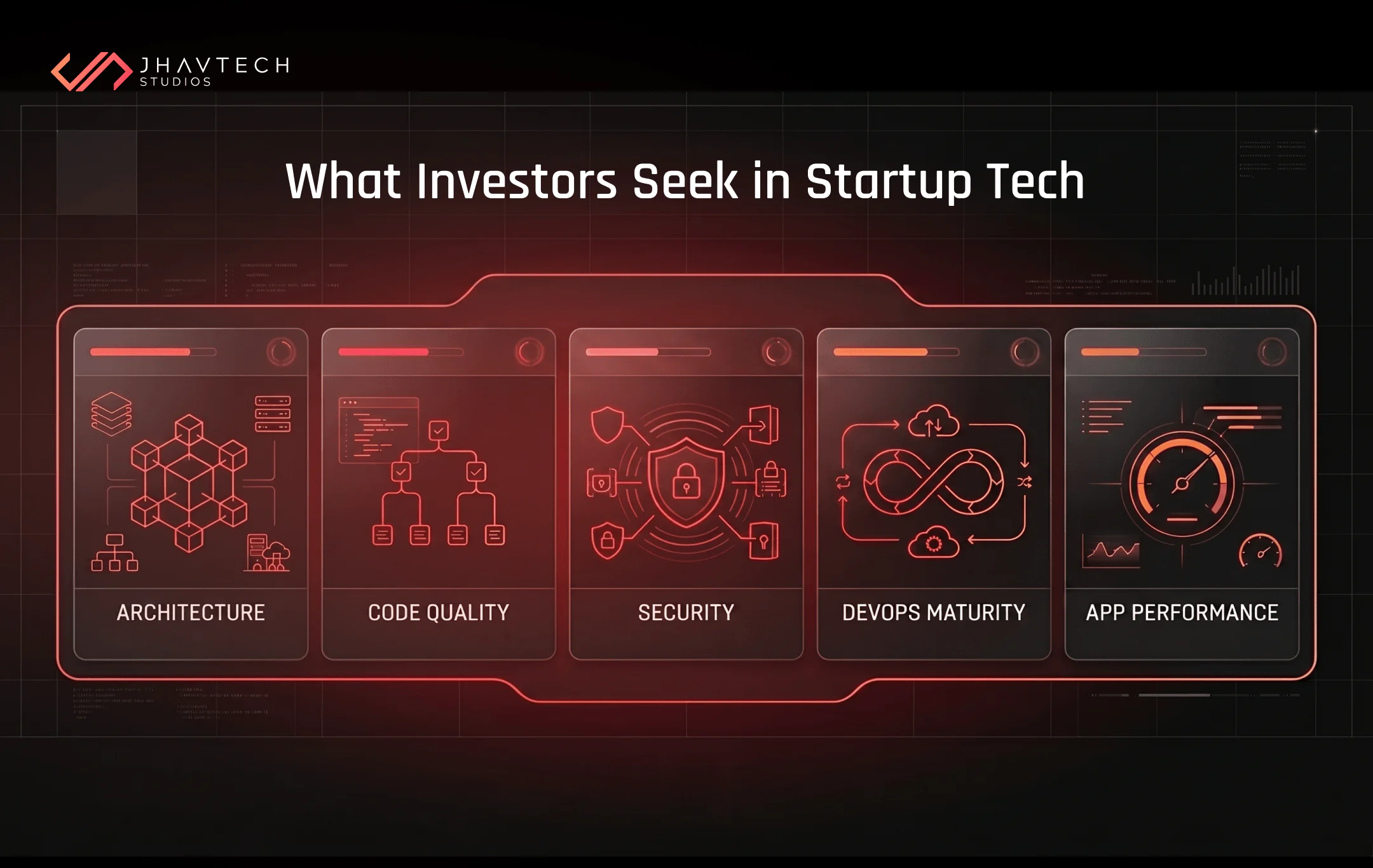
The 5 Things Investors Evaluate in a Startup Technology Stack
1. Scalable Software Architecture
The number one technical question investors want answered is: “Can this system handle 100x the current load without a complete rebuild?”
Scalability isn’t just a buzzword… it’s the difference between a product that captures growth and one that collapses under it. We explored this in detail in our piece on why your app is not scaling and how to fix it, but the investor lens adds another layer. They’re not just asking whether you can scale. They’re asking whether your architectural decisions allow you to scale affordably.
Red flags that experienced investors spot immediately:
- Monolithic architectures with no separation of concerns
- Hard-coded configurations that prevent environment-specific deployment
- A single point of failure with no redundancy or failover logic
- Databases queried directly from the front end
What they want to see instead is a clean separation between services, a cloud-agnostic or cloud-native approach (AWS, GCP, Azure), stateless application layers, and horizontal scalability built in from day one — not bolted on later.
2. Technical Debt and Code Quality
Technical debt is inevitable. Every engineering team cuts corners somewhere. What investors are really assessing is whether you know you have technical debt, whether you’ve quantified it, and whether you have a credible plan to manage it.
Here’s a sobering benchmark from the industry: research cited in 2025 M&A due diligence benchmarks shows that 74% of evaluated codebases contain high-risk vulnerabilities, and that the cost of remediating technical debt post-investment runs 3–5 times higher than addressing it pre-investment. If you find $500,000 worth of technical debt in due diligence, it comes straight off your valuation.
This is exactly why a thorough code audit before you start fundraising is one of the highest-ROI activities a founder can undertake. Our own experience rescuing projects confirms it: investors who discover a clean, documented, well-tested codebase move significantly faster, and with greater confidence, than those who encounter a patchwork of undocumented workarounds.
3. Security and Compliance
Security is no longer a “we’ll get to it” item on the roadmap. Technical due diligence specialists now treat security posture as a baseline requirement, not a differentiator. Investors know that a data breach isn’t just a technical incident; it’s a reputational and legal catastrophe that can sink a company before it ever reaches profitability.
The specific items that investors look for include:
- Encryption at rest and in transit
- Role-based access control (RBAC)
- Compliance with relevant data protection frameworks (GDPR, Australian Privacy Act, HIPAA for health-tech, PCI-DSS for fintech)
- Documented incident response procedures
- Penetration testing history and security audit reports
If your startup operates in a regulated industry and you haven’t addressed these, expect a hard conversation, or a significant valuation haircut.
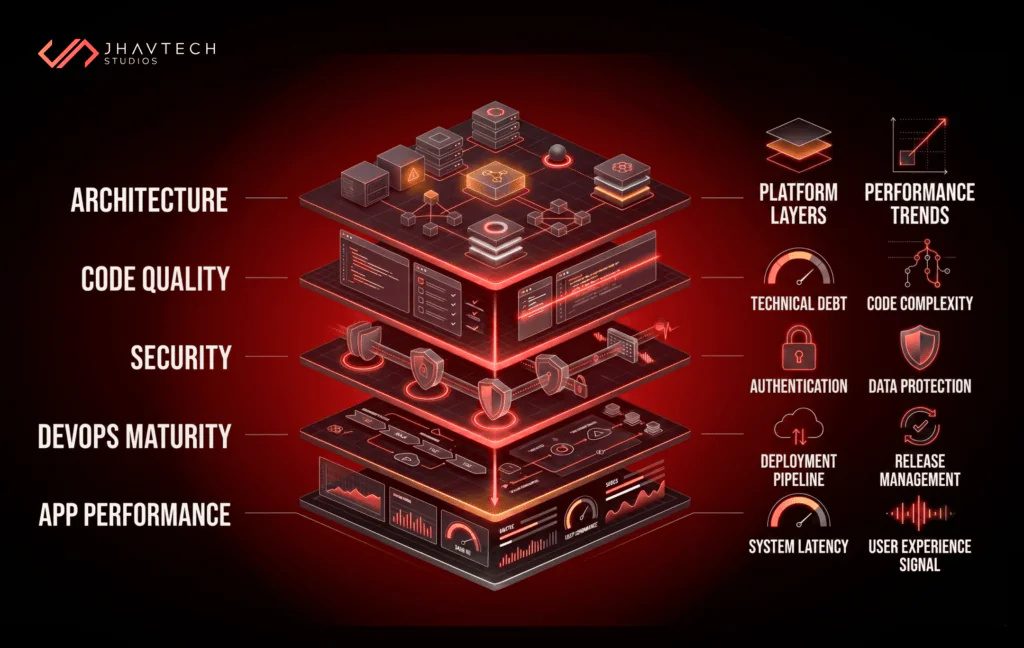
4. Startup Infrastructure Planning and DevOps Maturity
How you deploy code says a lot about how you run your business. Investors aren’t expecting a 50-person DevOps team from a 10-person startup, but they do want to see that you’ve thought seriously about startup infrastructure planning.
Specifically, they look for:
- Continuous integration and continuous delivery (CI/CD) pipelines
- Automated testing coverage (unit, integration, end-to-end)
- Monitoring and observability tooling (logging, alerting, performance dashboards)
- Environment separation (dev, staging, production)
- Documented deployment and rollback procedures
A startup with a mature DevOps culture signals that it can ship features reliably, recover from failures quickly, and onboard new engineers without chaos. That’s a fundamentally different risk profile from a team that deploys straight to production by SSH-ing into a single server. If your team isn’t there yet, building a solid DevOps foundation before your raise is one of the highest-leverage moves you can make.
5. App Performance and User Experience Metrics
Investors increasingly ask for product analytics alongside financial metrics, and for good reason. App performance is a proxy for product-market fit. High load times, frequent crashes, and poor performance scores directly correlate with churn.
The benchmarks to know: Google’s Core Web Vitals research consistently shows that a one-second delay in mobile load time can reduce conversion rates by up to 20%. If your app is clunky, slow, or unreliable, you’re losing users, and investors can see that in your retention curves.
What investor-ready software looks like on the performance front:
- Load times under 2 seconds for core user flows
- Crash rates below 0.1% on production
- Uptime SLA of 99.9% or better, with evidence to back it up
- App store ratings of 4.2 or above (for consumer products)
Getting performance right from day one is far easier than retrofitting it later. See how we build apps engineered to impress both users and investors — and what that standard looks like in practice.
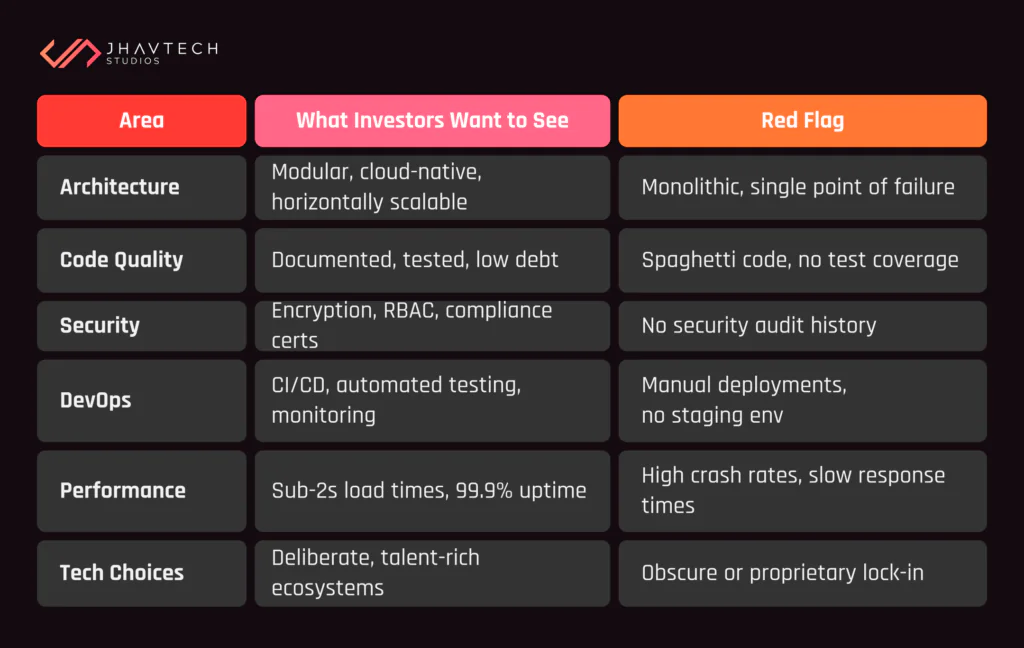
The Investor-Ready Tech Stack: What to Show vs. What to Avoid
Use this as your pre-fundraise audit framework. If you can tick every box, you’re in a strong position. If you can’t, you know where to focus first.
Is your tech stack investor-ready?
Most founders don’t find out it isn’t until they’re already in the room.
What the Data Is Actually Telling Us in 2026
The investment landscape in 2026 has shifted in ways that make technical readiness more critical than ever. According to consulting firm West Monroe, capital in 2026 is flowing specifically toward full-stack AI-native companies and startups with proprietary data advantages which means the bar for what counts as a “credible” technology stack has risen considerably.
At the same time, TechCrunch’s investor roundup for 2026 noted that investors are now digging deeper into “repeatable processes and proprietary workflows” rather than surface-level technology claims. In other words: it’s not enough to say you’re using the right tools. You need to demonstrate that those tools are being used in a disciplined, defensible way.
This is compounded by a concerning statistic: 70% of technology investments now fail to hit value creation targets due to technical issues that were discoverable during due diligence. That means the majority of avoidable investment losses trace back to things that a proper technical review would have caught.
The implication for founders is clear. Waiting until an investor asks for technical documentation is already too late. The preparation needs to happen months before the first conversation.
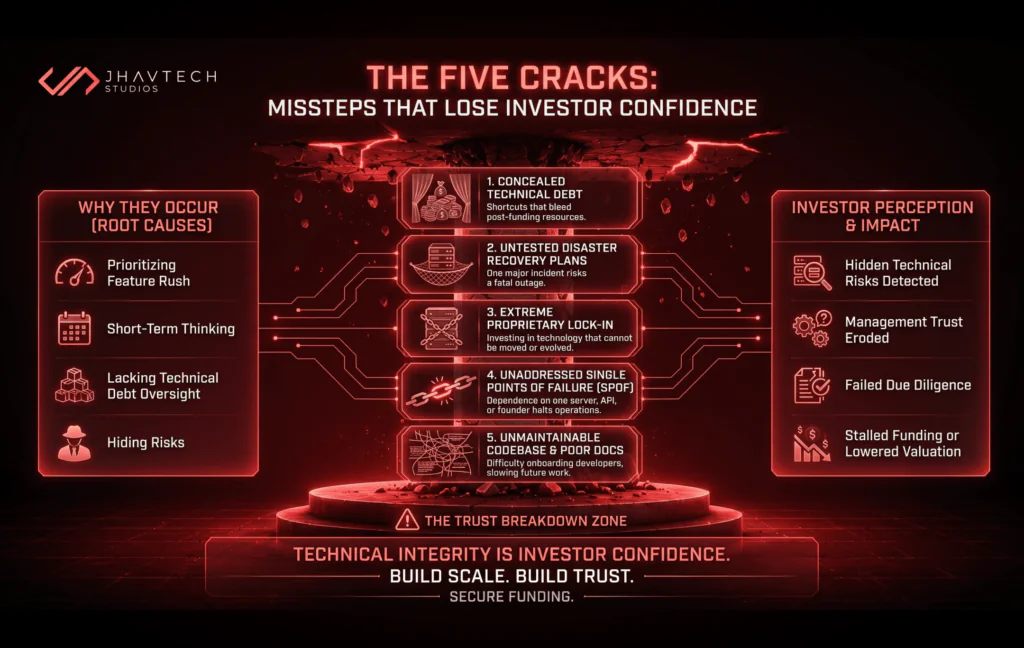
Common Mistakes That Derail Funding Conversations
Even technically strong teams get tripped up by avoidable oversights. Here are the most common:
Treating technical debt as invisible. Investors will find it. Better that you name it, quantify it, and present a remediation plan than have them discover it and wonder what else you’re hiding.
No documentation. Architecture diagrams, API documentation, deployment runbooks: these aren’t bureaucratic overhead. They’re evidence that your system is understood and manageable. Their absence is a significant trust signal.
Scaling the team before scaling the infrastructure. Premature scaling is one of the most damaging patterns in early-stage development. Investors who see a large engineering team and a fragile infrastructure are right to be concerned about burn rate vs. output.
Ignoring third-party dependencies. Open-source libraries that haven’t been updated in two years, or integrations that rely on vendors with questionable longevity, are genuine risks. Investors flag them.
Conflating “we built it fast” with “we built it well.” Speed to market is valuable. But if you built fast by skipping tests, ignoring security, and accumulating debt, you’ve mortgaged your future. A professional code review will surface these issues before your investor does.
How to Get Your Stack Investor-Ready Before the Raise
The good news is that most technical gaps are fixable, but they take time. The worst time to discover them is in the middle of due diligence. Here’s the recommended approach:
Start with an honest audit. Bring in someone outside your team to review the codebase objectively. Internal teams are too close to the code to spot their own blind spots.
Prioritise security and documentation. These are the two areas that produce the most investor concern when missing, and they’re also the most achievable in a short timeline.
Address the most critical technical debt. You don’t need to fix everything, but you do need to be able to explain what exists, why it exists, and what the plan is.
Build a lightweight architecture document. A single diagram showing how your services interact, where your data lives, and how your deployments work goes a long way. It shows maturity without requiring a full engineering wiki.
Run performance benchmarks and document them. Uptime history, load testing results, crash reports: these are the kinds of evidence that turn investor skepticism into confidence.
If your project is already in distress or you’ve inherited a codebase that’s under-documented and difficult to extend, a structured recovery approach starting in the first 48 hours can help you stabilise and position the product properly before your raise.
The Bottom Line
Your startup technology stack is not a back-office concern. It is, increasingly, a front-of-room conversation; one that determines whether investors see a fundable business or a liability.
The founders who raise successfully in 2026 are those who treat their technical infrastructure with the same rigour they apply to their go-to-market strategy. They know their architecture cold, they’ve addressed their technical debt proactively, and they can demonstrate that their software will hold up as the business grows.
That kind of technical confidence isn’t built overnight. But it is built and the earlier you start, the better positioned you’ll be when the investors start asking questions.
Your tech stack can make or break your funding round.
Don’t leave it to chance. Our senior engineers will review your codebase, flag the risks, and tell you exactly where you stand — at no cost.
Frequently Asked Questions
What is a startup technology stack, and why do investors care about it?
A startup technology stack is the combination of programming languages, frameworks, databases, cloud services, and tools used to build your product. Investors care because it directly affects scalability, security, and the cost to grow — all of which impact return on investment.
Can Jhavtech help us get our tech stack investor-ready?
Yes. We work with early-stage startups and SMEs to audit codebases, identify technical debt, and strengthen architecture — so your stack tells a confident story when investors come asking.
What is the single biggest technical red flag for investors?
Undisclosed or unmanaged technical debt. Investors expect some debt in early-stage companies but discovering it during due diligence, rather than having the founder proactively acknowledge it, is a serious trust issue.
Can a startup with an older tech stack still raise investment?
Yes, provided the team demonstrates awareness of the limitations, a clear roadmap for modernisation, and evidence that the existing system is stable and maintainable. The stack itself matters less than the team’s understanding of it.
What is the fastest way to make a startup’s tech stack investor-ready?
Commission an independent code review and technical audit before the raise begins. This gives you time to address critical gaps and creates documentation you can present with confidence during due diligence.