.svg)
.svg)


If you own an app, you have probably used the words support and maintenance interchangeably at some point. Many app owners do. It sounds harmless, but this misunderstanding often leads to budget blowouts, frustrated users, and avoidable downtime. The reality is that treating these two concepts as the same thing is one of the most common mistakes we see when teams start looking for software support services.
At Jhavtech Studios, we work with founders, product managers, and CTOs across Australia who only realise the difference after something breaks. By then, the damage is already visible to users. Let’s clear up the confusion and explain why understanding support versus maintenance matters far more than most app owners think.
Why this confusion keeps happening
On paper, both support and maintenance sound like “after launch work.” In practice, they solve very different problems.
Many development teams focus heavily on delivery. Once the app is live, attention shifts to the next project or feature. Post-launch care is often reduced to a vague line item that says “ongoing support.” This is where problems begin.
A 2024 report by Gartner found that nearly 70% of app downtime incidents were caused by poor post-launch planning rather than core development issues. That statistic alone shows why understanding this distinction is critical.
What software support actually means
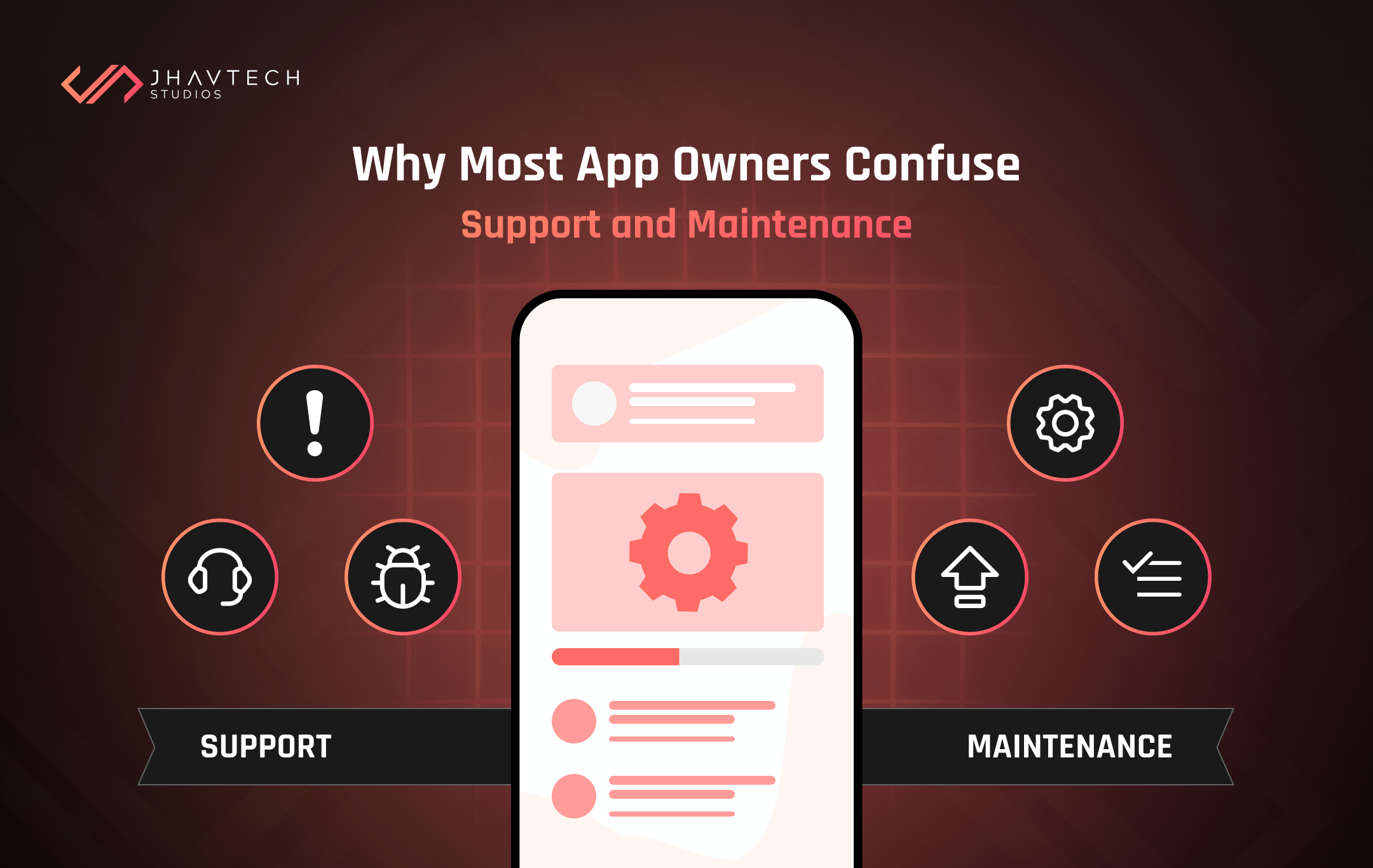
Software support is about keeping your app usable when things go wrong. It is reactive by nature. When users report issues, logs show errors, or systems fail unexpectedly, support steps in.
Think of support as the safety net. It includes activities such as:
- Investigating bugs reported by users
- Fixing crashes or performance issues
- Responding to incidents and outages
- Answering technical questions from internal teams
This is where software support services play a direct role in user satisfaction. If a payment fails, a login breaks, or a core workflow stops working, support is what prevents churn and negative reviews.
In mobile app development, this is especially critical. App store ratings can drop dramatically after just one unresolved issue. Studies from Apptentive show that users are three times more likely to leave a negative review if a bug remains unresolved for more than 48 hours.
What software maintenance really covers
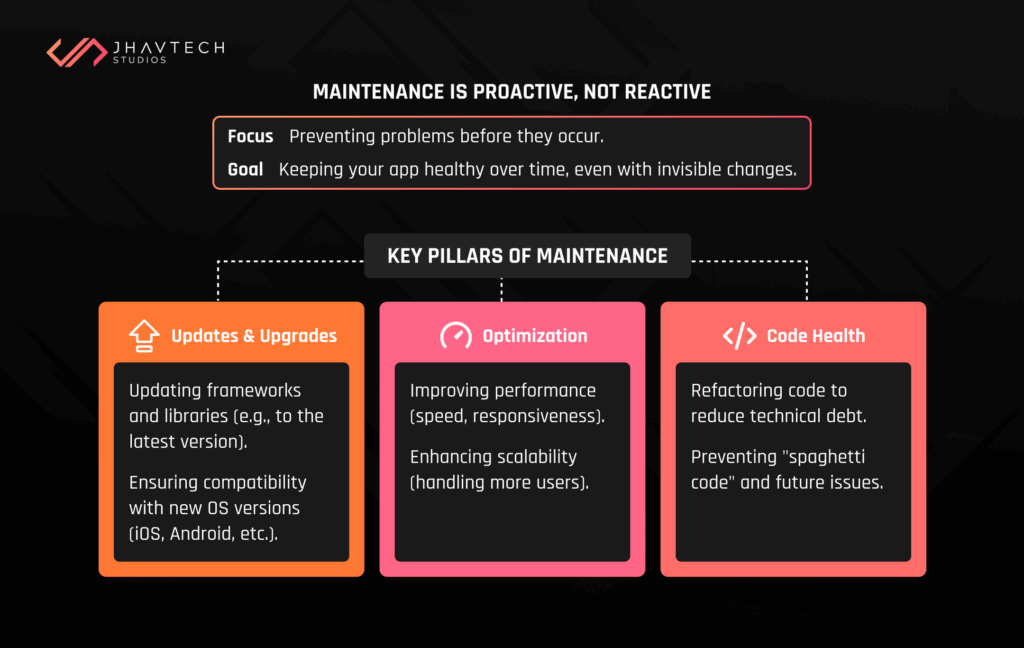
Maintenance is proactive. Instead of reacting to problems, it focuses on preventing them.
Maintenance typically includes:
- Updating frameworks and libraries
- Ensuring compatibility with new OS versions
- Improving performance and scalability
- Refactoring code to reduce technical debt
This is where the comparison software maintenance vs support becomes important. Maintenance keeps your app healthy over time, even when users do not see visible changes.
A 2023 study by IEEE found that applications that skipped regular maintenance accumulated technical debt 40 percent faster than those with scheduled updates. Over time, this makes even small fixes expensive and risky.
Why app owners get it wrong
Most app owners underestimate how fast technology changes. APIs evolve, operating systems update, and security standards shift. Without proper maintenance, your app slowly becomes fragile.
At the same time, many teams only budget for emergency fixes. They assume support alone is enough. This creates a cycle where teams are constantly reacting instead of improving.
We often meet clients who come to us for software project rescue after months of firefighting. In many cases, the root cause is not bad development, but a lack of structured post-launch planning.
The hidden cost of ignoring the difference
Let’s talk about the cost of software maintenance and support services. According to a 2024 report by McKinsey, companies that delay maintenance spend up to 30 percent more on emergency fixes over a two-year period.
Emergency support work is always more expensive. It disrupts roadmaps, pulls app developers away from planned features, and increases the risk of introducing new bugs.
This is why software support services should never be treated as a single catch-all solution. Support without maintenance is short-term thinking. Maintenance without support leaves you exposed when something breaks.
Post-launch app updates are not optional
In most instances, post-launch app updates are seen as “nice to have.” In reality, they are essential.
Apple and Google release major OS updates every year. Each update can impact performance, permissions, and background processes. Apps that fail to adapt quickly often experience crashes or feature failures.
A 2025 Statista survey showed that 62% of users uninstall apps that feel outdated or buggy after an OS update. Regular updates protect both user trust and long-term revenue.
This is where a balanced approach to software support services becomes valuable. Updates reduce the number of emergencies that support teams need to handle.
Startups feel this pain the most
For startups, every issue feels bigger. A single outage can affect investor confidence or early customer adoption.
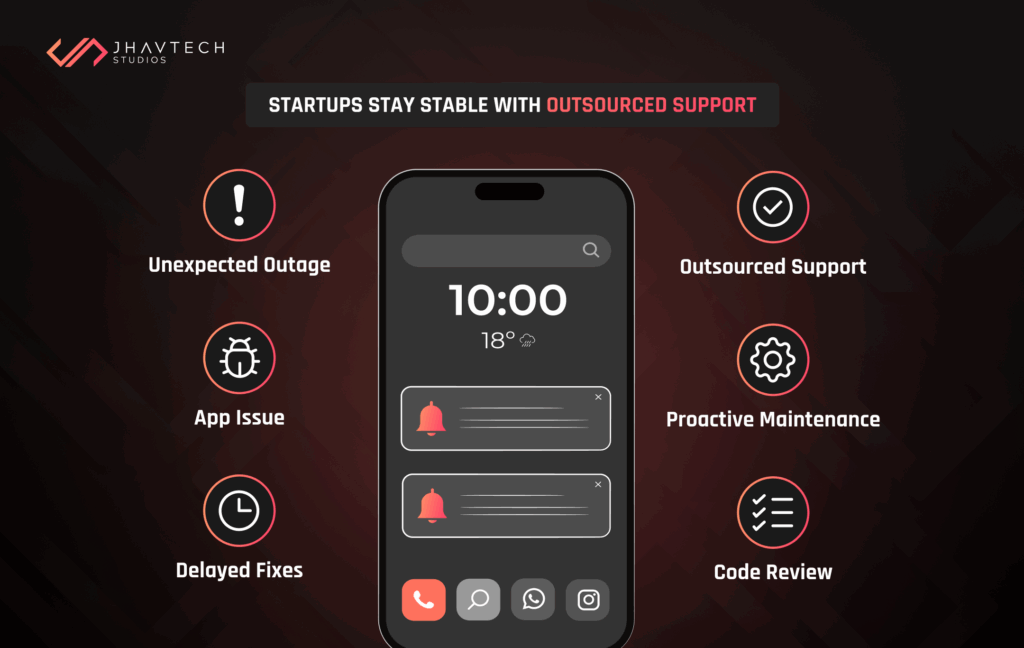
The benefits of outsourcing software support for startups are often overlooked until internal teams are overwhelmed. Outsourcing provides access to experienced engineers, structured processes, and predictable costs without hiring full-time staff.
At Jhavtech Studios, we see startups benefit from pairing outsourced support with regular maintenance planning. This approach keeps teams focused on growth while ensuring the app remains stable.
It also allows startups to tap into related expertise like code review and DevOps solutions without building everything in-house.
A real-world example
One Australian SaaS startup approached us after experiencing repeated outages during peak usage. Their internal team handled support tickets, but no one was responsible for maintenance.
After an audit, we found outdated dependencies and inefficient database queries. By introducing scheduled maintenance alongside structured software support services, outage frequency dropped by over 50 percent within three months.
The result was not just stability, but faster feature delivery and improved user feedback.
How to get the balance right
Getting this right does not require a massive budget. It requires clarity.
Ask yourself:
- Do we have a clear process for handling incidents?
- Are we planning updates ahead of OS or platform changes?
- Is technical debt being actively reduced?
Strong software support services should always work hand in hand with maintenance planning. One protects your users today. The other protects your product tomorrow.
Where Jhavtech Studios fits in
Jhavtech Studios provides structured software support services designed for growing products. Our approach combines responsive support with proactive maintenance so teams are not constantly reacting.
We also integrate closely with broader offerings such as IT consulting, mobile app development, and long-term product optimisation. For teams facing deeper issues, our experience in software project rescue ensures problems are fixed at the root, not just patched.
You can learn more about our approach on our support and maintenance service page, where we outline how we help teams plan beyond launch.
Final thoughts…
Support and maintenance are not interchangeable. Treating them as such leads to higher costs, frustrated users, and stalled growth.
When app owners understand the difference, they make better decisions. They plan smarter budgets, protect their users, and build products that last.
The next time you evaluate software support services, ask not just how fast issues will be fixed, but how many issues can be prevented in the first place.
If you want a clearer, more structured approach to post-launch care, Jhavtech Studios can help. Our team combines responsive support with proactive maintenance to keep your product stable, secure, and ready to scale. Explore our support and maintenance services or get in touch today for a conversation about what your app actually needs after launch.