.svg)
.svg)


The world of software development just went through a major vibe shift. If you have been keeping an ear to the ground in early 2026, you have likely heard a phrase being tossed around by everyone from Andrej Karpathy to the tech leads at IT companies: vibe coding. It sounds like something out of a late-night hackathon fever dream, but it is quickly becoming the defining movement of our era.
At Jhavtech Studios, we have watched technology evolve from assembly to high-level languages, and then to low-code platforms. But vibe coding is different. It is not just about writing less code; it is about shifting the human role from “syntax typist” to “creative director.” It is the art of using natural language to steer AI agents through complex builds until the software simply feels right.
What exactly is Vibe Coding?
To understand the hype, we have to look at the transition from traditional development to vibe coding. In the “old days” of 2023, a developer spent 80% of their time wrestling with semicolons, environment configurations, and documentation. Today, that script has been flipped.
The term was popularised by Andrej Karpathy in early 2025 to describe a workflow where the programmer “fully gives in to the vibes, embraces exponentials, and forgets that the code even exists.” It is a paradigm where the developer focuses on intent, taste, and system architecture while an AI, be it Cursor, Windsurf, or Replit Agent, handles the heavy lifting of implementation. You describe the “vibe” of the feature, you “see stuff, say stuff, and run stuff,” and the AI iterates in real-time. It is the purest form of natural language programming we have ever seen.
The Rise of AI-Assisted Code Engineering
While the term might sound casual, the reality is a sophisticated form of AI-assisted code engineering. We are moving away from simple autocomplete suggestions and into the world of “Agentic Environments.” According to recent data from early 2026, the share of new code relying on AI in the U.S. has jumped to nearly 41%, up from just 5% a few years ago.
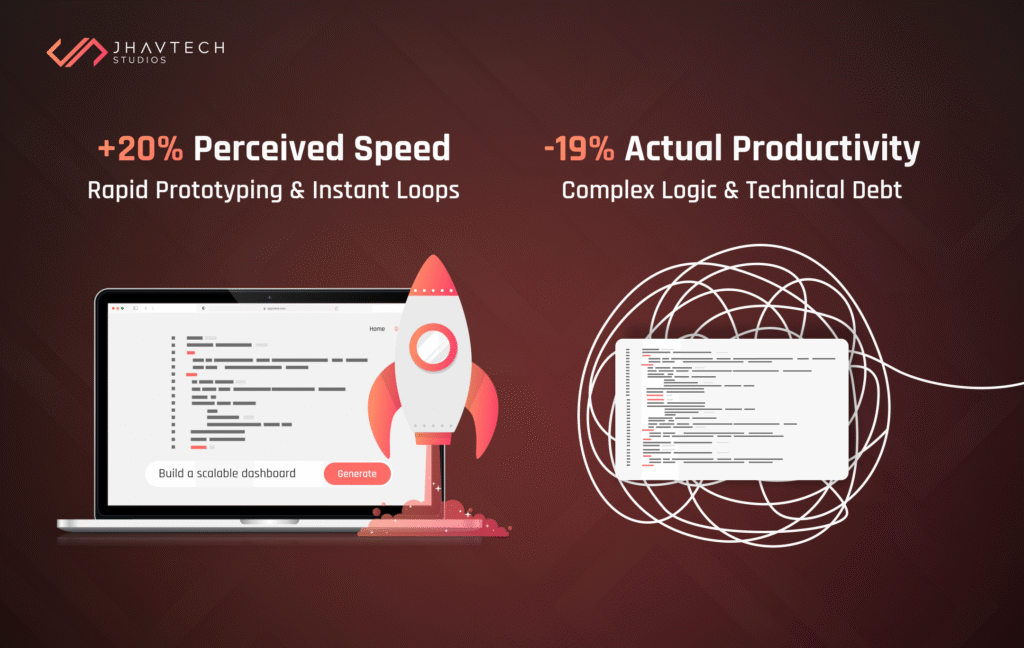
However, there is a catch. A landmark study by METR in July 2025 discovered what researchers call a “Productivity Paradox.” While developers felt 20% faster when they began vibe coding, objective measurements showed they were actually 19% slower on complex tasks within mature codebases. Why? Because while the AI types at lightning speed, it often lacks deep semantic reasoning and the implicit context of a 10-year-old repository.
At Jhavtech Studios, we believe the secret to mastering this power is knowing when to lean into the vibes and when to apply rigorous IT consulting principles. This high-level strategic oversight ensures that the tools you choose actually align with your long-term business goals rather than just providing a short-term hit of productivity. Without a roadmap, a team can easily drift into “prompt fatigue,” where they spend more time fighting the AI’s output than they would have spent writing the code manually.
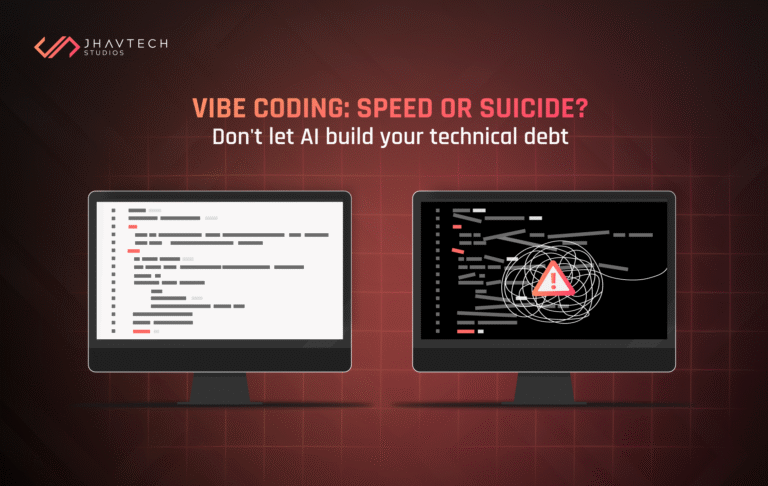
When that drift happens, the technical debt accumulates at an exponential rate. If you find yourself in a situation where your AI-generated project has become a tangled mess of incoherent modules and broken dependencies, you might actually need a software project rescue to untangle the logic and restore stability. Professional intervention at this stage is about more than just fixing bugs; it is about auditing the entire architecture to ensure it is viable for the future. The illusion of speed can be dangerous if it leads to a “needle-in-a-haystack” problem where critical security vulnerabilities are hidden deep within thousands of lines of generated code.
Vibe Coding is Changing Software Development in 2026
The impact of this shift is visible across the entire lifecycle of a product. Here is how vibe coding is changing software development for the better:
- Lowering the Barrier for Founders: Non-technical founders can now build functional prototypes to validate ideas before spending a cent on a full-scale build.
- The “33 Shots on Goal” Theory: Because the cost of iteration is so low, teams can experiment with dozens of versions of a feature rather than just two or three.
- Focus on Problem-First Design: Developers are spending more time on high-level design and less on boilerplate, which is essential for modern DevOps solutions.
However, the volume of code being produced is staggering. GitClear recently analysed 211 million lines of code and found that while volume is up, quality metrics are under pressure. Refactoring now accounts for only 9.5% of code changes, down from 24% in 2020. This indicates that many developers are simply “stacking” new AI code on top of old code rather than cleaning it up.
This habit of stacking without refining inevitably leads to code smells or those subtle hints that something is wrong with the underlying structure. These aren’t always bugs that break the app immediately; rather, they are structural weaknesses, like excessive class sizes or tightly coupled components, that make future changes nearly impossible. When you are “vibing” through a build, it is easy to ignore these warnings in favor of immediate visual results.
To prevent this, the human role must shift toward quality assurance and architectural integrity. An AI might give you a working login screen or a sleek dashboard, but without a professional code review, you might miss redundant logic, insecure API calls, or poor data handling that will break as you scale. This human-in-the-loop approach ensures that the “vibe” is backed by solid, production-ready engineering that won’t collapse under the weight of its own complexity.
The Best AI Tools for Vibe Coding in 2026
The “Vibe Stack” has matured significantly. If you are looking to upgrade your workflow, here are the best ai tools for vibe coding in 2026:
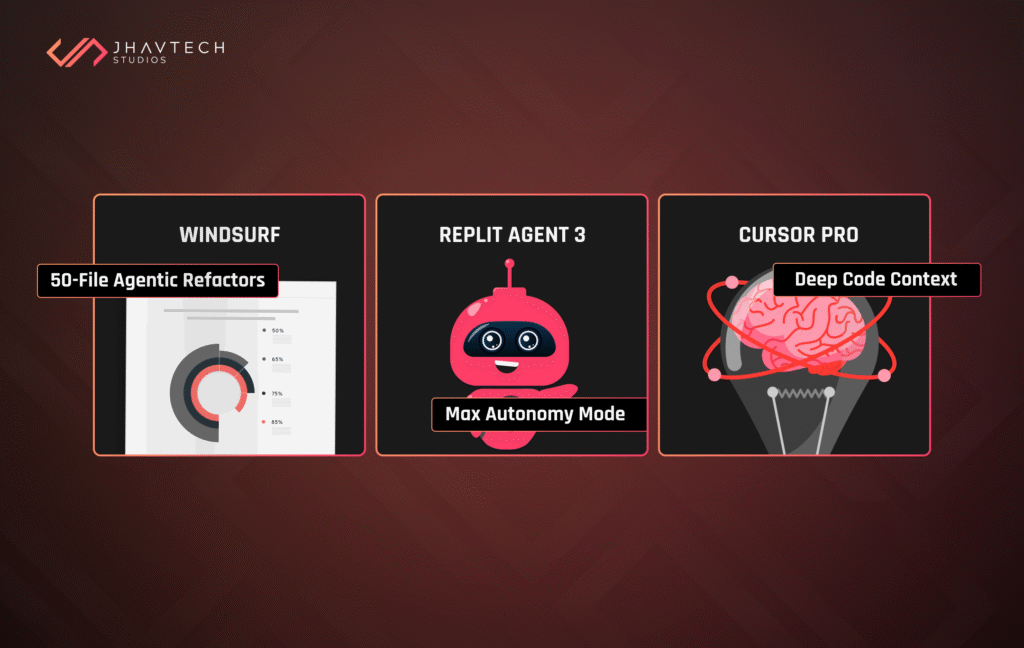
- Windsurf: Features “Cascade,” an agent that understands your entire repository’s dependency graph. It can handle 50-file refactors with a single prompt.
- Replit Agent 3: Offers a “Max Autonomy Mode” where it works unsupervised to handle database migrations and third-party integrations.
- Cursor Pro: Still the gold standard for many, its deep repository awareness makes it feel like the AI is reading your mind.
The Hidden Costs of the “Vibe” Approach
While vibe coding is incredibly efficient for MVPs and landing pages, the transition to production-grade software is where most “vibes” fail. AI tools frequently generate redundant code because they treat each prompt as a separate task rather than part of a cohesive system. A function that should take 50 lines might balloon to 200 lines due to unused imports and overly verbose logic.
As a project grows, these inefficiencies lead to higher support and maintenance costs. If your team does not understand the code the AI wrote, they cannot fix it when things go wrong at 3:00 AM. This is why we advocate for “Responsible Vibe Coding”, which means using AI to generate the first draft, but having human experts own the final architecture.
Balancing the Vibes with Engineering Excellence
It is tempting to think that vibe coding replaces the need for traditional expertise. In reality, it makes expertise more valuable. As we often tell our clients at Jhavtech Studios, the AI is a brilliant junior developer that never sleeps, but it still needs a senior architect to set the direction.
One of the biggest risks of the “vibe” era is the neglect of the boring stuff. You can “vibe” a feature into existence, but you cannot “vibe” your way through a security breach or a server collapse. Robust DevOps solutions are more critical than ever; they act as the guardrails for your AI-generated code, ensuring that speed does not come at the cost of safety.
Why Professional Oversight Matters
Recent surveys show that 67% of developers spend significant time debugging AI-generated code. For a business leader, this means the “savings” on the initial build might be eaten up by the time spent fixing “hallucinated” logic later. When you work with a professional team, you get the best of both worlds: the speed of vibe coding combined with the security of veteran engineering.
The Future: From Code Typist to System Orchestrator
As we look toward the rest of 2026, the definition of a “developer” continues to shift. We are no longer just writing instructions for computers; we are orchestrating a symphony of AI agents. The most successful builders will be those who can maintain their “vibe” while keeping their feet firmly planted in engineering reality.
Vibe coding is indeed a superpower, but every superhero needs a team. Whether you are looking to build a ground-breaking new app or you need help modernising a legacy system, the goal remains the same: creating software that works, scales, and delivers value.
At Jhavtech Studios, we specialise in bridging the gap between cutting-edge AI trends and battle-tested development practices. We don’t just follow the vibes; we engineer them into reality.
Are you ready to harness the power of vibe coding for your next project? Check out our services at Jhavtech Studios to see how we can help you build the future, one prompt at a time.