.svg)
.svg)


Why Founders Should Care About Software Scalability from Day One
.webp)
Here's a scene that plays out more often than most founders admit. A startup finally gets the traction everyone's been chasing. A TechCrunch mention, a viral LinkedIn post, or a big client signs on and tells their whole network. Signups spike. Then the app slows to a crawl, the database chokes, and support tickets pile up faster than the team can read them. The moment that was supposed to be a celebration turns into a scramble.
This isn't hypothetical. It's the natural result of building software without thinking past the next milestone. And it's entirely preventable.
It's also the exact gap we spend most of our time closing. As a software engineering partner that works almost exclusively with early-stage founders, Jhavtech Studios gets pulled into these conversations at two very different moments: either before a product is built, when a founder wants an architecture that won't need to be torn up in twelve months, or right after a growth spurt exposes every shortcut that got the MVP out the door. Acting as a startup tech advisory rather than just an execution shop is what lets us catch the second scenario before it happens instead of only cleaning up after it.
What Software Scalability Planning Actually Means
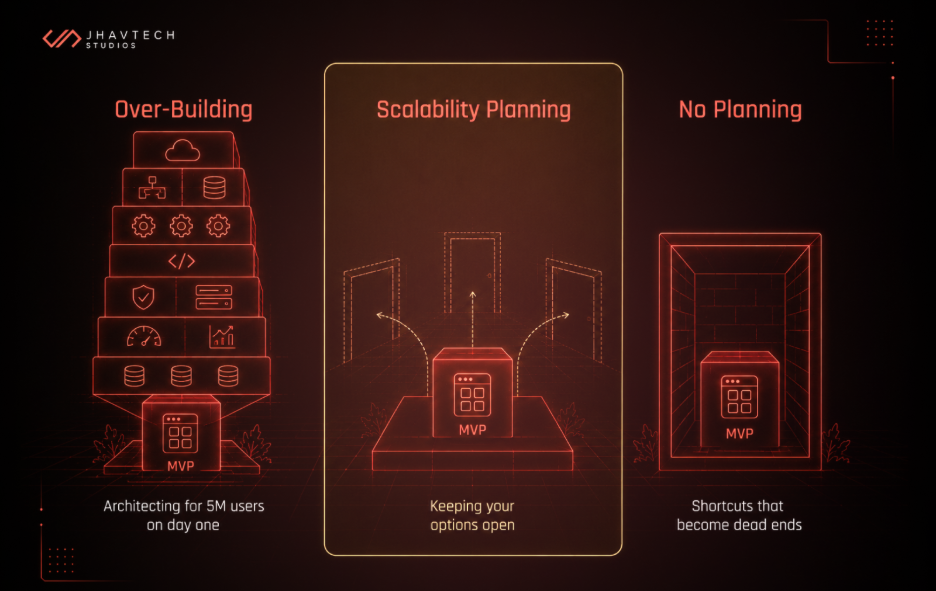
Software scalability planning is the practice of designing your architecture, database, and infrastructure decisions early on so your product can absorb growth in users, data, and features without a costly rebuild. It isn't about over-building for a future that might never arrive. It's not asking a five-person startup to architect like it's already serving five million users. That's a different mistake, and just as costly.
Real scalability planning is about making deliberate, informed decisions early on, ones that keep your options open instead of locking you into a corner. It means choosing a database structure that can handle relational complexity as your data grows, designing APIs that don't assume a single hardcoded use case, and separating concerns in your codebase so that one feature's growing pains don't take down the entire system.
Think of it less as "building for scale" and more as "not building against scale." There's a meaningful difference. You're not gold-plating your MVP. You're simply avoiding shortcuts that quietly become dead ends.
Why "We'll Fix It Later" Is the Most Expensive Sentence in Startup Tech
Every founder has said some version of this. Ship first, scale later. It sounds pragmatic, and in the earliest days, it often is. The problem is that "later" rarely arrives on a convenient schedule. It shows up during a product launch, a press cycle, or a critical enterprise demo, exactly when your system has the least room to fail and your team has the least time to fix it.
The financial stakes are bigger than most early teams expect. According to Splunk and Cisco's 2026 downtime research, unplanned outages now cost Global 2000 companies a combined $600 billion a year, a jump of 50% in just two years, with the average outage running around $15,000 per minute. Startups obviously aren't losing money at that scale, but the underlying pattern applies at any size: infrastructure that wasn't built to handle load fails at the worst possible moment, and the cost compounds the longer the outage runs.
It's not only about lost revenue while a system is down. Customer patience is thinner than it used to be. Research from Qualtrics found that 32% of customers walk away from a brand after just one bad experience, and mobile users are even less forgiving, with roughly 70% uninstalling an app within 48 hours of a crash and never coming back. For an early-stage company still trying to prove product-market fit, that kind of churn can be fatal.
And the startup failure numbers make the stakes even clearer. Roughly 90% of innovative, venture-backed startups fail over their lifetime, and running out of cash accounts for nearly a third of shutdowns. Emergency infrastructure rebuilds, the kind triggered by a system that can't handle growth, burn cash at precisely the moment a startup can least spare it. Scalability isn't just an engineering concern. It's a runway concern.
We've seen this pattern play out with clients before they came to us, and it's part of why we wrote about why most businesses wait until technical debt is too late to manage cheaply. The warning signs are almost always visible well before the crisis hits.
The Real Cost of Retrofitting Scalability
Founders rarely see the bill for skipped scalability planning until they're already deep into a growth spurt, and by then it shows up as rushed rebuilds, blown timelines, and infrastructure decisions made under duress instead of with a clear head. To put numbers around the "fix it now vs. fix it later" question, here's how the two paths typically compare for an early-stage SaaS product.
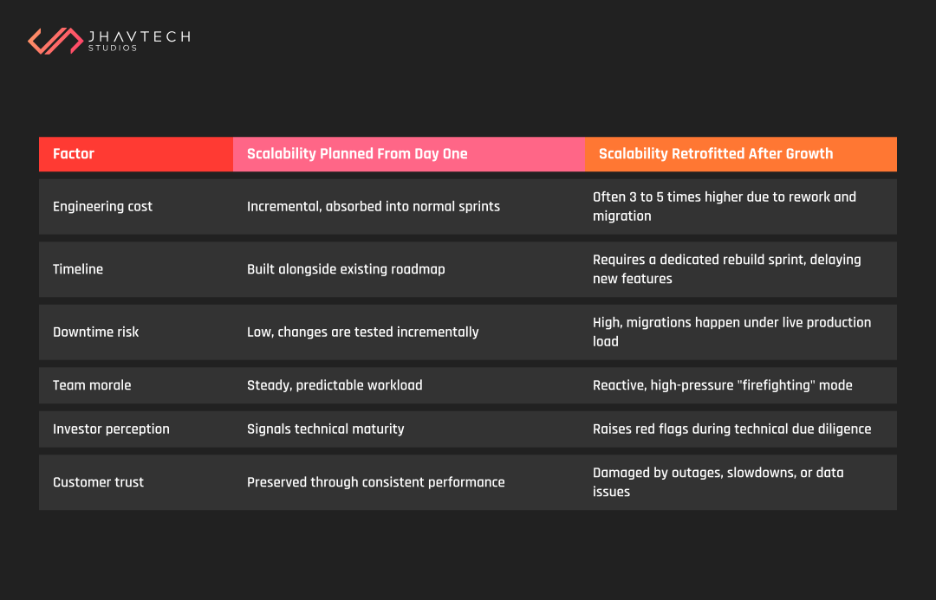
The pattern holds across almost every case we've worked on. A codebase that was never designed to scale doesn't just need new features bolted on. It usually needs core assumptions rebuilt from the ground up, and that work is far riskier when it happens under pressure with paying customers watching. As our team puts it to founders during early architecture reviews: scalability debt doesn't send an invoice until the day you can least afford to pay it.
This is also exactly the kind of issue that surfaces during investor due diligence. We covered this in more detail in our piece on why SaaS startups need a code audit before seeking investment. Investors increasingly bring in technical reviewers who can spot a system that will crumble under its own growth targets, and a scalability gap found during diligence can slow down or sink a round.
What Scalable Product Development Looks Like in Practice
Scalable product development means writing code and choosing infrastructure that can support growth in usage and complexity without requiring a ground-up rewrite. It doesn't require a massive engineering team or a six-month architecture sprint before you ship anything. It requires a handful of foundational decisions made with intention. Here's a practical checklist founders can use when evaluating their own product or vetting a development partner.
Scalability readiness checklist:
If several of these boxes are unchecked, it doesn't mean your product is doomed. It means you have a clear, actionable list of what to prioritize next. A lot of founders find it useful to get a second set of eyes on this list before committing more budget to new features. That's the exact gap a structured, no-cost look at your codebase is built to close, and it's often the fastest way to find out where the real risk is hiding before it becomes a bigger bill.
Building a Startup Growth Architecture That Doesn't Buckle
A startup growth architecture is the underlying technical foundation, your data layer, application structure, and hosting setup, built to support the company you're trying to become, not just the company you are today. It isn't a single technical decision. It's a set of principles that guide dozens of smaller decisions over time. A few that consistently separate startups that scale smoothly from those that hit a wall:
Design for statelessness where you can. Applications that don't rely on storing session data on a single server are dramatically easier to scale horizontally. This one architectural choice, made early, can save months of rework later.
Separate your data layer from your application layer. When your database and application logic are cleanly separated, you can scale each independently based on where the actual bottleneck is, instead of over-provisioning everything at once.
Choose cloud infrastructure with elasticity in mind. Fixed-capacity hosting might look cheaper on a startup budget, but it can't respond to sudden demand. Elastic infrastructure costs a bit more upfront and saves you from the far more expensive scenario of a launch-day outage.
Automate what you can, early. Manual deployment processes work fine when one person is pushing code. They break down fast once you have a team, multiple environments, and customers who expect zero downtime.
None of this requires building for a scale you haven't reached. It requires not building in ways that actively work against the scale you're hoping to reach.
SaaS Infrastructure Planning: Questions Investors Are Already Asking
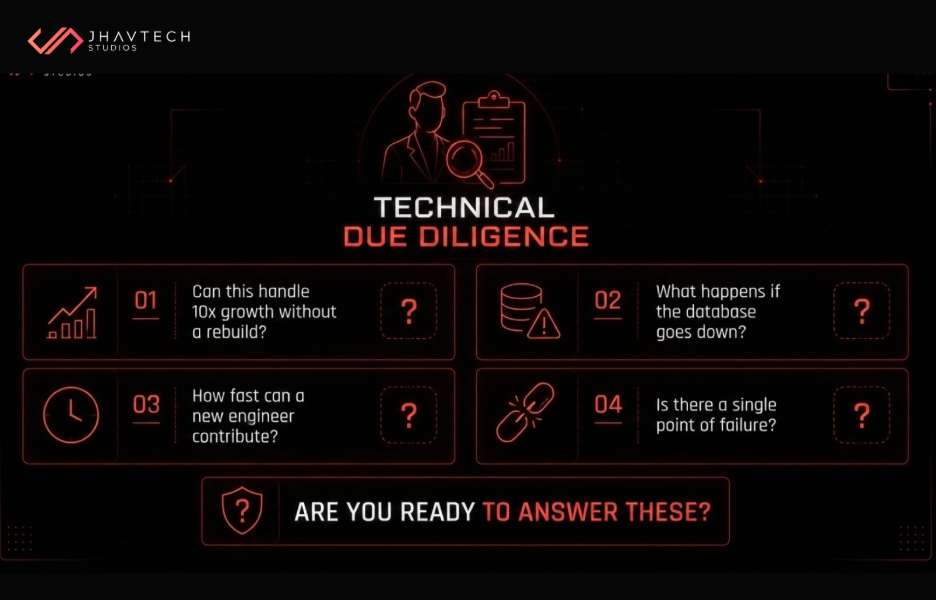
SaaS infrastructure planning is the process of choosing and configuring your hosting, database, and deployment setup so it can meet demand reliably as your customer base grows. It has become a standard part of investor due diligence, not an afterthought. Technical reviewers brought in during funding rounds are trained to ask pointed questions, and founders should be ready with real answers, not vague reassurances.
Common questions include: Can this system handle 10x current user load without a full rebuild? What happens if your primary database goes down? How quickly can a new engineer understand and contribute to this codebase? Is there a single point of failure anywhere in the stack?
If those questions make you uneasy, that's useful information. We walked through this exact scenario in our 2026 guide to building investor-ready SaaS products, which covers how technical readiness and fundraising readiness are far more connected than most founders assume.
How to Start Without Overengineering
The goal isn't perfection on day one. Chasing that will slow you down and burn cash you don't have. The goal is avoiding decisions that actively box you in later.
A practical approach: build your MVP fast but have someone with real infrastructure experience review the architecture before you scale your team or your marketing spend. This is also the moment many founders bring in outside help, whether that's getting your product built right from the ground up or getting expert hands on a system that's already showing strain, through a dedicated rescue plan, before it turns into a full outage. Either path beats discovering the problem mid-crisis.
Final Thoughts
Software scalability planning isn't a luxury reserved for well-funded startups. It's a discipline that costs very little to practice early and a great deal to ignore. The founders who treat it as a day-one priority aren't slowing themselves down. They're protecting the runway, the reputation, and the momentum they've worked hard to build.
If your product is starting to show cracks, or you'd rather catch them before they show, it's worth getting a professional opinion sooner rather than later. Sometimes that starts with something as simple as a second set of eyes on your existing code.
Frequently Asked Questions



.png)
.png)
.png)

.png)
.png)
.png)
.png)
.png)
.png)
.png)
.png)
.png)
.png)
.png)
.png)

.png)
.png)
.png)
.png)
.png)
.png)
.png)
.png)
.png)

.png)
.png)
.png)
.png)
.png)
.png)
.png)
.png)
.png)
.png)
.png)
.png)
.png)

.png)
.png)
.png)
.png)

.png)
.png)
.png)


.png)
.png)
.png)
.png)

.png)


.png)

.png)




.png)



.png)





.png)

.png)

.png)

.png)