.svg)
.svg)


Why SaaS Startups Need a Code Audit Before Seeking Investment
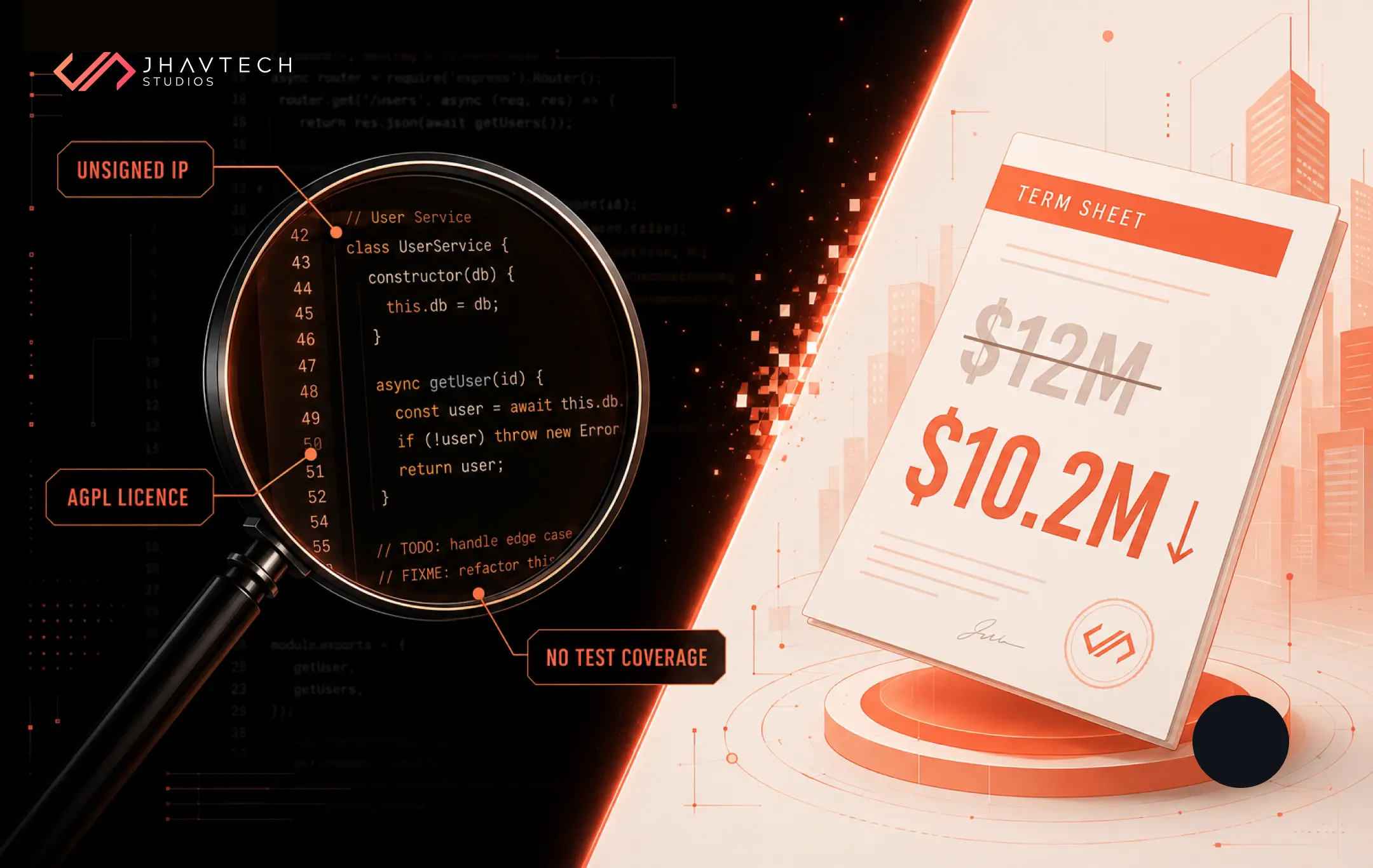
A SaaS code audit is an independent technical review of your codebase, architecture, security posture and IP ownership, run before your investors run theirs. The point is not perfection. It's control. You find the problems first, on your timeline, and you decide what gets fixed, what gets documented, and what gets disclosed. Below: what investors examine in 2026 and why it got sharper, three numbers on codebase risk that should give any founder pause, a checklist you can run against your own product this week, and what a startup software audit costs against what an unprepared diligence process costs you. Written for SaaS founders, CTOs and SME leaders raising in the next 6 to 18 months.
The Deck Gets You the Meeting. The Codebase Decides the Terms.
You nail the pitch. Metrics hold. Term sheet arrives at a number you're proud of.
Then the investor's technical advisor asks for read access to your repository, and three weeks later that number has moved. Not because your market shrank. Because someone found an AGPL-licensed library sitting inside your proprietary backend, or a contractor who left in 2024 and never signed an IP assignment, or a payments flow with no test coverage whatsoever.
None of that appears in a pitch deck. All of it appears in a code review.
Most founders think of the codebase as the thing that produces the product. Investors think of it as a large part of what they're buying, and its condition tells them how much of their cheque goes toward building the next thing versus repairing the last one.
What Changed? Investor Due Diligence Got Sharper
Two things happened over the past couple of years.
Capital got choosier. Fewer, larger cheques means more scrutiny per dollar, and technical review stopped being the token workstream slotted in after financials cleared. It runs in parallel now and it carries weight.
The bigger shift is AI-assisted development. Almost every startup ships code that a model partly wrote; investors know it, and that has opened a diligence category that barely existed in 2023. It's not about quality. It's about provenance. Who wrote this, where did it come from, and can you prove you own it?
A software risk assessment considered thorough three years ago now looks thin.
Three Numbers Worth Sitting With
Vulnerabilities per codebase more than doubled. Black Duck's 2026 Open Source Security and Risk Analysis report audited 947 commercial codebases across 17 industries and found the mean number of open-source vulnerabilities per codebase climbed 107% year on year, landing at 581. Open source now shows up in 98% of codebases. 87% carried at least one known vulnerability. 68% had licence conflicts, the highest in the report's decade of running.
Developers don't trust what they're shipping. Stack Overflow's 2025 Developer Survey drew responses from more than 49,000 developers. 84% use or plan to use AI tools. 46% actively distrust the accuracy of the output, up from 31% the year prior, and just 3% said they highly trust it. The top complaint was code that's almost right but not quite, with 66% saying they now spend more time fixing near-miss output than they save generating it.
Technical findings move prices. Analysis from CT Acquisitions, citing PitchBook's 2025 Software M&A Report, puts technology due diligence behind re-trades in 30 to 40% of software-heavy deals, with price reductions typically landing between 5 and 25% when buyers surface material findings in code quality, cybersecurity, IP ownership or third-party licence exposure.
Codebases are getting riskier faster than governance is catching up. The people writing cheques have noticed.
Where the risk actually sits
A mean of 581 vulnerabilities per codebase is easy to read past. The share of codebases affected is harder to dismiss, partly because it turns an industry average into a question about odds, and partly because these figures come from audits of real commercial code rather than a self-reported survey.
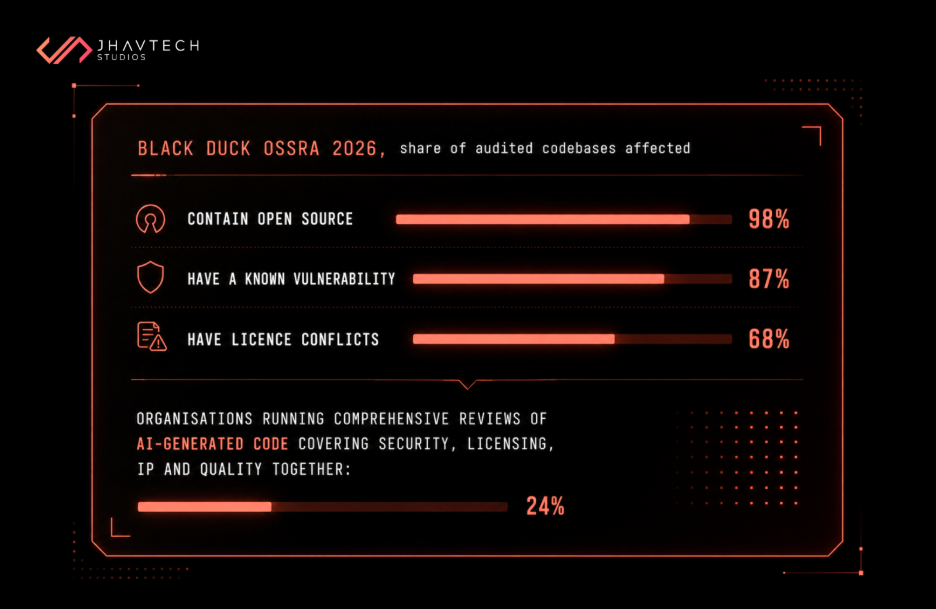
Roughly three in four organisations using AI coding tools aren't reviewing that code across all four dimensions. If you're in that group, an investor's advisor will find what you never went looking for.
What a SaaS Technical Review Actually Examines
Technical diligence isn't a code beauty contest. Nobody rejects a round because you picked a monolith. The line reviewers are drawing is between problems money can solve and problems it can't: ugly code is a budget line item, but unassignable IP, a copyleft licence baked into your core, or customer data handled outside your stated privacy policy cannot be bought out of once the money lands. That is why a review spends far more time on ownership and exposure than on elegance. Reviewers hunt for risk that transfers to the investor after close, and it clusters into seven areas.
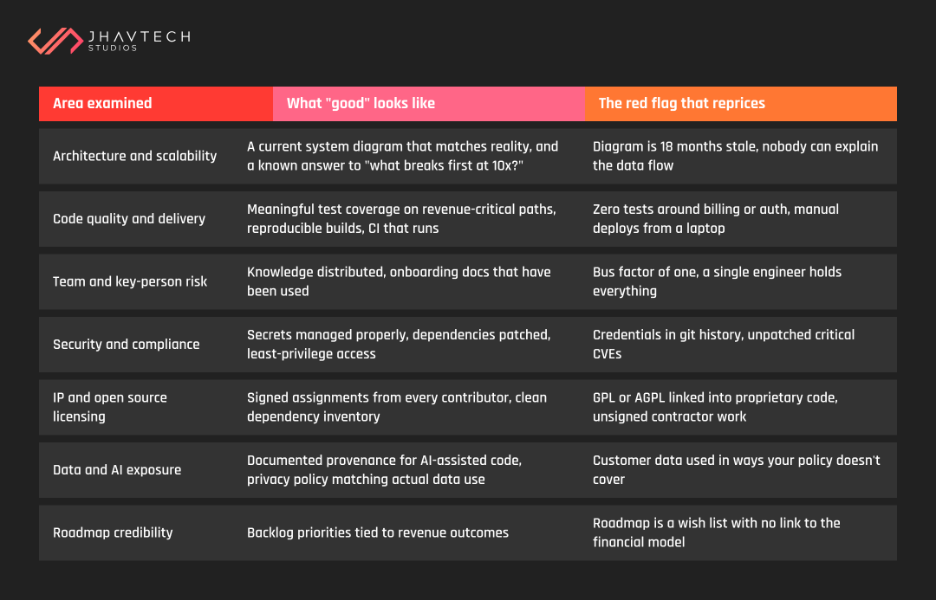
Investors aren't asking whether your engineering is flawless. They're asking whether you understand your own system well enough to be trusted with capital. Founders who can walk through their weak spots calmly, with a costed remediation plan, consistently outperform founders who insist everything is fine.
For the wider version of this, our guide on building SaaS products investors are willing to back covers the commercial side.
What we find when we open an early-stage codebase
Founders brace for a verdict on their code quality. That is rarely where the trouble is. Messy code at seed stage is normal and investors price it in. The findings that cause real damage are usually administrative, and four come up again and again.
The contractor nobody remembers. Someone built the original login system in 2023, invoiced through an agency, and no signed agreement transfers that work to the company. Ten minutes to spot, months to unwind, because it raises the one question no investor lets go of: do you legally own all of your product?
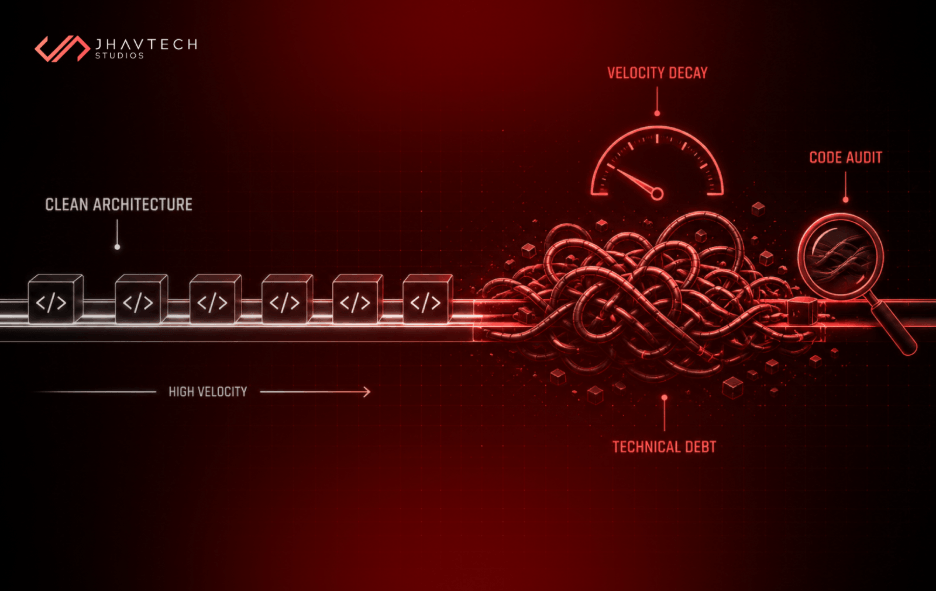
The diagram drawn during the meeting. We ask for the current system diagram and the CTO reaches for a whiteboard. That reach is the finding. If your platform design lives in one person's memory, diligence logs it as key-person risk.
Old credentials in the project history. Teams rotate keys in production and assume the old ones are gone. Version control keeps a permanent record of every change, so a key deleted a year ago is often still readable, and automated scanners find it in seconds.
The one engineer who can deploy. Everyone knows who it is. Nobody says it in front of an investor. Most common continuity risk we see, and one of the easiest to fix.
All of them are cheap to sort in month one of a raise and awkward to explain in week three of diligence.
The Pre-Diligence Checklist
Run this before you open a data room. Every unchecked box is a question you'll be answering under pressure later, in front of people you're trying to impress.
Ownership and IP
Security
Engineering health
Continuity
Financial linkage
Struggling with that last pair? Our piece on why technical debt gets ignored until it's expensive walks through how it compounds.
What This Costs You Versus What It Saves
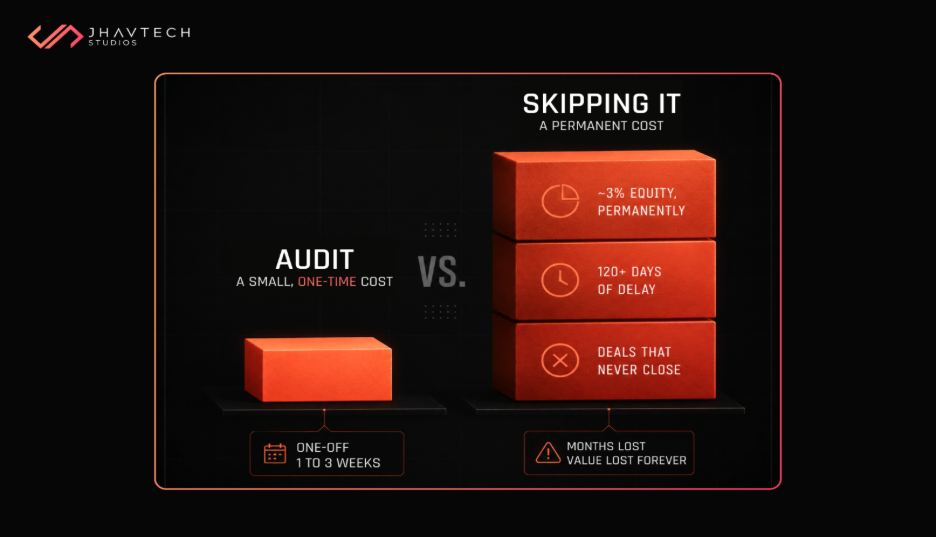
A startup software audit for an early-stage SaaS product usually runs one to three weeks, somewhere between a few thousand and low tens of thousands of dollars (AUD) depending on scope and codebase size.
Set that against the downside. Say you're raising $3M on a $12M pre-money. A 15% adjustment drops that to $10.2M, and holding the raise steady, your dilution moves from 20% to nearly 23%. Founders give up roughly three extra points of the company, permanently, over findings an audit would have surfaced months earlier. Deals carrying significant findings routinely stretch past 120 days. Some never close.
Investors will run this review regardless. The only variable is whether you've seen the findings first. There's a quieter benefit too. Remediation after an audit is work you'd have to do eventually regardless. Fixing an architectural flaw at 500 users is cheap. Fixing the same flaw at 50,000 users, mid-scale, with customers watching, is a different project with a different budget. We unpacked that compounding effect in how poor architecture turns into long-term business risk.
When to Run It
Sixty to ninety days before your first serious investor conversation is the sweet spot. Enough runway to fix material items and document the rest, without the audit itself becoming a distraction mid-raise.
Other moments that should trigger one:
- Coming off a heavy stretch of AI-assisted development with no provenance trail
- Your original technical founder or lead engineer just left
- You inherited a codebase from an agency or offshore team and have never independently verified it
- The prototype that got you this far now needs to hold up under real load
That last case comes up constantly. Plenty of teams reach the investment conversation on an MVP that was never built to survive scale, and the honest answer is usually a structured rebuild of the weak layer rather than a patch. There are specialists who untangle builds that have outgrown their foundations, and where the pressure sits on the customer-facing side, getting the app experience genuinely production-grade is usually the highest-leverage fix.
How to Present Findings to Investors
Don't hide the report. Use it.
Walking into diligence able to say "we commissioned an independent review three months ago, here's what we found, here's what we fixed, here's what we deliberately deferred and why" projects something specific: this founder manages risk on purpose. That signal beats a clean report you got by luck.
Share the scope and methodology rather than the raw report. List what you remediated, with dates. Then list what you deferred, with your reasoning and a cost to fix.
That last part is the move most founders miss. A vague technical weakness is something an investor discounts you for. The same weakness, quantified and slotted into your use of funds as "$60K, Q2, here's who does the work," stops reading as a liability and starts reading as evidence that you plan. Same finding, completely different conversation.
Frequently Asked Questions

.png)

.png)








.png)
.png)
.png)
.png)