.svg)
.svg)


How to Choose the Right Software Architecture for a Growing Business
Key Takeaways
- Software architecture is the structural blueprint that decides whether your product bends or breaks as you grow. Choosing well early saves you painful, expensive rewrites later.
- There is no single best architecture. The right choice depends on your team size, growth stage, budget, and how fast you need to scale, not on what the loudest engineers on LinkedIn are hyping.
- Most startups and SMEs are better served starting with a well-structured monolith or modular monolith, then evolving toward services only when real demand forces the move.
- In 2026, the trend has swung back toward pragmatism. Roughly 42% of organisations that jumped to microservices are pulling some services back together because the complexity was not worth it.
- A scalable software architecture is less about a trendy pattern and more about clean boundaries, good data design, and the ability to change one part without breaking everything else.
If you are running a growing business, you have probably had that uneasy feeling. The product works today, but you are not sure it will hold up when you have ten times the users, three times the team, and a feature list that keeps getting longer. It nags at you. And it almost always traces back to one thing: software architecture.
Here is the uncomfortable truth. Most founders and business leaders don't think about architecture until something has already gone wrong. The app slows to a crawl during a traffic spike. A small change takes three weeks and quietly breaks two unrelated features. A new developer needs a month just to understand how everything fits together. By then, fixing the foundation is a lot harder than pouring it correctly the first time. A lot harder.
This blog walks you through how to choose. Not with jargon, but with the questions that matter for a business that intends to grow.
What Software Architecture Really Means (In Plain English)
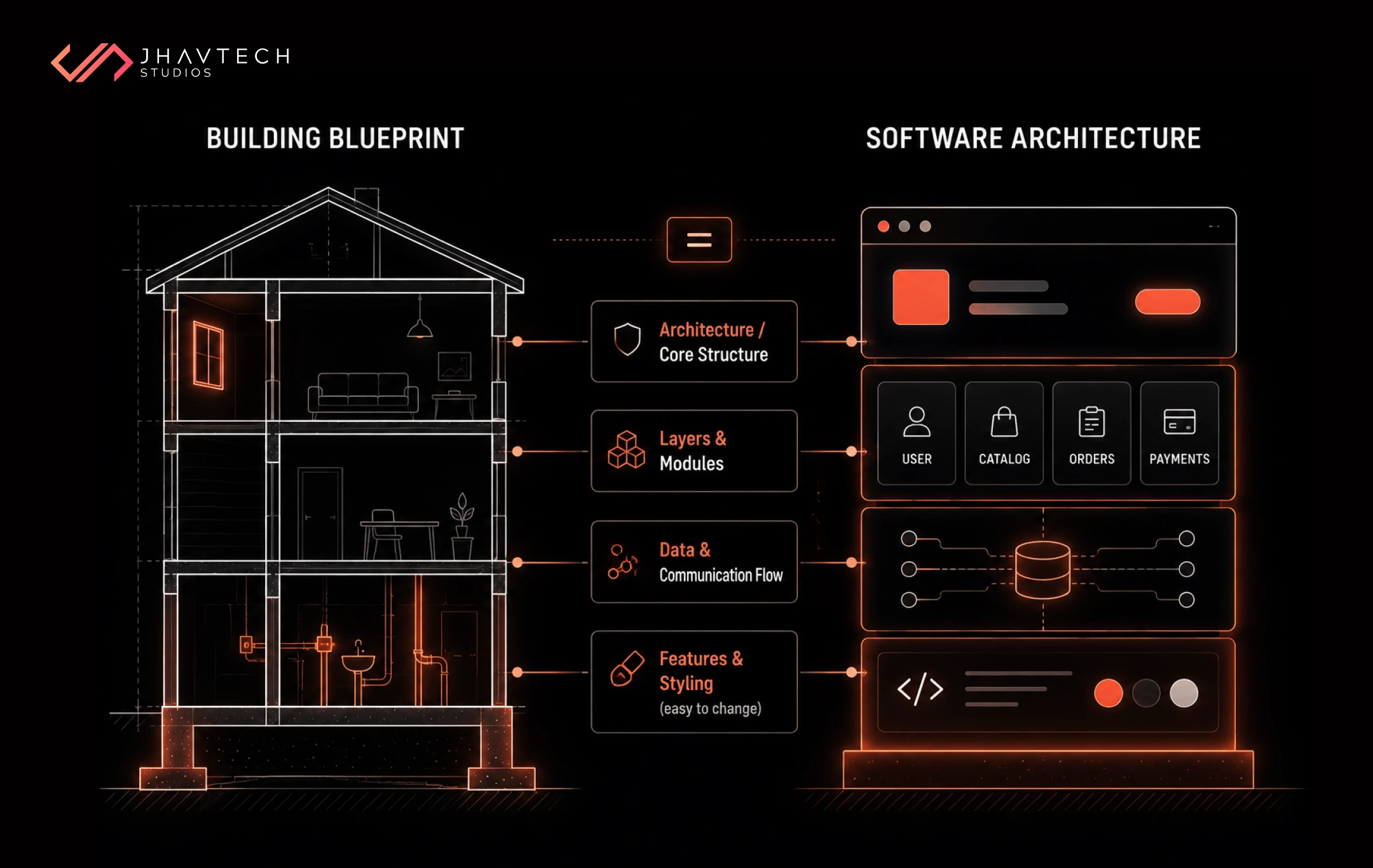
Think of software architecture as the floor plan for a building. Before anyone lays a brick, someone decides where the load-bearing walls go, how many floors the foundation can support, and where the plumbing and wiring run. You can repaint rooms and move furniture later without much trouble. Moving a load-bearing wall after the building is up? That is a demolition project.
Software architecture design works the same way. It is the set of high-level decisions about how the major pieces of your application are organised, how they talk to each other, and how they handle data, traffic, and change. Small styling tweaks are the furniture. The architecture is the load-bearing wall.
Application architecture specifically refers to how a single application is internally structured, its layers, modules, and the rules for how they interact. Get this right and your product can absorb growth. Get it wrong and every new feature adds friction until development slows to a crawl.
The reason this matters so much for a growing business is simple. Early decisions compound. A shortcut that saves two weeks at launch can cost six months of rework two years in. That is not a reason to over-engineer. It is a reason to choose deliberately.
The Main Types of Software Architecture You Should Know
You don't need an engineering degree to make a smart call here. You mostly need to understand the trade-offs of the main options.
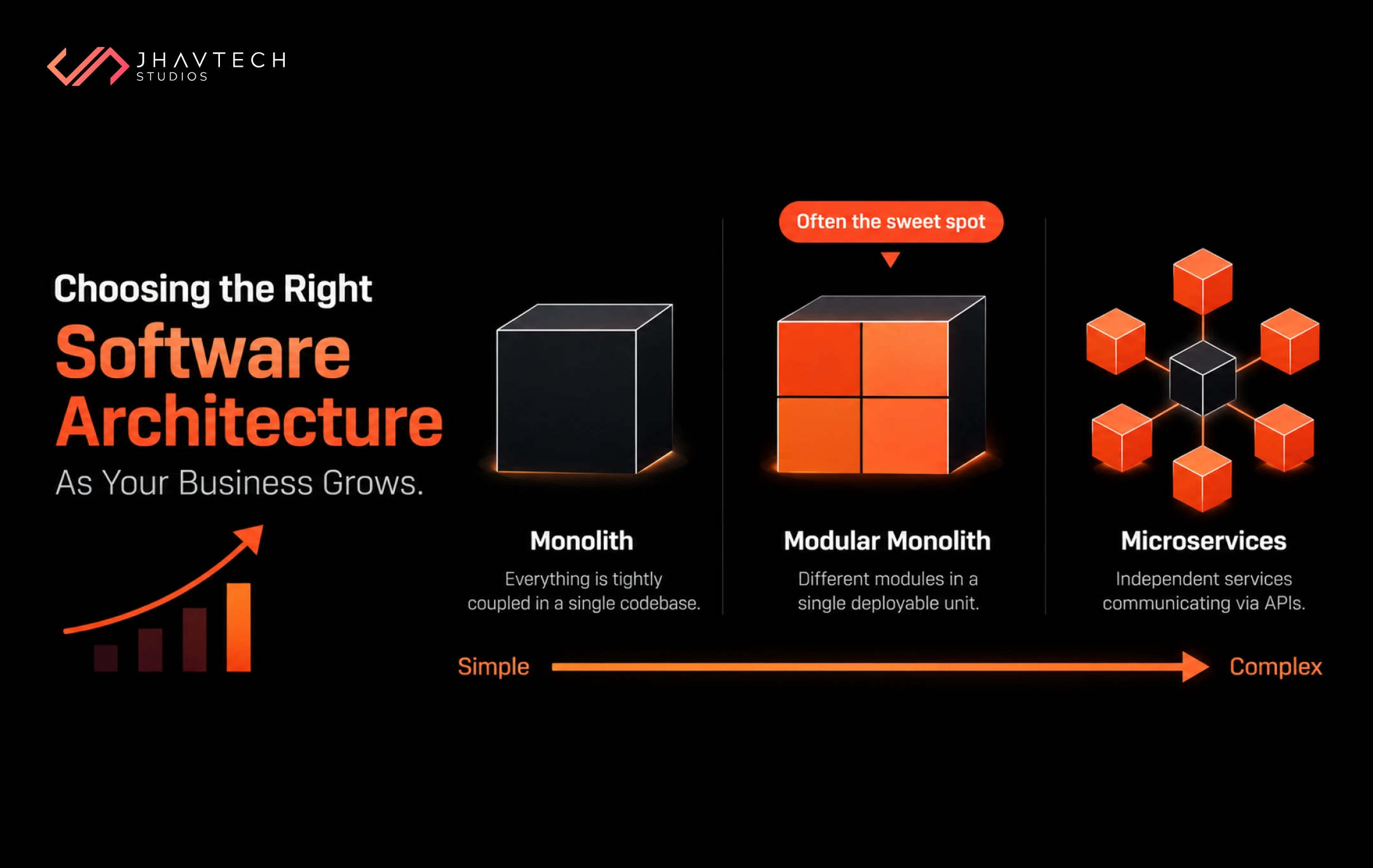
The Monolith
A monolith is a single, unified codebase where everything lives together and deploys as one unit. It has an unfairly bad reputation. For most early-stage products, a clean monolith is the fastest, cheapest, and most sensible way to ship. One codebase, one deployment, easy debugging, and a small team can move quickly.
The catch is that a badly organised monolith turns into what engineers call a "big ball of mud," where everything is tightly coupled and one change ripples everywhere. That tangle is how technical debt piles up unnoticed. The fix is not to abandon the monolith. It is to keep it clean.
The Modular Monolith
This is the sweet spot for a lot of growing businesses in 2026. You keep the simplicity of a single deployment, but you divide the code into well-defined modules with clear boundaries, almost like separate services living under one roof. You get discipline without the operational overhead of a distributed system. If you ever do need to break out a piece into its own service later, the seams are already there.
Microservices
Microservices split your application into many small, independently deployable services, each owning a specific job. This is what powers companies operating at enormous scale, because teams can work and deploy independently and individual pieces can scale on their own.
The trade-off is real complexity. You now have a distributed system with network calls between services, multiple databases, service coordination, monitoring across dozens of moving parts, and a bigger platform team to keep it all running. Cloud infrastructure costs climb too, because every service needs its own resources, networking, and observability tooling. For a small team, this often means paying the full cost of microservices while getting very little of the benefit.
Serverless and Event-Driven Approaches
Serverless lets you run individual functions without managing servers, paying only for what you use. Event-driven architecture organises the system around events (a payment made, an order placed) that trigger downstream actions. Both can be excellent for specific workloads, especially spiky or unpredictable traffic, and both can be mixed into any of the approaches above.
A Quick Comparison to Ground Your Decision
Here is how the main options stack up for a growing business.
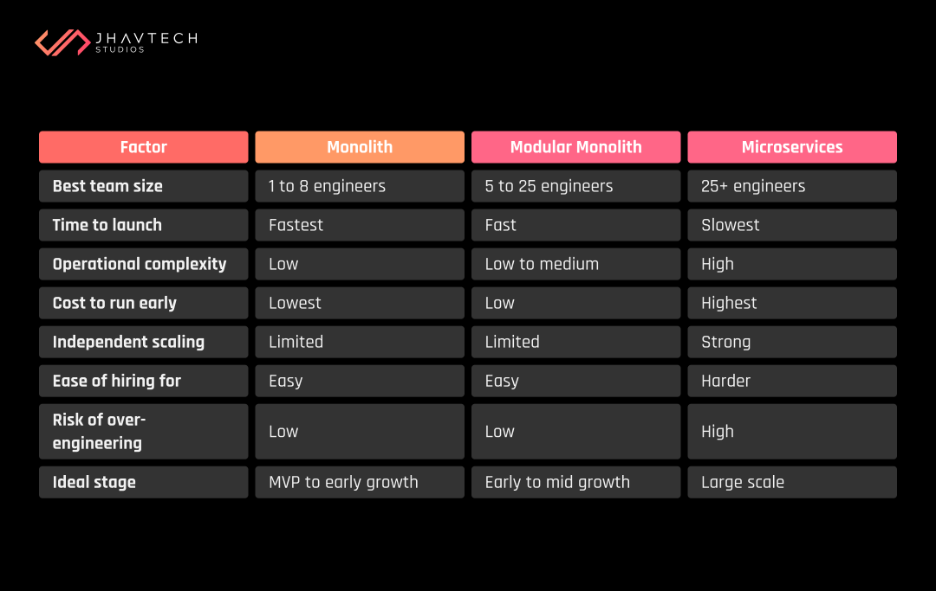
The pattern is hard to miss. For the stage most startups and SMEs are actually in, the simpler options win on almost every axis that affects your budget and speed.
What the 2026 Data Is Telling Us
For roughly a decade, microservices were treated as the default sign of a serious engineering team. That has changed, and the shift is backed by hard numbers rather than opinion.
According to the CNCF 2025 Annual Cloud Native Survey, cloud native adoption has now reached 98% of organisations, so the industry conversation has moved from whether to adopt these techniques to how to use them without drowning in complexity. And within that shift, a meaningful correction is underway. Multiple 2026 industry analyses of that survey data report that around 42% of organisations that adopted microservices have been consolidating at least some services back into larger, simpler deployable units, citing debugging difficulty, operational overhead, and cost as the main reasons.
The most famous example comes from Amazon itself. As reported by tech-news outlet The New Stack, the Prime Video audio and video monitoring team moved one internal workload away from a distributed serverless design back into a single consolidated application and reported cutting infrastructure costs for that workload by roughly 90%. The company that helped define modern cloud architecture chose the simpler structure when the numbers demanded it.
The lesson is not "microservices are bad." Microservices adoption is still huge, and for genuinely large operations they unlock things monoliths cannot. The lesson is that architecture is a business decision driven by your context, not a badge of maturity. Most teams don't have Google-scale problems, yet plenty were paying Google-scale operational bills.
Concrete Example: Two E-Commerce Startups and a Flash Sale
Picture two online stores of similar size, both bracing for a Black Friday flash sale. The first runs a well-structured modular monolith. When traffic spikes 20x, they scale up their single application horizontally, add a caching layer in front of the product catalogue, and ride out the surge with one engineer watching the dashboards. The second store, chasing "best practice," split the same product into eight microservices before they had the traffic to justify it. During the sale, their checkout service, cart service, and inventory service each need separate scaling, a network hiccup between two of them drops orders, and three engineers spend the peak hour chasing failures across distributed logs instead of selling.
Same traffic, same opportunity, wildly different outcomes. The difference was not talent or budget. It was choosing a structure that matched the stage of the business. This is the exact kind of foundation work we handled when strengthening the mobile architecture behind SoulConnect's scalable, AI-driven platform, where the goal was to support growth without bolting on complexity the product did not yet need.
How to Choose: A Framework for Decision Makers
Forget the pattern names for a moment. The right architecture falls out of honest answers to a handful of questions.
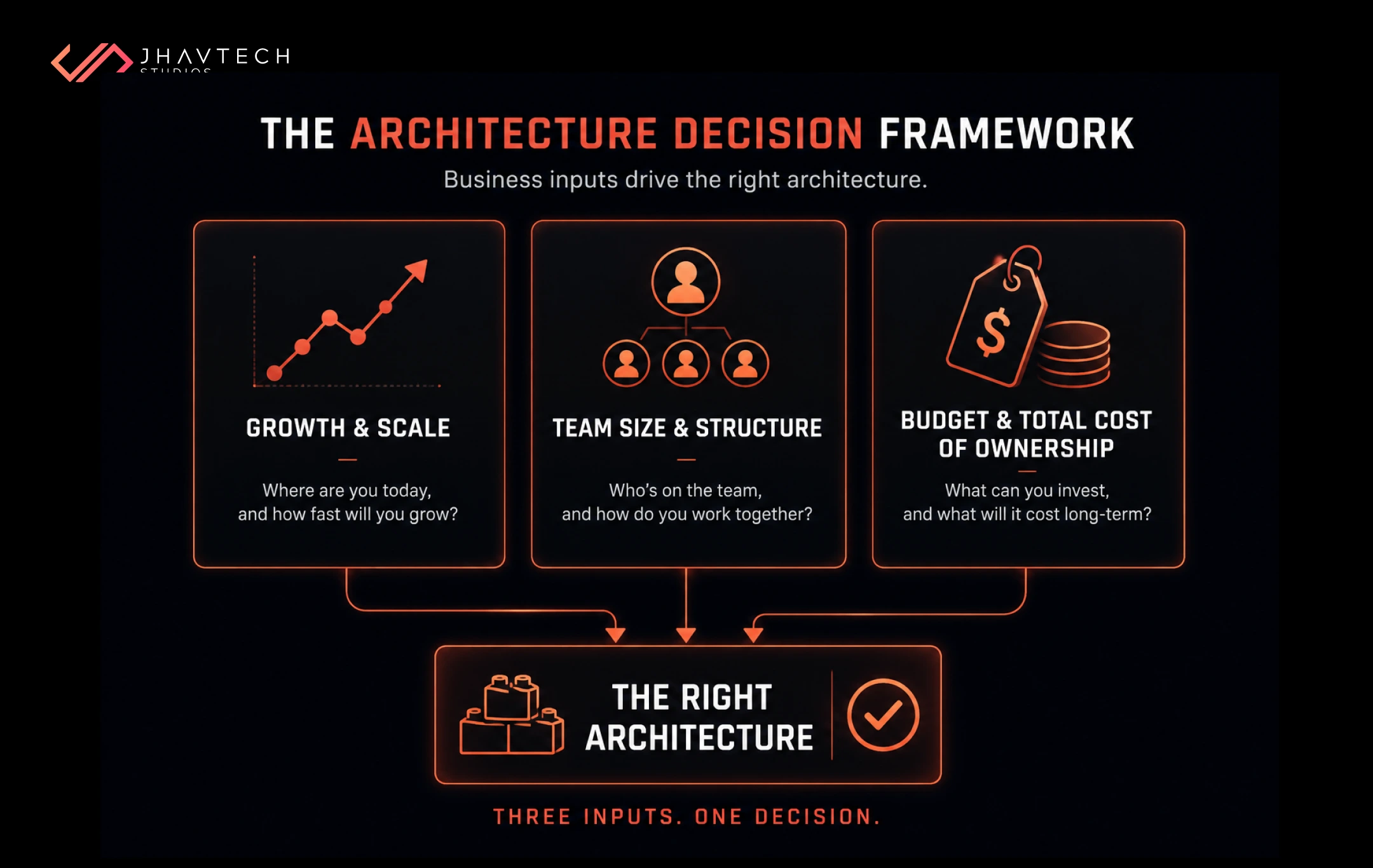
What factors determine your software architecture? Three things matter most, and everything else is detail:
- Growth and scale: How many users and how much traffic you realistically expect over the next 18 to 24 months, and which parts of the product will feel that load first.
- Team size and structure: How many engineers you have now and will have soon, since architecture should match the shape of your team rather than fight it.
- Budget and total cost of ownership: What you can spend to build and, just as importantly, to run and maintain the system across cloud infrastructure costs, tooling, and specialised hires.
Nail those three and the pattern almost picks itself. Here is how each one plays out.
How fast do you realistically need to scale?
Be honest here, not aspirational. Planning for a million users when you have five hundred is how startups burn their runway building infrastructure nobody uses yet. A scalable software architecture does not mean building for imaginary scale on day one. It means building clean boundaries so you can scale the parts that actually get busy when they get busy. Our team broke this down further in why founders should care about software scalability from day one, and the short version is that scalability is a design habit, not a specific technology.
How big is your team, and how big will it get?
Architecture and team structure are deeply linked. A three-person team running microservices spends more time managing infrastructure than building product. A fifty-person team crammed into one monolith steps on each other constantly. Match the structure to the humans, not the other way around.
What is your budget for building and running it?
Distributed systems cost more in cloud spend, tooling, and specialised engineers. If a modular monolith gets you to market faster and cheaper while still leaving room to grow, that is often the smarter capital decision. This is the same build-versus-buy logic we cover in our decision framework for build vs buy software, applied to how you structure what you build.
Where is complexity genuinely required?
You don't have to pick one architecture for everything. A common, sensible pattern is a solid modular monolith with one or two independent services broken out only where the workload truly justifies it, such as a heavy data-processing job or a spiky, unpredictable feature. This is also where mobile matters. If your growth is heading toward apps, it is worth pressure-testing your backend against your cross-platform and native app build strategy early, because the wrong backend shape tends to show up fast under real mobile traffic.
What does the total cost of ownership look like over three years?
The cheapest thing to build is not always the cheapest thing to own. If you are weighing the long-term maths, our guide on how to calculate the ROI of custom software before you build it is a useful companion to this decision.
Your Architecture Decision Checklist
Before you commit to a direction, run through this. If you cannot answer most of these clearly, that is a signal to get expert input first.
☐ We have written down our realistic user and traffic growth for the next 18 to 24 months.
☐ We know how many engineers we have now and roughly how many we will have in a year.
☐ We have a clear budget for both building and running the system.
☐ We have identified which one or two parts of the product are most likely to need independent scaling.
☐ We have chosen the simplest architecture that meets those needs, not the most impressive one.
☐ Our code has clear module boundaries so pieces can be separated later without a rewrite.
☐ We have a plan for monitoring, security, and data ownership from day one.
☐ We have documented the architecture so a new developer can understand it quickly.
☐ We have avoided committing to distributed complexity before the business genuinely needs it.
☐ We have had the design reviewed by someone who has scaled a product before.
The Mistakes That Quietly Kill Growing Products
A few patterns show up again-and-again when architecture goes wrong.
The first is premature complexity. Teams adopt microservices, Kubernetes, and a dozen tools because it feels like what a real tech company does, then spend their energy operating infrastructure instead of shipping value. The 42% consolidation trend exists precisely because so many teams learned this the hard way.
The second is the opposite: the neglected monolith. There is nothing wrong with a monolith, but there is everything wrong with an unstructured one. Without clear internal boundaries, it slowly congeals into something no one can safely change. This is exactly the kind of hidden risk a structured code and architecture health check is built to surface before it becomes a crisis.
The third is ignoring data architecture. How you model and store data is often more important to scalability than which service pattern you pick. A brilliant service design sitting on a poorly designed database will still buckle.
The fourth is building with no exit strategy. Good architecture keeps your options open. It lets you extract a service later, swap a component, or change a database without tearing the whole thing down. When teams skip this, a routine legacy system migration years later turns into a full rewrite, which is exactly the outcome you want to avoid.
If you have inherited a codebase that already suffers from these issues, the good news is that most of it is recoverable. A focused software turnaround and recovery engagement can stabilise a product that is buckling under its own growth and map the safest path back to solid foundations.
The Bottom Line
Choosing the right software architecture for a growing business is not about chasing the most advanced pattern. It is about matching your structure to your reality: your growth, your team, your budget, and the parts of your product that genuinely need room to expand.
Start simpler than your ego wants. Keep clean boundaries so you can grow into complexity rather than being crushed by it. Let real demand, not hype, pull you toward services when the time comes. That is what a scalable application architecture actually looks like in practice, and it is the difference between a product that grows with you and one you have to rebuild in two years.
Frequently Asked Questions







.png)


.png)
.png)









.png)
.png)
.png)

.png)