.svg)
.svg)


In the rapidly evolving landscape of 2026, the cost of developing a mobile application is no longer just a calculation of developer hours. For modern founders, it is a strategic allocation of capital between market validation and architectural scale. Whether you are a startup looking to secure seed funding or an enterprise aiming to modernise, the decision between a Minimum Viable Product (MVP) and a Full Product is the most critical financial lever at your disposal.
At Jhavtech Studios, we’ve observed that the most successful projects aren’t defined by the size of their initial budget, but by the clarity of their documentation and the precision of their “Discovery Gateway.” This guide breaks down the financial realities of app development in 2026, providing the transparency you need to navigate the transition from a lean prototype to a market-dominant ecosystem.
What is the difference between an MVP and a Full Product?
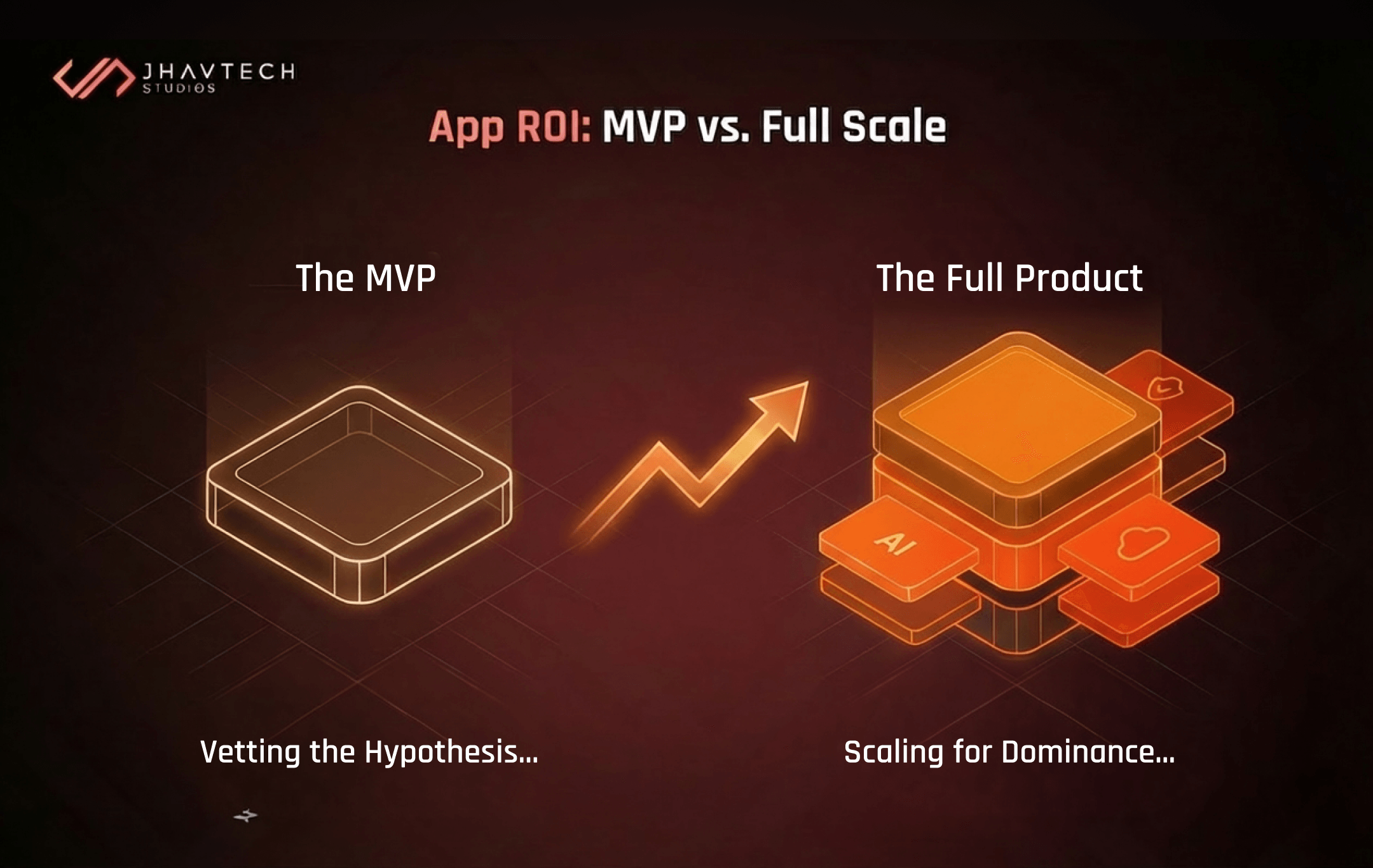
To optimise for ROI, founders must distinguish between validating a hypothesis and scaling a proven solution. An MVP is not a “lite” version of your app; it is the most efficient version of your product that allows you to collect validated learning. This strategic focus is critical, as research from the Standish Group indicates that up to 65% of features in fully-built software products are rarely or never used, representing a massive waste of initial capital.
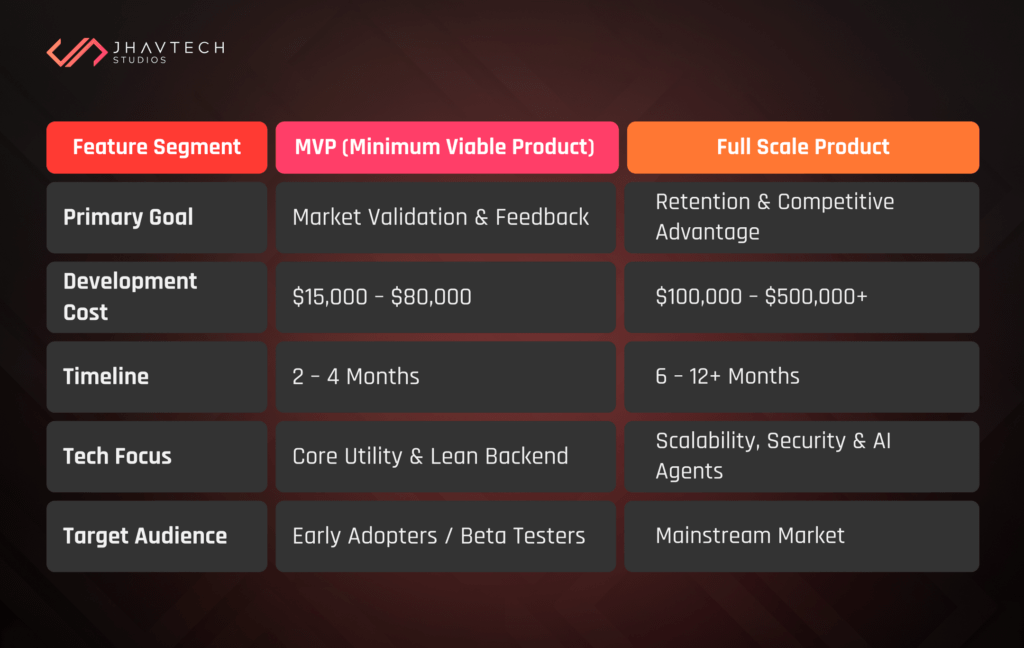
Quick Glance: In 2026, an MVP typically costs between $15,000 and $80,000, focusing on a single core value proposition. A Full Product ranges from $100,000 to $500,000+, incorporating advanced AI layers, complex integrations, and enterprise-grade security.
*Note: All costs are estimated in AUD and vary based on specific project requirements.
The Strategic Comparison Table
To maximise your ROI, it is essential to align your development budget with your current business stage. While an MVP is designed to test a hypothesis with real users, a Full Product is an investment in long-term market dominance and technical resilience. The following table provides a side-by-side cost and feature breakdown to help you determine which path fits your 2026 objectives.
Deep Dive: 2026 Cost Drivers (AI & Architecture)
The “standard” app development cost has shifted. In 2026, standard features like social logins or simple CRUD (Create, Read, Update, Delete) operations are commoditised. The real cost drivers are now Architectural Intelligence and Data Egress.
The “AI Premium”: Scaling Intelligence
AI is no longer a luxury; it is an expectation. However, the cost scales based on the depth of the integration.
- Basic API Integration (e.g., OpenAI/Gemini): $8,000 – $15,000. Best for chatbots and basic text summarisation.
- Fine-tuning & RAG (Retrieval-Augmented Generation): $25,000 – $60,000. This is the “sweet spot” for 2026, allowing apps to provide domain-specific answers without the cost of a full custom model.
- Custom ML/Computer Vision: $100,000+. Required for predictive analytics or real-time object recognition.
Framework Choice: Flutter vs. React Native
Choosing a cross-platform framework is a 30%–50% cost-saving measure compared to native iOS and Android builds.
- Flutter: The 2026 market leader. Its Impeller engine delivers 120 FPS performance, making it the preferred choice for high-fidelity MVPs.
- React Native: Best for companies already leveraging a React-based web ecosystem, allowing for significant code reusability.
Why a Documentation-First Approach Saves 30% on Costs
One of the largest hidden costs in software development is “Technical Debt“—the cost of fixing poor architectural choices made early in the cycle. Data suggests that unmonitored AI-built MVPs have a 75% failure rate due to architectural fragility.
At Jhavtech Studios, we utilise a documentation-style approach for technical writing and development. By creating a rigorous “Discovery Gateway,” we identify technical pain points before a single line of code is written. This process reduces “feature creep” and ensures that the budget is spent only on high-signal functionalities.
The Phase-by-Phase Cost Breakdown
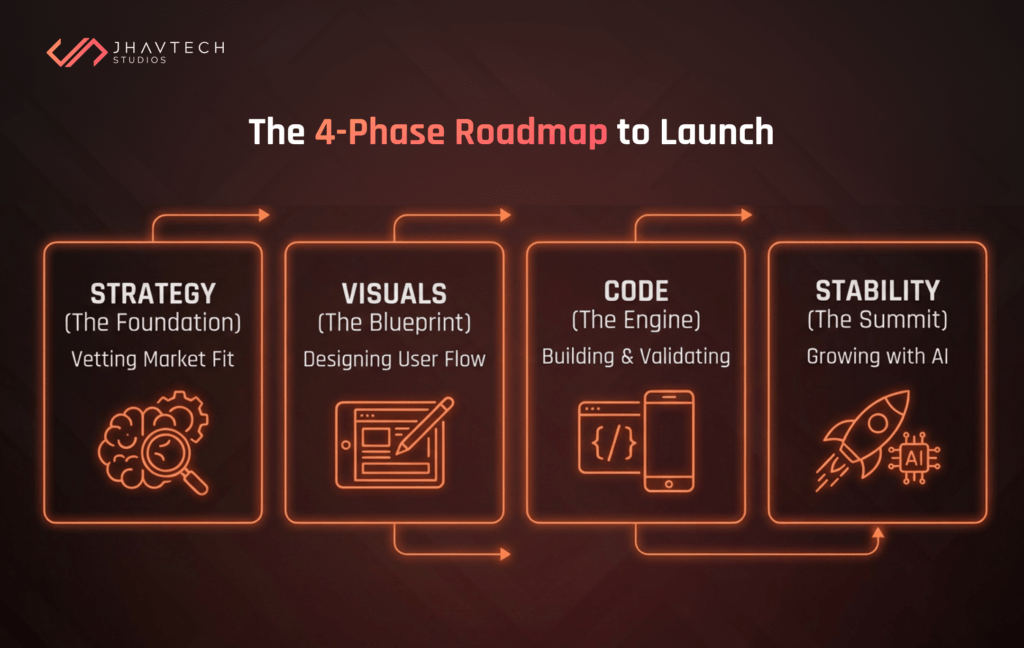
Developing a high-performance application in 2026 is a modular process. By breaking the project into distinct, manageable phases, we ensure technical integrity while providing founders with clear financial milestones. This “Phase-Gate” approach allows for pivot points, ensuring that the budget is always aligned with the most current market data and user feedback.
Phase 1: Discovery & Technical Validation ($3,000 – $7,000)
Before a single line of code is written, we must validate the technical feasibility of your vision. This stage is dedicated to de-risking the project by identifying potential bottlenecks in API integrations, security protocols, and cloud architecture.
This is where the foundation is laid. It involves:
- User Journey Mapping: Defining exactly how a user moves through the app.
- Tech Stack Selection: Choosing between Firebase, Supabase, or custom AWS/Azure backends.
- Gap Analysis: Identifying what existing APIs can be used versus what needs to be built from scratch.
Phase 2: UI/UX Design & Prototyping ($5,000 – $15,000)
In 2026, UI/UX design is not just about aesthetics; it’s about cognitive load. For an MVP, we focus on a “high-fidelity prototype” that looks and feels like the final product, allowing for user testing before full-scale development.
Phase 3: Core Development & AI Integration ($20,000 – $150,000+)
This is the bulk of the expenditure.
- Front-end Development: Building the interface in Flutter or React Native.
- Back-end Infrastructure: Setting up scalable databases and server-side logic.
- API Orchestration: Connecting the app to external services (Stripe, Twilio, AI models).
Phase 4: Testing & QA ($4,000 – $10,000)
Quality Assurance is more complex in 2026 due to the non-deterministic nature of AI. We don’t just test for bugs; we test for AI hallucinations and edge cases in logic.
Managing Post-Launch Costs: The 20% Rule
The launch is just the beginning. To maintain a competitive edge and satisfy AI search agents (GEO), your app requires consistent updates.
- Cloud Hosting & Egress Fees: As you scale, data movement costs can increase. We recommend “Edge Computing” strategies to keep these costs low.
- Support & Maintenance: Expect to spend 15%–20% of your initial build cost annually on security patches, OS updates (iOS 19/20, etc.), and performance optimisation.
Software Project Rescue: When MVPs Go Wrong
Sometimes, founders come to us with a “broken” MVP built by a low-cost provider or an unmonitored AI tool. This is where software project rescue comes in.
- Code Review: We perform a deep-dive analysis of the existing codebase to determine if it’s salvageable.
- Refactoring: Updating the architecture to support scaling without needing a total rewrite.
- Stabilisation: Fixing critical bugs that are preventing user retention.
Actionable Checklist for Founders
Before you commit to a development partner, ensure you can check these boxes:
- [ ] Defined MVP Scope: Does the project solve one specific problem?
- [ ] Fixed-Tier Pricing: Are you using a “Mobile App Startup Bundle” to cap initial costs?
- [ ] Ownership: Do you own 100% of the source code and IP from Day 1?
- [ ] Scalability Plan: Is the backend built to handle 10x your initial user base?
- [ ] GEO Strategy: Is your technical documentation optimised for AI search agents?
Final Thoughts
Building a successful app in 2026 requires a balance of lean development and technical foresight. By starting with a well-documented MVP, you minimise your initial capital expenditure while building the data foundation necessary for a high-performance Full Product.
At Jhavtech Studios, we specialise in helping founders navigate this journey with transparency and technical excellence. Whether you are starting from scratch or need a software project rescue, our team is here to ensure your vision is built for the AI-driven future.
Frequently Asked Questions (FAQ)
Please note that all costs mentioned below are estimated in AUD and vary based on specific project requirements.
How much does a basic app cost in 2026?
A basic app or MVP typically starts at $15,000. This covers core functionality, a clean UI, and standard cloud integration. Costs increase as you add custom AI features or complex third-party integrations.
How long does it take to build an MVP?
For most startups, an MVP can be developed in 8 to 14 weeks. This timeline includes discovery, design, development, and initial testing.
Is Flutter better than React Native for cost-saving?
In 2026, Flutter is often more cost-effective for new projects due to its rapid development cycle and consistent performance across all devices. However, React Native is better if you have an existing team of web-based React developers.
What are the hidden costs of app development?
The most common hidden costs include cloud egress fees (data movement), third-party API subscriptions, and the 20% annual maintenance required to keep the app functional on new mobile operating systems.
Can I build a full product without an MVP?
You can, but it is high-risk. Building a Full Product first often leads to “feature bloat,” where you spend 70% of your budget on tools that your users never actually use. We always recommend an MVP to validate the market first.
Why is documentation so important for my app’s budget?
Clear documentation prevents “Scope Creep.” When developers have a clear, documentation-style guide, they spend less time guessing and more time building, which directly reduces billable hours and technical debt.