.svg)
.svg)


The Rise of AI and the Big Question About Safety
Artificial Intelligence (AI) has become the engine driving innovation in modern app development. It is powering everything from hyper-personalised recommendations in retail apps to predictive maintenance in logistics systems and intelligent automation across virtually every industry.
But for businesses across Sydney, Melbourne, and beyond, a major question keeps surfacing: “Is AI really safe for my business and my clients?”
It is a completely valid concern. The market hype often focuses on speed and cost reduction, promising that AI can build a complete, functional, and secure app on its own. The reality is far more complex. While AI is a phenomenal tool for generating code snippets and prototypes, it is not a finished solution. It lacks the critical qualities of systemic vision, ethical judgment, and security context.
For any mission-critical application, relying solely on machine-generated code introduces unacceptable risks. This is why the debate of AI vs human developers is not about choosing a winner, but about defining roles. The smart strategy is AI-augmented development, where human experts retain the driver’s seat.
In this comprehensive guide, we will move past the hype to explain what AI safety truly means, expose the deep security and privacy risks inherent in machine-generated code, and show you how Jhavtech Studios builds AI-powered apps that are secure, transparent, and trustworthy.
1. Understanding AI Safety: Beyond Just Technology
AI safety is far more than just protecting a server; it’s about ensuring that autonomous systems act in predictable, fair, and responsible ways that align with your business values and regulatory requirements.
When a business adopts AI, it introduces a system that can learn, decide, and influence user behaviour at scale. For the Australian business landscape, this has tangible commercial and legal consequences.
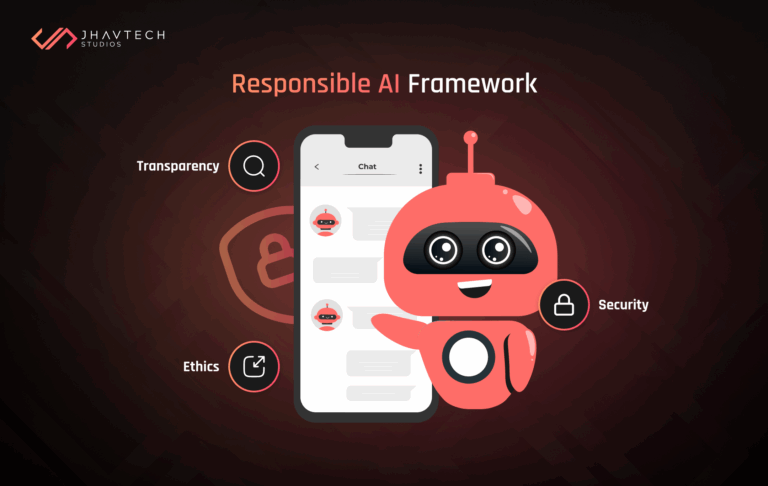
That is why AI safety must cover three essential pillars:
- Ethical AI: Ensuring the system makes unbiased and fair decisions. A system trained on flawed data might inadvertently discriminate in loan approvals or recruitment, causing serious reputational and legal harm.
- Data Security: Keeping user data private, encrypted, and compliant with local laws like Australia’s Privacy Act and global standards like GDPR.
- Model Transparency and Explainability: Ensuring all stakeholders can understand how the AI arrived at a specific decision. This is fundamental for accountability in high-stakes fields like finance or legal tech.
2. Common Risks in AI App Development
Before you commit resources to building an AI-powered app, you must understand where potential risks arise. These risks are amplified when human expertise is absent, particularly when relying heavily on generative tools. The consequences range from serious legal liability to catastrophic data loss.
A. Security Vulnerabilities in AI Generated Code
This is the most critical risk that businesses often overlook. The idea that newer, smarter AI models automatically produce safer code is demonstrably false. Comprehensive analysis of over 100 large language models (LLMs) reveals a troubling reality: only 55% of AI-generated code was secure, meaning nearly half of AI-generated code introduces known security flaws.
This high rate of insecurity is a direct result of AI’s lack of security context. The model knows how to write functionally correct code, but it does not know the application’s deep security requirements, business logic, or system architecture. This context gap leads to critical, predictable technical failures:
- Injection Risks: Models frequently fail to generate code with proper input sanitisation, making systems vulnerable to Cross-Site Scripting attacks.
- Cryptographic Failures: AI still generates insecure cryptographic implementations in 14% of cases, creating a direct pathway for the exposure of sensitive data.
- AI-Native Flaws: Even more concerning are novel risks like dependency hallucinations, where the AI suggests outdated, insecure, or even non-existent software libraries, instantly introducing supply chain vulnerabilities.
This data decisively answers the operational argument in the AI vs human developers debate: without rigorous human auditing, you are deploying flawed code.
B. Data Privacy Breaches
AI systems rely on massive, complex datasets. When mishandled, this can quickly lead to severe privacy violations and legal trouble. The risk is compounded by the way AI tools ingest data:
- Redundant Ingestion: Sensitive company data is often duplicated across numerous external databases during training or fine-tuning, leading to a loss of control and increased surface area for attack.
- Loss of Control: Your enterprise knowledge is scattered, and you lose visibility into where confidential information resides, making compliance checks impossible.
C. Algorithmic Bias and Lack of Accountability
If your AI is trained on biased or incomplete data, it will inevitably lead to unfair, discriminatory, or simply inaccurate outcomes. Furthermore, if an AI-generated component breaks in production, the app developers must take ownership, debug it, and explain the failure. AI cannot assume legal, financial, or organisational responsibility. This need for accountability is precisely why human developers must remain firmly in the driver’s seat for mission-critical applications.
D. Black-Box Decision-Making
When users or business owners cannot understand the ‘why’ behind an AI’s decision, trust collapses. This lack of model transparency creates legal risk and user reluctance, especially in markets where confidence is key.
3. Why AI Safety Matters for Businesses
In 2025, consumer awareness of data use is higher than ever. A single privacy scandal, an algorithmic bias incident, or an obvious security malfunction can permanently damage brand reputation and erode customer trust.
According to research, 76% of consumers say they are less likely to use an app that does not clearly explain how its AI works. Ethical and secure AI is not just a ‘nice to have’; it is a fundamental competitive advantage. For organisations in Australia, improving transparency and ensuring human oversight are two steps that demonstrably build business value. Businesses that prioritise a robust, human-led approach gain market credibility, foster higher engagement, and achieve better compliance outcomes.
The true challenge is not about the speed of code generation, but the long-term cost of failure. AI vs human developers is a competition decided by who has the most to lose. In the world of enterprise applications, the answer is always the business itself, which is why human expertise is not negotiable.
The Crucial Debate: AI vs Human Developers in App Architecture
The core of the AI vs human developers debate rests on system architecture and long-term vision. AI excels at spotting patterns, completing code snippets, and predicting the next logical function. However, its current capabilities stop short of:
- Long-Term System Vision: AI cannot predict usage spikes, model complex cascade failures across different modules, or adequately consider future regulatory policies. Human developers are required to align code and infrastructure with long-term business goals.
- Creative Problem-Solving: AI struggles with abstract, multi-layered systems, such as real-time financial dashboards or novel application structures. Human developers provide the innovative architecture needed to differentiate your product.
- Interpreting Nuance: AI cannot empathise with a user or interpret the subtle, context-dependent nuance of a client’s business requirements, making it prone to generating code that is functionally correct but strategically flawed.
This means the value of human expertise lies in the intangible skills of logical reasoning, experience-based judgment, and intuitive debugging. If a mobile app develops an unexpected bug only on a specific device (say, an older iOS version), AI may not fully comprehend the user environment to replicate and fix it. Only an experienced mobile app developer can apply human intuition to solve such a unique environment-specific issue.
4. How to Build a Safe AI-Powered App
Building an innovative AI app without compromising on security and integrity requires a strategic commitment to human-augmented development.
A. Collect Only What You Need
Minimise data collection to the absolute necessity. Use anonymised datasets and secure APIs to process sensitive information, ensuring clear user consent is obtained upfront, and that you are only collecting data that aligns with regulatory requirements.
B. Ensure Transparency
Clearly explain what your AI does and how it benefits users. If your app uses predictive analytics to optimise the user experience, disclose it transparently within the user flow. Providing detailed visibility into the model’s operation is critical for accountability.
C. Human Oversight: The Mandatory Human-in-the-Loop Model
Delegating too much control to AI without human intervention creates enormous operational and security risks. Decision-critical systems (like healthcare, financial trading, or resource management apps) must always allow for human review and intervention. This is not about slowing down innovation; it is about ensuring control and accountability when it matters most. For instance, in an AI-powered healthcare application, the diagnosis suggested by the model must be reviewed and validated by a human doctor before being acted upon.
D. Regular Code Reviews and Expert Auditing
Because the security vulnerabilities in AI generated code are so prevalent (45% of code introducing flaws), regular, expert-level auditing is non-negotiable. AI systems evolve, and so should your code. Human auditors are essential for spotting subtle, AI-native flaws like ‘architectural drift’ that look correct to a machine but break security protocols in production. A Free Code Review from Jhavtech Studios ensures your models, APIs, and logic remain secure, scalable, and compliant.
For an enterprise checklist for securing generative AI code deployment, consider the following non-negotiable steps:
- Semantic Security Audit: A human review process dedicated to identifying flaws that AI missed, such as improper data sanitisation and cryptographic weaknesses.
- Architecture Validation: Human developers must validate the overall system architecture to ensure the AI has not introduced risky dependencies or flawed logic.
- Governance Policy Alignment: Ensure all AI components adhere to organisational policies regarding PII handling and regulatory compliance.
The Inevitable Winner in Complex Projects: AI vs Human Developers
The only sustainable model for high-stakes enterprise applications is one where human ingenuity guides machine acceleration. The AI vs human developers debate has already been decided in favour of collaboration.
Jhavtech Studios has a history of building complex, secure applications across various sectors, as evidenced in our portfolio. Whether it is integrating real-time data for financial services or building scalable platforms for industry, these projects require the nuanced strategic planning and deep security expertise that AI simply cannot provide. We understand that a business is paying for a solution that works for years, not just a prototype that works for a day. We avoid the trap of technical debt by ensuring the focus remains on code quality, long-term maintainability, and architectural integrity—all key areas where human developers excel.
5. How Jhavtech Studios Ensures AI App Safety
At Jhavtech Studios, we believe safe AI is smart AI. Our approach is rooted in an unwavering commitment to responsible development, ensuring every AI project we undertake is built with security and compliance at its core.
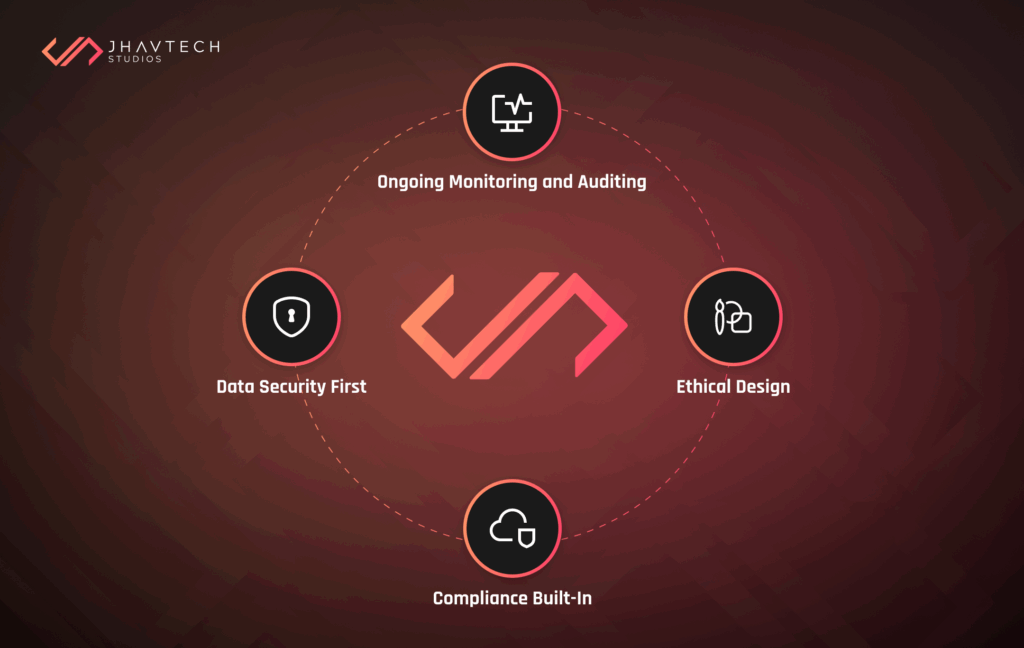
- Data Security First: We integrate end-to-end encryption, secure cloud storage, and multi-layer access control, specifically mitigating the risks of redundant ingestion and loss of control over sensitive enterprise knowledge.
- Ethical Design: We implement bias detection and model interpretability tools throughout the development lifecycle to ensure fairness and explainability, crucial for establishing consumer trust.
- Compliance Built-In: Our apps are engineered from the ground up to comply with global and local standards, including GDPR, ISO 27001, HIPAA (for our healthcare clients), and the stipulations of Australia’s Privacy Act.
- Ongoing Monitoring and Auditing: Post-launch, we monitor model performance and user interactions to ensure your AI behaves as intended, safely and reliably. This continuous oversight catches ‘architectural drift’ or new security vulnerabilities that emerge over time, extending the longevity of your investment through rigorous support and maintenance.
6. The Role of External Validation
Leading global organisations advocate for transparent and auditable AI models. Frameworks like the OECD Principles on Artificial Intelligence and the European Commission’s forthcoming AI Act provide crucial benchmarks for responsible development.
For businesses navigating this landscape, particularly smaller organisations that may struggle with resource-intensive practices like expert consultations and cybersecurity reviews, external validation becomes a streamlined necessity. By partnering with a firm like Jhavtech, you gain access to an established framework that embeds these governance standards into the development process, removing the compliance hurdle and ensuring your applications are future-proofed against evolving regulation.
7. Building AI Apps That Inspire Confidence
At the end of the day, users do not just want powerful apps; they want trustworthy experiences. The businesses that lead with ethics, accountability, and transparency will be the ones that thrive in the AI-powered decade ahead.
The current stage of technology requires a clear-eyed perspective: the most innovative AI products are those that leverage machine speed under the command of human intelligence. The most secure systems are those where every line of code generated by an AI is subjected to the rigorous scrutiny of an experienced developer.
This is the central lesson from the AI vs human developers conversation: The best result is always collaboration.
With Jhavtech Studios as your AI app development partner, you gain:
- Secure, compliant AI solutions engineered for the Australian market.
- Transparent model design that builds user trust.
- Ongoing monitoring and expert auditing to maintain security.
- Human-centric innovation that ensures your app meets nuanced business goals.
Conclusion: Safe AI Is Smart Business
AI safety is not a technical hurdle; it is your brand’s credibility shield. When users trust your app, engagement, retention, and referrals all rise.
The distinction between AI as a prototype tool and the human developer as the architect and security auditor is paramount. Only by embracing the nuanced role of the human expert can businesses successfully navigate the serious security vulnerabilities in AI generated code. The answer to the AI vs human developers debate is clear: use the former for speed, but rely on the latter for success, security, and long-term viability.
That is why Jhavtech Studios focuses on building AI apps that are intelligent, ethical, and safe—empowering your business to innovate responsibly.
Ready to build your AI-powered app safely? Contact Jhavtech Studios today for a consultation on your project.
Frequently Asked Questions:
1. What makes an AI app “safe”?
A safe AI app is one developed with essential human oversight to ensure data privacy, auditability, and ethical behavior, mitigating the significant risks posed by automated code generation.
2. Is AI app development suitable for startups?
Yes, AI is highly suitable for rapid prototyping, but startups must integrate human expertise to validate the code, ensuring it is secure and scalable for production deployment.
3. What is the biggest difference between AI code generation and human development?
The AI vs human developers debate boils down to accountability: AI provides speed, but only a human possesses the ethical judgment and long-term systems vision required to own mission-critical architecture.