.svg)
.svg)


Code is expensive, but guesses are even costlier. In the high-stakes world of technology, speed is often touted as the ultimate advantage. Founders are often told to “move fast and break things,” which leads many to rush straight into development. However, there is a massive difference between moving fast and moving in the right direction. For many entrepreneurs, the most expensive mistake they will ever make is hiring a developer before they have a tangible design. This is exactly why every startup needs a prototype before writing a single line of code.
A prototype is more than just a sketch; it is a functional, clickable blueprint of your vision. It bridges the gap between a vague idea and a technical reality. Without it, you aren’t building a product; you’re gambling with your capital.
The True Cost of “Code First, Think Later”
The statistics are sobering: nearly 70% of startup failures are attributed to a lack of market fit or poor user experience. When you skip the prototyping phase, you are essentially asking developers to build a house without an architectural plan.
The cost of app development for startups can skyrocket when developers have to backtrack to fix logical flaws that could have been identified in a design tool. It is estimated that fixing an error after the code is written costs 10 times more than fixing it during the design phase. This financial risk is a primary reason why every startup needs a prototype before writing a single line of code.
App Prototyping for Startups: The Ultimate Insurance Policy
When we discuss app prototyping for startups, we are talking about risk mitigation. A prototype allows you to “fail” safely and cheaply. By creating a visual representation of your app, you can test the flow, the logic, and the user interface (UI) before the first bracket of code is ever typed.
For the non-technical entrepreneur, this is a superpower. It allows you to lead the project with clarity. Instead of trying to explain a complex feature with words, you can simply show it. This clarity ensures that when you finally do hire a development team, they know exactly what to build, reducing “scope creep” and keeping your budget intact.
Mobile App Prototype vs MVP: What’s the Difference?
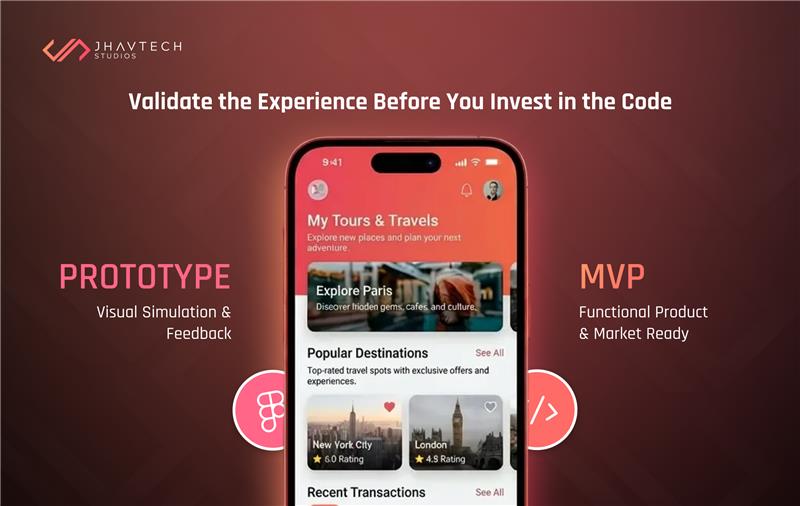
Many founders confuse a prototype with a Minimum Viable Product (MVP). While an MVP is a functional version of your product that you release to the market, a prototype is a simulation used for internal validation and investor pitching.
Understanding the mobile app prototype vs MVP distinction is crucial. An MVP requires a backend, a database, and actual coding. This means it requires significant investment. A prototype, however, is all about the frontend experience. It looks and feels like the real thing, but it’s built in a fraction of the time. This is why every startup needs a prototype before writing a single line of code: it allows you to simulate the MVP experience and gather feedback without the MVP price tag.
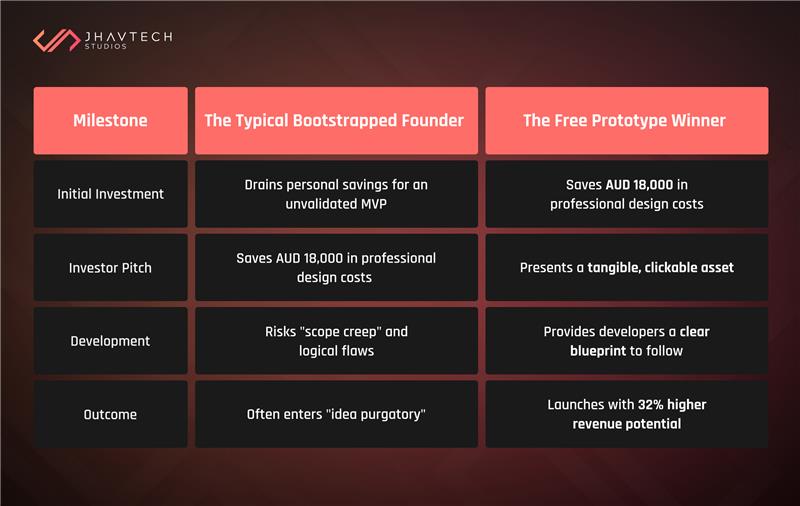
The Prototype Advantage: A Comparative View
How to Validate an App Idea Without Code
User feedback is the lifeblood of a successful startup. Traditionally, you would have to build the app to see if people like it. Today, you can validate app idea without code by putting a high-fidelity prototype in front of potential users.
This approach isn’t just a trend; global research has shown a direct correlation between design-led strategies and superior financial performance. In fact, studies on the business value of design indicate that companies prioritising user experience see 32% more revenue growth than their industry peers.
By observing how a user interacts with your clickable screens, you can identify “friction points.” Do they know where to click next? Does the value proposition make sense? If they get stuck on screen three, you can change the design in minutes. If you had already coded that feature, changing it could take days or weeks. This iterative process is why every startup needs a prototype before writing a single line of code.
The AUD 18,000 Difference in Your Pitch
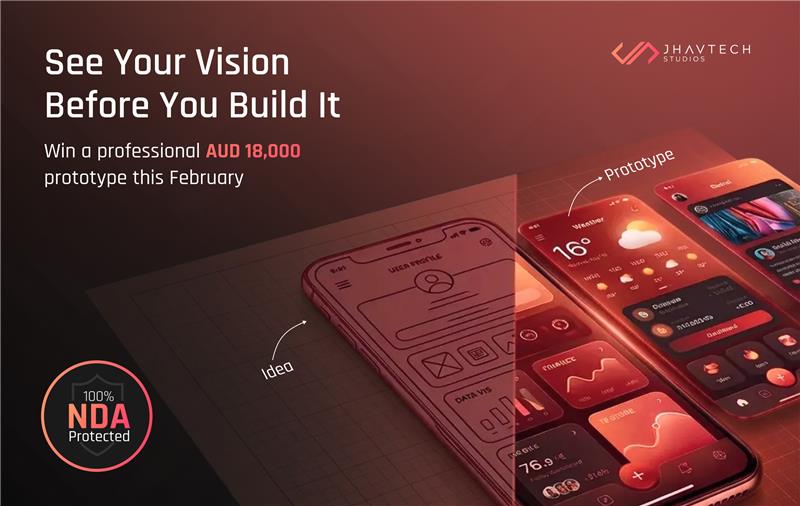
Investors see hundreds of decks a week, but they rarely see a fully realized, AUD 18,000 professional prototype from an early-stage founder. By entering this campaign, you are positioning yourself to walk into a pitch with an asset that usually requires a full seed round to produce. This is your chance to leapfrog the “idea” phase and present a “product”. Instead of asking an investor to imagine your vision, you are handing them a high-fidelity reality that showcases world-class UI/UX design to prove your concept’s viability. This level of preparation signals that you are a low-risk founder who respects capital and understands the business value of professional design. Ultimately, an AUD 18,000 prototype bridges the credibility gap, turning a skeptical “maybe” into a confident “let’s talk numbers”.
Winning the Room: Attracting Investors
If you are looking for external funding, a pitch deck is no longer enough. As aforementioned, investors see hundreds of decks a week. A high-fidelity prototype, however, stands out. It shows that you are serious, that you have thought through the user journey, and that you have a “tangible” asset.
A prototype transforms your pitch from “I have an idea” to “I have a product ready to be built.” It provides the visual proof needed to secure the capital required for full-scale development. This professional edge is another reason why every startup needs a prototype before writing a single line of code.
The Jhavtech Solution: Win a Free Prototype Worth AUD 18,000
At Jhavtech Studios, we’ve seen too many brilliant ideas stall because the barrier to entry (i.e. technical design) was too high. That is why this January, we are launching our most ambitious initiative yet: the “Free App Prototype Campaign.”
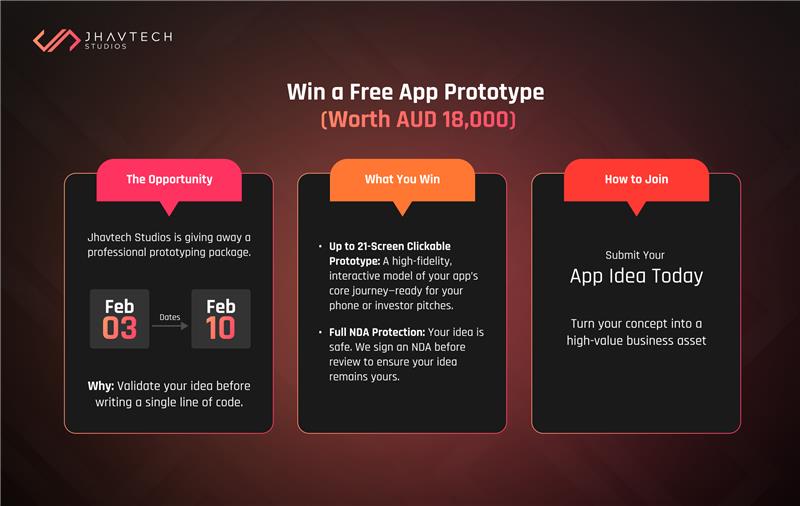
We want to show you firsthand why every startup needs a prototype before writing a single line of code. From January 5 to February 3, we are inviting founders to submit their app ideas for a chance to win a professional prototyping package.
What is included in the prize?
- Up to 21-Screen Clickable Prototype: We design the core journey of your entire app—up to 21 professionally crafted screens—delivered as a high-fidelity, clickable prototype you can open on your phone or pitch to investors.
- Full NDA Protection: Your intellectual property is safe with us. Jhavtech signs an NDA before we even review your submission, ensuring your idea remains 100% yours.
Why February is the Best Time to Start
The campaign runs until February 10. We chose this date because it represents a fresh start. As you plan your goals for 2026, there is no better way to kick off the year than by having a professional, investor-ready asset in your hands.
Whether you are a first-time founder or a seasoned entrepreneur, you need to understand why every startup needs a prototype before writing a single line of code. It is the difference between a project that launches and a project that lingers in “idea purgatory.”
Final Thoughts: Secure Your Vision
The transition from “idea” to “app” is the hardest leap a founder will take. Don’t make that leap into the dark. By prioritising design and validation, you protect your money, your time, and your dream.
Now that you know why every startup needs a prototype before writing a single line of code, it’s time to take action. This is a rare opportunity to receive a AUD 18,000 asset for free… an asset that could be the catalyst for your startup’s success.
Submit Your App Idea for the Free Prototype Campaign Here
Submissions close on February 3, 2026. The winner will be announced on February 10.