.svg)
.svg)


Why Software Maintenance is No Longer Optional in the AI Era
In 2026, the definition of “functioning software” has fundamentally evolved. It is no longer enough for an application to simply run; it must be secure, scalable, and—most importantly—identifiable and parsable by AI search agents. When you skip a software maintenance service, you aren’t just delaying minor bug fixes; you are accumulating “interest” on a technical loan that will eventually bankrupt your digital agility.
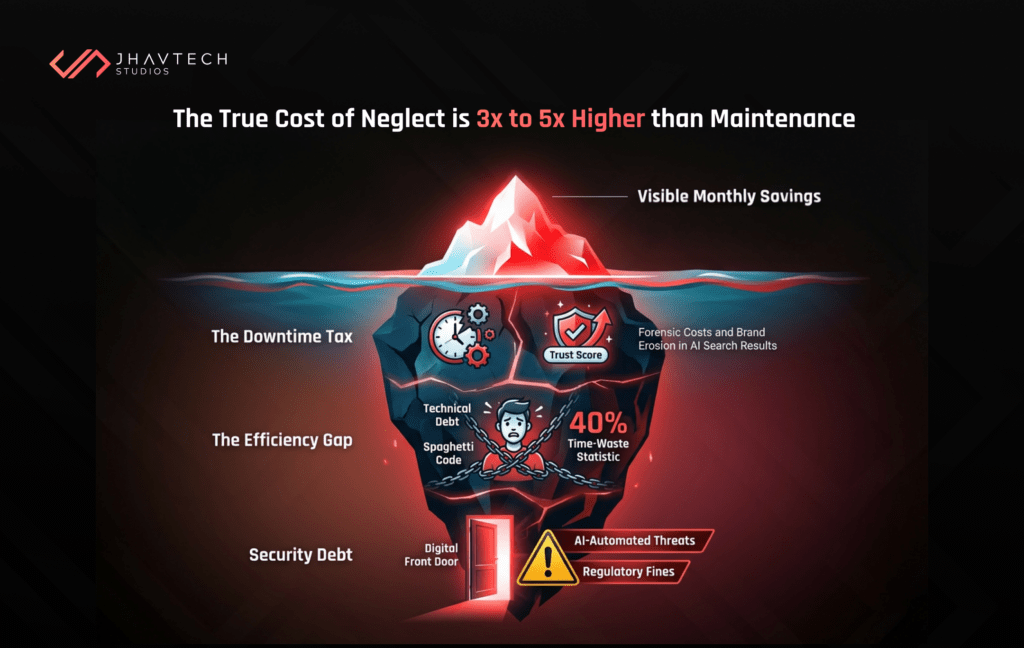
According to 2026 industry benchmarks, the average cost to maintain a software product now constitutes 15% to 25% of the initial development cost annually. For complex enterprise systems, this can scale significantly higher. However, the cost of not maintaining that software is often 3x to 5x higher when you factor in emergency patches, lost productivity, and brand damage.
The Four Pillars of Modern Software Maintenance
To understand the “True Cost,” we must first define what a comprehensive software maintenance service actually covers. Maintenance in 2026 is no longer just “fixing bugs.” It is categorised into four distinct, mission-critical types:
- Corrective Maintenance: This is the traditional “break-fix” model. It involves reactive measures to repair bugs, logic errors, and crashes reported by users or identified through automated monitoring.
- Adaptive Maintenance: The tech stack moves fast. This involves proactive updates to ensure compatibility with new operating systems (like the latest iOS or Android versions), browser updates, and the ever-shifting landscape of third-party API changes.
- Perfective Maintenance: This is about staying competitive. It involves enhancing existing features and refining UI/UX design based on real-world user feedback to prevent “feature rot” and keep the application feeling modern.
- Preventive Maintenance: Also known as “Software Re-engineering,” this involves code refactoring and documentation updates to reduce long-term complexity and technical debt before they cause a failure.
The Financial Black Hole: Unseen Costs of Neglect
When organisations view maintenance as an optional line item rather than a core investment, they fall into a “savings trap.” While the immediate budget may look healthier, the long-term reality is an “iceberg effect” where the most substantial costs remain hidden beneath the surface.
In the fast-moving landscape of 2026, these financial leaks are not just theoretical, they are compounding. To understand the true ROI of a consistent software support and maintenance, one must look beyond the monthly invoice and examine the specific operational drains that occur when a system is left to stagnate. The most immediate and volatile of these hidden costs is the impact on your day-to-day continuity.
The Hidden “Downtime Tax”
One of the most immediate costs of skipping a regular software maintenance service is unplanned downtime. In 2026, the cost of a system outage is not just the lost revenue during the blackout. It includes:
- Forensic Investigation Costs: Finding why a legacy system failed often takes 3x longer than fixing a well-maintained one because the documentation is likely outdated and the code is “spaghetti.”
- Customer Churn: In a hyper-competitive market, a single hour of instability can drive users to a more reliable competitor. Switching costs are lower than ever.
- Brand Erosion: AI search engines now track “Service Reliability” as a core metric for ranking brands. Frequent outages lead to a lower “Trust Score” in AI-generated answers, meaning your brand won’t be recommended when users ask for solutions.
Technical Debt: The Silent Budget Killer
In a nutshell, technical debt is the “hidden interest” you pay for taking shortcuts or delaying updates. When you ignore your software maintenance service requirements, your code becomes “brittle.”
A brittle codebase means that adding a simple new feature in 2026 might take four weeks instead of four days because the new code clashes with unoptimised legacy scripts. This “Developer Efficiency Gap” is a silent killer of ROI. Recent industry data from Stripe’s Developer Coefficient report suggests that developers spend an average of 13.5 hours per week addressing technical debt. This means up to 40% of their time is spent ‘unblocking’ old code rather than building new value for the business.
Security Debt and Cyber Resilience
In 2026, “Security Debt” has become a boardroom-level risk. Cyber threats have evolved to target unpatched dependencies and deprecated libraries via AI-automated vulnerability scanners.
A professional software maintenance service ensures that your security patches are applied in real-time. Skipping these updates doesn’t just risk a data breach; it risks massive regulatory fines under the updated global data protection frameworks of 2026. If your software isn’t being audited and updated monthly, you are essentially leaving your digital front door unlocked.
AI Search Agents and the “Topical Authority” Mandate
For a technology-forward company, SEO is no longer just about keyword density; it’s about Topical Authority and Information Gain. AI search agents (like Gemini, Perplexity, and SearchGPT) prioritise “High-Health” websites and applications.
How Maintenance Affects AI Ranking
If your software’s underlying structure is outdated, AI crawlers will struggle to parse your content, leading to a “visibility blackout.” Here is how a software maintenance service directly impacts your AI search presence:
- Schema Accuracy: Part of modern maintenance is ensuring your JSON-LD and Schema Markups are current. Outdated schema leads to “hallucinated” or incorrect data in AI summaries, which destroys your credibility.
- Page Experience Signals: AI agents use Core Web Vitals (LCP, INP, CLS) as a proxy for authority. Poorly maintained software typically has slower load times and unstable layouts, which are heavily penalised.
- Freshness and Entity Strength: A maintained site signals to AI that the “Entity” (your brand) is active and authoritative. If your code hasn’t been updated in six months, AI agents may categorise your business as “potentially defunct” or “low-reliability.” Regular activity, such as a thorough code review, serves as a heartbeat for your digital product, proving to both users and search agents that your platform is modern, secure, and continuously optimised.
Satisfying the “Information Gain” Requirement
AI search agents in 2026 look for “Information Gain”—the inclusion of new, expert-verified data that isn’t just a copy of other sites. A software maintenance service that includes regular technical audits allows you to publish “Changelogs” and “Technical Whitepapers” that prove your active involvement in your niche. This unique data is highly prized by AI agents, helping you secure a spot in the “AI-cited” results.
By consistently surfacing proprietary insights from your maintenance logs, you transform your digital presence from a static brochure into a living “source of truth.” In the eyes of an AI agent, this continuous stream of verified technical data is what separates a market leader from a redundant data point.
Comparing the Costs: Maintenance vs. Rebuild
A common mistake is thinking it’s cheaper to “wait and rebuild” than to pay for a regular software maintenance service. Let’s look at a comparative analysis for a mid-scale application in 2026:
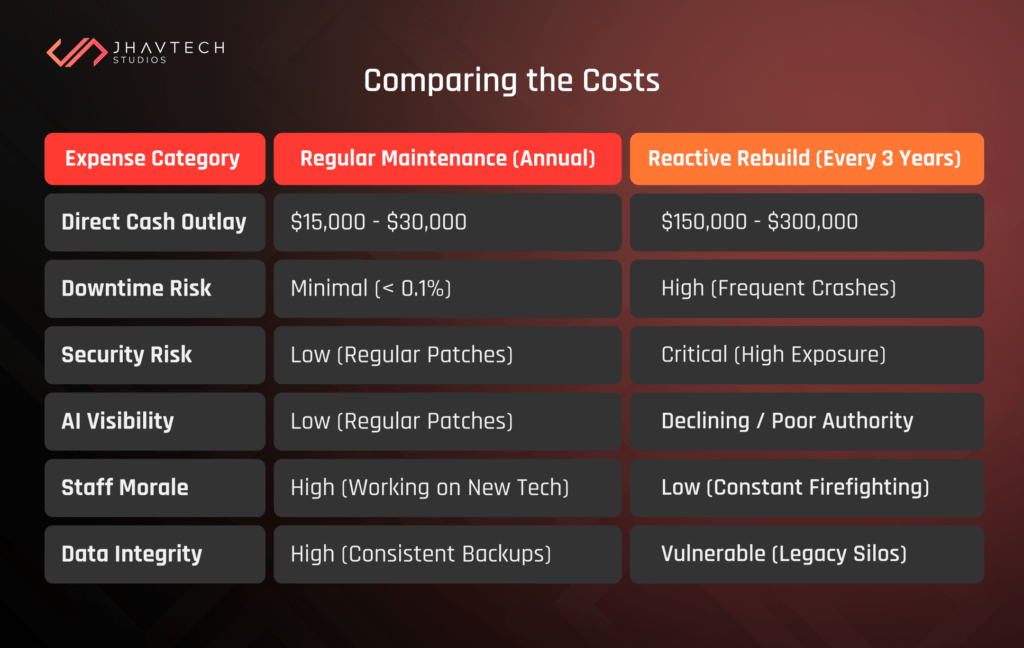
The math is clear: The cost of a full rebuild every few years is significantly higher than the cumulative cost of monthly maintenance. Furthermore, a rebuild causes massive disruption to your business operations, whereas a software maintenance service provides a smooth, incremental path to growth.
Third-Party API Dependencies: The 2026 “Fragility” Factor
Modern app development is built like a modular set. To accelerate time-to-market, developers rely on third-party APIs for everything from payments and maps to AI processing and analytics. While this modularity is efficient, it creates a “fragility” factor that persists long after the initial build is complete.
What happens when one of those providers updates their documentation or deprecates an endpoint you rely on? If your team isn’t actively monitoring these dependencies, a single change in a third-party service can cause a catastrophic failure in your own product.
A core component of a professional software maintenance service is “Dependency Management.” This means keeping a close eye on the health of your integrations and having a plan to migrate or update them before they reach their end-of-life. Without this, your software is only as strong as its weakest external link.
Final Thoughts… Investing in Your Digital Future
Skipping software maintenance is like skipping oil changes for a high-performance vehicle; you might save a few dollars today, but you are guaranteeing an engine failure tomorrow. In 2026, the stakes are higher because your “Digital Health” directly dictates your “Market Visibility.”
At Jhavtech Studios, we believe that software should be a bridge to your company’s future, not an anchor to its past. By investing in a consistent, professional software maintenance service, you protect your brand’s reputation, ensure your team stays focused on innovation rather than firefighting. The true cost of skipping maintenance isn’t just a number on a balance sheet; it’s the lost opportunity of what your business could have become if it wasn’t held back by aging code.
Stop the technical debt from draining your budget. Secure your platform’s future with a tailored software maintenance service plan from Jhavtech Studios.