.svg)
.svg)



Legacy software modernisation is no longer optional, it’s a survival strategy. This blog breaks down the real cost of clinging to outdated systems, the most common legacy app issues facing startups and SMEs, and what a smart software migration strategy actually looks like in 2026.
The Software That Built Your Business Might Now Be Breaking It
There’s a particular kind of frustration that builds slowly in growing businesses. It usually starts as a minor annoyance: a report that takes too long to generate, an integration that never quite works the way it should, a new hire who needs two weeks just to navigate the internal system. Then, one day, you look up and realise your competitors are moving faster, serving customers better, and shipping features you can’t match, not because they’re smarter, but because their tools let them move.
That’s the legacy software trap. And right now, it’s quietly draining resources from thousands of startups and SMEs across Australia and beyond.
Legacy software doesn’t announce its failures. It erodes momentum. It chips away at team productivity. It quietly inflates your IT spend while starving the innovation budget. And by the time most decision-makers see it clearly, the gap between where they are and where they need to be has grown considerably.
This article exists to make that gap visible before it becomes a crisis.
What Do We Actually Mean by “Legacy Software”?
It’s worth being precise here, because the word “legacy” gets misused. Legacy software isn’t simply old software. It’s software that has become a liability such as systems that are difficult or expensive to modify, poorly documented, no longer supported by their original vendors, or built on architectures that can’t integrate with modern tools and platforms.
For many businesses, legacy systems fall into one of three categories:
- Custom-built platforms developed years ago that no one fully understands anymore
- Off-the-shelf products that are end-of-life or have been abandoned by their developers
- Patchwork stacks or combinations of old and new tools, held together by manual workarounds and a general sense of dread
In each case, the problem isn’t just technical. It’s strategic. Legacy software limits what your business can do, how fast it can move, and how well it can respond to change.
The Numbers That Should Concern Every Business Owner
This isn’t anecdotal. The data on legacy software is striking, and it’s getting harder to ignore.
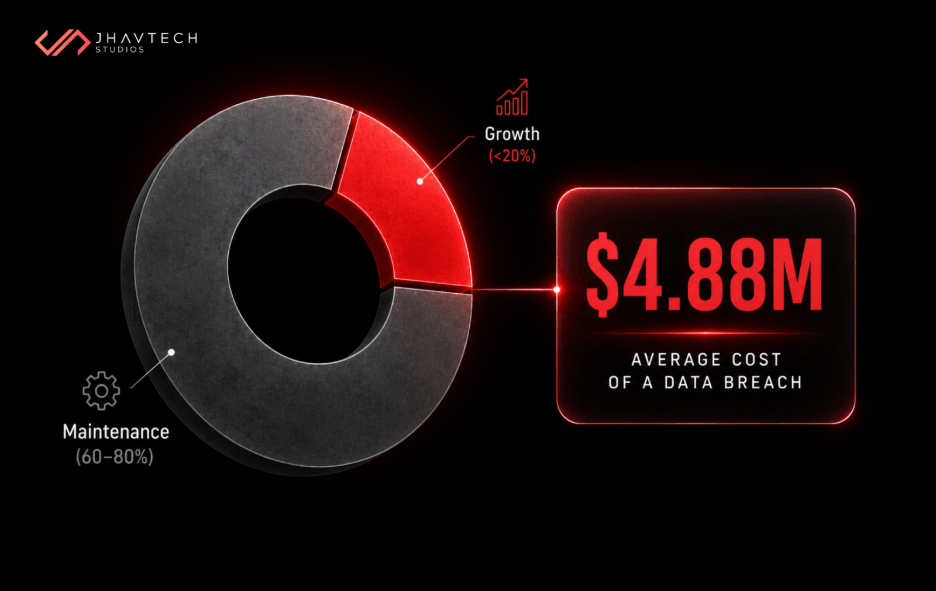
According to industry research tracking legacy modernisation costs, organisations typically spend 60–80% of their IT budget just maintaining legacy infrastructure. This means as little as 20 cents in every dollar actually goes toward growth, new features, or competitive innovation.
A 2025 survey of over 500 US IT professionals by Saritasa, as cited by Kissflow, found that 62% of organisations were still relying on legacy software systems, despite acknowledging known security and performance risks. Meanwhile, Gartner estimated enterprises were spending up to 70% of their IT budgets on simply “running the business” and leaving under 30% for anything forward-looking.
For SMEs, the risk profile is even steeper. IBM’s 2025 Cost of a Data Breach Report, as referenced by NinjaOne, put the average global breach cost at $4.88 million, and one of the most common entry points? Outdated systems with unpatched vulnerabilities. That’s not a technology problem. That’s a business risk.
Five Legacy App Issues That Actively Block Growth
1. Integration Failures That Multiply Over Time
Modern businesses run on interconnected tools including CRMs, payment platforms, analytics dashboards, and communication stacks. Legacy systems were rarely built with open APIs or modern integration standards. Every new tool you adopt requires a workaround, a manual export, or a custom connector that someone needs to maintain. Over time, this creates a brittle web of dependencies that breaks constantly and costs significantly to manage.
2. Security Vulnerabilities You Can’t Patch Away
Old software often means unsupported software. No vendor patches. No security updates. No compliance pathway. This is particularly dangerous in sectors like healthcare, finance, and e-commerce, where regulatory obligations are rising alongside the threat landscape. Legacy systems aren’t just insecure. In many jurisdictions, running them may expose your business to compliance penalties.
3. Talent Friction and Developer Debt
Developers don’t want to work on legacy systems. If you’re building a team or trying to attract strong engineering talent, an outdated codebase is a genuine recruiting liability. Beyond hiring, research suggests companies accrue $361,000 of technical debt for every 100,000 lines of legacy code. This pertains to debt that compounds year after year. Before you hire your next developer, it might be worth getting an independent technical health check on your existing codebase to understand exactly what you’re working with.
4. Poor User Experience That Costs You Customers
If your customers interact with software you built five or ten years ago, they feel the difference even if they don’t articulate it. Clunky interfaces, slow load times, mobile incompatibility, and limited self-service capabilities all create friction. In 2026, users expect the same quality of experience from a regional SME that they get from enterprise platforms. Legacy systems rarely deliver that.
5. Inability to Scale When Opportunity Arrives
Growth is rarely linear. A campaign goes viral, a new market opens up, a large client suddenly comes on board. Legacy systems fail at their worst at these moments when they are unable to scale, unable to adapt, unable to keep up. Worse, knowing this creates a kind of unconscious conservatism where founders avoid pursuing certain opportunities because they already know their systems can’t handle them. And it’s not just legacy platforms that create this problem. Even newer systems can buckle under pressure if they weren’t built with scale in mind. Our post on why scaling your app too early can destroy product performance is a useful companion read if this particular risk resonates with you.
How Legacy Systems Compare to Modernised Alternatives
Here’s a practical comparison across the dimensions that matter most to decision-makers:
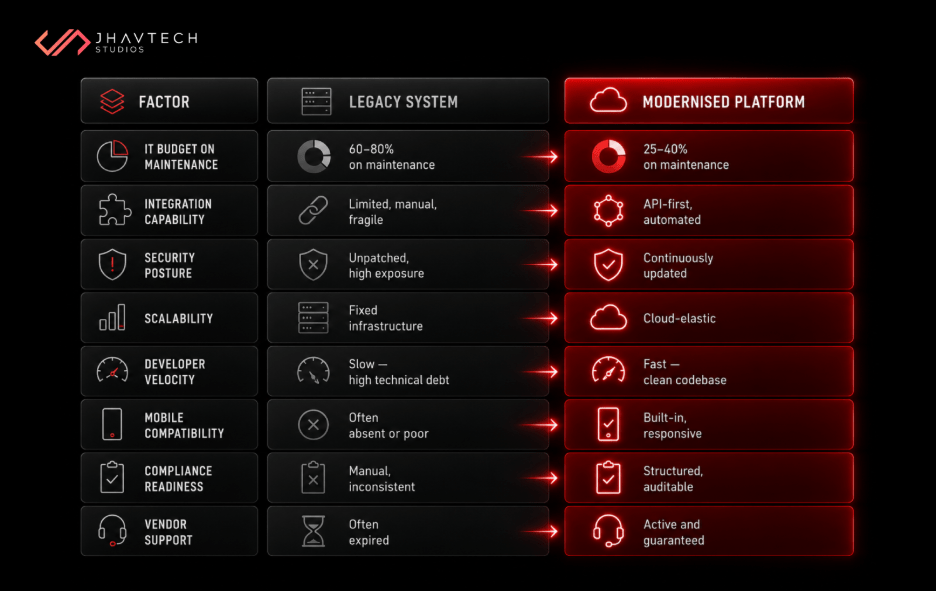
The contrast isn’t subtle. In almost every dimension that drives competitiveness, legacy systems lose, not because they were bad when they were built, but because the world moved on.
Is your legacy system the bottleneck?
Slow deployments, broken integrations, security gaps — outdated systems don’t fail loudly. They bleed quietly. Find out exactly where yours stands in 48 hours, at no cost and no commitment.
The Real Cost of Waiting: Why “If It Ain’t Broke” Is Dangerous Thinking
Here’s the argument business owners make most often for not addressing legacy app issues: “It still works.” And technically, that’s true. Your system processes transactions. Reports get generated. Invoices go out. Nobody’s panicking. But “working” is a very low bar.
The real cost of legacy software isn’t usually a catastrophic failure. It’s the slow bleed of opportunity cost. It’s the feature your team couldn’t ship this quarter. The automation that would have saved 20 hours a week but wasn’t possible on your current stack. The customer who tried your product, found it frustrating, and moved on quietly.
It’s also worth acknowledging that the longer a modernisation is delayed, the harder it becomes. Technical debt compounds. Developers who understood the original system retire or leave. Documentation gets lost. The codebase grows more tangled with every patch. A project that would take three months today may take nine months in two years, and cost significantly more.
According to legacy modernisation research published in April 2026, AI-assisted modernisation tools are now compressing project timelines dramatically, turning what was once an 18-month migration into a 5–7 month engagement. The window for cost-effective modernisation is open right now in a way it hasn’t been before.
What a Smart Software Migration Strategy Looks Like in 2026
A good software migration strategy in 2026 looks nothing like the big-bang replacement projects of the past. Nobody’s asking you to throw everything out and start from scratch over 18 months. Modern approaches are phased, risk-managed, and designed to keep your business running while the transformation happens underneath.
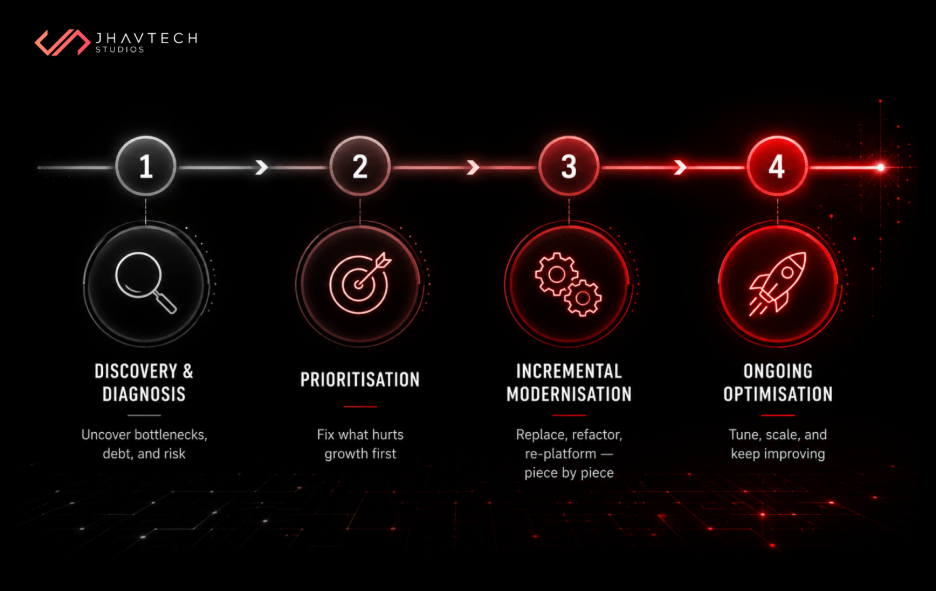
The typical lifecycle for a well-run legacy modernisation engagement looks something like this:
Phase 1 — Discovery and Diagnosis
This is where you establish the true state of your system. What are the actual bottlenecks? Where is the technical debt concentrated? A structured technical code review at this stage is invaluable; it surfaces the risks before they surface themselves.
Phase 2 — Prioritisation
Not everything needs to be modernised at once. The goal is to identify which components create the most risk or limit the most growth, and address those first. This is strategic triage that’s ruthlessly practical.
Phase 3 — Incremental Modernisation
Component by component, the legacy system is replaced, refactored, or re-platformed. Modern architecture patterns (i.e. microservices, cloud-native deployment, API-first design) create systems that are extensible and maintainable.
Phase 4 — Ongoing Optimisation
Modernisation isn’t a destination. Once the core migration is complete, the focus shifts to continuous improvement: performance tuning, feature velocity, and building the kind of cross-platform digital experiences that your customers actually expect in 2026.
This is also worth reading alongside our recent post on the hidden costs of skipping a code audit, which digs into the compounding impact of deferred technical decisions, as well as our piece on how to know if your software project needs a rescue team, which is directly relevant if your legacy system has already started to break down in production.
Is Your Software a Bottleneck? A Quick Self-Assessment
Run through this checklist. If you check more than three boxes, your legacy system is almost certainly costing you more than you realise.
Legacy Software Warning Signs Checklist:
□ Your development team spends more time fixing bugs than shipping features
□ New integrations with third-party tools require significant custom work
□ Your system hasn’t had a security audit in the last 12 months
□ Mobile functionality is limited, absent, or an afterthought
□ Onboarding new staff takes weeks because the system is unintuitive
□ You’ve had unplanned downtime in the past year
□ Your vendor no longer actively supports your core platform
□ You rely on manual exports or spreadsheets to bridge data between systems
□ Your developers have flagged the codebase as a risk or a barrier
□ You’ve delayed a product decision because you weren’t sure the system could handle it
If this list feels uncomfortably familiar, you’re not alone. Also worth reading: our analysis of the hidden cost of delayed software projects in 2026, which unpacks exactly what inaction costs over a 12-month window.
How Jhavtech Studios Approaches Legacy Modernisation
We’ve worked with startups and SMEs across Australia for over a decade, and the most common thread in our engagements isn’t a failed launch or a bad hire. It’s a system that outgrew its original design and was never given the attention it needed to evolve.
Our approach to legacy software modernisation is direct and practical. We start with an honest, independent assessment of your current platform after which we’ll tell you what’s working, what’s fragile, and what’s quietly costing you. We don’t recommend rebuilding what doesn’t need to be rebuilt. We don’t sell unnecessary complexity.
What we do is help you create a clear path from where you are to where you need to be, with minimal disruption to your operations and a realistic timeline you can plan around.
When legacy systems have already started failing as indicated by missed deadlines, mounting bugs, failed deployments, our rapid stabilisation and project recovery service is designed to stop the bleeding fast and restore confidence in the platform.
And if you need to extend your legacy platform into new channels, our team builds cross-platform applications designed from the ground up to integrate cleanly with both existing infrastructure and modern cloud services.
Your system should work for you, not against you.
If your team is spending more time fighting your software than building with it, something needs to change. Let’s show you exactly what that change looks like and what it will cost you to keep waiting.
Frequently Asked Questions
What is legacy software modernisation?
It’s the process of updating, rebuilding, or replacing outdated software systems so they align with current business needs, security standards, and technology capabilities without necessarily replacing everything from scratch.
How do I know if my software qualifies as “legacy”?
If your system is hard to modify, no longer vendor-supported, incompatible with modern tools, or actively slowing your team down, it is legacy, regardless of its age.
How long does a typical legacy modernisation project take?
With modern AI-assisted tooling, timelines have compressed significantly. Many mid-sized projects now complete in 5–7 months. A proper audit at the start gives you a realistic estimate specific to your system.
Do I have to replace everything, or can I modernise incrementally?
Incremental modernisation is almost always preferable. Phased approaches let you prioritise high-risk or high-impact components first, while keeping your business operational throughout.
What’s the first step if I think legacy software is impacting my business?
Start with an independent technical audit. Book a free code review with Jhavtech Studios to get a clear picture of where your system stands… quickly.