.svg)
.svg)


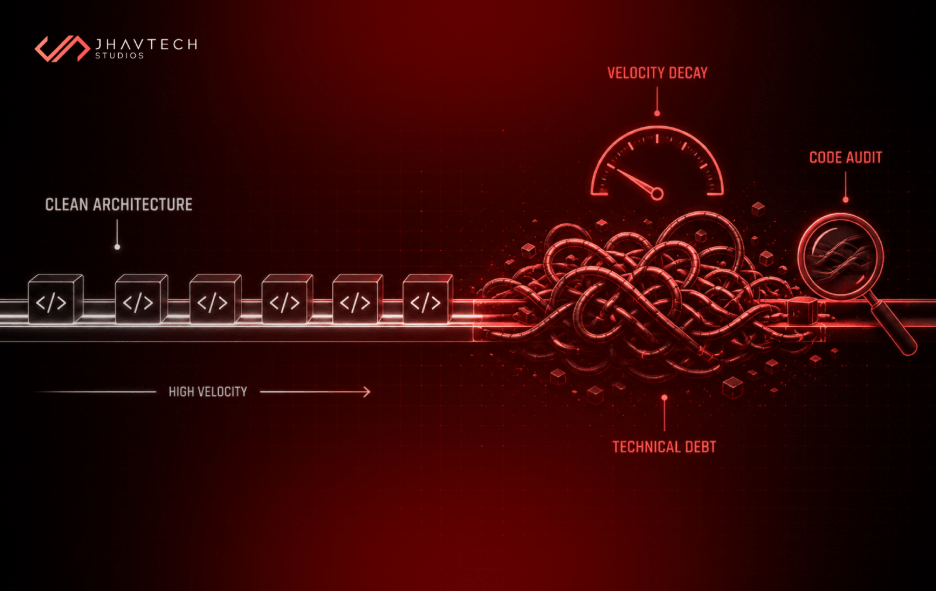
Every day your code goes unaudited is costing you money, even if you don’t see the charge on your invoice. For Australian startups and SMEs, skipping a code audit isn’t just a technical oversight. It’s a silent drain on productivity, team morale, and your bottom line. This guide unpacks five hidden costs that compound when technical debt goes unchecked, and why waiting for “the right time” to audit your codebase is actually the most expensive decision you can make.
The Silent Drain: Why Technical Debt Costs More Than You Think
Let’s start with the uncomfortable truth: you probably don’t know exactly how much your codebase is costing you. A lot of Australian businesses operate with vague awareness that their technical debt is a problem. They know deployments take longer. They know their dev team complains about legacy systems. They know new features take weeks instead of days. But they don’t know the price tag.
Here’s the thing: technical debt isn’t like a supplier invoice you can ignore. It compounds. And unlike financial debt, which you can refinance or restructure, technical debt gets harder to manage the longer you leave it untouched.
According to McKinsey’s research on tech debt, companies that actively manage their technical debt can free up engineers to spend up to 50% more of their time on work that supports business goals.
The challenge? Most businesses don’t connect these dots. They see slower releases and blame poor planning. They watch good engineers leave and blame lack of career growth. They struggle to attract new talent and blame market conditions. But the root often traces back to codebase quality that was never formally assessed.
That’s where a code audit comes in. But this isn’t about the audit itself; it’s about what happens when you skip it.
Hidden Cost #1: Velocity Collapse and Missed Market Windows
Let’s talk about your delivery timeline. When your codebase is poorly structured, every new feature becomes a detective mission. Developers spend hours tracing through sprawling functions, deciphering naming conventions, and understanding side effects of changes nobody documented. What should take one sprint takes three. For startups, market timing is everything. A feature that would’ve given you competitive advantage in Q2 becomes table-stakes by Q4 because it took you six months instead of six weeks to build.
According to Sourcery.ai’s 2022 technical debt research, teams with high technical debt spend nearly 50% more time on bug fixing and understanding existing code, resulting in nearly 40% less time for developing new features.
Let’s put numbers to this. If your team of 5 developers could deliver 20 features per year with a clean codebase, but technical debt cuts that to 12 features per year, you’ve lost 8 feature releases. At even $50K in ARR per feature for a typical B2B SaaS, that’s $400K in foregone revenue—annually.
The compounding part? As debt accumulates, velocity doesn’t just plateau; it declines further. You’re not losing features linearly; you’re losing them exponentially. When you understand what healthy development velocity should be, you’ll recognise exactly where your velocity is being lost. Read our comprehensive guide on app development best practices to see what the baseline should be.

Hidden Cost #2: The Talent Exodus (And the Replacement Tax)
This one cuts deeper than spreadsheets. Good engineers don’t want to fight legacy code. They want to build things. They want clarity. They want to feel like they’re making progress. When they’re instead spending 70% of their time maintaining terrible architecture, they leave.
And when they leave, you don’t just lose someone who knew the codebase inside-out. You lose someone who could’ve been your next technical leader. You lose momentum. You lose knowledge. And you spend 6-12 months recruiting and onboarding their replacement – who, by the way, will be equally frustrated by the same technical debt.
The Australian IT recruitment market is particularly tight. According to the 2024 Tech Talent Outlook Report (which surveyed 907 Australian tech professionals), skilled software engineers have more options than ever. The real cost here isn’t just the 40-50% salary replacement tax. It’s the 3-month ramp-up period where your new hire is less productive. It’s the loss of context that slows down decision-making. It’s the knowledge that walks out the door and never comes back.
For a team of 8 developers, losing two engineers per year to frustration with technical debt is costing you $150K-200K in direct recruitment and onboarding costs, plus another $300K+ in lost productivity. That’s half a million dollars in the cost of not auditing your code.
If your best engineers are already looking elsewhere, a code audit might be the most cost-effective investment you make this year. Book a 30-minute consultation to understand what’s driving your team’s frustration.”
Hidden Cost #3: Compounding Bugs and Quality Decay
Here’s where debt becomes exponential. A poorly structured codebase doesn’t just slow development… it breeds bugs. Systems that interweave concerns and lack clear boundaries have unexpected side effects. Changes to “unrelated” code break things elsewhere. Testing becomes a nightmare because you can’t isolate components.
These bugs don’t just affect users. They consume engineering time. Every bug is a context switch. Every context switch breaks flow state and focus. And because the codebase is tangled, even simple bugs take hours to diagnose.
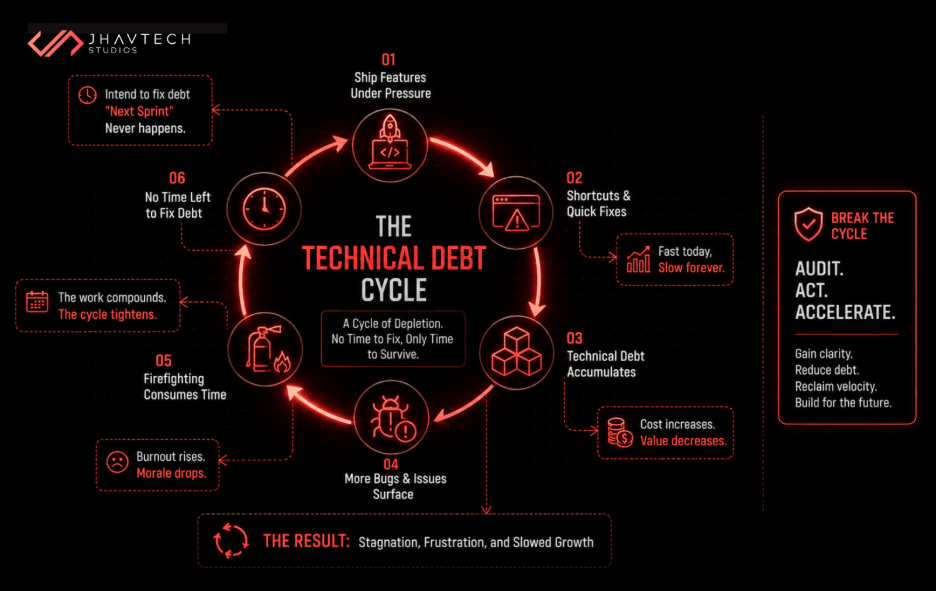
The worst part? Your technical debt creates a vicious cycle:
- Bugs increase as code quality degrades
- More bugs mean more firefighting
- Firefighting means less time for proper refactoring
- Less refactoring means debt accelerates
- Debt accelerates, so more bugs appear next
Stripe’s research found that developers in high-debt environments spend 60-70% of their time on bug fixes versus new development, compared to 15-20% in healthy codebases. For Australian SMEs running lean operations, this is brutal. If your team of 4 can normally deliver 50 features a quarter, but 3 of those quarters are spent chasing bugs from previous quarters, you’re essentially running at 25% capacity. That’s not just inefficiency—that’s a existential threat to growth.
This bug cycle isn’t just a productivity drain; it’s a warning sign. If this sounds familiar, read our guide on why mobile apps crash and how systematic rescue approaches fix it.
Hidden Cost #4: Slowing Security and Compliance
This is the cost nobody wants to talk about until it’s too late. Poorly audited code is a security vulnerability by definition. You don’t know what’s in your codebase. You don’t know if there are hardcoded credentials, SQL injection vulnerabilities, unpatched dependencies, or outdated libraries with known exploits.
For Australian businesses handling customer data, privacy compliance is non-negotiable. The Privacy Act and sector-specific regulations like the Notifiable Data Breaches scheme carry real penalties. A security incident traced to unaudited, negligent code isn’t just expensive—it’s reputation-ending.
And here’s the sneaky part: the longer you go without an audit, the more compliance risk you accumulate. When you finally need to demonstrate security posture to a potential customer, an enterprise client, or a compliance auditor, you’re not just fixing issues; you’re forensically reconstructing the history of your codebase. That’s expensive and time-consuming.
Even if you avoid a breach, the cost of bringing an unaudited codebase into compliance, particularly around dependency management, code coverage, and security testing, is substantial. We typically see organisations spending $30K-100K+ just on compliance remediation once they finally take security seriously.

Hidden Cost #5: Enterprise Customer Lock-Out
This one hits startups where it matters most: growth stage. Enterprise customers require code audits as part of due diligence. They ask for security certifications, code coverage metrics, architecture documentation, and third-party reviews.
If your codebase hasn’t been professionally audited, you can’t pass due diligence. And if you can’t pass due diligence, you’re locked out of a customer segment that could change your trajectory.
We’ve worked with Australian startups that lost $2M-5M in deal flow because they couldn’t demonstrate codebase quality to enterprise prospects. The painful part? A proactive code audit would’ve cost $15K-30K. The opportunity cost of waiting? Measured in millions.
This is why code audits matter at earlier stages. Not when you need to pass due diligence, but before you’re suddenly trying to close a $500K deal and your codebase review is blocking the contract.
Technical Debt Compounds Exponentially
Let’s zoom out for a moment.
Each of these costs doesn’t exist in isolation. They interact and amplify each other:
- Slower velocity means missed feature opportunities
- Missed opportunities mean lower revenue growth
- Lower growth means you can’t hire top talent
- Inability to hire top talent means the remaining team is stretched thin
- Stretched teams cut corners, adding more debt
- More debt means more bugs and longer timelines
- Longer timelines mean customers see competitors with better features
- Lost customers mean less runway and hiring freezes
This is the compounding effect of technical debt. It’s not linear; it’s exponential. And it snowballs faster than most businesses realise.
The Australian tech sector has particularly tight timelines. You’re competing globally but operating at 25% the funding levels of Silicon Valley startups. That makes velocity your most valuable asset. Technical debt is the enemy of velocity.
What a Code Audit Actually Reveals
So what happens when you finally audit your code? A professional code audit doesn’t just tell you there are problems. It quantifies them. It reveals:
- Architecture bottlenecks slowing development
- Security vulnerabilities and compliance gaps
- Testing coverage gaps and quality metrics
- Dependency risks and outdated libraries
- Refactoring priorities and estimated remediation effort
- Recommendations for team structure and process improvements
More importantly, it gives you a roadmap. Instead of vague awareness that something’s wrong, you have concrete visibility into what to fix, how long it’ll take, and what the ROI is for each fix.
Our approach to code audits specifically focuses on actionable findings rather than academic critique. We’ve worked with SMEs across Australia, and the most valuable audits are the ones that map directly to business outcomes.
Calculate Your Hidden Technical Debt Cost
Most Australian SMEs are burning $300K-800K annually in hidden technical debt costs they’ve never calculated. Get a free, confidential analysis of your codebase in 30 minutes.
No pitch. No obligation. Just honest visibility into what’s actually happening in your codebase.
The Case for Proactive Audits Over Reactive Fixes
Here’s a principle that applies in every domain: prevention is cheaper than cure.
An engineer friend of mine recently shared a story about her company. They’d been running with unaudited code for 4 years. When they finally ran an audit at the urging of a prospective enterprise customer, they discovered thousands of lines of dead code, 87 known security vulnerabilities, and architectural decisions that were actively blocking scalability.
The remediation project took 6 months and cost $200K. But here’s the kicker: if they’d done a proactive audit two years earlier, the same fixes would’ve taken 2 months and cost $30K. The delay didn’t save money, it cost them $170K extra, plus two years of missed opportunities.
That’s Australian business in a nutshell. We’re pragmatic. We don’t invest in things until they hurt. But in this case, delaying that investment makes the pain worse.
A proactive code audit is like a health check-up. You don’t wait until you have a heart attack to see a cardiologist. You go regularly to catch problems early.
Why Now Is The Right Time (And Why “Later” Never Comes)
If you’re reading this, I’m betting you’ve been thinking about auditing your code for a while.
Maybe you’ve had it on the product roadmap for six months. Maybe someone in your team flagged it in a retro two years ago. Maybe you know it’s important but it’s never quite been urgent enough to bump other priorities.
Here’s the thing about technical debt: it doesn’t get better on its own. And “later” has a sneaky way of never arriving. You’ll audit your code when you have time, but there’s never enough time because the technical debt is consuming all your time. The only way to break the cycle is to make it a priority now. Not next quarter. Not when funding comes in. Not when things calm down. Now.
For many Australian startups, the right time to audit is:
- When you’re planning significant new features (so you know what constraints you’re working with)
- When you’re bringing on new investors or applying for grants (so you can demonstrate responsible engineering)
- When you’re planning to hire new engineers (so you know if your codebase will attract or repel them)
- When you’re facing performance or scalability challenges (to understand if it’s architecture or infrastructure)
- When you’re genuinely uncertain about code quality (which, if you don’t have recent audit data, you should be)
The Path Forward
Technical debt is real. Its costs are real. And they’re compounding every single day. But here’s the good news: it’s fixable. And the longer you wait, the more expensive the fix becomes. The longer you act, the simpler and cheaper the remediation.
A code audit is the first step. It’s the diagnostic before the treatment. It tells you exactly what you’re dealing with and what recovery looks like. If your codebase has never been professionally audited, that’s your starting point. If it’s been more than 18 months since your last one, you’re flying blind.
For Australian SMEs competing in global markets with limited resources, visibility into technical debt isn’t optional, it’s a competitive advantage. Teams that understand their codebase quality can move faster, hire better talent, and land bigger customers. Teams that don’t are slowly handicapping themselves.
Start Your Code Audit Journey
Your codebase is either an asset or a liability. Right now, you probably don’t know which. We’ve audited codebases across Australian startups and SMEs. The process is simple: conversation about your challenges, then honest code feedback.
Completely confidential, zero obligation, and no pitch. Just a conversation about what’s really happening in your codebase and what your path forward looks like.
When Technical Debt Becomes a Crisis (And How to Recover)
Sometimes audits reveal that the situation is more serious than expected. Codebases so tangled that they’re genuinely at risk of becoming unmaintainable. Or worse, systems that are actively bleeding money through downtime, poor performance, and constant firefighting.
When that happens, you’re not just looking at an audit. You’re looking at a recovery project. If you’re in a situation where your codebase has become a competitive disadvantage, where your team is burning out, or where new feature development is practically impossible, there’s a structured approach to recovery.
Discover how other Australian teams have successfully recovered from critical technical situations and what the recovery process looks like.
Building the Right Engineering Culture Around Code Quality
Here’s something that doesn’t get discussed enough: technical debt is partly a code problem, but it’s mostly a culture problem.
Teams that maintain healthy codebases do so because they’ve built a culture where code quality is non-negotiable. Not in a dogmatic way, but in a pragmatic way. They understand that shortcuts today create penalties tomorrow.
That culture starts with visibility. With audits. With honest conversations about what the code actually looks like and what it costs to maintain. It continues with processes: code review standards, testing requirements, refactoring budgets, documentation practices. And it’s reinforced by hiring engineers who care about craft, not just shipping.
For Australian SMEs, this is critical. You’re competing against Silicon Valley companies with 10x your budget. You’re not going to win on infrastructure or scale. You’ll win on speed, focus, and engineering excellence. And engineering excellence requires a codebase you can actually move fast in.
Whether you’re building web platforms, scaling backend systems, or developing modern applications that demand clean architecture, the foundation is always solid engineering practices.
Frequently Asked Questions
How much does a code audit actually cost?
Pricing depends on your codebase size and complexity. We offer a free confidential assessment to understand your code and provide an accurate, customised quote tailored to your situation.
How often should we audit our code?
Annually for active development is our standard recommendation. The right frequency depends on your team size and development velocity. If you’re facing performance issues or planning enterprise deals, that’s a good trigger for an audit regardless of schedule.
What if the audit reveals really bad news about our codebase?
Bad news is valuable. We’ve rescued 30+ projects from critical code issues, and most clients saw velocity improvements within 3-6 months of focused remediation. The key is knowing what you’re dealing with so you can act.
Can we do a code audit internally with our own team?
Your team has valuable context, but external audits bring objective perspective from experience across hundreds of codebases. The best approach combines both: we conduct the external audit, then work with your team to implement fixes.
What’s your process for getting a project back on track?
Our six-step approach: (1) Evaluate the project, (2) Create a detailed roadmap, (3) Execute methodically, (4) Provide weekly updates, (5) Rigorous quality testing, (6) Ongoing support. Average time to get back on track: 3.5 weeks. We’ve fixed 250+ bugs across 30+ rescued projects.