.svg)
.svg)


If you’re diving into iOS app development, one of the biggest decisions you’ll face is choosing the right programming language. For years, Objective-C was the go-to language for Apple platforms. But with the introduction of Swift in 2014, the landscape started to shift dramatically.
Now, developers around the world find themselves asking: Swift vs. Objective-C—which should I choose?
This blog breaks it down for you. Whether you’re building a brand-new app or maintaining a legacy one, we’ll help you make an informed, future-ready decision by comparing performance, safety, usability, and long-term viability.
What Is Objective-C?
Objective-C is a general-purpose, object-oriented programming language that dates back to the early 1980s. It was Apple’s core language for iOS and macOS for decades. Built as a superset of C, Objective-C introduced powerful features like dynamic typing and message passing. While it’s no longer the default for new apps, it’s still widely used in legacy codebases and older enterprise systems.
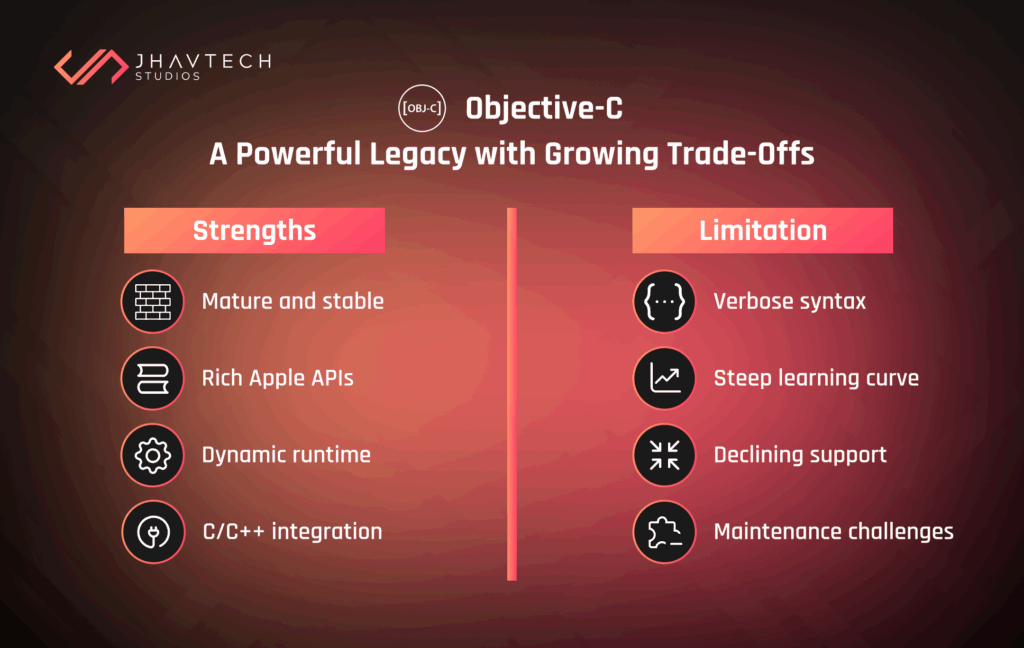
Objective-C Strengths:
✅ Mature, battle-tested, and stable
With over 30 years of use, Objective-C has proven itself in high-scale, commercial-grade environments.
✅ Access to a rich ecosystem of Apple libraries
Objective-C developers benefit from full access to Apple’s older Cocoa and Cocoa Touch APIs, many of which still haven’t been modernised in Swift.
✅ Dynamic runtime with message-passing capabilities
Its dynamic nature allows developers to modify program behavior at runtime—something Swift handles more rigidly.
✅ Seamless integration with C and C++ codebases
If your app relies on performance-intensive C libraries or existing C++ modules, Objective-C can work with them directly.
Objective-C Limitations:
❌ Verbose and syntactically complex
App developers often joke that writing Objective-C feels like writing a novel. For example, calling a method can involve nested brackets and long-winded declarations.
❌ Steep learning curve for new developers
Compared to modern languages like Swift or Kotlin, Objective-C’s syntax and manual memory management feel outdated and unintuitive.
❌ Declining community support and future updates
Apple has shifted nearly all focus to Swift. Objective-C still works—but don’t expect new features or frameworks designed with it in mind.
❌ Harder to maintain and scale over time
The verbosity and dynamic nature that once made Objective-C powerful can make long-term maintenance more challenging, especially in large codebases.
If your app has been around for a while and is written in Objective-C, you’re not alone. Many enterprises still rely on it. In fact, we regularly assist companies through our Free Code Review Service to assess whether sticking with Objective-C is still the smartest option.
What Is Swift?
Introduced by Apple in 2014, Swift is a powerful, open-source programming language built for iOS, macOS, watchOS, and tvOS development. It was designed to be faster, safer, and more intuitive than Objective-C—offering a modern alternative without sacrificing performance or flexibility.
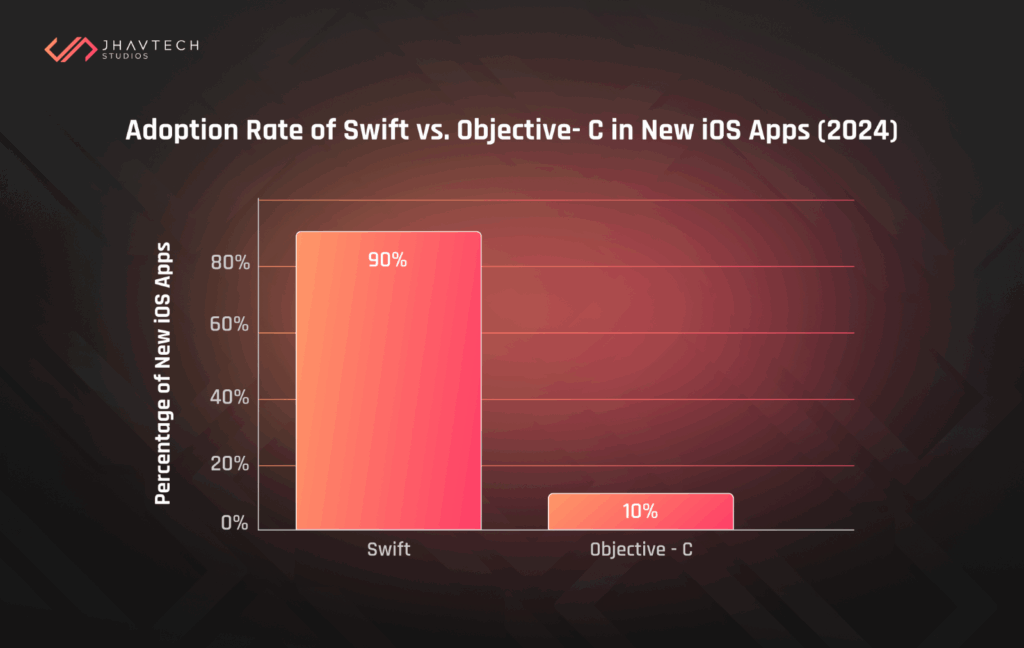
Today, Swift is the default choice for most new Apple platform apps. Backed by Apple and a thriving open-source community, it powers over 90% of new iOS apps (JetBrains, 2024) and is consistently ranked among the most-loved programming languages by developers worldwide. At Jhavtech Studios, we use Swift to build everything from quick-turnaround MVPs to complex enterprise-grade solutions.
Swift Advantages:
✅ High performance, thanks to LLVM optimisation
Swift compiles to native code using the LLVM (Low-Level Virtual Machine) compiler infrastructure. This means it generates highly optimised machine code that runs faster and more efficiently than Objective-C, especially in compute-heavy applications like gaming or real-time data processing.
✅ Cleaner, modern syntax that’s easier to read and write
Swift drops the nested brackets and verbose declarations of Objective-C in favor of a simpler, more intuitive syntax. This makes code easier to write, review, and maintain—especially in teams with mixed levels of experience.
✅ Built-in safety features to catch errors early
Swift includes modern safety features like optionals, type inference, and automatic memory management via ARC (Automatic Reference Counting). These tools help eliminate entire classes of bugs—such as null pointer exceptions and memory leaks—at compile time rather than runtime.
✅ Backed by Apple and a growing developer community
Apple actively maintains Swift, pushing out updates with every major iOS release. Plus, the open-source nature of Swift means developers around the world can contribute to its evolution. Swift now has over 100K stars on GitHub and a vibrant ecosystem of third-party libraries, tools, and learning resources.
✅ Interoperable with Objective-C
You don’t have to rewrite your entire codebase to use Swift. Thanks to Apple’s seamless interoperability, Swift and Objective-C can coexist within the same project. You can incrementally migrate features or modules over time, reducing risk and effort.
Swift is now the default for most modern iOS and macOS apps, and it’s the foundation of our iOS Application Development Services—from simple MVPs to complex enterprise apps.
Side-by-Side Comparison: Swift vs. Objective-C
To make things clearer, here’s a direct comparison of the two languages based on critical factors:
| Feature | Swift | Objective-C |
| Syntax | Concise, beginner-friendly | Verbose, outdated |
| Performance | Fast, optimised with LLVM | Moderate |
| Learning Curve | Gentle, modern paradigms | Steep, complex structures |
| Error Handling | Strong and built-in | Prone to runtime issues |
| Community | Rapidly growing | Shrinking |
| Apple Support | Full, with continuous updates | Limited, mostly maintenance only |
Visual Comparison: Developer Sentiment in 2024
According to the 2024 Stack Overflow Developer Survey, here’s how developers feel about Swift vs. Objective-C:
The graph shows the percentage of developers who “love,” “dread,” or “want to learn” each language. These numbers say a lot. Swift isn’t just a trend—it’s a preference. In fact, over 65% of developers say they “love” working with Swift, while Objective-C ranks among the top 10 most dreaded languages, with only a small fraction expressing interest in learning it. This growing divide reflects not just developer sentiment, but also hiring trends and long-term project planning. Choosing Swift means aligning your app with where the iOS ecosystem—and developer talent—is heading.
When to Use Swift:
Wondering if Swift is the right choice for your next app? Here are situations where Swift shines:
- Starting from scratch and want clean, efficient code
- Launching an MVP quickly with fewer bugs
- Building UI-heavy or animation-rich apps
- Focusing on long-term scalability and maintainability
If you’re aiming for high performance and a smooth user experience (UX), Swift is your best bet. Its concise syntax and built-in safety features reduce development time and lower the risk of runtime crashes. Plus, Apple continually releases new APIs that are Swift-first or Swift-exclusive, giving you early access to cutting-edge capabilities.
When to Use Objective-C
There are still valid reasons to stick with Objective-C—at least for now:
- Your app is built entirely on an existing Objective-C codebase
- You rely on older C libraries or legacy Apple frameworks
- Your development team has years of experience with Objective-C
- There’s no immediate business value in rewriting the app
Objective-C remains a reliable choice for maintaining large, stable applications that don’t require frequent updates. It also provides more granular control in certain low-level scenarios where performance tuning is critical. In many cases, a hybrid approach—gradually integrating Swift into an Objective-C project—can be the smartest move.
Is Swift the Future of iOS Development?
Yes—without a doubt.
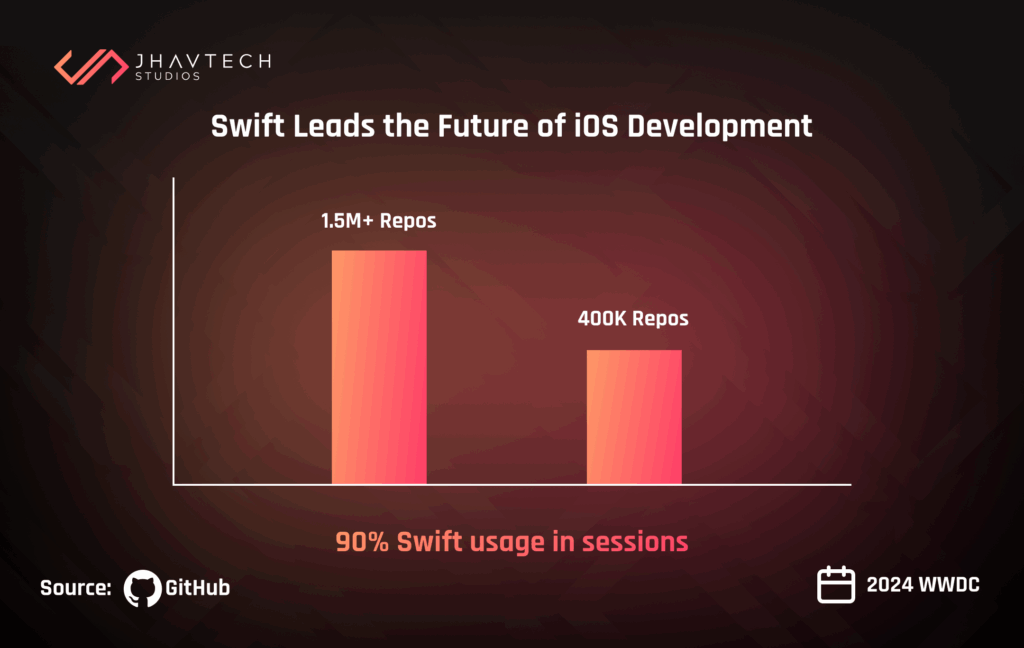
Apple continues to invest heavily in Swift, positioning it as the cornerstone of modern app development across iOS, macOS, watchOS, and tvOS. New frameworks like SwiftUI, Combine, and RealityKit are built specifically for Swift, offering capabilities that Objective-C simply can’t match. At the 2024 Apple Developer Conference, over 90% of code examples and sessions featured Swift exclusively, reinforcing its central role in Apple’s development roadmap.
The open-source community is also driving Swift’s momentum. According to GitHub’s 2025 State of the Octoverse, there are now 1.5+ million Swift repositories, compared to fewer than 400,000 for Objective-C—a nearly 4x gap that continues to widen. Meanwhile, Swift consistently ranks among the top 10 most-loved programming languages.
In short, Apple is future-proofing Swift, and so should you. Adopting Swift today not only gives your app a performance and developer productivity boost, but also ensures long-term compatibility with Apple’s evolving ecosystem.
Ask Engine–Optimised FAQs
Is Swift better than Objective-C?
For most new apps, yes. Swift is faster, safer, and more developer-friendly. Unless you’re working with a large legacy system, Swift is the smarter choice.
Can Swift and Objective-C work together?
Absolutely. Apple provides robust support for interoperability between the two. You can gradually transition your Objective-C codebase to Swift.
Is Objective-C still supported by Apple?
Yes, but just for legacy purposes. Don’t expect major new features or updates.
Should I rewrite my Objective-C app in Swift?
It depends. Rewriting can be costly. Often, a phased or hybrid migration is more cost-effective. We can help you evaluate that through a Free Code Review.
What’s the learning curve for Swift?
Swift is widely considered beginner-friendly. Most developers pick it up in weeks, thanks to its intuitive syntax and helpful tooling like Xcode’s auto-complete.
Conclusion: Which One Should You Choose?
If you’re starting a new project, the answer is clear: choose Swift. It’s modern, fast, secure, and backed by Apple’s long-term vision. Still on Objective-C? That’s okay—but start thinking ahead. Whether it’s refactoring, hybrid integration, or full migration, having a plan can future-proof your app.
Waiting too long to modernise can lead to higher technical debt, difficulty hiring developers, and missed opportunities to leverage the latest iOS capabilities. Proactively evolving your tech stack ensures your app remains scalable, maintainable, and competitive in a fast-moving market.
At Jhavtech Studios, we’ve helped startups and enterprises navigate the Swift vs. Objective-C debate with clarity and confidence. Contact us today for expert advice tailored to your app’s lifecycle.