.svg)
.svg)


In today’s digital-first economy, one question keeps surfacing for startups and enterprises alike: “Is mobile app development still worth the investment in 2025?”
It is a fair question. The cost of building and maintaining an app has risen, competition is fiercer than ever, and emerging technologies like AI and AR are reshaping user expectations. Yet, the data shows that well-planned, user-centric apps consistently deliver some of the highest returns in the digital world. The catch is knowing how to manage costs, pick the right monetisation strategy, and calculate ROI effectively.
In this article, we’ll break down the real ROI of mobile app development in 2025, explore development cost benchmarks, share examples of companies already seeing big returns, and discuss practical steps to maximize your investment. We’ll also answer tough questions such as “Is it worth it to build a mobile app in 2025?” and how to evaluate mobile app development cost vs return 2025.
Mobile App Industry in 2025: A Booming Market
Before diving into ROI, it helps to understand the big picture. The mobile app industry is not slowing down. In fact, it has become one of the fastest-growing sectors in the global digital economy, shaping how people shop, communicate, work, and entertain themselves. For businesses, this growth represents not just an opportunity but also a necessity—staying competitive increasingly depends on having a strong mobile presence.
- Global mobile app revenue is projected to reach $935 billion by 2025 (Statista).
- 90% of mobile time is spent on apps compared to browsers.
- The average person uses 10 apps daily and 30 monthly (Data.ai, 2025).
- In-app spending is growing at 12% annually, fueled by subscriptions, microtransactions, and ads.
For businesses, this is not just about keeping up with a trend. Mobile apps are proven engines for revenue growth, customer engagement, and brand loyalty. At Jhavtech Studios, we’ve seen clients, from retailers to healthcare providers, use apps to expand their reach, retain customers, and scale efficiently.
Understanding the ROI of Mobile App Development
ROI (Return on Investment) is a straightforward calculation
ROI = (Net Gain from App − Cost of Development) Cost of Development × 100
For example, if you spend $100,000 on an app and it generates $300,000 in revenue, the ROI is 200%.
But when it comes to apps, ROI goes beyond pure revenue. Businesses also gain:
- Customer retention and engagement through features like push notifications.
- Brand visibility that keeps you top of mind in a crowded market.
- Operational efficiency by automating workflows and reducing costs.
- Actionable insights from user behavior data that guide smarter decisions.
This is where the calculating mobile app ROI formula becomes important. You need to consider both financial returns and strategic gains.

The Cost of Mobile App Development in 2025
So, how much should you budget for an app this year? The short answer is: it depends. Complexity, features, and the development approach all play a role.
Average estimates in 2025
- Simple app: $25,000 – $50,000
- Medium complexity app: $50,000 – $120,000
- Enterprise-grade app: $120,000 – $300,000+
Factors that influence cost include
- Development approach (native iOS/Android vs cross-platform frameworks like Flutter).
- The quality of UI/UX design.
- Backend infrastructure, hosting, and integrations.
- Third-party services such as AI chatbots, payment gateways, and location tracking.
- Ongoing maintenance, which typically adds 15–20% of initial development cost annually (GoodFirms, 2025).
When looking at mobile app development cost vs return 2025, keep in mind that while upfront costs may feel high, the long-term ROI can far exceed the investment if done strategically.
Check our detailed Mobile Application Development Service to understand how costs can be optimised without sacrificing quality.
Benefits of Mobile App Development: Why ROI Is High
Despite the price tag, mobile apps consistently deliver value across multiple areas. They not only drive revenue but also enhance customer experiences and give businesses a competitive edge that websites alone cannot match.
1. Revenue Growth
Monetisation remains a major driver of ROI. Businesses use:
- Subscriptions (Netflix, Calm, Spotify).
- In-app purchases (mobile games, fitness programs).
- Ads and partnerships (freemium news or entertainment apps).
2. Customer Loyalty & Retention
Features like personalised offers, gamification, and push notifications help users return. Research shows apps improve customer retention rates by up to 25% compared to mobile websites (BuildFire, 2025).
3. Competitive Advantage
An app helps you stand out in industries where competitors still rely mainly on websites. By offering faster access, personalised experiences, and unique features, a mobile app can become a differentiator that attracts new customers and keeps existing ones engaged.
4. Operational Efficiency
Apps reduce manual errors, speed up workflows, and integrate with enterprise systems. For example, logistics companies use apps to streamline deliveries, cutting operational costs by up to 30%.
5. Actionable Data Insights
Every tap and scroll provides analytics that can improve services, personalise experiences, and identify upsell opportunities. When leveraged effectively, this data transforms into a strategic asset, guiding smarter business decisions and fueling long-term growth.
Real-World ROI Examples
Fitness Industry – Subscription Revenue
A fitness app offering AI-driven personalised workouts achieved 300% ROI within 18 months, largely through recurring subscription revenue.
Healthcare – Operational Savings
A telemedicine platform reduced in-person visits by 40%, translating to significant savings for hospitals and faster care for patients. ROI for this healthcare app was achieved in under a year.
E-commerce – Sales Boost
Retail brands report 60% more sales through mobile apps than mobile websites, thanks to frictionless checkout and targeted notifications.
These examples prove that the ROI of mobile app development in 2025 is not just theoretical—it is happening across industries right now.
How to Maximise ROI from Your App in 2025
Building an app is only step one. Here are strategies to maximize returns:
1. Select the Right Tech Stack
Choose frameworks like Flutter, Swift, or Kotlin that offer scalability and long-term support.
2. Design with Users in Mind
A clean, intuitive UI/UX can reduce churn and increase retention by 50%.
3. Integrate Analytics from the Start
Tools like Firebase or Mixpanel help track engagement, conversions, and churn.
4. Adopt Monetisation Early
Plan your revenue model before launch (e.g. ads, freemium, or subscriptions).
5. Continuous Updates & Maintenance
Apps that are regularly updated see 62% higher retention rates compared to stagnant apps (Business of Apps, 2025).
6. Code Reviews and Testing
Regular code reviews ensure fewer bugs and smoother scaling. Combined with rigorous testing, they safeguard app performance, security, and user satisfaction, which directly impacts ROI.
ROI Benchmarks: What Businesses Can Expect
These benchmarks give a realistic picture of how long it typically takes different types of apps to generate returns. While timelines vary by industry and strategy, the table below highlights the average ROI businesses can expect from mobile app development in 2025.
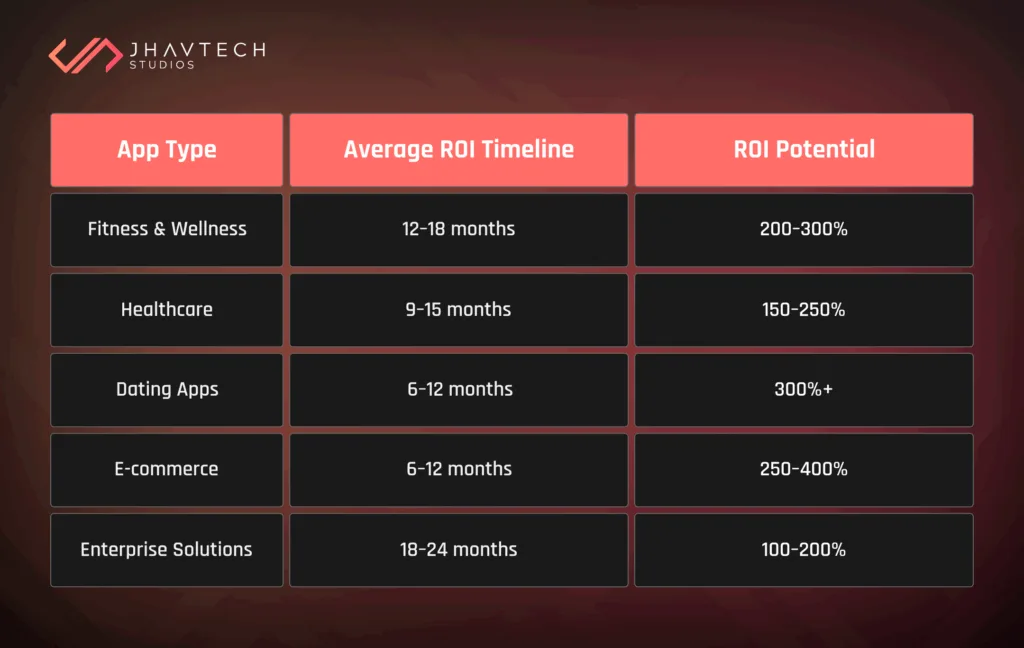
These benchmarks highlight the importance of timing and industry focus.
App Monetisation Strategies That Work in 2025
Understanding app monetisation strategies is essential to achieving strong ROI. With user spending on mobile apps projected to keep climbing, choosing the right model can make the difference between steady revenue growth and a struggling app. Here are the leading approaches this year:
- Subscription-first models: Recurring revenue ensures predictable cash flow.
- Freemium with in-app purchases: Widely used in gaming and learning apps.
- Advertising and partnerships: Profitable when apps have high daily active users.
- Transaction-based models: Common in fintech and e-commerce apps.
The best results come from hybrid models—combining multiple strategies to diversify revenue streams.
Mobile App Trends 2025: Shaping ROI
ROI also depends on how well you adapt to new trends. Businesses that stay ahead of these shifts can capture market share faster, deliver more engaging experiences, and future-proof their investments. Key mobile app trends 2025 include:
- AI-powered personalisation: Apps now deliver customised experiences in real time.
- Voice-enabled interfaces: Expected to be integrated into 60% of apps by 2026.
- AR/VR experiences: Used in retail, education, and healthcare for deeper engagement.
- Sustainability-focused apps: Growing demand for eco-friendly tracking apps.
Keeping pace with these trends ensures your app stays competitive and relevant.
Is It Worth It to Build a Mobile App in 2025?
The short answer: yes, if you do it strategically.
Apps remain one of the most effective digital investments for both small businesses and global enterprises. With billions in revenue potential and rising mobile adoption, the opportunities are too significant to ignore. When you factor in the ability to build brand loyalty, streamline operations, and gather valuable data, the question is not whether it’s worth building an app—it’s whether you can afford not to.
Final Thoughts...
In 2025, mobile app development continues to deliver strong ROI across industries. While development costs can be substantial, the long-term financial and strategic returns make it a smart investment. The key lies in managing costs effectively, selecting the right monetisation strategies, and keeping up with mobile app trends 2025.
Whether you’re a startup wondering “Is it worth it to build a mobile app in 2025?” or an enterprise calculating mobile app development cost vs return 2025, the answer is clear: apps remain a cornerstone of digital growth.
At Jhavtech Studios, we help businesses maximize ROI through scalable, high-performance apps tailored to specific goals.
Ready to explore your app idea’s ROI potential? Get in touch with our team for a free consultation today.
Frequently Asked Questions:
1. What is the average ROI of a mobile app in 2025?
Depending on the industry, ROI ranges between 150% and 400% within 12–24 months.
2. How long does it take for an app to be profitable?
Most apps become profitable within 6–18 months, depending on user adoption and monetisation strategy.
3. Do small businesses benefit from mobile apps?
Yes. Apps help small businesses boost customer engagement, repeat purchases, and loyalty.
4. Is a mobile website enough in 2025?
Websites are necessary, but apps offer higher engagement, personalisation, and monetisation potential.
5. How can I reduce app development costs without compromising quality?
Use cross-platform frameworks like Flutter and partner with experienced teams like Jhavtech Studios.