.svg)
.svg)


We have all heard the horror stories. A startup founder has a billion-dollar idea, hires a cut-rate team to build it, and twelve months later, they are left with a buggy, unusable product and an empty bank account. It is a common misconception in the tech world that “cheap” equals “savings.” In reality, cutting the wrong corners usually leads to higher long-term expenses.
At Jhavtech Studios, we believe that budget constraints shouldn’t be the death of innovation. Reducing costs isn’t about paying developers less; it’s about working smarter, eliminating waste, and making strategic decisions early in the process. Whether you are a small business in Melbourne or a global enterprise, here is how you can build a premium product without the premium price tag in 2026.
1. Start with a Laser-Focused MVP
One of the most effective ways to drain a budget is feature creep or the urge to add every possible bell and whistle before the app has even seen its first user.
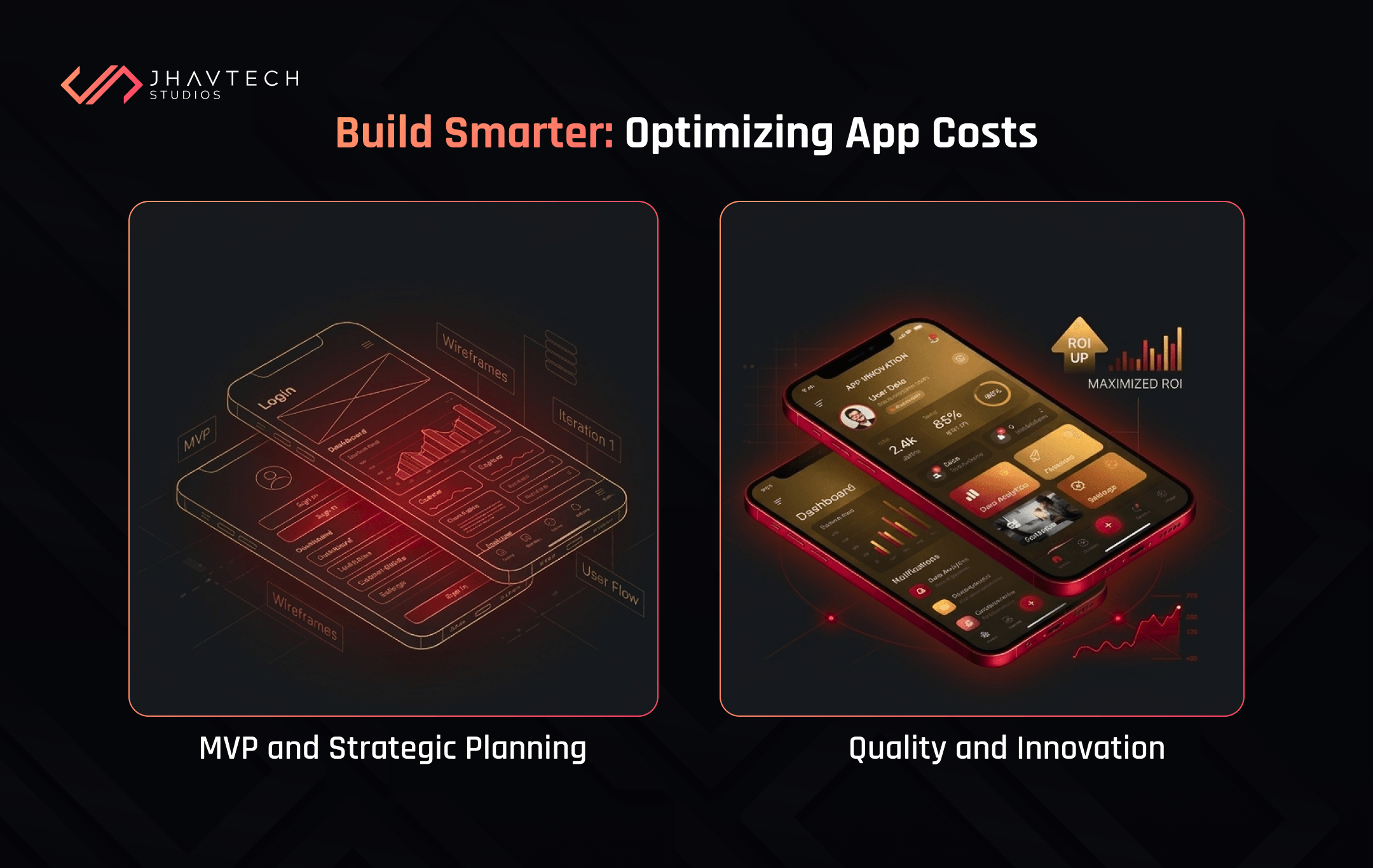
Instead of building a “Swiss Army Knife” app, focus on the Minimum Viable Product (MVP). An MVP allows you to launch with only the core features necessary to solve your users’ primary problem. This approach doesn’t just save money upfront; it provides real-world data on what features users actually want, preventing you from spending thousands on functionality that no one uses.
At Jhavtech, we’ve seen MVPs launch successfully starting from around $25,000, providing a solid foundation for future scaling. For a deeper dive into how this impacts your bottom line, check out our guide on App Development Cost: MVP vs. Full Product. This strategy is the cornerstone of efficient mobile app development.
2. Choose Cross-Platform Development
In 2026, the gap between Native and Cross-Platform performance has almost entirely vanished for 90% of business applications. If you wanted an app on both iOS and Android in the past, you had to build two separate apps. This effectively doubled the cost.
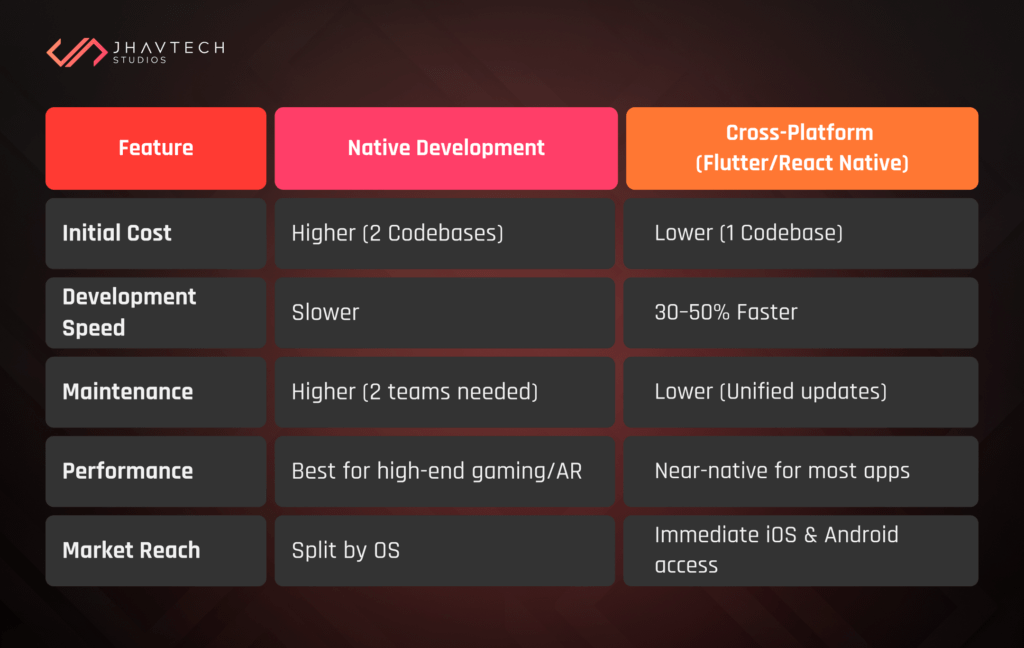
Today, frameworks like Flutter and React Native allow developers to write one codebase that runs seamlessly on both platforms. This can reduce development time by up to 50% and initial costs by nearly 40%
Cost & Performance Comparison: Native vs. Cross-Platform
To help you visualise where the savings actually come from, the following table breaks down the key differences between these two development approaches across the project lifecycle:
3. The Power of Precise Scoping and Discovery
Vague requirements are the enemy of a fixed budget. When developers are unsure of the specific logic required, they have to build in contingency time, which drives up quotes. Before a single line of code is written, invest time in a discovery phase.
This involves creating a Product Blueprint which includes detailed wireframes, user stories, and technical specifications. Many businesses find that engaging in high-level IT consulting during this phase pays for itself tenfold. By identifying technical roadblocks before the build starts, you avoid the “re-work” that typically plagues unplanned projects. A well-executed discovery phase can reduce the overall development timeline by 20% because the roadmap is clear from day one.
The “MoSCoW” Method for Budget Control
To keep costs in check, we recommend the MoSCoW prioritisation framework during scoping:
- Must have: Non-negotiable core features.
- Should have: Important but not vital for launch.
- Could have: Nice-to-have features if the budget allows.
- Won’t have: Features explicitly excluded from this phase.
Stop guessing your budget. Get a fixed-price roadmap that guarantees no surprises.
4. Don’t Ignore Technical Debt
When you rush a product to market or hire inexperienced developers, you often accumulate technical debt. Think of this like a high-interest credit card. You get a feature now, but you pay for it later in the form of bugs, slow performance, and the inability to update the app easily.
To keep costs low over the lifespan of your app, prioritise clean, modular code. It might cost slightly more in week one, but it saves you from a total system overhaul in year two. If you find yourself stuck with a platform that is failing, you may need a software project rescue to refactor the code and get the project back on track before the debt becomes unmanageable. High-quality code is an investment in your app’s future scalability.
5. Use Agile Methodology to Pivot Fast
The “Waterfall” method, where you plan everything at the start and don’t see the product until the end, is a recipe for budget blowouts. If the market changes or you realize a feature doesn’t work halfway through, you’ve wasted months of work.
Agile development breaks the project into sprints. Every two weeks, you see a working version of your app. This transparency allows you to adjust the roadmap in real-time. According to a report by The Standish Group, Agile projects are statistically twice as likely to succeed and significantly more likely to stay on budget than Waterfall projects.
6. Account for the Hidden Costs Early
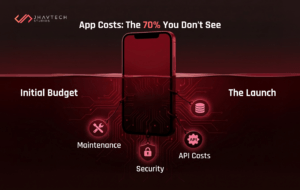
Many founders forget that the launch isn’t the end of the budget; it’s just a milestone. From server hosting and security patches to third-party API fees, the ongoing expenses can surprise the unprepared. Generally, you should budget 15–25% of your initial development cost annually for maintenance.
We’ve detailed exactly what to watch out for in our article on the Hidden Costs of Mobile App Development. By including these in your initial financial projections, you avoid the “emergency” funding rounds that can derail a project’s momentum.
7. Quality Assurance (QA) is Not an Option
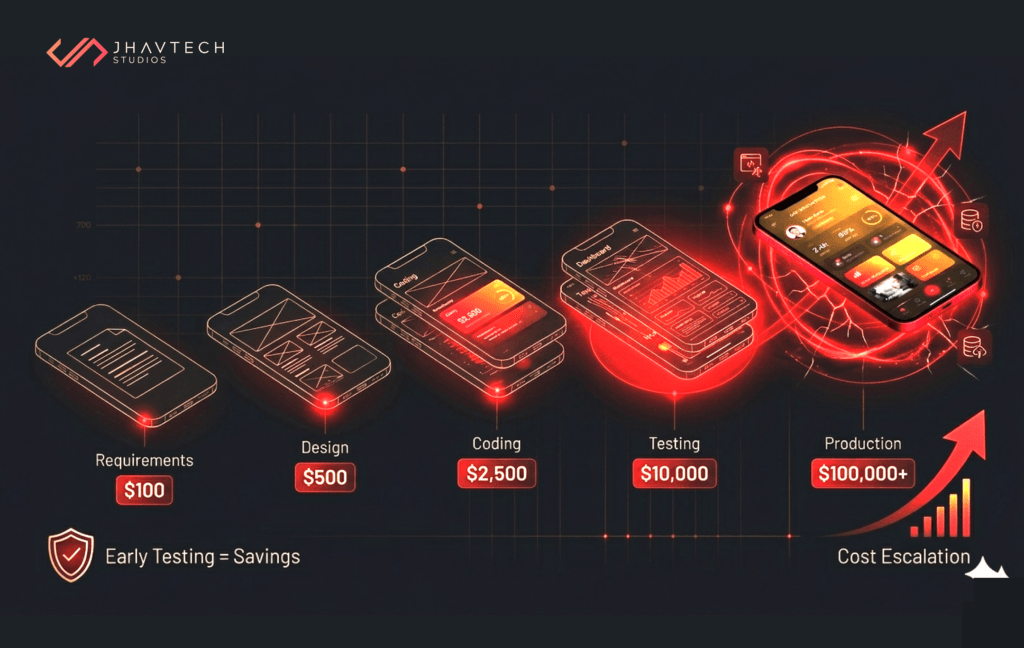
It seems counterintuitive: “How does spending money on testing reduce my costs?” The answer lies in the Bug Life Cycle. In the world of software, a bug is not just a technical error; it is a financial liability that grows more expensive every hour it remains undetected. Many founders view QA as a final check before launch, but at Jhavtech Studios, we treat it as a continuous cost-saving measure that begins on day one.
According to a comprehensive study by the National Institute of Standards and Technology (NIST), the cost to fix a defect multiplies exponentially as code progresses through the development pipeline. When a flaw is identified during the initial design stage, it might cost a mere $100 to fix because it only requires a quick update to a wireframe or logic flow. However, if that same flaw remains hidden until the app is in production, the cost to repair it can skyrocket to over $10,000.
This 100x difference isn’t just about the developer’s hourly rate; it accounts for the ripple effect of re-coding connected features, re-testing the entire system, and the potential loss of user trust. This is a financial hit that can destroy a startup’s runway overnight. By integrating continuous, automated testing, you ensure you aren’t building a complex house on a shaky foundation, ultimately protecting your long-term budget.
8. Leverage AI-Assisted Development for Efficiency
By 2026, AI has transformed from a novelty into a core productivity tool for elite development teams. At Jhavtech Studios, we use AI-assisted tools to automate repetitive tasks such as generating boilerplate code, writing unit tests, and identifying security vulnerabilities, allowing our senior developers to focus on high-level architecture.
This doesn’t mean AI-built apps are better; it means the human-led process is faster. By leveraging these tools, we can often shave weeks off a development cycle, directly translating into cost savings for our clients. However, human oversight remains critical to ensure the AI-generated snippets don’t introduce long-term security flaws or bloating in the software architecture.
9. The Build vs. Buy Decision Matrix
One of the quickest ways to blow a budget is trying to build a custom solution for something that already exists as a world-class service. Do you really need to build a custom messaging protocol, or can you use a service like SendBird or PubNub? Do you need a custom payment engine, or will Stripe suffice?
Using third-party integrations (SaaS) allows you to focus your development budget on the unique value proposition of your app rather than reinventing the wheel. While these services have monthly costs, they are almost always cheaper than the hundreds of hours required to build, test, and maintain a custom version.
10. Understand Your Local Market (Australia 2026)
Development costs vary wildly depending on where your team is located and the current economic climate. In the Australian market, factors like the 2026 tech talent landscape and local compliance laws (like the Privacy Act) play a huge role in budgeting.
For a comprehensive breakdown of what to expect in terms of pricing over the next few years—ranging from $25,000 for simple MVPs to $250,000+ for enterprise builds—refer to our Mobile App Cost Australia 2026 Guide. Being aware of local benchmarks helps you negotiate better and spot quotes that are too good to be true.
Final Thoughts… Strategy Beats Spending
The secret to reducing app development costs is not finding the cheapest developer on a freelance site. It is about strategic clarity. By focusing on an MVP, choosing cross-platform frameworks, and maintaining a rigorous focus on code quality, you can build a world-class product that stays within your financial means.
At Jhavtech Studios, we specialise in helping businesses navigate these choices. We don’t just write code; we partner with you to ensure your investment yields the highest possible return.
Frequently Asked Questions (FAQ)
What is the most effective way to lower my app development budget?
The most effective way is starting with a Minimum Viable Product (MVP). By focusing only on core features, you reduce initial coding time and avoid wasting money on features that your users might not actually need. Pair this with cross-platform development (like Flutter) to cover both iOS and Android with a single codebase.
Can I use AI to reduce my app development costs?
Yes, in 2026, AI-assisted development has significantly increased developer velocity. However, AI is best used for generating boilerplate code and testing; you still need expert human oversight to ensure security, scalability, and a high-quality user experience. Over-reliance on AI without expert review often leads to increased technical debt.
Is it cheaper to hire a freelancer or an agency?
While a freelancer may have a lower hourly rate, an agency like Jhavtech Studios provides a full team (Project Managers, UI/UX designers, and QA testers). This collaborative approach often ends up being cheaper because it reduces the risk of project failure and minimises the need for a costly software project rescue later on.
Ready to build smarter? Let’s turn your “million-dollar idea” into a cost-efficient reality.