.svg)
.svg)


The tech world has long been obsessed with the mantra of moving fast and breaking things. For years, the gold standard for mobile app development for startups was speed. Founders were told that if they weren’t embarrassed by their first release, they launched too late. But as we navigate through 2026, the landscape has shifted dramatically. The “move fast” culture has hit a wall, and the debris is scattered across the app stores in the form of abandoned platforms and one-star reviews.
In the current market, users have zero patience for glitchy interfaces or slow load times. According to recent industry benchmarks, nearly 80 percent of users will abandon an app within the first three days if they encounter performance issues. The rush to market is no longer a competitive advantage; it’s a liability. At Jhavtech Studios, we have seen a surge in founders seeking a software project rescue because their initial build, rushed to meet an arbitrary deadline, crumbled under the weight of its own technical debt.
The Hidden Cost of the Need for Speed
When we talk about mobile app development for startups, the conversation usually revolves around time-to-market. However, the hidden costs of rushing are becoming impossible to ignore. In 2024, a study revealed that the average startup spends nearly 40 percent of its engineering budget on fixing bugs that were introduced during the initial “fast” build phase. This isn’t just a financial drain; it’s a momentum killer.
Building fast often means skipping essential steps like a comprehensive code review. When developers are forced to cut corners to hit a launch date, the underlying architecture suffers. What looks like a functioning app on the surface is often a house of cards underneath. This lack of structural integrity makes it nearly impossible to add new features later without breaking existing ones.
Lean MVP Development over Rapid Chaos
The alternative to the ‘build fast’ trap isn’t ‘build slow.’ It’s lean MVP development. This is critical because recent data shows that 42 percent of startups collapse due to misreading market demand, often because they rushed a product to market without validating the core features. A lean approach allows for agility without sacrificing the foundation. the core features. A lean approach allows for agility without sacrificing the foundation.
Mobile app development for startups in 2026 requires a strategic pivot toward quality. A lean approach allows for agility while focusing on the core problem your app solves and ensuring that the solution is robust. When you prioritise lean principles, you aren’t just building an app; you are building a scalable business tool.
App Scalability and Performance as the New Standard
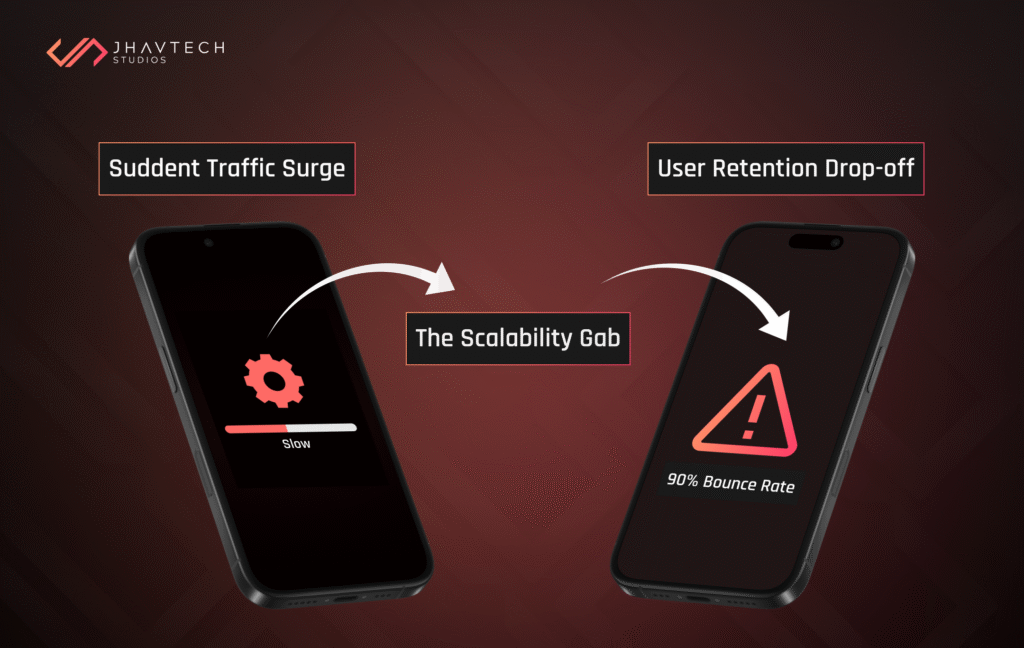
Another casualty of the “build fast” era is scalability. Many apps launched in the last few years failed not because they didn’t have users, but because they couldn’t handle them. If your infrastructure isn’t designed for growth from day one, a successful marketing campaign can actually be the thing that kills your business.
App scalability and performance should be non-negotiable pillars of your strategy. We have seen instances where a startup gains sudden traction on social media, only for their app to crash because the database wasn’t optimised for concurrent users. In a world of instant gratification, you don’t get a second chance to make a first impression. Recent performance benchmarks show that nearly 90 percent of users will leave an app if it fails to load or perform within a few seconds, making app scalability and performance a survival requirement rather than a goal.
At this stage, you need expert app developers who understand how to build for the long haul. 2026 is the year where “good enough” no longer makes the cut. If your app feels sluggish or crashes under load, users will simply move to a competitor who took the time to do it right.
How to scale a startup app without technical debt
The most common question we get from founders is how to scale a startup app without technical debt. The answer lies in the architecture. Technical debt is like high-interest credit card debt; a little bit might help you move in an emergency, but if you don’t pay it off quickly, it will bankrupt you.
To avoid this, you need to implement automated testing and continuous integration from the very beginning. This is where DevOps solutions come into play. By automating the deployment and testing process, you ensure that every update is stable. It allows you to maintain a high velocity without the risk of breaking the core user experience. Proper documentation and modular code design are also essential. If your code is a “monolith” where everything is interconnected, scaling becomes a nightmare.
The Evolution of Mobile App Development for Startups
The industry has matured. Investors in 2026 are no longer impressed by a high number of downloads alone. They are looking at retention rates, LTV (Lifetime Value), and the cost of maintenance. A poorly built app has a high cost of ownership that can quickly outpace its revenue.
Effective mobile app development for startups now involves a deep dive into user psychology and data-driven design. It’s about creating an experience that feels seamless. This requires a team that doesn’t just take orders but acts as a strategic partner. When Jhavtech Studios takes on a project, we look at the product roadmap for the next three years, not just the next three months. This forward-thinking approach is what separates the winners from the “zombie apps” that haunt the app stores.
The Rise of Sustainable Mobile App Development Strategies for Startups 2026
As we look toward the horizon, the focus is shifting toward sustainable mobile app development strategies for startups. Sustainability in tech means building products that are maintainable, eco-efficient, and capable of evolving. It’s about moving away from the “disposable software” mindset.
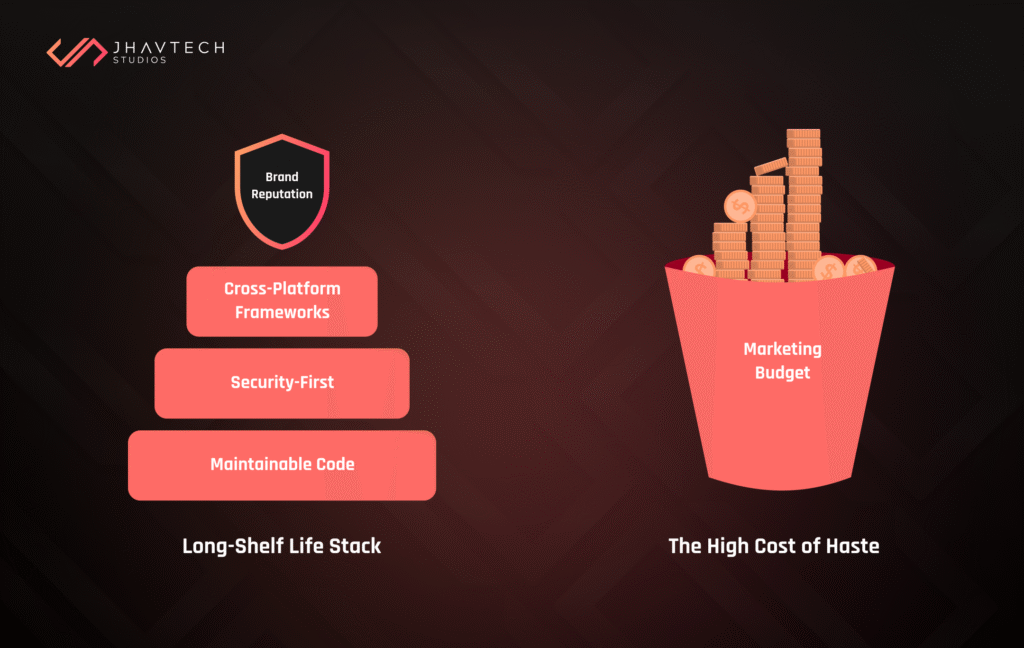
Sustainable strategies involve choosing the right tech stack that has a long shelf life. It means investing in cross-platform frameworks like Flutter or React Native when appropriate to save costs without compromising quality. It also means building with a “security-first” mindset. In an era of increasing data breaches, a fast-built app with weak security is a ticking time bomb for a startup’s reputation.
Quality is the Best Marketing Strategy
In the crowded digital marketplace of 2026, your app’s performance is your brand. You can spend millions on user acquisition, but if the product is flawed, you are pouring money into a leaky bucket. Mobile app development for startups has become a game of precision.
Consider the example of a fintech startup that rushed its launch in early 2025. They bypassed rigorous load testing to beat a competitor to market. When they were featured in a major news outlet, the app went down for six hours. The resulting negative press and loss of trust were far more expensive than the extra month of development would have been. Quality isn’t a luxury; it’s a survival tactic.
Finding the Right Partner for Mobile App Development for Startups
Choosing who builds your vision is the most critical decision you will make. You need a team that understands the nuances of the current market. For a vast majority of startups, the role of mobile app development has evolved from mere coding to strategic engineering.
At Jhavtech Studios, we emphasse a collaborative process. We believe that the best products are built when the founders’ vision meets engineering excellence. This involves constant communication and a commitment to transparency. Whether you are building from scratch or need help fixing a project that has gone off the rails, the goal is always the same: a product that thrives in the real world.
Moving Beyond the “Build Fast” Myth
It is time to retire the idea that speed is the only metric that matters. The most successful apps of the next decade will be those that prioritise the user experience and technical stability. Mobile app development for startups should be about building a foundation for a lasting company, not just a flashy demo for a pitch deck.
When you focus on quality, you reduce the long-term costs of development. You create a product that users love and recommend. You build a brand that stands for reliability. In 2026, the market is rewarding the builders who take the time to do things right. The “build fast” era might be dying, but the era of high-quality, high-impact apps is just beginning.
Final Thoughts: A Strategic Approach to 2026 and Beyond
To succeed today, founders must balance their ambition with a pragmatic approach to technology. Mobile app development for startups is more complex than ever, but it is also more rewarding for those who navigate it correctly. By avoiding the pitfalls of extreme speed and focusing on lean, scalable, and sustainable practices, you position your startup for genuine success.
Don’t let the pressure to launch drive you to make decisions that will haunt your cap table and your customer support inbox later. Invest in a solid architecture, prioritise user needs, and choose partners who value your long-term growth as much as you do. The future of mobile app development for startups belongs to those who build with intention, not just with haste. If you are ready to build something that lasts, the resources and expertise are available to make that vision a reality. Success in the 2026 app economy isn’t about who crosses the finish line first; it’s about who is still running when the others have broken down.
If you are ready to turn your vision into a robust, high-performing reality, check out our mobile app development for startups bundle to get your project started on a foundation of excellence. Let us build something that does not just launch, but lasts.