.svg)
.svg)


When you build a mobile or web app, everything looks good on paper until it hits real users. Then, performance issues show up: pages load slowly, users abandon apps, crashes happen under load, etc. These aren’t just technical headaches—they cost you dollars and reputation in Australia’s competitive tech market.
At Jhavtech Studios, we recently helped a fitness and wellness startup that was seeing all these problems. After doing a comprehensive code review, we improved performance by 45%, slashed crash rates, boosted retention, and helped them win back trust. This case study unpacks exactly how a thorough codebase assessment made this possible, what we fixed, and why every business should treat code review as central to the development workflow.
Background: The Client’s Problem
— A fitness and wellness startup in Melbourne faced performance, security, and retention issues that threatened its growth.
Our client is based in Melbourne, Australia—a health-tech startup with big ambitions. Their mobile app lets users track workouts, calorie intake, and progress over time. Early uptake was promising, but then things started going wrong:
- Slow loading times, especially on lower-end Android phones
- Frequent crashes under peak usage (e.g. evenings, group challenges)
- Rapid battery drain because background services weren’t optimised
- Concerns from users about weak security on stored data
Despite decent marketing and design, the app’s retention rate dropped by 28%. Negative reviews started piling up. Revenue started falling behind projections. The customer support inbox was lighting up.
Step 1: Conducting a Thorough Code Review
— A structured code review goes beyond bug hunting—it examines performance, scalability, and security at the core of the app.
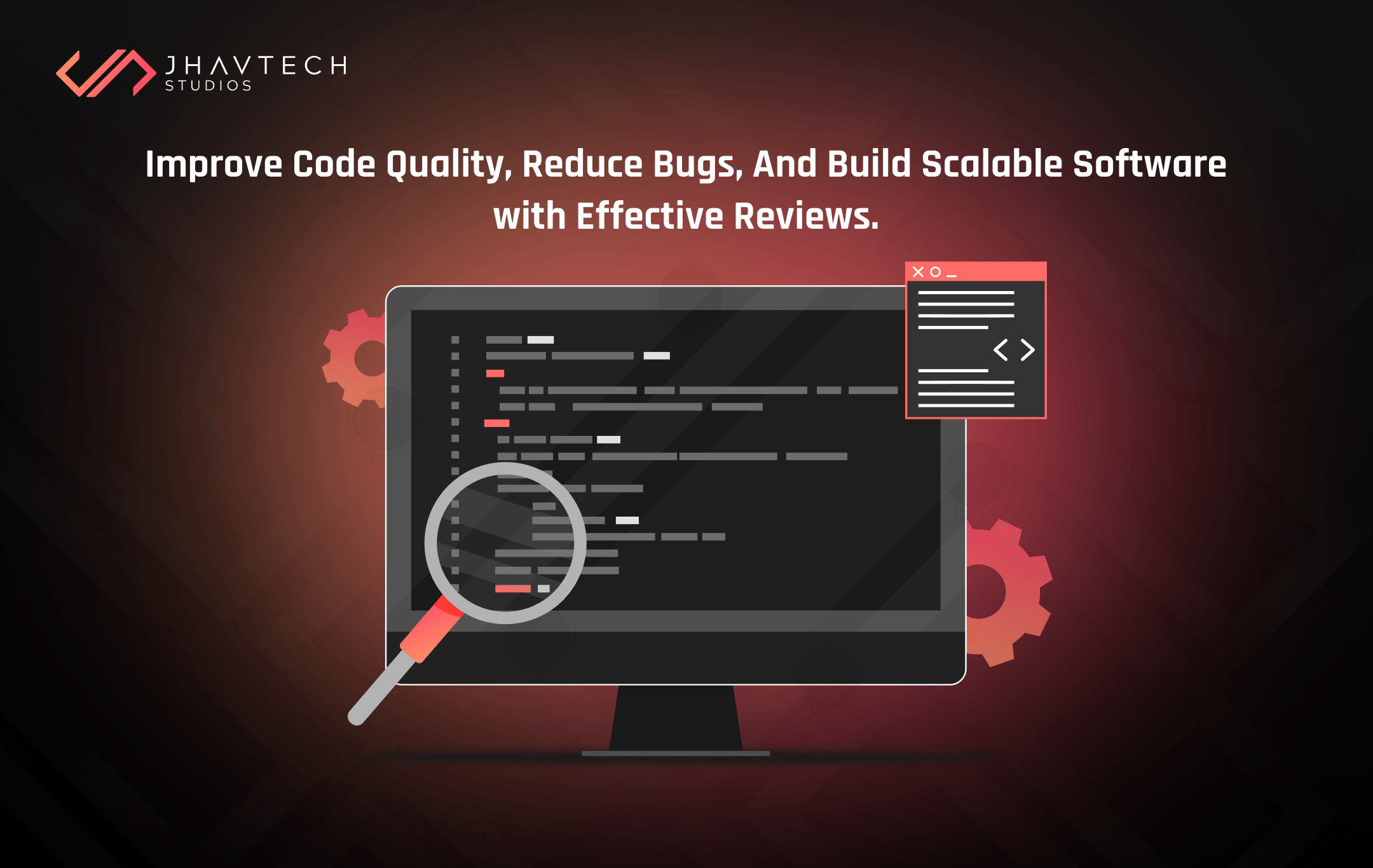
We kicked things off with our Free Code Review service—offered by Jhavtech—designed to dig deep into your codebase. A software audit is more than just spotting syntax issues: it’s about architecture, performance, security, and maintainability.
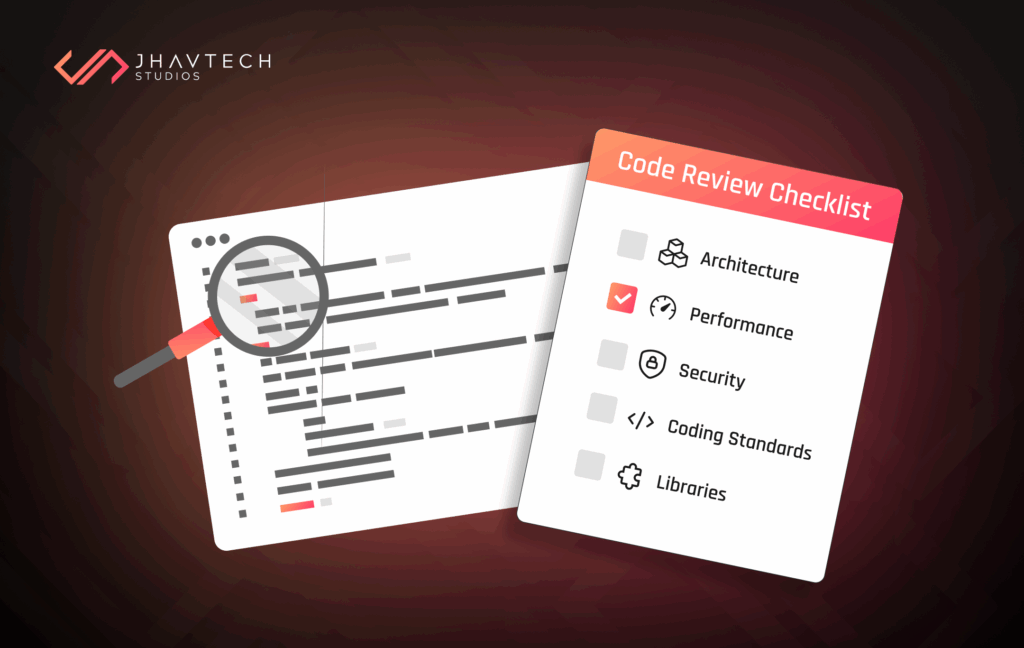
Here’s what we checked:
- Architecture review: Is the code modular, easy to scale
- Performance bottlenecks: Unnecessary loops, redundant API calls, memory leaks
- Security issues: Weak encryption, data handling practices
- Coding standards: Consistency, readability, maintainability
- Third-party libraries: Are they outdated? Adding bloat?
If you’re curious: more about our Free Code Review service here at Jhavtech Studios. It’s tailored to Australian SMBs and startups.
Step 2: Identifying Issues
— A detailed review revealed deep architectural flaws, hidden performance bottlenecks, and security gaps that testing alone couldn’t catch.
A proper code quality check is a bit like running a health check on your body. You might feel okay on the surface, but a detailed scan can reveal hidden problems that, if ignored, could turn into something serious. When we dug into this app’s codebase, what we found wasn’t just a handful of bugs—it was a collection of structural issues that explained why the app kept stumbling under pressure. These weren’t minor tweaks; they were systemic flaws that needed urgent attention. Key findings:
- Redundant and repeated API calls slowing every screen that fetched remote data
- Database queries with no indexing, queries doing too much work, causing server overload
- Hard-coded logic in places that should’ve been modular or data-driven—so scaling or changing features was painful
- Memory leaks, especially from poorly handled object lifecycles and background processes
- Authentication system that was “good enough” but not strong enough—encrypted data at rest was inconsistent; secure password hashing was missing in some flows
Individually, these issues might have been manageable, but together they created a perfect storm of instability, lag, and security risks. This is exactly the kind of situation where a software project rescue becomes necessary. Stepping in early prevents wasted time, costs, and lost user trust.
Step 3: Implementing Fixes
— Fixing issues meant more than patches—it required restructuring code for scalability, reliability, and long-term maintainability.
Detecting issues is one thing, fixing them is another. The real value of a code review comes when insights are translated into tangible improvements that boost stability and performance. For this client, that meant moving beyond “patches” and instead re-engineering critical parts of the app so it could scale, stay secure, and deliver a smoother user experience. During the code quality check, we worked closely with the client’s dev team to put changes in place:
- Batch processing to replace redundant API calls, reducing network chatter
- Optimising DB queries: adding indexes, caching hot data to avoid repeated round trips
- Refactoring: moving hard-coded logic into configurable, modular components
- Patching memory leaks, tightening up background service lifecycles to cut battery usage
- Strengthening security: implementing two-factor auth, better encryption for data at rest and in transit, sharper input validation
Results: 45% Improvement in Performance
— The impact was measurable: faster load times, fewer crashes, stronger security, and happier users.
Once the fixes were rolled out, the difference was night and day. What had been a sluggish, crash-prone app was transformed into a responsive, reliable product that users actually enjoyed coming back to. The numbers spoke for themselves, proving how a targeted code review can deliver measurable gains in both performance and customer satisfaction:
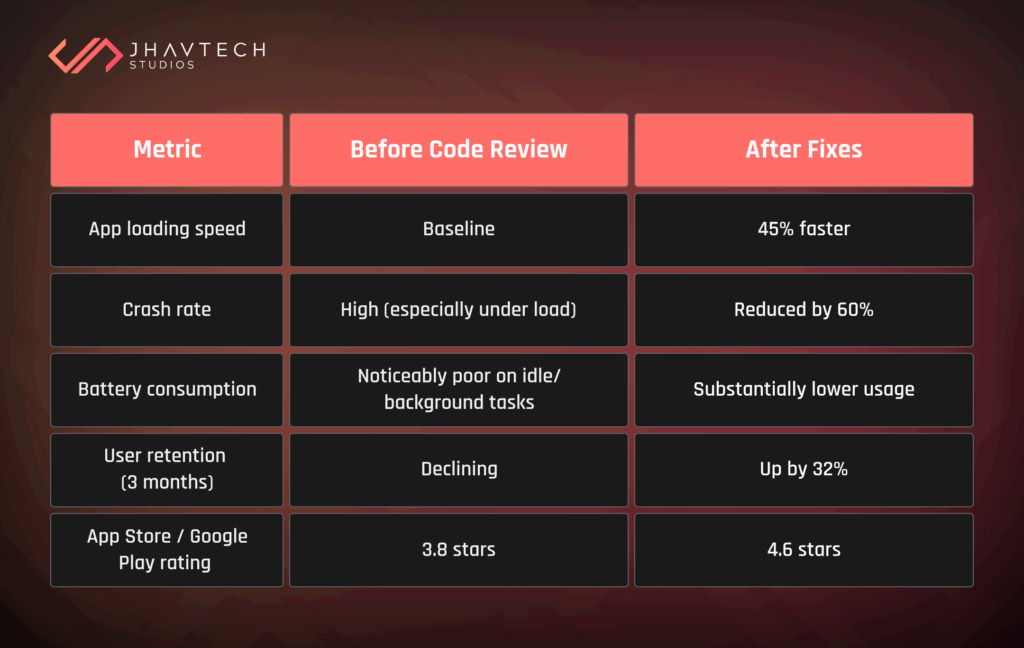
These aren’t just vanity metrics. Faster load times, fewer crashes, and better security directly improved user satisfaction—leading to better reviews, higher retention, more word‐of‐mouth. All because of a well-executed codebase review.
Why Code Reviews Are a Must for Every App
— From reducing technical debt to boosting user trust, code reviews are one of the smartest investments in app development.
If you’re wondering whether this applies to you, consider this:
- Hidden bugs lurk deep in your codebase; without a proper code review, many never get discovered until a user does
- Fixing things early saves serious money. Studies (e.g. IBM’s Systems Sciences Institute) show that defects fixed after release can cost 30× or more than if they were caught during development.
- Performance and scalability depend on maintainable architecture, modular components, and efficient query/caching patterns—all things uncovered via codebase reviews
- User trust & ratings are fragile. Poor performance or security risks hit reviews and uninstall rates hard
- Long-term costs, like technical debt and maintainability, compound: the more you delay code review and refactoring, the more expensive each change becomes
Key Lessons from This Case Study
— Every review uncovers patterns that businesses can learn from—highlighting why early, thorough reviews pay off.
Every case study reveals more than just results—it highlights the principles that can be applied to any software project. This client’s journey shows that performance gains don’t come from quick fixes alone, but from disciplined practices like regular codebase reviews. By looking beyond surface-level bugs and addressing deeper structural issues, we uncovered insights that any Australian startup or enterprise can learn from:
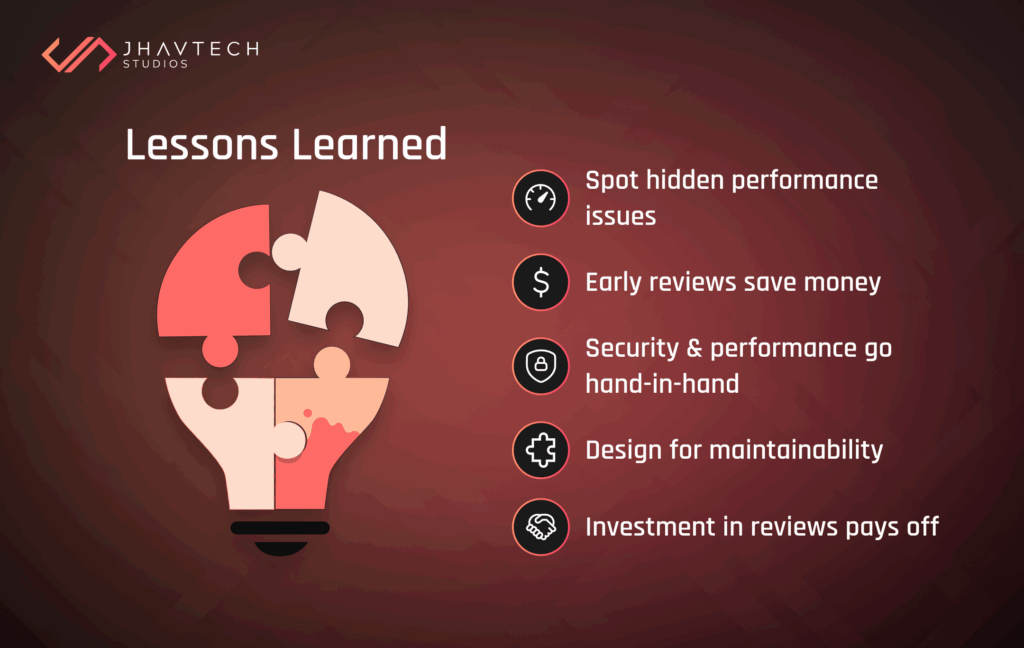
- Performance issues often hide deep in the code. They may not appear until under load or specific usage flows. Good performance review practices find them.
- Early code review is cost-effective. As noted, the later a defect is found in the SDLC (software development lifecycle), the more expensive it becomes.
- Security and performance go hand-in-hand. You can’t sacrifice one for the other. A code quality check should always include both.
- Modularity & maintainability matter. Hard-coded logic creates scaling nightmares; modular design from good code review practices gives flexibility.
- Investment in code review pays off. It’s not just about fixing what’s broken—it’s about preventing what could go wrong, keeping user trust, maintaining agility.
How to Build a Code Review Culture (in Australia & Beyond)
— Building a culture of code review ensures long-term performance, security, and team collaboration.
To get results like this, having a review is one thing—you need to build a review culture. Some suggestions:
- Set clear checklists: performance, scalability, security, maintainability
- Use tools and metrics: track review cycle time, defect rates, reviewer engagement to avoid bottlenecks.
- Encourage peer reviews: let junior and senior devs alike participate—knowledge sharing helps everyone
- Automate what you can: static analysis, testing, formatting checks, and dependency scanning so human reviewers focus on architectural decisions and performance-critical parts
- Review smaller changes more often, rather than large batches. Smaller pull requests make software quality checks more manageable and effective
Final Thoughts…
— A strong code review process can transform apps—protecting reputation, saving costs, and driving long-term success.
This case study from Jhavtech Studios shows that a serious, well-executed code review can transform a struggling app into a high-performing, stable, secure product. A 45% performance gain wasn’t just a technical win—it translated into happier users, better reviews, more revenue, and long-term value.
If your app is showing signs of slow performance, crashes, poor retention, or security concerns, don’t wait. A codebase review now can save you time, money, and user trust down the line.
Book your Free Code Review with Jhavtech Studios today and give your app the performance, security, and user experience it deserves.
Frequently Asked Questions:
1. What is a code review in app development?
A code review is a structured process of examining the source code to find bugs, improve performance, ensure security, enforce best practices, and make sure your architecture remains scalable and maintainable.
2. How long does a code review take?
Typically between 1–2 weeks, depending on the complexity of your codebase, the size of team, and the current state of the code.
3. Do I need a code review if my app is already live?
Yes, especially if you’re seeing slow performance, crashes, security concerns, or low retention. A post-launch codebase review can uncover issues that regular testing misses.
4. Is a code review different from testing?
Yes. Testing usually checks whether the app functions as intended. A code review checks how the code is written: its structure, performance implications, security risks, maintainability, and best practices.